The real enemy of Xibei has never been Luo Yonghao.
The hottest thing recently is, without a doubt, the battle between Luo Yonghao and Xi Bei.
If you haven't paid attention, it doesn't matter. Chaping Jun will briefly tell you the ins and outs.
On September 10th, Luo Yonghao posted a Weibo saying that Xi Bei's dishes are all pre - made and expensive, which is disgusting. He called on restaurants to be forced to indicate pre - made dishes.
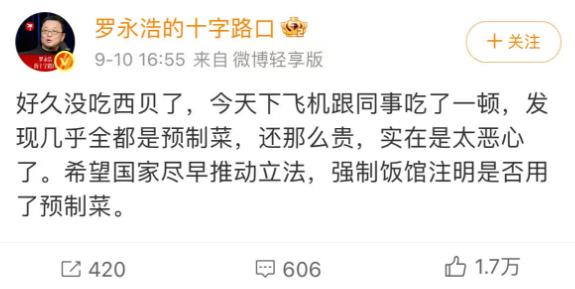
Screenshot of Luo Yonghao's Weibo
Xi Bei is a well - known national chain restaurant with nearly 400 stores across the country and a large scale.
After reading the Weibo, Jia Guolong, the founder of Xi Bei, couldn't bear it and publicly responded that currently Xi Bei doesn't have pre - made dishes and will sue Luo Yonghao.
Xi Bei also introduced a series of measures, such as launching a menu similar to Luo Yonghao's, with a total of 13 dishes. Customers can either order directly or adjust the dishes according to the menu. At the same time, it opened its kitchens to allow customers to visit the cooking process.
On the one hand, Boss Jia may think he is in the right and a big - scale event can bring in a large amount of traffic. On the other hand, in recent years, the trend of bosses becoming internet celebrities has been intensifying. Boss Jia has also made many public statements. Maybe he also wants to build his personal IP through this opportunity, so his attitude is very tough.
Well, now the conflict has completely escalated, from "Pre - made Dishes on the Tip of the Tongue" to "Legal Report Today".
Luo Yonghao wasn't idle either. He posted more than 20 Weibo posts to fight back, gave away iPhones in retweets, offered a reward of 100,000 yuan, and even held a live - stream to discuss this matter.
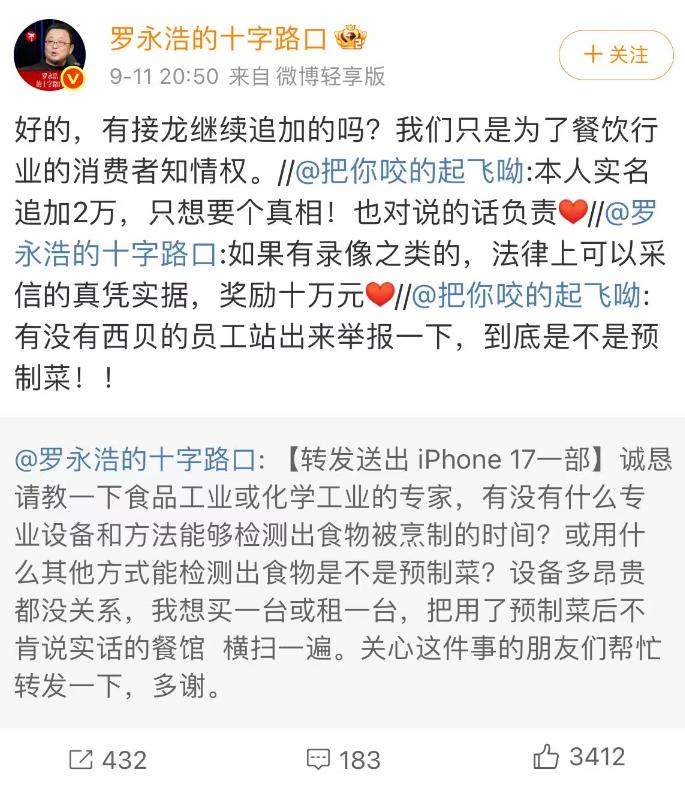
Screenshot of Luo Yonghao's Weibo
In the continuous exchanges of attacks, this matter has escalated from Luo's personal complaint to a national online hot topic and has been on the hot search list all day.
Xi Bei has suddenly become the target of public criticism.
People visited the kitchen, dug into the boss's various statements, and searched for Xi Bei's past news.
Even Xi Bei's official account was bombarded.
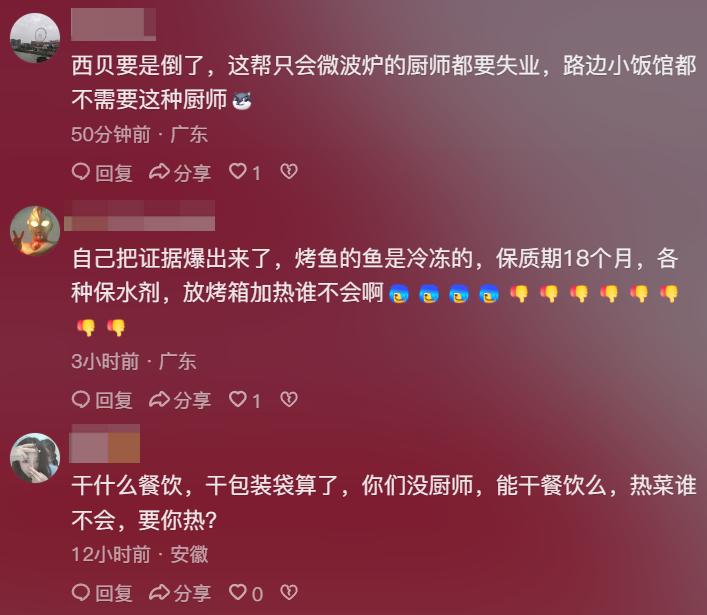
Screenshot of Xi Bei's account statement
The root cause of this controversy is simple: people have different definitions of pre - made dishes.
Is what Luo said reasonable?
From the perspective of consumers, it makes sense to say that the dishes they eat lack the wok hei, don't seem freshly cooked, and contain pre - made ingredients.
However, Xi Bei's confidence isn't baseless but has some real justifications.
In 2024, to regulate the market, the State Administration for Market Regulation led the release of the "Notice on Strengthening Food Safety Supervision of Pre - made Dishes and Promoting High - quality Development of the Industry", which standardized the definition and scope of pre - made dishes.
In this notice, dishes made in the central kitchen are not within the scope of pre - made dishes.
Maybe at first, Xi Bei thought it was a sure - win situation...
But obviously, Xi Bei didn't get the result it wanted. Instead, things seem to be going further and further astray.
Because in business, compliance is one thing, and winning public support is another. The last one to learn this lesson was probably Zhang Xiaoquan.
First of all, at present, there are various opinions on what pre - made dishes are. Don't tell me there are regulations. In fact, everyone has their own definition and may not follow these regulations.
For example, some people think that as long as the dishes aren't made from fresh ingredients and eaten immediately after being cooked, they are pre - made dishes. The longer they can be stored through preservation technology, the more worrying they are.
But some people think that according to this statement, aren't marinated foods, roujiamo, frozen dumplings, and many McDonald's products all pre - made dishes? Are they all unsafe?
Some people associate pre - made dishes with cooking packets and can't accept spending a lot of money just for a heating service.
After all, a large part of the reason people are willing to dine out is to pay for the chef's skills, fresh ingredients, and the unique wok hei.
Some people understand pre - made dishes as semi - finished products, where the time - consuming pre - cooking of ingredients is done in the central kitchen, then quickly frozen to preserve freshness, and sent to the stores for further processing.
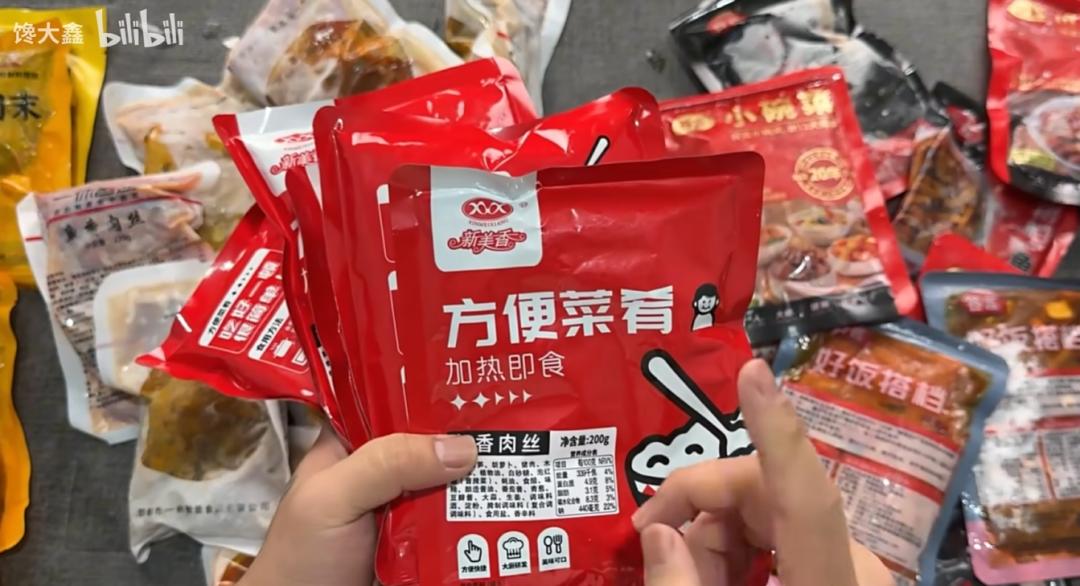
Screenshot of a Bilibili video
There have been several rounds of discussions about the definition of pre - made dishes.
In addition to the above - mentioned notice, in 2022, the China Cuisine Association led the drafting of the group standard "Pre - made Dish Product Specification", which also tried to define pre - made dishes.
The main idea was to divide pre - made dishes into the following categories according to the degree of processing:
Ready - to - eat, such as marinated foods that can be eaten directly upon arrival;
Ready - to - heat, such as various cooking packets that can be eaten after heating or thawing;
Ready - to - cook, deeply - processed ingredients that can be simply cooked after arrival, such as stewed beef brisket;
Ready - to - assemble, similar to cleaned vegetables, where the ingredients are prepared and you cook them by yourself after getting them.
In the absence of a consensus, Xi Bei thought this was a dispute over the definition of pre - made dishes, which was completely off - track.
Today, Xi Bei's official Weibo posted a nine - grid long picture, announcing the cooking process of each dish one by one, trying to prove that its dishes aren't pre - made.
But when netizens saw it, they found soup bases, large packets of tomato soup, and large packets of pumpkin puree. Isn't this still pre - made?
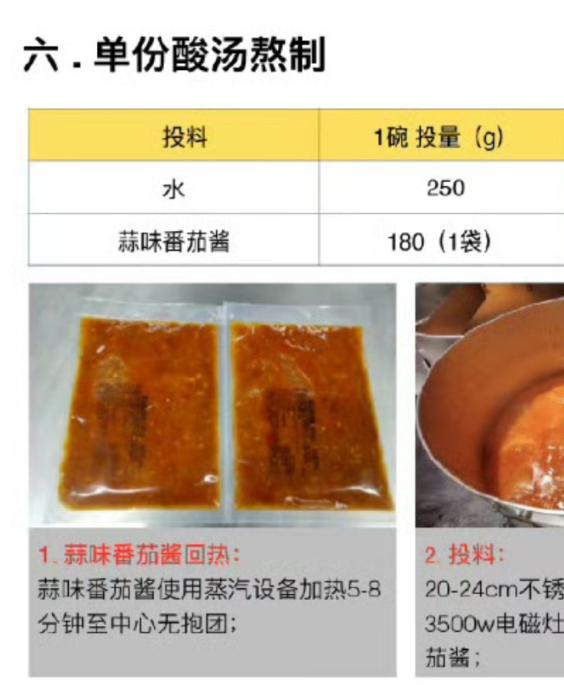
Xi Bei's Weibo statement
Xi Bei's current predicament is that the more it posts, the more it is scrutinized, and the more likely it is to lose badly.
To put it bluntly, at present, there is only one type of non - pre - made dish in people's minds.
After you order a dish, the kitchen starts to stir - fry fresh ingredients in the wok. The dish is fragrant, hot, and served on the table still steaming.
To be honest, Xi Bei's real enemy from beginning to end isn't Luo Yonghao. It's the long - standing dissatisfaction of consumers with the widespread and opaque use of pre - made dishes in the catering industry.
People aren't discussing whether Xi Bei is right or wrong. Instead, Xi Bei has just become a punching bag this time.
You see, Xi Bei's youmian is one of its signature products, hand - rolled on - site by employees. It looks very handmade and not pre - made at all.
But in the comment sections of these videos, there are usually jeers. Whether it's pre - made or not isn't the core concern of people.
What consumers want now actually boils down to two points: reasonable prices and the right to know.
You can either offer cheap, fast, and pre - made dishes; if you charge a high price, the dishes have to be delicious, freshly made, and time - consuming.
Many catering enterprises have achieved catering industrialization through central kitchens, but they haven't let customers enjoy the corresponding benefits. Although the ingredients aren't as fresh as those bought on the same day and the cost has been reduced, the prices remain the same.
Of course, if you can sell pre - made dishes at a high price, that's also a skill. But the premise is that you have to be open and transparent to ensure that consumers are willing to pay.
Now many catering enterprises use pre - made dishes, charge high prices, but don't tell consumers. Do you think this is right?
Let's take Laoxiangji as an example. Laoxiangji also uses pre - made dishes, but it not only has reasonable prices but also clearly labels them, giving consumers the right to choose. As a result, it has won praise.
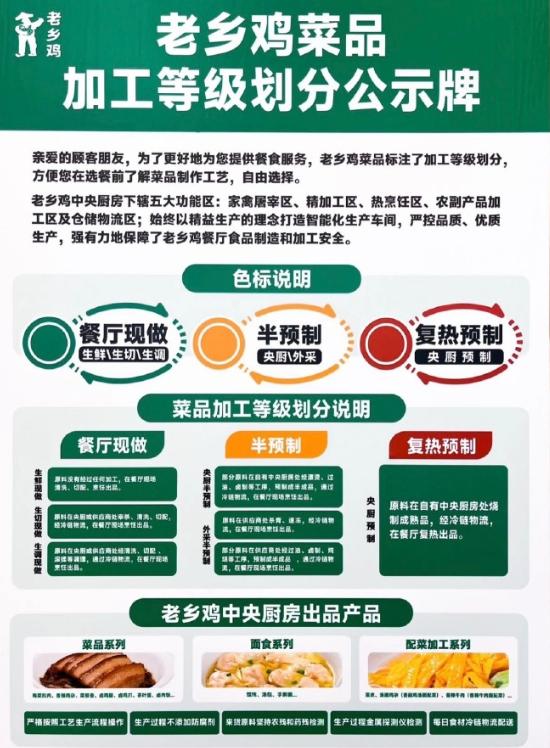
Laoxiangji's dish publicity
So, I think Luo is really right about one thing. Maybe it's a good thing that Xi Bei is being so stubborn this time. It might force the catering industry to be more explicit and standardized about pre - made dishes.
What consumers hate isn't pre - made dishes.
It's paying for something without knowing what it is.
This article is from the WeChat official account "Chaping X.PIN". Author: Chaping Jun. Republished by 36Kr with permission.