Financing Series 1 | The Ultimate Showdown: The "Design" Art of Doubling Financing Valuation and Court Win Rate
Author: Gong Lefan
In the legal battlefield of the 21st century, it will be an ultimate showdown of visual narrative ability — whoever can make the facts 'speak' for themselves will hold the microphone of justice.

When the average human attention span has dropped to 8 seconds, whether it is the 'best of times' or the 'worst of times', it is destined to be an era of seizing attention. This brings new challenges, whether it is about how to impress a judge in court or how to increase a company's market value in the secondary market.
A recent study by two business school professors published in Harvard Business Review on 654 publicly disclosed large - scale mergers and acquisitions in the United States from 2012 to 2017 showed amazing findings. When the content of a merger and acquisition disclosure included a visual presentation to illustrate the significance of the deal, the probability of it being recognized by the market in a timely manner was more than twice that of deals without visual presentations. [1]
Obviously, in the face of the same challenge of scarce attention, if the right methods are used, amazing returns may be achieved.
This is true on Wall Street, and also true for fundraising and valuation in Silicon Valley. The legendary well - known Silicon Valley investor Guy Kawasaki emphasizes that instead of first 'educating' the audience (and investors), it is better to first 'entertain' them. Only in this way can the roadshow avoid falling into the boring 'technical' quagmire and stimulate investors' interest in further understanding. Otherwise, no matter how good a company is, it may be buried regrettably because the boring presentation makes people sleepy.
The same goes for the courtroom. Some lawyers stay in the 'conventional' way of expression, sparing no expense to use long - winded texts to elaborate their views, thinking that the more they write, the more reasonable the judge will think it is. On the contrary, in practice, we have found that adjudicators may actually have pre - conceived biases towards such texts and take further actions based on this — usually not in favor of the party's client.
This article will use successful real - life cases and reveal the art of 'cognitive reconstruction' from the perspective of brain science. Whether in business or law, whether it is about impressing investors or judges, the traditional text - based communication model is becoming less and less effective. To occupy the other party's mind, it is necessary to carry out a 'design' for communication upgrading around brain science, use visual art — to 'cognitively reconstruct' the 'facts' and keep the other party's attention.
"All future businesses are attention businesses." — Kevin Kelly
I. Introduction: How will the attention of judges and investors affect your fate?
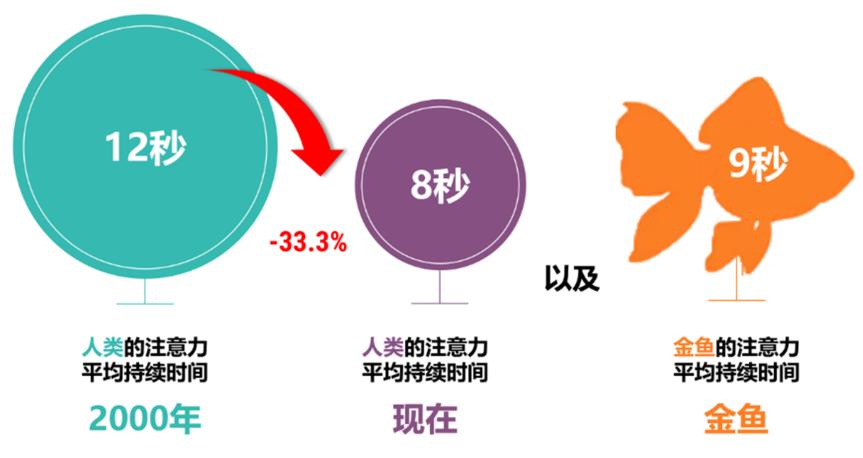
Studies show that the current average human attention span is 8 seconds, which is even lower than that of goldfish (9 seconds). In 2000, the survey showed it was 12 seconds, and by 2013, it had dropped by one - third to 8 seconds, showing a continuous shortening trend. What does this mean for law and business?
Click to view the large image
In this era of seizing attention, what are the traditional communication and expression models that will be eliminated?
First, why might the information - overloaded model be a failing model? If you are a lawyer and your agency opinion is hundreds of pages long without highlighting the key points and lacking impact, asking the judge to carefully figure out what you really want to express in those hundreds of pages, you are likely to face an unfavorable judgment result. Of course, if the opposing lawyer is the same as you, you may be evenly matched in terms of expression, but the result will depend on the judge's subjective judgment. Such uncertainty is not what you, as an excellent lawyer, want to see, let alone your client.
If you are an entrepreneur seeking fundraising, then a PPT with overloaded information and long - winded expressions is likely to lead to the failure of your financing. A 2023 study by DocSend in the United States showed that the PPTs of founders who successfully raised funds were relatively shorter. Up to 40% of the financing documents of teams that successfully obtained seed - round financing had fewer pages than the average, while up to 65% of those that failed to get investment had more pages than the average. And the average number of pages of financing documents decreased from 19 pages before to 15 pages in 2023. [2]
Second, why will the model of piling up a large amount of text be eliminated? Investment decisions are usually not made on the spot after the roadshow — but there is an exception — that is, to decide 'not to invest' on the spot. If the content you present is long - winded in text, complex in logic, and lacking in aesthetics, whether in a financing roadshow or a courtroom persuasion scenario, it is likely to make people's brains 'suffer' and cause rejection, or even make them 'shut down' instantly.
The result is — "If your copy makes the judge or investor suffer, the result will make you suffer." A 2020 survey by the European Venture Capital Association showed that up to 42% of investors' main concern for rejecting investment was that 'the founder could not clearly explain the business model or competitive barriers'.
Previously, a 'conventional' and unimpressive agency statement might get a passing grade or 70 points. But now, for high - level lawyers with high standards and a results - oriented approach, it will be judged as 'failing'. You can't expect that as long as you 'make sense', the judge or arbitrator must 'understand' you. This kind of thinking is 'outdated'.
II. Visualization, courtroom persuasion, and investment roadshows: Five fatal points in the battle for attention
"The whole world will engage in a battle for eyeballs. Whoever can attract more attention will become the master of the century." — Andy Grove (former president of Intel)
Traditional law school and business school courses never have a class on 'attention' and efficient communication. However, this is determining the success or failure of business and legal affairs. The following five common 'weaknesses' may have a fatal impact on important communications:
(1) Fatal weakness ①: One - way output, ignoring the audience's feelings
What is the most common problem in communication? It is not considering the audience's reception effect and indulging in self - centered expression. In consumer psychology and communication, there is a concept called WIIFM, which is an abbreviation for What’s in it for me? The core logic is based on the observation of human behavior and decision - making motivation — people naturally prioritize things that are directly related to their own interests. Therefore, as the communicator and outputter, one must focus on what specific value the other party can obtain from my information — this requires the communicator to jump out of the self - perspective and focus on the audience's needs, pain points, and benefits. Just like sales.
From the perspective of a listed company's market value management, no matter how good a company's strategy is, it needs to be expressed and disseminated in a simple and clear way to gain recognition and implementation. After extensive research, two business school professors, João Cotter Salvador and Freek Vermeulen, found that corporate managers must switch from being sense - makers to sense - givers. They should be good at importing the company's strategic cognitive map into the minds of employees and investors. And research shows that the most effective method is to present the text in a strategic visualization. [3]
In a financing or merger and acquisition roadshow, if you want the other party (investor or acquirer) to offer an attractive high price, you must first let them feel the potential value of the enterprise. The proposal should always revolve around the significance and highlights of the deal for them.
Persuasion in the courtroom and arbitration tribunal is obviously different from the investment scenario. What should be concerned about is the interest demands of judges and arbitrators. In the litigation or arbitration cases I handle, I will fully consider how to make judges and arbitrators quickly understand. The more your copy, presentation, and story make them feel relaxed, time - saving, and comfortable, the higher the probability of impressing them. If you can also emphasize the benchmark significance of the case, it can also attract the judge's attention. The underlying logic of all these is WIIFM.
In the litigation or arbitration cases I handle, I will fully consider the busyness of judges and arbitrators. For the core content of the case, I will design and insert visual narratives and/or logical analysis parts to make judges and arbitrators willing to actively pay attention to the materials we submit.
When I coach founders for financing roadshows, on the one hand, I emphasize the importance of designing an engaging presentation. On the other hand, I remind entrepreneurs to maintain eye contact with the audience during the speech and pay attention to their expressions, gestures, and sitting postures from time to time. Once I find that the audience is tired, I immediately adjust the strategy and switch to a new topic (prepared in advance) to boost the audience's attention. In the preparation of the roadshow PPT, I focus on the perfect combination of aesthetics, artistry, and logic to prevent the audience from 'distracting' — all of this is based on the underlying WIIFM theory.
(2) Fatal weakness ②: Failure to grasp the main contradiction, lack of framework, and insufficient sharpness
How to improve the 'sharpness' (compelling) of your expression to quickly persuade judges and investors? Even make the other party's views and opinions collapse completely in the courtroom?
After taking the audience's attention into account, you need to build your own 'framework' and manage your expression well. First of all, it depends on whether you have the ability to see the essence through the phenomenon, whether you can grasp the main contradiction and the core contradiction, and sharply explain your views, so as to 'hit instantly' and 'seal the deal with one sword'. If a complaint, defense, or supplementary opinion submitted to the court lacks 'sharpness' (compelling), although it may seem 'professional' on the surface, the actual persuasive effect will be greatly reduced.
Visual presentations must also penetrate the essence, highlight the key points, and grasp the main contradiction. You may have a lot of content to persuade the other party and a lot of foreshadows, but if you don't put the most important content that can attract and impress the judge in the most prominent and top - most position, the whole case will seem like plain water, with mediocre reasoning, and the wonderful views will be buried in the long - winded text.
Let's take a real case as an example. The plaintiff we represented was a European designer. After being employed by the defendant's company, she worked hard and won many customers' praise. However, she found that the company was reluctant to pay the 1% bonus she was promised when the total value of the 'design and construction contracts' exceeded 30 million. Finally, she had to take legal action.
Where was the focus of the dispute? In court, the defendant (the company)'s lawyer unexpectedly proposed that the 'design and construction contracts' in the original contract were not specifically defined and should specifically refer to 'design + construction' contracts, rather than the design contracts, construction contracts, etc. claimed by the plaintiff.
From the perspective of text interpretation, at first, the judge was led by the other party's rhythm and thought that 'design and construction contracts' should, as the name suggests, be 'design + construction' contracts. But if judged by this standard, the total amount of such contracts held by our client was far below the 30 - million mark. Only when all three types of contracts were recognized could the total amount of the plaintiff's contracts exceed 30 million. Suddenly, the issue of the 'definition', that is, what the 'true intention' of the two parties was when signing the contract, became a 'Rashomon' - like problem that was unclear and indistinguishable in court.
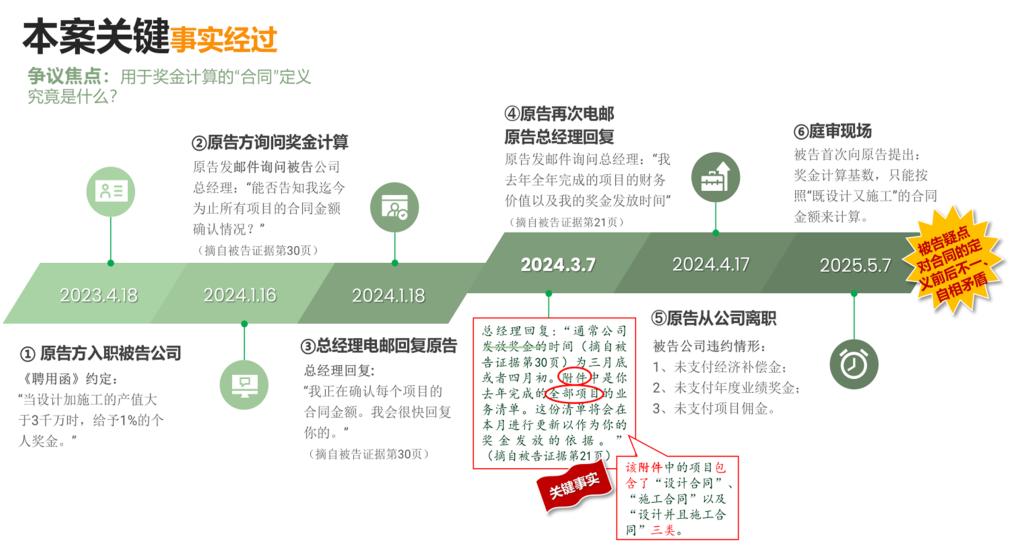
How to deal with the unclear 'Rashomon' problem? Visual narrative is the 'surface', and the 'core' lies in whether it can effectively grasp the essence. The essence of this case is the contradictory behavior of the defendant, who defaulted on the scope of the contract during the performance period but suddenly raised objections during the litigation. Therefore, clarifying the defendant's factual attitude towards the definition of 'design and construction contracts' from the plaintiff's employment to departure is the key to the case, rather than getting entangled in the text definition itself. So, I personally designed the following chart to visually narrate the key points of the dispute (the following chart has been desensitized, and the time information has been adjusted).
Click to view the large image
Regarding the key dispute point of what the contract actually included, through this 'chronicle', I outlined the important time points and important facts (circled in red) — and finally raised a key question — why did the defendant never raise any objections to the 'type and scope of the contract' until its lawyer pointed out the definition problem in court for the first time? After testing, it takes no more than 30 seconds to understand this chart — which allows the judge to quickly understand the key points of the case and brings us an irreplaceable advantage.
What was the result of the case? Just two days later, I received a call from the judge asking if we were willing to accept a settlement, and the amount we could get was about 90% of our claim. With the client's consent, the two parties finally reached a settlement — in a way that was completely in favor of our client. The client was very satisfied and highly recognized our work.
How to improve the 'sharpness' (compelling) of the copy? Without this chart, it would be very difficult for us to 'prove' that the definition actually included three types of contracts. The 'sharpness' would be weaker, and whether the judge could understand our justifications in text form was uncertain. But now, through the visual presentation, we can let the reader (the judge) see the whole picture of the story and finally find the person who contradicted themselves and was really lying.
How to make the other party's defense collapse completely? Once this key dispute point is broken through and the judge finds that the defendant is the liar, then the other party's entire defense in the case will collapse.
(3) Fatal weakness ③: What is needed is 'positioning', not 'piling up'
Then, if the expression and presentation methods are appropriate, can they bring a 'soaring' result in valuation when applied to the communication and roadshows of mergers and acquisitions and financing?
The answer is yes. Why do so many entrepreneurs encounter difficulties in roadshows in practice? Whether it is a financing roadshow or a courtroom debate, the most common mistake is to have too many points, which are difficult to remember, and to pile up views randomly without order, with no prominent focus and unattractive form. But if the right professional methods are used, amazing results can be achieved.
How to conduct a roadshow to obtain a high - premium return? I once represented a medical device company in a merger and acquisition deal and faced this challenge. At that time, the actual controller wanted to sell 100% of the company's equity to a European listed company. Since no financial advisor was hired to negotiate the price and the project was urgent with a tight schedule, the most important and challenging problem at that time was how to help the client (the seller) negotiate and reasonably increase the valuation and premium.
Where was the challenge of 'raising the premium'? For the buyer, who had already offered a considerable acquisition price, they were not very willing to increase the purchase price. For the seller, there was a concern that if the price increase demand was too high, the whole deal might fall through. But if the demand for a price increase was given up, the premium that could have been easily obtained (almost like 'net profit') would be missed regretfully. [4]
How to find a reasonable reason as a breakthrough? To make the other party voluntarily increase the valuation premium, it must be based on