Zhike | The Ministry of Finance Reshapes Expectation Management. Will the A-share Market's "Crazy Bull" Turn into a "Slow Bull"?
Author | Fan Liang
Editor | Ding Mao
Last week, the A-share markets in the two cities recorded a huge trading volume of 10 trillion yuan, which is essentially a fierce manifestation of market divergence.
For every 10 trillion yuan of funds entering the market to buy, there are corresponding 10 trillion yuan of funds leaving the market to sell. At the same time, the Shanghai Composite Index dropped by nearly 4% overall, indicating that the bears had a slight upper hand in this seesaw battle.
Overall, the current market divergence mainly focuses on two points: First, whether the domestic will continue to introduce incremental fiscal policies that exceed expectations; second, whether the current valuation level of A-shares can support a bull market.
Then, how to view the current incremental policies and the valuation of A-shares, and how will the future market trend?
Starting a New Round of Expectation Game?
After the A-share market opened on October 8, it rose sharply and then dropped significantly. On the one hand, the significant increase in the Hong Kong stock market during the National Day holiday raised market expectations, but then the decline in the Hong Kong stock market dampened market enthusiasm; on the other hand, the press conference of the National Development and Reform Commission on the "package of incremental policies" did not respond to the "imagination" of the market previously.
Of course, since the press conference of the National Development and Reform Commission is mainly focused on overall planning and does not involve the interpretation of specific fiscal policies, the market places its hopes on the "Increasing the Counter-Cyclical Adjustment of Fiscal Policies and Promoting High-Quality Economic Development" held by the Information Office of the State Council on October 12, and the meeting of the Standing Committee of the National People's Congress at the end of October.
It is difficult to say whether the meeting on October 12 exceeded or fell short of expectations. This is because, compared with the meeting on October 8, this meeting more clearly defined the direction of the exertion of incremental policies, but did not give an estimated range of the amount of incremental policies, which on the one hand soothed the funds that left the market due to the disappointment of the expectations of the October 8 meeting, but on the other hand, it did not directly respond to the enthusiasm of the entering funds for the "x trillion yuan" policy, only giving an implication of "strength".
Overall, this meeting is likely to trigger a new round of policy expectation game in the market, and it is difficult to say whether it is bad or good for the A-share market next week. It is expected that the market will be in a state of shock and upward movement before the specific policy details are announced.
In terms of the specific content of the meeting, the incremental policies include the following points:
First, efforts will be intensified to support local governments in resolving government debt risks, with a significant increase in the debt quota to support local governments in resolving implicit debts. At the same time, it is emphasized that "this policy to be implemented is the most powerful measure to support debt resolution introduced in recent years".
From a historical perspective, debt resolution is mainly carried out through the issuance of replacement bonds and refinancing bonds. According to statistics from Guosheng Securities, the previous debt resolution scales were: 12.2 trillion yuan (2015 - 2018), approximately 600 billion yuan (2019 - 2021), 1.07 trillion yuan (end of 2021 - 2022), and 1.7 trillion yuan (2023 - to date).
For this debt resolution scale, Chengtong Securities predicts that it may not be less than 5 trillion yuan; Ping An Securities also believes that in terms of the lower limit, it is expected that the one-time adjustment scale of the local government debt limit will not be less than 5 trillion yuan; Huachuang Securities pointed out that in the medium term (1 - 3 years), the debt resolution scale may be 6 trillion yuan.
Second, Special treasury bonds will be issued to support large state-owned commercial banks in replenishing their core Tier 1 capital, enhancing these banks' ability to resist risks and extend credit, and better serving the real economy.
Third, tools such as local government special bonds, special funds, and tax policies will be superimposed and used to support and promote the stabilization of the real estate market.
Fourth, the support and guarantee for key groups will be strengthened. A one-time living subsidy has been issued to people in difficulties before the National Day. In the next step, the efforts to award, support, and assist students will be increased to enhance the overall consumption capacity.
In the interpretation given by Oriental Jincheng, it is judged that the incremental scale of fiscal policies in this package of incremental policies will not be less than 4 trillion yuan, exceeding market expectations.
Regarding the impact on the capital market, the current overall view of brokerage firms is relatively positive, and the viewpoints are summarized as follows:
CICC: Looking forward to the future market, the positive policy turning signal released by the State Council Information Office and the Political Bureau Meeting at the end of September, and this time the Ministry of Finance further confirmed the signal of future fiscal exertion. The market bottom has basically been identified. After experiencing adjustments, the market is expected to regain confidence, and the future market may stop falling and stabilize, but the recovery slope may be slower than the previous period, and the focus in the future will be on the landing of the specific fiscal plan at the meeting of the Standing Committee of the National People's Congress that may be held this month.
Everbright Securities: In terms of stocks, it is expected that the bottom will gradually rise, showing a slow bull trend, and the crazy rise of the index is not sustainable. The current market rise is due to the reversal of market expectations after the policy is introduced. After the policy ignites the market, the subsequent market interpretation will ultimately depend on the improvement of the fundamentals after the policy takes effect.
Zheshang Securities: For the stock market, if the subsequent fiscal stimulus is implemented and funds are strengthened to ensure the three guarantees and兜底 risks, it will enhance risk appetite and help boost market confidence.
Kaiyuan Securities: Different from the comprehensive policies that some investors originally expected, the focus of this meeting is more on the resolution of risks and the use of new debts, with less emphasis on the livelihood income end and the post-cycle consumption end. This meeting can be positioned as "neutral and slightly positive", therefore, the future incremental policies that are both strengthened and smoothed will bring potential "slow bull" opportunities. The first stage of the rebound has basically ended, and the slow bull has entered the second stage.
What is the Current Valuation Level of A-Shares?
The start of a fast bull market generally stems from a series of policy combinations, where the improvement of liquidity, risk appetite, and fundamental expectations brings about a valuation logic shift from low to high. Therefore, a prerequisite for a bull market is that the valuation should be at a historically low level.
By analyzing the valuation situation of A-shares at the three nodes of July 2014 - September 23, 2024 - October 11, 2024, the following characteristics can be observed:
In the big bull market in 2014, the market started in July. The P/E ratio of Wind All-A Shares was about 12 times that month, with the percentile at the 5% percentile in the 10-year period. The P/E ratio of Wind All-A Shares (excluding finance and petrochemicals) in 2014 was 22 times, with the percentile at the 20% percentile in the 10-year period.
When the market started on September 23, 2024, the P/E ratio of Wind All-A Shares was about 15 times, with the percentile at the 6% percentile in the 10-year period. The P/E ratio of Wind All-A Shares (excluding finance and petrochemicals) in 2014 was 23.03 times, and the percentile was also at the 6% percentile in the 10-year period.
At this time, although the P/E ratio multiple of Wind All-A Shares is higher than that in 2014, the percentile is at a low level and has a basis for an increase. Therefore, after the central bank announced a series of policy benefits for the capital market, the sharp rise in the A-share market is actually the repair of the valuation percentile.
By October 12, 2024, the P/E ratio of Wind All-A Shares was about 18 times, and the percentile rose to the 50% percentile in the 10-year period. The P/E ratio of Wind All-A Shares (excluding finance and petrochemicals) in 2014 was 28.5 times, and the percentile was also at the 41% percentile in the 10-year period.
At this time, compared with July 2014, the P/E ratio multiple and percentile level of Wind All-A Shares are at a relatively high level, and the repair of the valuation percentile has come to an end.
Looking at the sub-indices, in terms of the absolute P/E ratio, the characteristics of large-cap stocks > mid-cap stocks > small-cap stocks still exist. However, due to the market's pursuit of high-dividend assets such as finance and public utilities this year, the valuation percentile of the large-cap stock index is significantly higher than that of small and mid-cap stocks, such as the valuation percentile of the CSI 300 in the past ten years is 66%, while the valuation percentiles of the CSI 500 and CSI 1000 are 42% and 39% respectively.
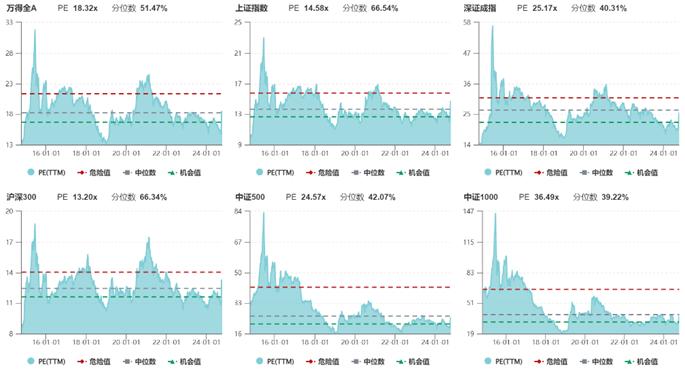
Figure: P/E Ratio of Sub-Indices Source: Wind, Compiled by 36Kr
Therefore, at the current valuation level, the driving factor for the future bull market will no longer be valuation repair, but a pure valuation increase.
To continue to increase the valuation after the valuation repair, a more intense policy stimulus is required. This is also one of the reasons why the market has high expectations for fiscal policies. In the context of the current unclear announcement of the stimulus intensity of fiscal policies, it is difficult for the market valuation to increase rapidly in the short term, and the basis for a fast bull market no longer exists, and the possibility of a significant market correction is also not high. With the support of the existing policies, it is expected that the future market will be in a state of shock and upward movement.
*Disclaimer:
The content of this article only represents the author's views.
The market is risky, and investment needs to be cautious. Under no circumstances does the information in this article or the opinions expressed constitute investment advice for anyone. Before making an investment decision, if necessary, investors must consult a professional and make a cautious decision. We do not intend to provide underwriting services or any services that require a specific qualification or license for trading parties.