In September, the average residential rent in large and medium-sized cities across the country tended to decline steadily, with the largest decrease in first-tier cities.
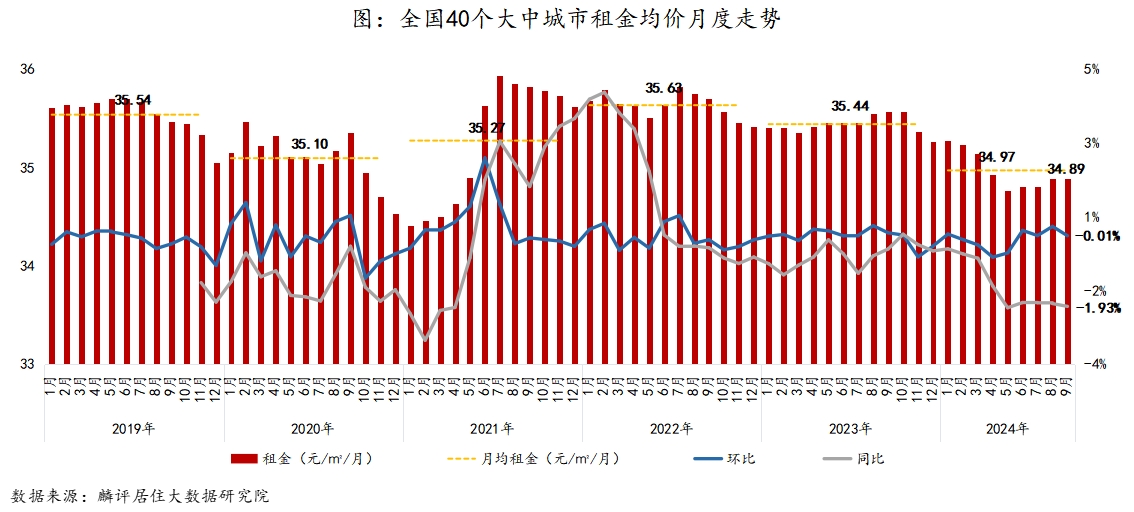
According to the monitoring data of Linping Residential Big Data Research Institute, in September 2024, the average listing rent in 40 large and medium-sized cities across the country was 34.89 yuan/square meter/month, a month-on-month decrease of 0.01% and a year-on-year decrease of 1.93%. The rental market entered the traditional off-season in September, and the rent slightly dropped based on that in August.
From the overall performance within the year, under the influence of the downgrading of rental consumption and the accelerated entry of indemnificatory rental housing into the market, the rent lacks the driving force for an increase. The rent in the first nine months of this year generally shows a trend of being high in the early part and low in the later part. The monthly average rent level within the year is lower than that of previous years. The data shows that the average rent in large and medium-sized cities across the country from January to September 2024 was 34.97 yuan/square meter/month, a decrease of 1.33% compared to the monthly average rent in 2023. In addition, it is expected that the rental market in October will continue the off-season trend, with the average rent continuing to decline month-on-month, and the rent level will still be lower than that of the same period last year.
Source: Linping Residential Big Data Research Institute
Rents in First-tier Cities Declined the Most Month-on-Month
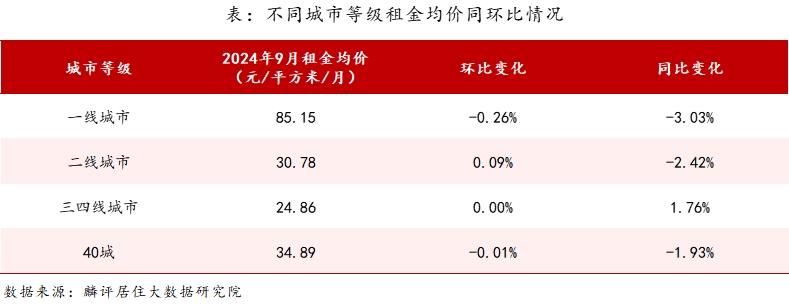
By city grades, in September 2024, the average rent in first-tier cities was 85.15 yuan/square meter/month, a month-on-month decrease of 0.26% and a year-on-year decrease of 3.03%; the average rent in second-tier cities was 30.78 yuan/square meter/month, a month-on-month increase of 0.09% and a year-on-year decrease of 2.42%; the average rent in third- and fourth-tier cities was 24.86 yuan/square meter/month, remaining the same month-on-month and a year-on-year increase of 1.76%.
In comparison, the activity of the rental market in first-tier cities decreased significantly in September, and the rent turned from an increase to a decrease month-on-month; the second-tier and third- and fourth-tier cities continued to maintain a certain level of activity. In combination with the recent policy regulation, the Politburo meeting on September 26 determined for the first time to "promote the stabilization of the real estate market" and proposed a series of policy measures, such as adjusting the housing purchase restriction policy and reducing the interest rate of existing housing loans. Subsequently, starting from September 29, Guangzhou, Shenzhen, Shanghai, and Beijing successively released new real estate credit policies, which may to a certain extent stimulate the release of residents' demand for "switching from renting to buying". The decrease in the activity of the rental market led to a decline in rent, while the second-tier and third- and fourth-tier cities may continue to be in a relatively loose policy environment, with smaller seasonal fluctuations in rent.
Source: Linping Residential Big Data Research Institute
The Number of Cities with Month-on-Month Rent Increase Decreased by 5, and Chongqing Had the Highest Month-on-Month Increase
According to the statistics of Linping Residential Big Data Research Institute, among the 40 large and medium-sized cities in the country in September, the average rent in 22 cities increased month-on-month, 5 cities less than the previous month; the rent in the remaining 18 cities decreased month-on-month. From the perspective of the top 10 cities with the highest month-on-month increase, most are second-tier cities. Among them, Chongqing led with a month-on-month rent increase of 1.86%; Zhengzhou and Tianjin ranked second and third, with month-on-month increases of 1.8% and 1.69% respectively; the month-on-month increase in 5 cities including Yantai, Shenyang, and Nanjing was also above 1%.
From the perspective of the top 10 cities with the highest month-on-month decrease, Beijing had the largest decrease, with a month-on-month rent decrease of 1.95% in September; the average rent in Weihai was 23.78 yuan/square meter/month, with a month-on-month decrease of 1.82%, ranking second; Zhuhai, Chengdu, and Wenzhou ranked among the top five with month-on-month decreases of 1.81%, 1.8%, and 1.16% respectively. The month-on-month decrease in the remaining cities including Baoding, Guilin, and Xi'an was all below 1%.