Bei den chinesischen EDA-Tools, wer kämpft mit den schwierigen Aufgaben?
„The toolchain is not yet fully seamless“, „There are still gaps in core technology“, „The industry ecosystem urgently needs to be improved“ – these three tough nuts are the decisive obstacles that Chinese EDA companies must break through to achieve a breakthrough.
In the face of this battle for supply chain security, Chinese EDA manufacturers are doing everything they can to move forward: IPO gongs have become more frequent, and a large number of industry acquisitions are being carried out.
The EDA market is becoming vibrant
Currently, there are only three listed companies in the Chinese EDA market, namely Huada Jiutian, Galenics Electronics and Guangli Microelectronics. However, since 2025, several leading EDA companies have successively initiated the process for listing on the A-share stock exchange in China:
On April 10, 2025, the EDAIP company Xinyaohui Technology Co., Ltd. started IPO counseling. The counseling company is Guotai Junan Securities Co., Ltd.
On December 11, 2025, Quanxin Zhizao Technology Co., Ltd. completed the counseling registration with the Anhui certification authority. The counseling company is Guotai Haitong Securities Co., Ltd.
On December 24, 2025, the IPO counseling of Xinhe Semiconductor Technology (Shanghai) Co., Ltd. was officially completed. CITIC Securities confirmed in a report that the company has the necessary corporate structure and compliance capabilities for listing.
On December 26, 2025, the IPO counseling disclosure system on the official website of the China Securities Regulatory Commission showed that Shanghai Hejian Industrial Software Group Co., Ltd. officially submitted an IPO counseling application to the Shanghai certification authority. The brokerage company is Guotai Haitong Securities Co., Ltd.
Now let's take a look at the acquisitions of Chinese EDA companies in 2025.
On September 29, Galenics Electronics issued an announcement stating that it intends to acquire a 100% stake in Chengdu Semiconductor IP Design Enterprise Ruicheng Xinwei and a 45.64% stake in Chengdu Semiconductor IP Design Enterprise Nengneng Microelectronics through the issuance of shares and cash payment for approximately 2.174 billion yuan and raise additional capital. Before this transaction, Ruicheng Xinwei held a 54.36% stake in Nengneng Microelectronics, and Nengneng Microelectronics was a subsidiary of Ruicheng Xinwei. After the completion of the transaction, both Ruicheng Xinwei and Nengneng Microelectronics will become subsidiaries of the listed company.
In December 2025, Huada Jiutian carried out the strategic acquisition of Sierxin Technology Co., Ltd., a leading company in the field of digital EDA in China. This acquisition was jointly completed by Huada Jiutian and the Greater Bay Area Fund, indicating that industry leaders and strategic funds are collaborating to strengthen the integration of the Chinese EDA supply chain.
Behind the capital frenzy lies the industry's concerns and desires. To answer the question, „Who is cracking the tough nuts?“, we first need to see who is on the battlefield.
For EDA companies, a higher level of EDA integration is beneficial. However, the entire EDA toolset is extremely complex. EDA tools can be divided into three categories: Complete EDA for digital chip development, Complete EDA for analog and mixed - circuit development, and EDA for semiconductor manufacturing. The tools for complete digital circuit development can be divided into front - end and back - end parts, and both the front - end and back - end have different design and validation tools. The tools for analog and mixed - circuit development focus on circuit development, simulation and validation, and physical implementation. The EDA tools for semiconductor manufacturing are used for the development of manufacturing process platforms and wafer manufacturing.
The first tough nut: The „gaps“ and „welding“ of the toolchain
Regarding the problems of the first tough nut: International giants offer a „turnkey“ project. From front - end development to back - end layout planning and then to assembly and testing, the data flows smoothly. In contrast, Chinese tools have been „scattered in points“ for a long time. Design companies use the front - end tool from Company A, the simulation software from Company B, and the validation tool from Company C. Data conversion is not only inefficient but can also result in a loss of accuracy and even lead to the failure of the chip manufacturing process.
So, who is cracking this first tough nut and how?
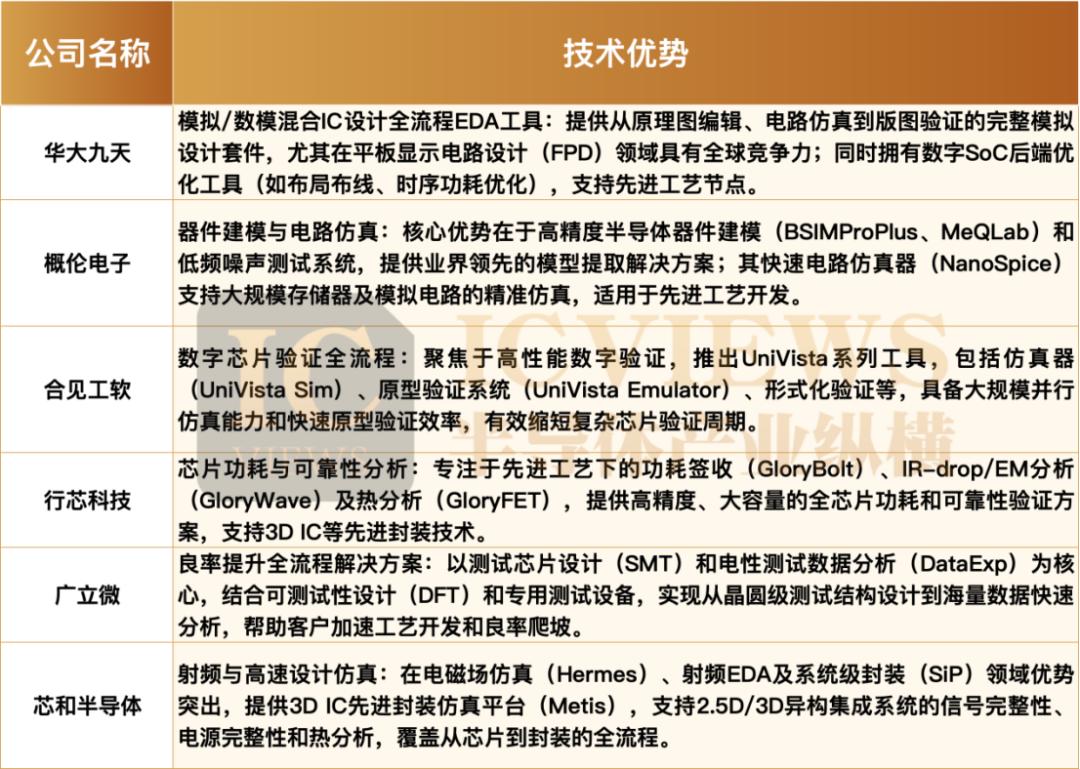
Huada Jiutian is one of the first Chinese companies involved in EDA development. Based on analog EDA, Huada Jiutian has gradually expanded its business scope to the fields of digital technology and advanced packaging and is striving to create a complete toolchain.
In the field of analog circuit development, Huada Jiutian offers a complete toolchain from circuit diagram creation, layout planning to circuit simulation and physical validation. This system includes core products such as Empyrean Aether (circuit diagram creation tool) and Empyrean ALPS (circuit simulation tool).
In the field of RF circuit development, Huada Jiutian has also achieved complete process coverage. Its system integrates tools such as RF model extraction, circuit diagram creation, and electromagnetic field simulation, filling the gap in this area on the Chinese market.
In digital circuit development, although Huada Jiutian has not yet achieved complete process coverage, it is quickly closing the key gaps through self - development and strategic acquisitions. In recent years, Huada Jiutian has accelerated the filling of gaps in digital EDA by acquiring and investing in Xinda Technology, Acasix, and Sierxin.
In the development of circuits for flat - panel displays, its complete EDA tool system is world - leading and includes all tools from the modeling of optoelectronic components, optical simulation, circuit development, layout planning, physical validation to circuit simulation.
The second tough nut: The „generation gap“ and „catching up“ in core technology
Regarding the problems of the second tough nut: For established manufacturing processes above 28 nm, Chinese tools are generally „usable“. For advanced manufacturing processes of 7 nm, 5 nm, or even 3 nm, international giants have collected algorithm models, physical effect libraries, and process data over decades, which represents an extremely high technological hurdle. Chinese tools often have generation gaps in terms of accuracy, speed, and convergence.
So, who is cracking this second tough nut and how?
Galenics Electronics pursues the strategy of „ground penetration“. It does not directly aim for a complete toolchain but focuses on device modeling and circuit simulation. These two steps are the bridge between development and manufacturing and require a very high accuracy of algorithms. The wafer manufacturing customers of Galenics Electronics include nine of the top ten wafer manufacturing companies in the world, including TSMC, Samsung Electronics, UMC, GlobalFoundries, SMIC, etc. The company's device modeling and validation EDA tool has already achieved a high market position and is used and validated by most leading wafer fabs in the world. Its memory customers include Samsung Electronics, SK Hynix, Micron Technology, etc., which are among the three largest memory manufacturers in the world and long - term customers of Galenics Electronics. The circuit simulation and validation EDA tool has already been introduced into the world's leading semiconductor companies. This „accompanying“ model enables the company to obtain the latest process data immediately and improve the algorithms. It compensates for the lack of „breadth on the development side“ with the „depth on the manufacturing side“ and reduces the generation gap in core algorithms.
Hejian Industrial Software has chosen the strategy of „lateral breakthrough“. Since the complete toolchain cannot be established immediately, it maximizes the most critical bottleneck, „validation“. Hejian Industrial Software is a leading Chinese company in digital EDA and represents the full - process/platform type: It focuses on digital chip EDA and cooperation with high - end IP and is the only Chinese platform EDA company that covers digital validation, DFT, and IP. It is also one of the few domestic leading companies with the ability for complete EDA and self - development of high - end IP. The high - speed interface IP solution of Hejian Industrial Software supports several advanced manufacturing processes, has been validated in chip manufacturing, and has been successfully used in the chips of leading Chinese IC companies.
Its UniVista series of hardware validation accelerators is the first self - developed Chinese hardware simulator product that can be expanded to 46 billion logic gates and supports the further expansion of multiple systems. This can significantly improve the efficiency of simulation validation and shorten the simulation validation cycle of ultra - large chips.
Xingxin Technology has decided to tackle the most difficult „sign - off“ step. Sign - off is the last checkpoint before chip manufacturing. A mistake can result in losses in the millions of dollars. For a long time, this area was monopolized by tools such as Synopsys PrimeTime. Xingxin Technology has significantly improved the efficiency and accuracy of time analysis by introducing a new parallel computing architecture and machine learning algorithms and has been validated in the advanced manufacturing projects of several leading Chinese chip companies. It has proven that Chinese EDA can not only „imitate“ but also „innovate“ in core algorithms.
Xinhe Semiconductor aims to overcome the new chain of „advanced packaging“. Xinhe focuses on RF/high - speed simulation and analysis of advanced packaging (Chiplet) and fills the gap in the Chinese market in system and packaging EDA. With the rapid development of 5G, millimeter - wave communication, and Chiplet technology, the demand for RF circuit development and simulation of advanced packaging is constantly increasing. The RF simulation and packaging parasitic parameter extraction tools of Xinhe Semiconductor can effectively solve the problems of signal and power supply integrity caused by high - frequency and high - density packaging. Its products have already been included in the supply chains of companies such as Huawei, ZTE, and Changjiang Electronics Technology. Thanks to its advantages in electromagnetic simulation and signal integrity analysis, Xinhe redefines the design processes of advanced packaging. It does not simply build an old chain but a new chain that adapts to 3D stacking technology.
Guangli Microelectronics has taken a unique path of „combining hardware and software“. In contrast to pure software companies, Guangli Microelectronics has recognized the most urgent problem of wafer fabs – improving yield. It is not only an EDA software company but also a hardware manufacturer capable of self - developing high - precision WAT (Wafer Acceptance Test) devices and CP (Chip Probe Test) devices. On the map of Chinese EDA, Guangli Microelectronics is the only company that can form a complete cycle through „data acquisition with devices + data analysis with software“. Its strategy is „hardware - based promotion of software“: First, it penetrates into the core production lines of wafer fabs with its high - threshold and highly required test devices and becomes an indispensable part of the production process.
AI for EDA is the common weapon of all players. In the face of the limitations of traditional algorithms, Huada Jiutian, Galenics Electronics, and unlisted emerging companies are strongly relying on artificial intelligence. For example, Huada Jiutian has already successfully applied AI technology in several individual tools such as simulators and CUDA library tools, significantly improving development efficiency and accuracy. Hejian Industrial Software has officially released the second - generation digital development AI intelligence platform – the intelligence system UniVista Design Agent (UDA) 2.0.
An insider told the industry magazine Semiconductor Industry Review that the application of AI in the EDA field depends on the application situation, such as in simulation intelligence systems and back - end routing intelligence systems. It cannot be solved with a single model but requires the iterative cooperation and real - time scheduling of multiple models. Therefore, a „janitor“ - like scheduling system needs to be created to connect the models. From a technical perspective, a data intelligence system foundation needs to be built to connect the originally independent „stovepipe“ models and enable the interactive iteration of multimodal and multiple models. For example, the coupling analysis of electrical and thermal models can be carried out, which is completely different from the traditional step - by - step analysis model. In the future, the EDA field may no longer simply sell individual tools but rather integrated models. The business model will change significantly. In terms of technological breakthroughs, AI will advance faster in the field of digital circuit development because digital circuit development is mainly described by code and can be more easily combined with AI. There are also progress in the field of physical simulation, such as the generation of current distributions and electromagnetic field distributions in seconds.