Mehrdimensionale Zeitreihenprognose für Chart-Manipulation, Leistungsschwankungen von 0%, Aufbrechen des Dualismus von CI/CD
New research on CPiRi at ICLR'26 breaks the deadlock in time series prediction: With a frozen base module, time series features are extracted, and a lightweight module focuses on learning the real relationships between channels, instead of relying on position encoding to "memorize the answers by rote". Tests showed that the performance remained unchanged when the channels were randomly arranged, and the model could generalize to the entire network with only 25% of the data, representing a true balance between robustness and accuracy.
In the field of multivariate time series forecasting (MTSF), there has long been a debate in the academic world between the channel dependence (CD) direction and the channel independence (CI) direction.
Supporters of channel dependence (CD) (e.g., Crossformer, iTransformer) advocate explicitly modeling the complex relationships between channels through methods such as spatio-temporal graph neural networks (STGNNs) and channel attention mechanisms. Although the theoretical upper limit is high, they are very prone to overfitting.
Supporters of channel independence (CI) (e.g., PatchTST, DLinear) advocate treating each channel as an independent time series. Although this method is simple and crude, they dominate the rankings due to their strong robustness.
This leads to a counter-intuitive paradox: Why is the generalization ability of CD models, which explicitly model more information, worse than that of the "lone-fighting" CI models?
When we look at the surface, it becomes clear that it is essentially a compromise in architectural choice.
Most current CI main models are based on non-autoregressive (NAR) or direct mapping architectures. To avoid the accumulation of noise, they have to give up modeling the joint distribution between channels.
Is there an architecture that has both the robustness of CI (insensitive to noise and heterogeneity) and the ability of CD to capture physical relationships (understanding the causality between channels)?
To solve this paradigm paradox and the problem of the "shortcut" of position memories, a research team from Zhejiang University of Finance and Economics proposed a brand-new multivariate spatio-temporal decoupling framework, CPiRi. Through a frozen pre-trained time encoder, robust temporal dynamic features are extracted, and a lightweight spatial module focuses on learning the "content-driven" interactions between channels.
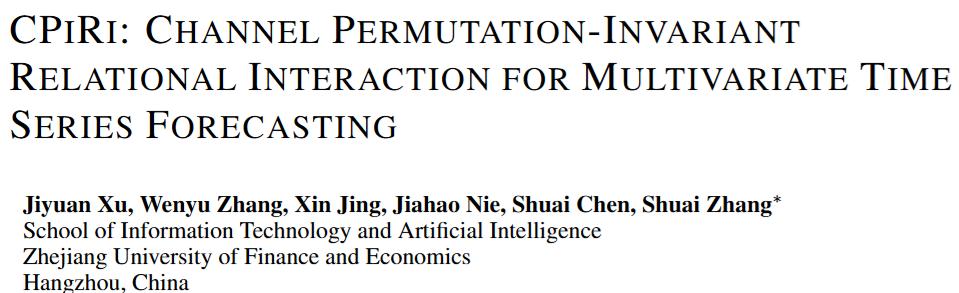
Publication link: https://openreview.net/pdf?id=tgnXCCjKE3
Code link: https://github.com/JasonStraka/CPiRi
In combination with an innovative permutation-invariant regularization strategy (channel permutation), the model is forced to learn generalizable relationships between channels and completely break away from the dependence on absolute position indices.
Experiments show that CPiRi not only improves several SOTA results but also has amazing zero-sample induction generalization ability in the extreme small-sample situation where only 25% of the sensors were seen.
This research provides a new, implementable, transferable, and maintainable technology path for real business scenarios where "structural distribution drifts" can easily occur, such as in intelligent traffic management and power grids.
The hidden challenges in the real world: The coordinated drift of structure and distribution
Before we delve into the CPiRi framework, we first need to understand the real physical environmental conditions that modern MTS forecasting tasks are exposed to. In complex industrial systems, the process of data generation is often accompanied by a continuous change in the underlying physical or logical topology.
Multivariate time series data in the real world are inevitably exposed to two types of complex evolutionary phenomena in an open and dynamic environment:
- Distributional drift: That is, the statistical properties of the time series, such as mean, variance, and autocorrelation, change dynamically over time (e.g., seasonal changes, holiday effects, changes in device status), resulting in inconsistent data distributions between the training set and the test set. This forms the main threshold for the accuracy of forecasting tasks.
- Structural drift: That is, the physical or logical topology of the sensor network that supports data generation changes over time. For example, in a smart city, road construction may cause some traffic sensors to fail, or the expansion of the power grid may add new monitoring nodes.
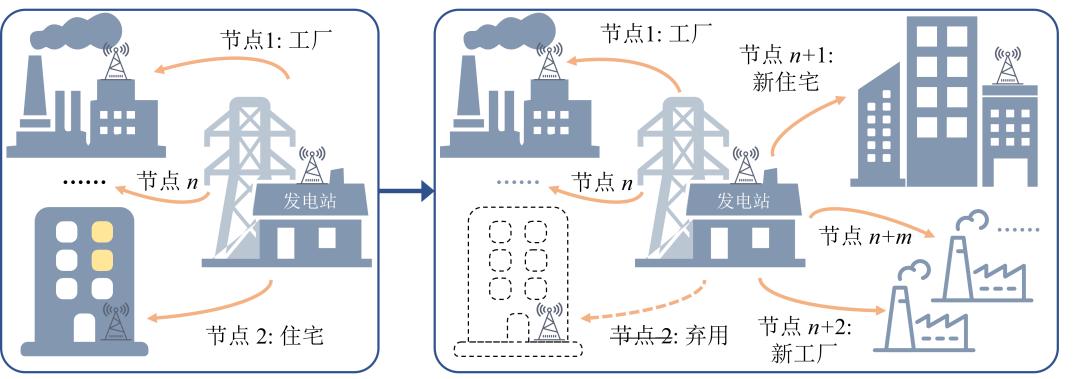
These two drifts often do not occur in isolation but are closely linked, forming a structural - distributional co - drift. Disturbances at the structural level (e.g., the addition of a new traffic flow monitoring node on a main road) can directly break the original spatial dependence relationships and trigger a synchronous drift of the marginal distribution. This requires that the deep - learning model not only needs to capture the temporal dynamics but also has strong adaptability to topological dynamics, robustness, and generalization ability.
When the system undergoes regional migration, extensive network reorganization, or faces the challenge of cold - start with completely unknown channels, traditional models tend to experience a drastic performance decline due to the strong "position memory effect". In this scenario, the computational cost takes a back seat, and the "global generalization ability" and "trans - domain portability" of the model for unknown scenarios become the core problems in solving the problem.
The CPiRi framework was specifically developed to completely solve this problem of strong structural distribution drift. The core goal of its design is to break the model's dependence on a specific channel configuration. By constructing a general architecture with channel permutation invariance, the model obtains the "meta - ability" (meta - skill) to infer relationships between channels, so that it remains stable even with strong channel rearrangements, additions, deletions, or trans - domain deployments.
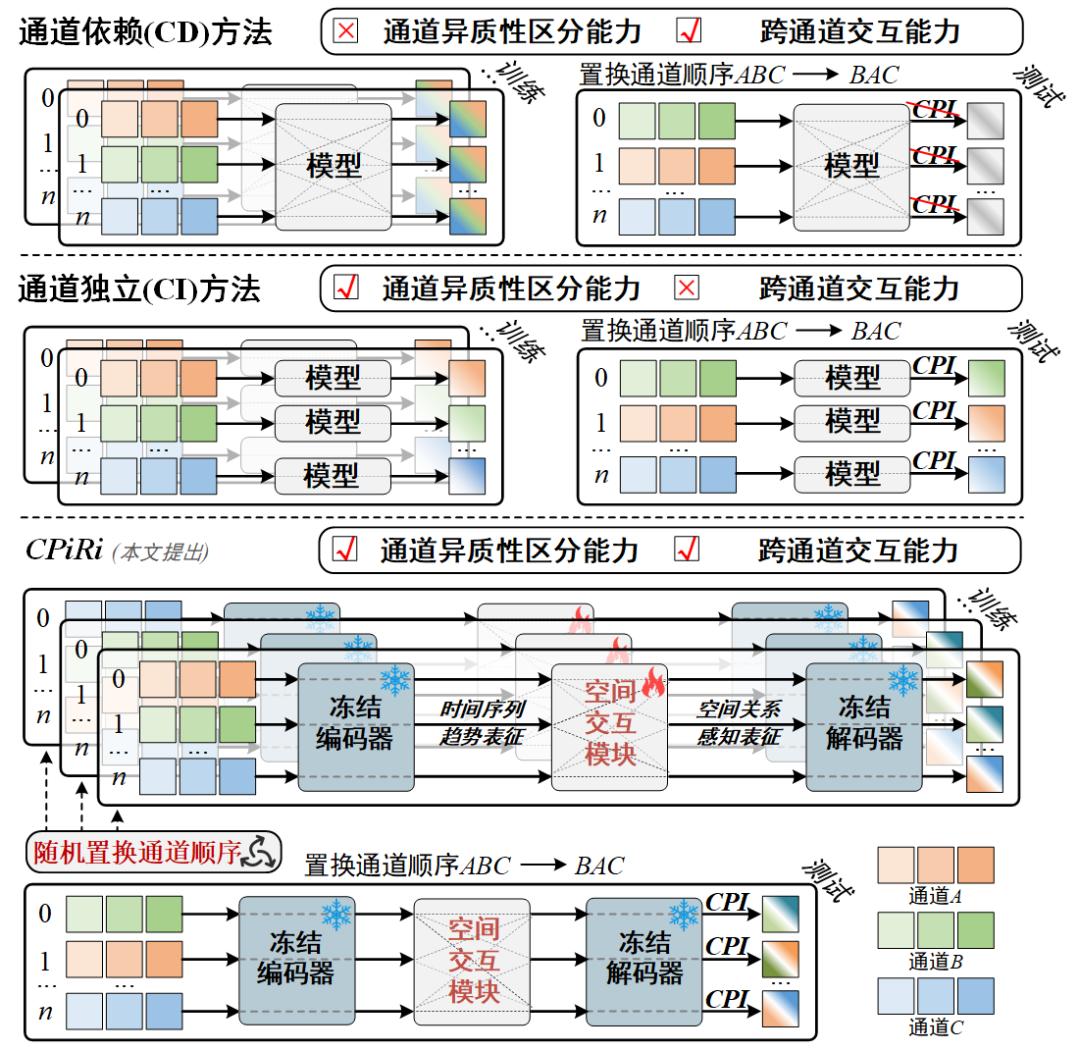
Weighing classic forecasting paradigms
In recent years, MTS forecasting technology based on deep learning has developed rapidly. However, in the face of strong structural distribution drift, existing models have fallen into a deep "paradigm paradox" when dealing with the relationships between channels. Modern deep - learning MTS forecasting models can be mainly divided into two opposing camps: the channel - independent (CI) paradigm and the channel - dependent (CD) paradigm.
The channel - independent (CI) paradigm: The price of robustness is blindness to relationships
The basic concept of channel - independent models is to decompose multivariate time series forecasting tasks into multiple independent single - channel time series forecasting tasks. For example, the DLinear model only uses simple fully - connected layers to model the decomposed time series independently; PatchTST applies the Transformer architecture to independent channel - patch sequences. Recently, base models based on the experience of large - language models (LLM) (e.g., Chronos - Bolt, Sundial), which are pre - trained on a huge amount of single - channel time series data, have taken the CI paradigm to a new level.
- Absolute advantages: CI methods naturally have excellent robustness and essentially meet the "channel permutation invariance" (because the channels are calculated independently and do not interfere with each other). They are outstanding in resisting the influence of noise, dealing with channel heterogeneity, and trans - domain generalization.
- Fatal flaws: This paradigm completely sacrifices the explicit modeling of interactions between channels (e.g., the coupling of traffic flow at adjacent intersections, the common change of load at adjacent nodes in the power grid). The ignorance of the spatial coupling mechanisms in the system severely limits the model's ability to describe the global spatio - temporal dynamic structure of a complex system, thus setting the upper limit of forecasting accuracy.
The channel - dependent (CD) paradigm: The "apparent correlation" trap of position memory
To capture the complex interactions between channels, channel - dependent models emerged, which attempt to explicitly explore spatial features through joint modeling. Early spatio - temporal graph neural networks (STGNN) rely on predefined or adaptive graph structures; later Transformer - based models (e.g., Informer, Crossformer, STID) capture the spatio - temporal dependencies between channels through various attention mechanisms or trans - dimensional embeddings.
- Absolute advantages: On static, closed, and channel - fixed test benchmarks, CD models can usually achieve excellent forecasting accuracy by exploring the complex deep interactions between channels.
- Fatal flaws: Existing CD models show high pathological sensitivity to the specific channel configuration in the training phase (e.g., the number of channels, the absolute input order, the a priori topology). Studies have shown that these models often tend to find a "position memory shortcut" during the training phase - they don't really learn to infer relationships based on the semantic content of time series signals but simply memorize the absolute position indices of the channels (e.g., "The 3rd channel in the input tensor is always strongly correlated with the 5th channel").
To uncover this hidden flaw, the researchers introduced an important channel permutation invariance (CPI) diagnostic test. The logic is simple: If a model really understands the semantic dependence relationships between channels, its forecasting performance should remain stable even when the order of the input channels is randomly shuffled during the test phase (Channel Shuffling).
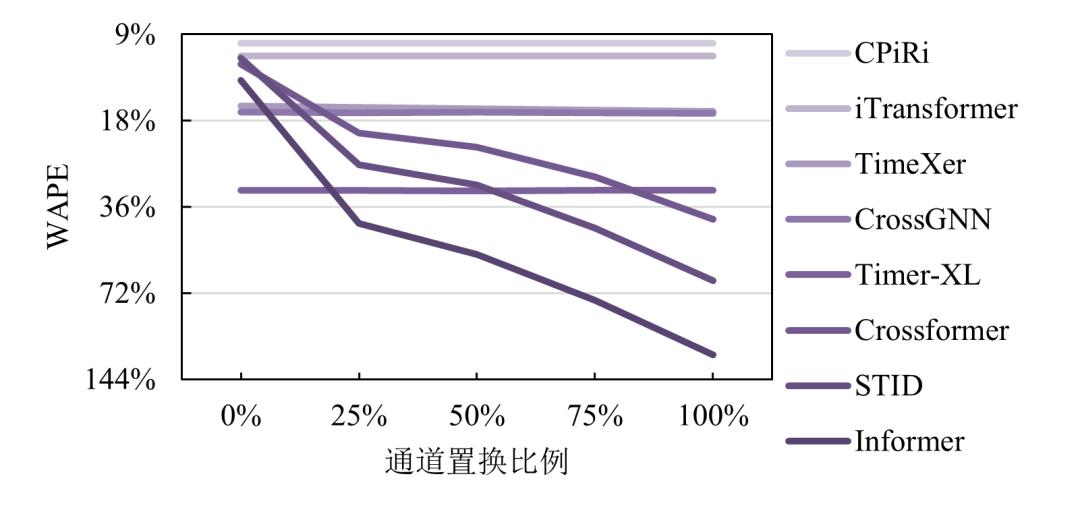
However, the results of the diagnostic test are alarming: On the PEMS - 08 traffic flow dataset, the SOTA - CD models showed amazing weakness when the channel order was shuffled. For example, the forecasting error of Informer increased by more than 400%, and the error of STID increased by more than 235%. This strong rigidity at the architectural level makes these models almost unusable in the real deployment environment where the structure of the sensor network changes.
Only a few innovative CD models (e.g., iTransformer) attempt to design the architecture to be insensitive to the channel order by transposing the Transformer attention mechanism - considering time steps as feature dimensions and channels as sequence tokens. However, this dimension - transposition method requires extremely high - dimensional spatio - temporal features to be calculated in a coupled manner in each attention layer, which almost increases the computational cost to
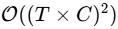
When processing a large number of channels