In Huaqiangbei ist KI zunächst ein Geschäft.
In Huaqiangbei, some people teach a plush toy to read people's emotions in half a year, while others replicate the latest overseas AI hardware in 48 hours. The merchants here rarely discuss the technology itself, but they can always produce new products in no time and put them into watches, glasses, and dolls, then display them on the counters.
The once-popular mobile phone accessories and smart products have given way to new star products: AI hardware. Veteran players are transforming, and new entrepreneurs are entering the market. Huaqiangbei is using its unique supply chain speed to verify the authenticity of this AI wave. It is the testing ground for global electronic consumption and also an opportunity field for countless people. When the wave arrives, the merchants who have been sticking it out here for a decade and the explorers who enter the market with ideas are all looking for the next business in their own ways.
AI Comes to Huaqiangbei
At the end of February, a group announcement posted by the group leader popped up on the phone of Theo, an AI hardware entrepreneur: "Those who want the Huaqiangbei version of the OpenClaw box can come to me for pre - orders." At this time, only one day had passed since the release of the overseas original OpenClaw integrated box.
The original box is priced at $399. The group leader said that he found people in Huaqiangbei to disassemble, study, and produce it. They can achieve 80% similarity, and each box costs 699 yuan, which can be shipped the next day. Ten days later, the group leader "showed off" the sales results on his WeChat Moments. The boxes sold like hotcakes, and he earned six - figure income.
Such stories are not uncommon in today's Huaqiangbei. During the Spring Festival this year, the overall revenue of Shenzhen Huaqiangbei increased by 35% year - on - year. AI hardware has become a popular "tech New Year gift". In the first two months of the year, the overall sales of technology products increased by more than 30% year - on - year, among which the sales of AI glasses soared by 70% to 80%. As an established electronic consumption city, Huaqiangbei has become popular on the Internet again, and this time, its label is the most trendy AI.
If you come to Huaqiangbei now, it still looks like an ordinary electronic product market. But if you just stroll around a bit, you'll find that AI is everywhere.
At noon on an ordinary weekday, on the silver - white counter, a row of cute AI dolls were rolling their eyes. Lin Shaodong's attention was attracted by them. Half a year ago, in his impression, these AI dolls were not so "smart". They couldn't say hello, wave their hands, or take pictures and record sounds.
The shop owner came over and asked Lin Shaodong to ask the doll a question: "Is the person standing in front of you a handsome guy?" The doll immediately replied, "You are very handsome and tall, and you are full of energy." Lin Shaodong works in Huaqiang Electronic World. He told the Mirror Phase Studio that there are more than six thousand shops here, offering everything from accessories, electronic components to terminal products.
In Huaqiangbei, there is only a counter between new technology and products. You can see a drone flying in the air and a robotic dog running in the corner. If you look closely, you can also find all kinds of novel products such as AI time managers and AI guitars. There are countless styles of AI glasses alone. Customers can even get their glasses with the right prescription on the spot and pick them up the same day, with an average price of only 150 - 180 yuan.
Many stalls may seem unremarkable, but they are often connected to a complete production line behind. The shops are responsible for sensing the market, and the factories are responsible for rapid production. New products are first sold on a trial basis in a few stalls. If the sales are good, other merchants will quickly follow suit. In the past two or three years, more and more AI products have emerged from here, been replicated, and then taken to all parts of the world. As a result, Huaqiangbei has welcomed new customers: retail buyers, cross - border e - commerce practitioners, hardware entrepreneurs, foreign purchasers... All kinds of people are shuttling in the market.
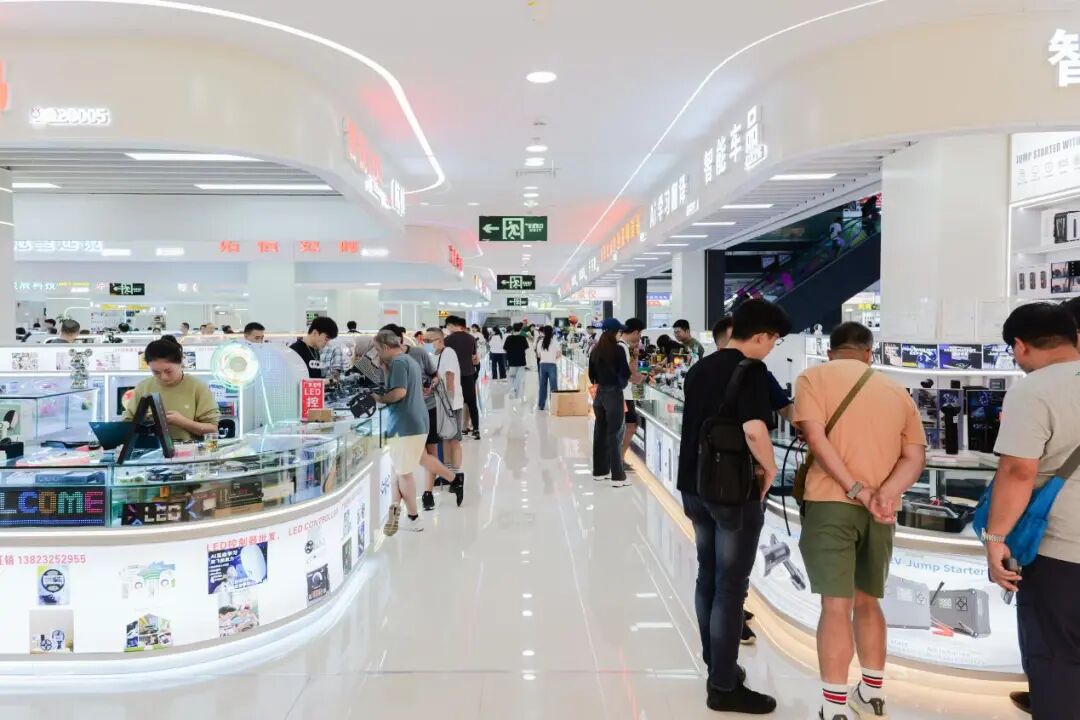
● The first floor of the first store of Huaqiang Electronic World in Shenzhen. Photo source: Respondent
Chen Xiaosha is in her forties and runs the flagship store of Luojiefu blood pressure watches on the first floor of the first store of Huaqiang Electronic World in Shenzhen. At the end of October last year, a special guest came to the store: Professor Marshall, the winner of the Nobel Prize in Physiology or Medicine. The professor, accompanied by a lawyer and an assistant, spent more than half an hour in the store, all experiencing the air - pump blood pressure watches with AI functions in the store.
One month later, Professor Marshall sent a message on WeChat, expressing his appreciation for this product.
The work schedule in Huaqiangbei is also changing because of AI. In the past, the electronic world opened at 9:30 a.m. and closed at 7 p.m. Now, the closing time has been postponed to 9 p.m., and the nearby express delivery stations don't stop until one or two o'clock in the morning. More than 3 million packages are sent from here to all parts of the world every day.
The once - called "No. 1 Electronic Street in China" has officially entered the AI era. New people, new products, and new stories have begun.
All in AI
A few years ago, if someone said that Huaqiangbei would become popular again because of electronic products, many people might not believe it.
At that time, this once - called "No. 1 Electronic Street in China" was going through a rather long period of low tide.
Five or six years ago, when Xiao Ting, the general manager's assistant of Xinrui Technology, a blood pressure watch manufacturer, first went to Huaqiangbei, the scene he saw was very different from what it is now. At that time, in addition to 3C products, many merchants were also selling cosmetics, imported goods, etc. As the No. 1 electronic market in China, it seemed a bit unworthy of the name. As early as 2017, due to the impact of e - commerce on the electronics business and the decline in gross profit, Mingtong Digital City in Huaqiangbei was transformed into the "Mingtong Cosmetics Market". Since 2020, the COVID - 19 pandemic has made the passenger flow and order volume in Huaqiangbei even worse.
Huaqiangbei needs new products and new stories. AI just appeared at this time.
In 1998, Jiang Xiaolin came to Huaqiangbei to start a business. From security equipment and earphones to now specializing in smart glasses, his shop has almost transformed with every round of electronic trends. In 2022, Jiang Xiaolin began to consider adding AI functions to his products. At that time, a company shareholder heard many people mention at the Consumer Electronics Show in the United States that AI would change the form of consumer electronic products. He brought this news back to Huaqiangbei, told the idea to the solution providers, and asked them to coordinate AI cooperation, hoping to add this somewhat mysterious concept to the smart glasses.
AI first entered here as a "future concept". At the end of 2023, when hardware entrepreneur Theo first came to Huaqiangbei, he found that many merchants selling electronic products had begun to try to "AI - ize". However, at that time, it was more about AI at the software level, such as installing AI programs on computers or adding simple intelligent functions to existing products.
The real wave of AI hardware became obvious at the end of 2024. At that time, many enterprises began to transform in order to survive. Shenzhen Xinrui Technology Co., Ltd. is one of them. As early as 2019, Xinrui Technology began to sell smart watches in Huaqiangbei. At that time, the ex - factory price of their watches was in the range of 150 - 300 yuan, while the purchase price of some products with the same appearance in the Huaqiangbei market was less than 100 yuan. Although they thought their products were of better quality and had a longer service life, many customers' idea was "I just want to buy a watch that looks like an Apple Watch."
To some extent, choosing AI is a self - rescue for Huaqiangbei. Price competition left enterprises with almost no way out. Around 2023, the company finally decided to transform. After obtaining relevant patents for blood pressure measurement, they formed a R & D team of more than 30 people to develop blood pressure monitoring watches. They self - developed everything from hardware, software, structural design to the APP system, reduced the entertainment functions, and put the health monitoring data on the home page.
At the end of 2024, Xiao Ting helped Xinrui Technology obtain the Class II medical device certification from the National Medical Products Administration for the blood pressure watch as a "wrist - type electronic blood pressure monitor". In April 2025, the company opened its first flagship store in Huaqiangbei. In May and June of the same year, the idea of adding AI functions to the team took shape. At the end of the year, the AI blood pressure watch was officially launched.
Also in this year, the smart glasses in Jiang Xiaolin's shop were all updated to "AI smart glasses". He changed the slogan of his original shop "Youhe Intelligent Manufacturing" and hung up an LED sign that said "All in AI".
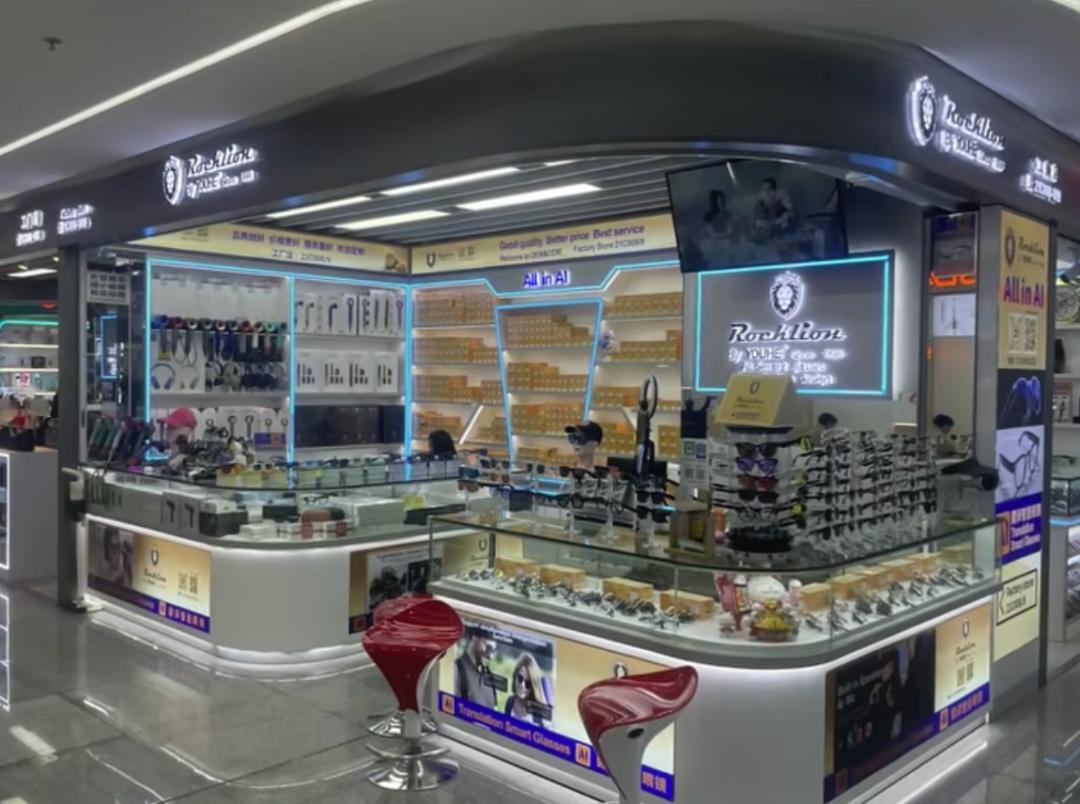
● Jiang Xiaolin's AI smart glasses store. Photo source: Respondent
The changes spread from individual shops to the whole street. Even the market operators in Huaqiangbei began to prepare for this AI wave.
Lin Shaodong recalled that before the Spring Festival in 2025, Huaqiang Electronic World invested about 20 million yuan to renovate the first - floor and the periphery of the first and second buildings of the first store in Shenzhen to create a "sense of technology and future". The overall design is mainly in silver. The former "one - meter counters" have been expanded into delicate and independent small stalls, and the aisles have also been widened. Screens at the pillars and corners continuously display high - tech scenes such as space and the universe. They also equipped nearly 200 employees and security guards with AI translators each to provide consultation, shopping guidance, and explanation services for foreign friends. When Lin Shaodong heard the news at that time, he was a little nervous. He thought that this was undoubtedly a desperate change.
But with the transformation of the market, Lin Shaodong's work has become busier in the past year. There have been continuous media interviews, visiting groups, and study groups. Just recently, a cross - border e - commerce exhibition was held in Shenzhen. At three or four o'clock in the afternoon, the exhibition organizers organized dozens of people to come here by bus for a visit. Huaqiangbei has become lively again.
"Hidden Talents"
If AI has brought new products to Huaqiangbei, then it is still the people here who really make this market run.
"Hidden talents", this is Theo's impression of Huaqiangbei.
In 2023, Theo and two friends in Shenzhen began to try to develop an AI robot for the office desktop. One team member was responsible for hardware development, one for software development, and he was responsible for contacting suppliers, negotiating cooperation, and purchasing parts. And Huaqiangbei was the place he went to most often. He lives in Beijing. In the following year and a half, he flew to Shenzhen frequently. In one month, he flew there 8 times at most, and his membership level of Shenzhen Airlines was upgraded to platinum.
In Huaqiangbei, every boss he met was like an "AI product manager".
One day, Theo bought six or seven AI hardware items at a store at once. The boss was curious and asked him what he was going to do with them. After hearing that he was doing entrepreneurial research, the boss immediately pointed to one of the products and said directly, "We don't even bother to copy it." Then the boss recommended another product, which was a copy of a Japanese brand. The original one had an emotion recognition function, "which is not easy to copy".
Another time, when he was purchasing parts, he asked the shopkeeper if they had a certain model. The shopkeeper took a look and said, "Your information is too outdated. This model was phased out two years ago. Using it now is like using a Nokia in 2025."
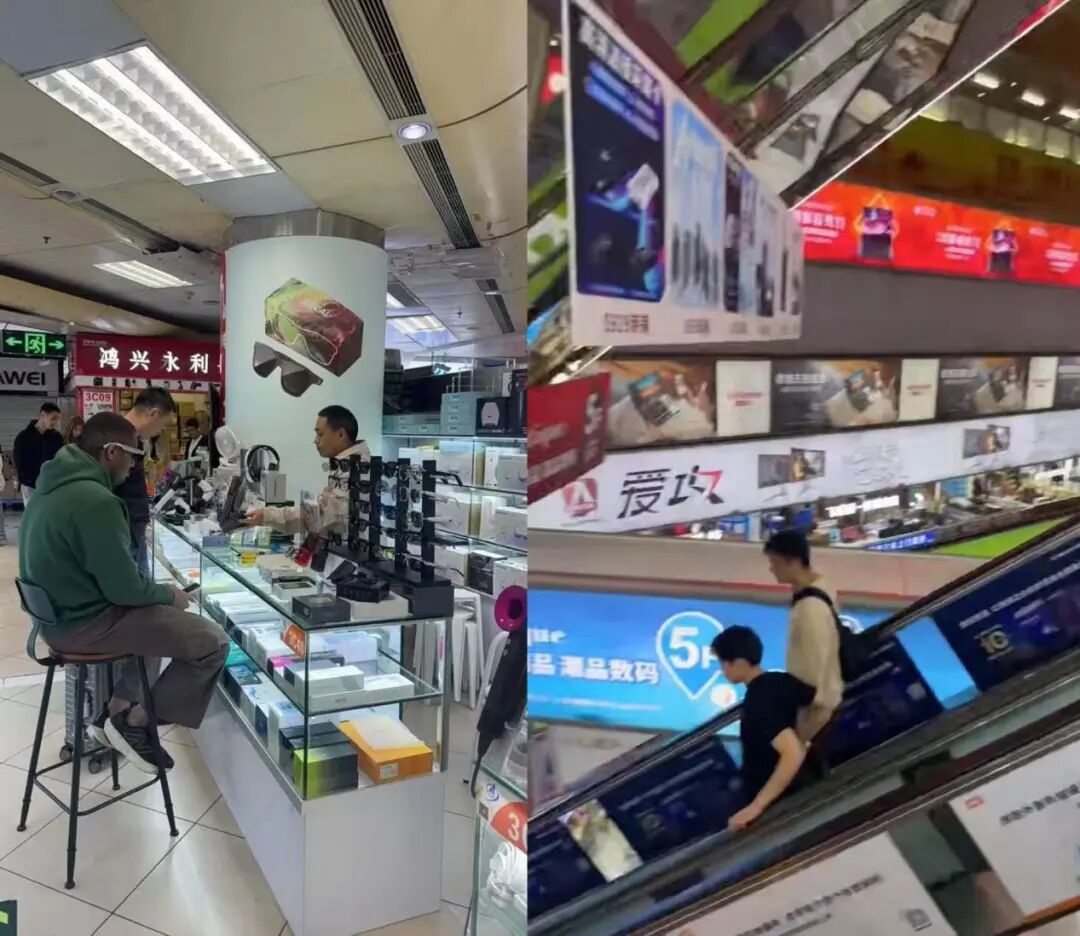
● It's like "panning for gold" in Huaqiangbei. Photo source: Respondent
In Huaqiangbei, to judge whether a product is worth making, you don't need a market report or user research. You just need to take a look at the parts, calculate the cost, and then see how the products in the next stall are selling.
Theo still remembers a female shop owner. Her shop was two or three times larger than an ordinary stall and was filled with all kinds of AI hardware, including AI glasses, AI rings, portable AI drum sets, keyboards, etc. The boss could not only play the piano but also explain the technical principles of each piece of hardware clearly. At that time, he wanted to buy a copy of an Apple Watch to compare with the genuine one. When the boss heard about it, she just threw the watch to him and said, "Then I'll give it to you." She said she had a lot of watches and asked him to take it to study slowly. If he thought it was good, he could introduce customers to her. Later, Theo really introduced many friends in Shenzhen to her.
Here, trust, information, and business are often the same thing. Lin Shaodong shared a story. Once, during his inspection of the market, he found that two stores opposite each other were selling the same AI toys. According to market practice, the main business categories of merchants in the same area are usually differentiated to avoid selling the same products and falling into vicious price - cutting competition. He asked them separately, and both said that this toy was only sold by them in the whole Huaqiangbei. They just happened to have the same supply channel, and they had already negotiated privately to keep the price the same. This fully reflects the survival wisdom of the merchants in Huaqiangbei.
Once, Theo took a list of six or seven parts to Futian Port near Huaqiangbei to find suppliers, including hardware brackets and core structural parts. A Hunan boss who had been doing business in Huaqiangbei for 14 years took a look at the list and immediately took him by car into the industrial park. There was a special sample library in the factory, where the parts were stored in plastic baskets classified by type, and there were model stickers on the baskets. As they were chatting, the boss said that he would give him 5 samples of each part for free to test. If they were not suitable, he didn't have to buy them. Later, he ordered about 200 pieces of each part, which was not a large quantity, but the boss was very enthusiastic.
In the past decade, the trends in Huaqiangbei have changed from mining machines, beauty products, e - cigarettes to balance bikes, and now it's AI's turn. As the trends change round by round, some people leave, and some people enter. But the bosses in Huaqiangbei remain the same: they may not know exactly what AI is, but they know that it's a business, and they must seize it.
AI Is First and Foremost a Business
In Huaqiangbei, almost no one takes the success or failure of a product too seriously.
In today's Huaqiangbei, new products appear every week, and old products disappear. But in Lin Shaodong's view, the so - called "failure" in Huaqiangbei is more just a trial - and - error process: if a product doesn't sell