Quantencomputing: Eine neue Ära der Rechenleistung im Zeitalter nach dem Moore'schen Gesetz
With the increasing ineffectiveness of "Moore's Law" and the obvious bottleneck in "single computing performance", after more than half a century of technological accumulation and iteration, quantum computing finally steps onto the stage. It promises to overcome the limits of classical physics and usher in a new era of computing performance. Internationally, more than 30 countries have already established the quantum computing industry. The technological competition pattern shows a tri - polar situation among China, the United States, and Europe. Breakthroughs in cutting - edge technologies and technological autonomy are the focuses of strategic competition, which has attracted wide attention in society.
This article aims to analyze the current development trend of quantum computing at home and abroad and identify the investment opportunities in the quantum computing industry. There are numerous sub - areas in the fields of overall quantum computer devices, upper - level components, and lower - level software applications that should be particularly noted.
The current state and development trend of the quantum computing industry
The current state of the quantum computing industry: The practical application phase of quantum computers
Quantum computing is a new computing paradigm based on the principles of quantum mechanics (superposition, entanglement, interference) to control information processing units. The core is to use quantum bits (qubits) instead of classical bits to create non - classical correlations through quantum entanglement, increase the probability of the correct result through quantum interference, and achieve exponential or polynomial accelerations compared to classical computers on certain problems (e.g., prime factorization, quantum simulation, combinatorial optimization). Quantum computing has the following advantages compared to classical computing:
Information unit: Classical computers use classical bits, whose state is either 0 or 1. Quantum computers use qubits, which can exist in a superposition α|0⟩ + β|1⟩ like spinning coins and thus contain two states simultaneously. The squared magnitudes of α and β represent the probability that the quantum state collapses to |0⟩ or |1⟩ upon measurement.
State space: N classical bits can only represent N bit - information. When N qubits work together, they can process 2^N states in parallel through quantum superposition. The information capacity grows exponentially with the number of bits. This means that the computing space of only 300 qubits is already larger than the number of atoms in the universe.
Processing mode: Both the serial computing of CPUs and the parallel computing of GPUs in classical computers are deterministic operations on different data blocks. Quantum computers use quantum superposition to achieve quantum parallelism. One operation can be applied to the superposition of 2^N data.
Output result: The result of classical computing is deterministic, while the result of quantum computing is probabilistic and must be obtained through multiple measurements and statistical analyses.
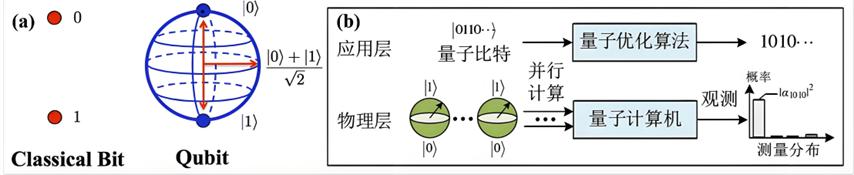
Figure 1: (a) Comparison between classical bits and qubits (b) Schematic diagram of the quantum computing process
Since Paul Benioff first proposed the concept of the "quantum Turing machine" in 1980, quantum computing has gone through four critical phases:
1980 - 1994: The theoretical foundation phase, in which Feynman introduced the concept of quantum computing and the Shor algorithm showed the potential of quantum superiority.
1994 - 2018: The technological exploration phase, in which computer scientist Grover from Bell Laboratory developed the Grover algorithm. Technological routes such as superconductivity, ion traps, and quantum photonics began to develop in parallel. D - Wave launched the first commercial quantum annealer on the market.
2018 - 2023: The NISQ era (Noise Intermediate - Scale Quantum Computer, proposed by John Preskill in 2018. "Intermediate - Scale" means that the number of qubits is between 100 and 1000. "Noise" means that the fidelity of qubits is affected by internal and external factors and cannot be used for stable computing). Google's "Sycamore" processor with 53 qubits achieved "quantum superiority" for the first time. The National Laboratory achieved the validation of quantum superiority with the "Zuchongzhi - 3" processor.
Since 2024: The practical application phase of Noise Intermediate - Scale quantum computers, in which the focus is on overcoming quantum errors, demonstrating logical qubits, and industrial application. It is expected that by 2027, a leap to over 100 logical qubits will be achieved, and the phase of practical quantum computing with error correction will begin, gradually leading to the FTQC (Fault - Tolerant Quantum Computer).
According to the general development plan, the current technological trends are as follows: 1) Continuously expand the number of qubits to achieve leaps into the hundreds, thousands, and tens of thousands; 2) Further develop error correction and fault - tolerance technologies; 3) Solve some practical problems through quantum computing (simulation) applications.
There are many physical implementation possibilities for qubits. The industry mainly focuses on superconductivity, ion traps, quantum photonics, neutral atoms, semiconductors (quantum dots), NV (diamond - nitrogen vacancy) color centers, and topological quantum as physical implementation routes. The first five routes are the current main technological routes in the field of quantum computing.
Superconductivity route: This route uses Josephson junctions, which are composed of superconductor - insulator - superconductor (S - I - S), to form a non - resonant oscillator energy - level structure. The lowest two energy levels are used as qubits (|0⟩ and |1⟩ states). Quantum gate operations are realized through microwave pulses. Companies such as Google, IBM, Rigetti, IQM (Finland), and Chinese companies such as Guodun Quantum, Benyuan Quantum, Logic Qubit, and Liangxuan Quantum follow this route.
Ion trap route: This route uses radio - frequency electromagnetic fields (Paul trap) or electrostatic fields (Penning trap) to trap ions (e.g., Ca⁺, Yb⁺, Ba⁺). The internal energy levels (hyperfine structure or Zeeman sublevels) of the ions are used as qubits. The internal states of the ions are manipulated by lasers or microwaves. Companies such as Quantinuum, IONQ, Oxford Ionics (UK, acquired by IONQ), AQT (Austria), and Chinese companies such as Huayi Quantum, Yaozheng Quantum, and Guoyi Quantum follow this route.
Neutral atoms route: This route uses optical tweezers (highly focused laser) to trap neutral atoms (e.g., Rb, Cs) and form two - or three - dimensional arrays. The ground - state hyperfine energy levels of the atoms are used as qubits. The atoms are excited to the Rydberg state by lasers. The Rydberg blockade effects are used to realize the interactions and entanglement gates between the atoms. Companies such as Atom Computing (USA), QuEra, Infleqtion (USA), PASQAL (France), and Chinese companies such as Zhongke Kuyuan, Liangyi Wanxiang, and Zhongqi Wuliang follow this route.
Quantum photonics route: This route uses the polarization states (horizontal/vertical), path states (two optical fibers), or time - bin states (different time slots) of photons to encode qubits. Quantum gates are realized through linear optical elements (beam splitters, wave plates, phase modulators). Companies such as Psiquantum, Xanadu (Canada), and Chinese companies such as Turing Quantum, Bose Quantum, and Silicon Quantum follow this route.
Silicon semiconductor route: This route uses quantum dots formed in semiconductor heterostructures (e.g., GaAs/AlGaAs or Si/SiGe) through the electrostatic confinement of gate electrodes to trap single electrons. The spin states (up/down) of the electrons are used as qubits. The spin states are controlled by electrical pulses. Two - qubit gates are realized through exchange interactions. International companies such as Intel, Diraq (Australia), and SemiQon (Finland) follow this route.
The superconductivity, ion trap, and quantum photonics routes have an earlier development. The neutral atoms route has been a "dark horse" in recent years. Currently, all routes are developing in parallel, each with its own characteristic features, and there is no tendency for one route to dominate the entire technology.
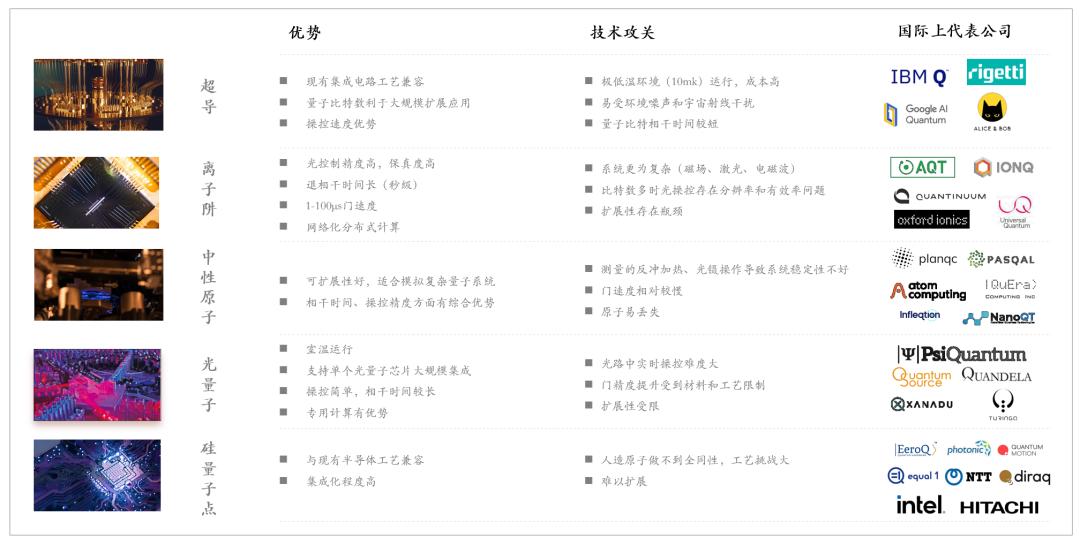
Figure 2: Characteristics of the five main technological routes of quantum computing (compiled by Yunxiu Capital)
The development trend of quantum computing: Quantum error correction and super - computing performance
Quantum error correction becomes a competitive area
Physical qubits are the original carriers of information but are very sensitive. They can be easily affected by environmental influences such as temperature, interference from other electronic systems in the hardware, and measurement errors. They can also be easily dephased, leading to information loss. To protect the information stored in the qubits, many unreliable physical qubits can be combined in a certain way to form fault - resistant logical qubits. When a qubit is faulty and causes an error, other qubits can help protect the system. This process is called quantum error correction and can significantly reduce the error rate of quantum computing. A universal quantum computer with practical application value that can execute complex algorithms should use logical qubits as the basic units of quantum gates.
The error correction process of physical qubits can be realized through special coding methods. The currently widely used Surface Code encodes logical qubits on multiple physical qubits in a two - dimensional lattice (code distance d = 3, 5, 7...). Bit - flip and phase - flip errors are detected through X - and Z - stabilizer measurements. This coding method uses the topological properties of the quantum system to encode and store quantum information. The topological quantum states of such multi - qubit systems are insensitive to local disturbances and have excellent fault - tolerance properties for quantum information.
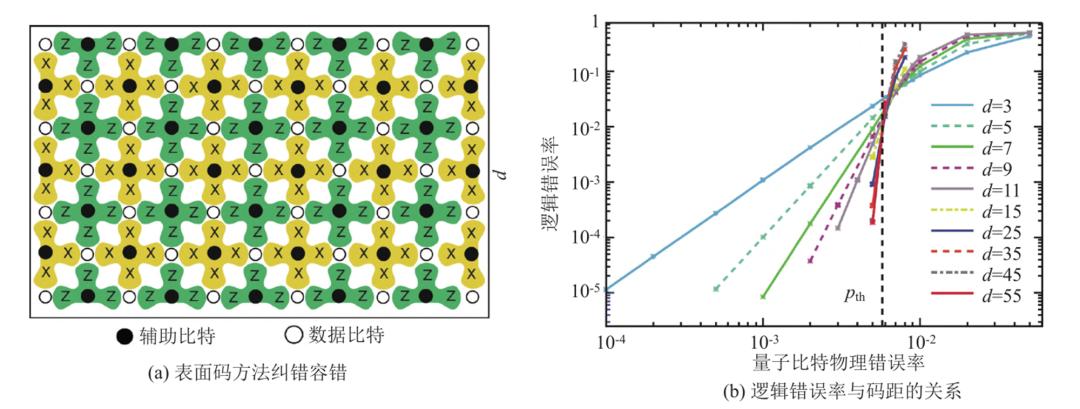
Figure 3: Quantum error correction Surface Code and correction threshold (Source: Article "An Overview of the Development of Quantum Computer Technology")
To achieve effective quantum coding, a basic condition must be met - the error rate of physical bits must exceed the "fault - tolerance threshold". If the physical error rate is greater than the threshold, "the more corrected, the more errors". If the physical error rate is less than the threshold, "the more corrected, the fewer errors". Currently, only the American companies Quantinuum, Google, QuEra, as well as the team of Professor Pan from the University of Science and Technology of China and the team of Professor Yu from the Shenzhen Quantum Research Institute have exceeded the fault - tolerance threshold and reached the critical point to expand the number of qubits and improve the performance of logical qubits. Quantum error correction becomes a new technological competitive area after the expansion of the number of qubits and the validation of quantum superiority.
Quantinuum (USA): In April 2024, Quantinuum, based on the H2 - 1 ion trap processor (56 physical qubits), exceeded the "correction threshold" of 99.9% two - qubit fidelity for the first time. With the Surface Code + lattice operation technology, 4 logical qubits were created. The logical error rate is 800 times lower than that of physical qubits.
Google: In December 2024, Google introduced the new quantum chip Willow. The chip uses 105 superconducting qubits. With the Surface Code method, the coding lattice was expanded from 3×3 to 5×5 and 7×7. This has led to the logical error rate decreasing exponentially with the number of physical bits. Google has achieved a positive gain in the error correction of superconducting quantum chips for the first time in the world.
QuEra (USA): In 2025, QuEra developed an integrated fault - tolerance architecture with 96... (The text seems incomplete here)