Das Engagement und die "Schneidkunst" der Frühjahrs-Neuheiten von Apple
As expected, there will be a general trend in the product world this year towards "price increases while reducing the configuration". Even some "small companies" have already announced that they will stop developing new flagship models, and many "large companies" have postponed the launch of their non-main model products. In contrast, Apple takes the opposite approach and has impressed the entire industry with a dense series of spring new products.
From the iPhone 17e with an epic doubling of the starting capacity, to the MacBook Pro with the powerful M5 Pro/Max, to the long-awaited Studio Display XDR with a 120Hz high-frequency refresh rate, Apple's core strategy is obvious: The overall hardware standards are raised to prepare for the end-device AI ecosystems, and at the same time, a strict product hierarchy is maintained with extremely sophisticated "tailoring".
iPhone 17e: The "King of Pragmatism" with a reused housing
As the most discussed product among the current new products, the iPhone 17e is undoubtedly a bombshell in the mid-range market. Its upgrades hit the mark directly: Most impressively, the selling price remains unchanged while the storage capacity jumps - directly from 128GB to a standard configuration of at least 256GB. In the price segment of 4,499 yuan (3,999 yuan after government subsidy, and possibly below 3,500 yuan with platform coupons), this undoubtedly redefines the storage lower limit for mid-range smartphones (even though the prices of Apple's mid-range smartphones are still a bit higher).
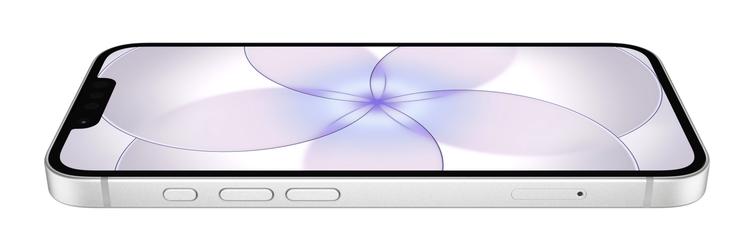
Image source: Apple
In terms of core computing power, the iPhone 17e is equipped with the A19 chip (albeit a version with a missing GPU core), combined with the self-developed C1X baseband, which doubles the performance and reduces the power consumption by 30%. In addition, there is MagSafe magnetic charging, which was missing in the previous model, the iPhone 16e. The iPhone 17e thus closes the most criticized gaps.
But Apple is still Apple. While it gives the iPhone 17e an extremely good price-performance ratio, the "tailoring" is still so precise that it makes one grit one's teeth. In an era when Android smartphones in the lower price segment already have high-frequency refresh rate screens, the iPhone 17e still stubbornly adheres to a 60Hz screen. The legendary Dynamic Island is also missing again, and the "comb screen" of the iPhone 16e remains. This deliberate differentiation in hardware obviously serves to maintain the premium position of the actual Pro series.
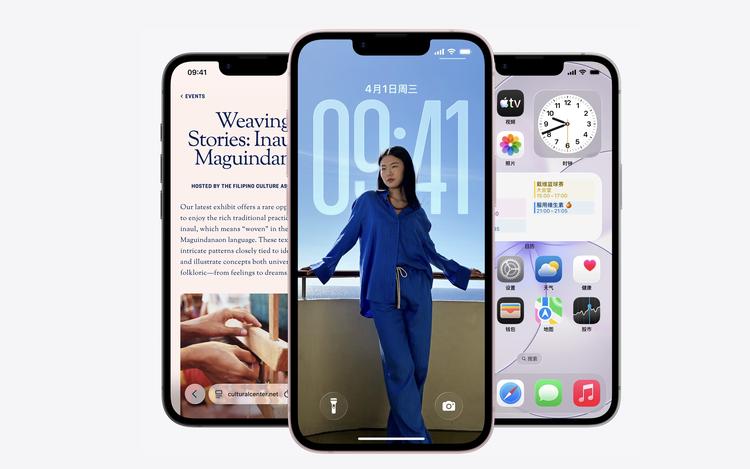
Image source: Apple
Moreover, although the energy efficiency of the chip and the baseband has been greatly improved, the battery capacity is the same as that of the iPhone 16e, and the officially claimed video playback runtime of 26 hours remains unchanged. This is largely because the screen does not support an adaptive refresh rate, which makes it impossible to further reduce the power consumption.
As for the 48-megapixel single lens with 2x telephoto through cropping, although it is sufficient for daily "scanning" tasks, the lack of macro photography, spatial video, and Center Stage constantly reminds us that this is an entry-level model in the iPhone series.
The iPhone 17e is like an excellent student with a strength in a certain direction. With 256GB and the A19 chip, it offers an incredible price-performance ratio and is specifically aimed at pragmatic buyers who value performance and capacity. But with the 60Hz screen, it also builds a wall to specifically steer buyers with higher experience requirements towards more expensive models.
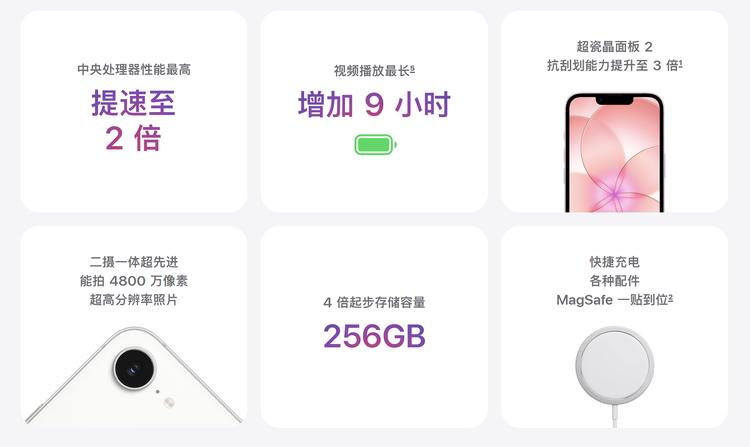
Image source: Apple
By the way, the iPhone 17e also has some "small surprises". It is the first product in China to support both a physical SIM card and an eSIM at the same time. A physical SIM card and an eSIM or two eSIMs can be in standby mode at the same time. Users can thus benefit from the convenience of the eSIM when traveling and also freely change the physical SIM card. This is significantly better than the iPhone Air.
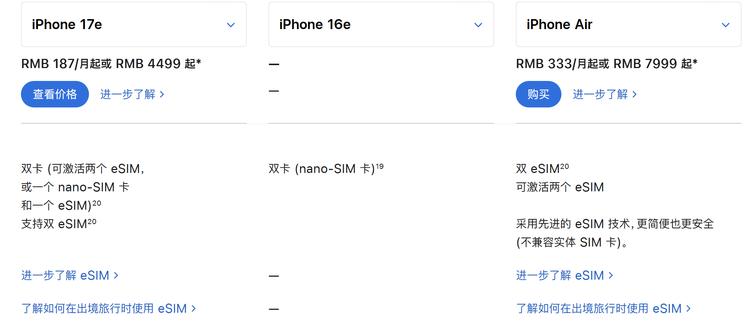
Image source: Apple
iPad Air M4: A product with "double inconvenience" in system and configuration
If the iPhone 17e is a "delicacy" for users outside China to try out iOS, then the new iPad Air with the M4 chip is the core product with which Apple tries to fully invest in AI at the tablet level.
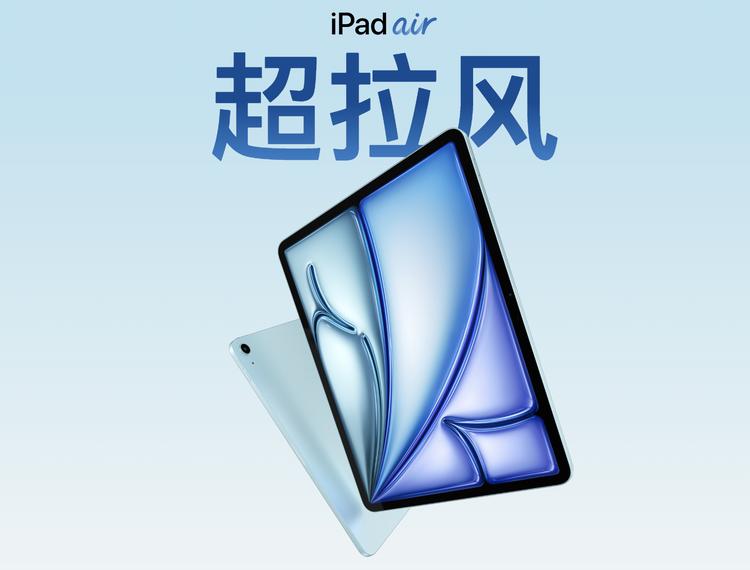
Image source: Apple
The most radical change in this iPad Air lies not in the powerful M4 chip, but in the fact that Apple has exceptionally increased the shared memory capacity by 50% to 12GB to meet the ever-growing end-device AI models. The bandwidth also increases to 120GB/s. Combined with the 16-core Neural Engine, whether it is about intelligent typography in Goodnotes or one-click image cropping in Final Cut Pro, it shows a dominance at the iPad Pro level. Together with the complete switch to the Wi-Fi 7-compatible N1 chip and the 50% faster C1X cellular baseband, this tablet has reached the hardware level of the previous generation iPad Pro.
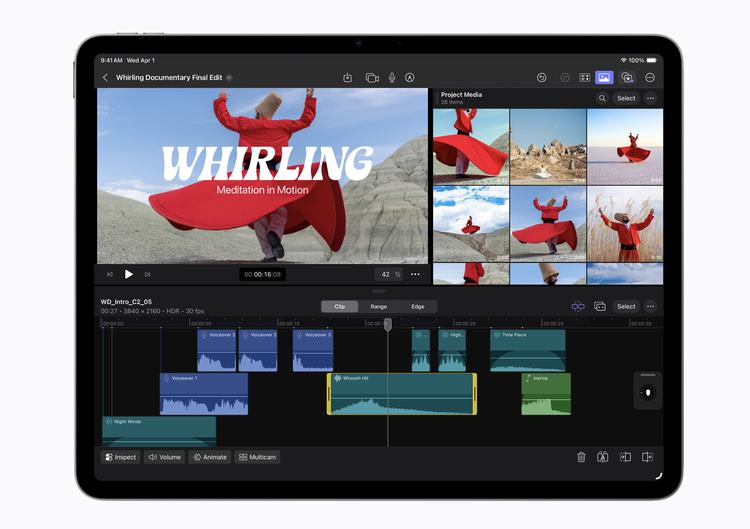
Image source: Apple
However, Apple's incomprehensible business thinking is shown again here. If the iPhone 17e already has a starting capacity of 256GB, it is astonishing that the iPad Air M4, which is positioned as a "productivity tool" and has to process large amounts of multimedia materials, still only has a starting storage capacity of 128GB, which is completely insufficient for video project files that can easily be several gigabytes in size.

Image source: Apple
Moreover, although Apple has brought a more flexible window system and an improved file app, the iPad still has a long way to go before it can achieve true desktop freedom in practice for intensive office work. The perfect combination of 12GB of memory and the M4 chip often gets into a situation where the performance is over - dimensioned and cannot be fully utilized.
MacBook Air M5: The "All - rounder" that fills the last puzzle piece
The MacBook Air is one of the best - selling thin and light laptops in the world. However, in recent years, the starting storage capacity of 256GB and the "slow single - particle SSD" have been the main reasons for scaring off buyers. With the M5 generation, Apple has finally decided not to be so stingy.

Image source: Apple
The basic experience of the M5 MacBook Air is fully unleashed: The starting capacity is doubled to 512GB (up to 4TB can be selected), and the read and write performance of the new SSD is doubled compared to the previous generation. The previous read and write bottlenecks that plagued novice users are completely eliminated.
With the support of the M5 chip, not only does the bandwidth of the shared memory increase by 28%, but the processing speed of AI tasks is astonishingly 9.5 times faster compared to the M1 era.
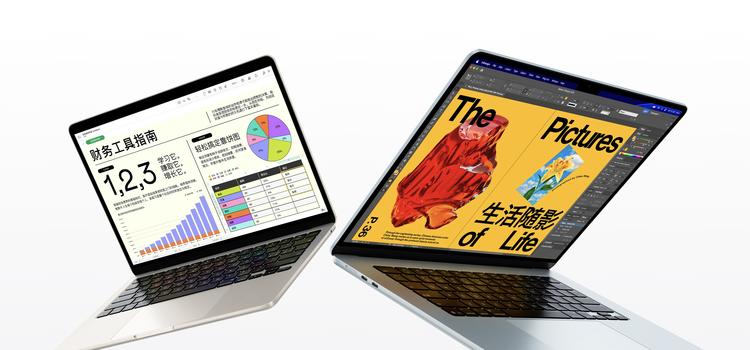
Image source: Apple
The most astonishing thing is that while delivering such strong performance, it still maintains a fan - less, noiseless design and has a runtime of up to 18 hours. Together with the addition of Wi - Fi 7, Bluetooth 6, and the support for two external monitors, the M5 MacBook Air is almost a "mobile all - rounder" without any weaknesses.
It's a pity that although the peak performance of the M5 is extremely impressive, in long - term, high - load 3D renderings or local training of large AI models, the fan - less passive cooling inevitably leads to a frequency drop. But for most text processors, programmers, and light video editors, this computer is almost perfect.
MacBook Pro M5 Pro/Max & Studio Display XDR:
The "Monsters" built for the extreme
In the professional market, Apple didn't even try to hide it this time and directly brought the performance to an astonishing level. The upgrades of the M5 Pro/Max MacBook Pro are specifically tailored for post - processing in Hollywood, top - notch programmers, and experienced AI developers.
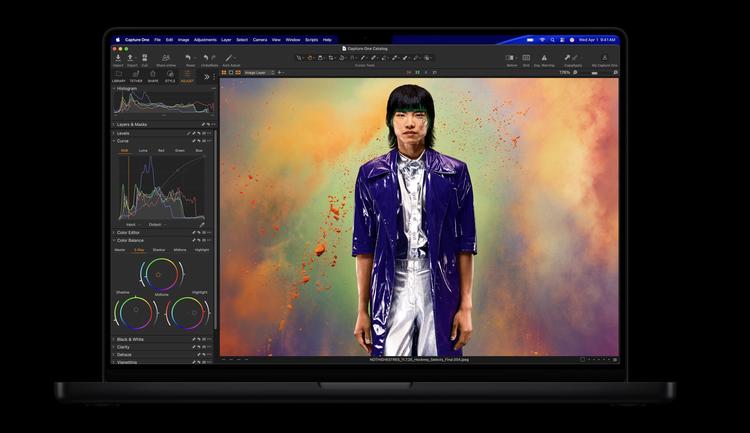
Image source: Apple
The M5 Pro has a standard storage capacity of 1TB, and the M5 Max starts directly with 2TB. The peak performance of the SSD reaches an astonishing 14.5GB/s. With a memory bandwidth of up to 614GB/s and an upper limit of 128GB of shared memory, it can easily process large local language models.

Image source: Apple