Jacob Schmookler: A Pioneer in Innovation Economics Who Uncovered the Secrets of Market Demand

When inventors in the 19th century were immersed in their laboratories pursuing technological breakthroughs, an American economist discovered a revolutionary law through cold, hard numbers: market demand is the real engine driving innovation.
In an archive in New York, a middle - aged economist was poring over a pile of yellowed patent records. He wasn't looking for a world - changing great invention but calculating the relationship between the number of patents and investment fluctuations. It was this seemingly dull work that led him to discover the hidden truth behind technological innovation - market demand has a decisive influence on innovation activities.
This economist is Jacob Schmookler, a key figure in the field of innovation economics.
He was one of the most insightful pioneers of innovation economics in 20th - century America. A doctor from the University of Pennsylvania, he revolutionized the theory of technological innovation with empirical research methods. His book “Invention and Economic Growth” is hailed as a milestone in this field. Through a systematic analysis of hundreds of thousands of patent data, he empirically demonstrated for the first time the decisive influence of market demand on technological innovation, shattering the traditional belief that “scientific discovery necessarily leads to technological breakthroughs”. Schmookler's “Dual - Edge Theory of Innovation” emphasizes that supply (knowledge base) and demand (market pull) are as indispensable as the two blades of a pair of scissors, providing a key theoretical framework for contemporary innovation policy - making. His research results were praised by Nobel laureate Simon Kuznets as “opening the black box of technological innovation” and directly influenced the development of the later theory of the national innovation system. Although he died at a young age, his academic legacy continues to nourish multiple disciplines such as innovation economics, science and technology policy, and management.
In the 1950s and 1960s, when most people attributed technological innovation to the sudden inspiration of genius inventors, Schmookler showed us a different story through his rigorous empirical research.
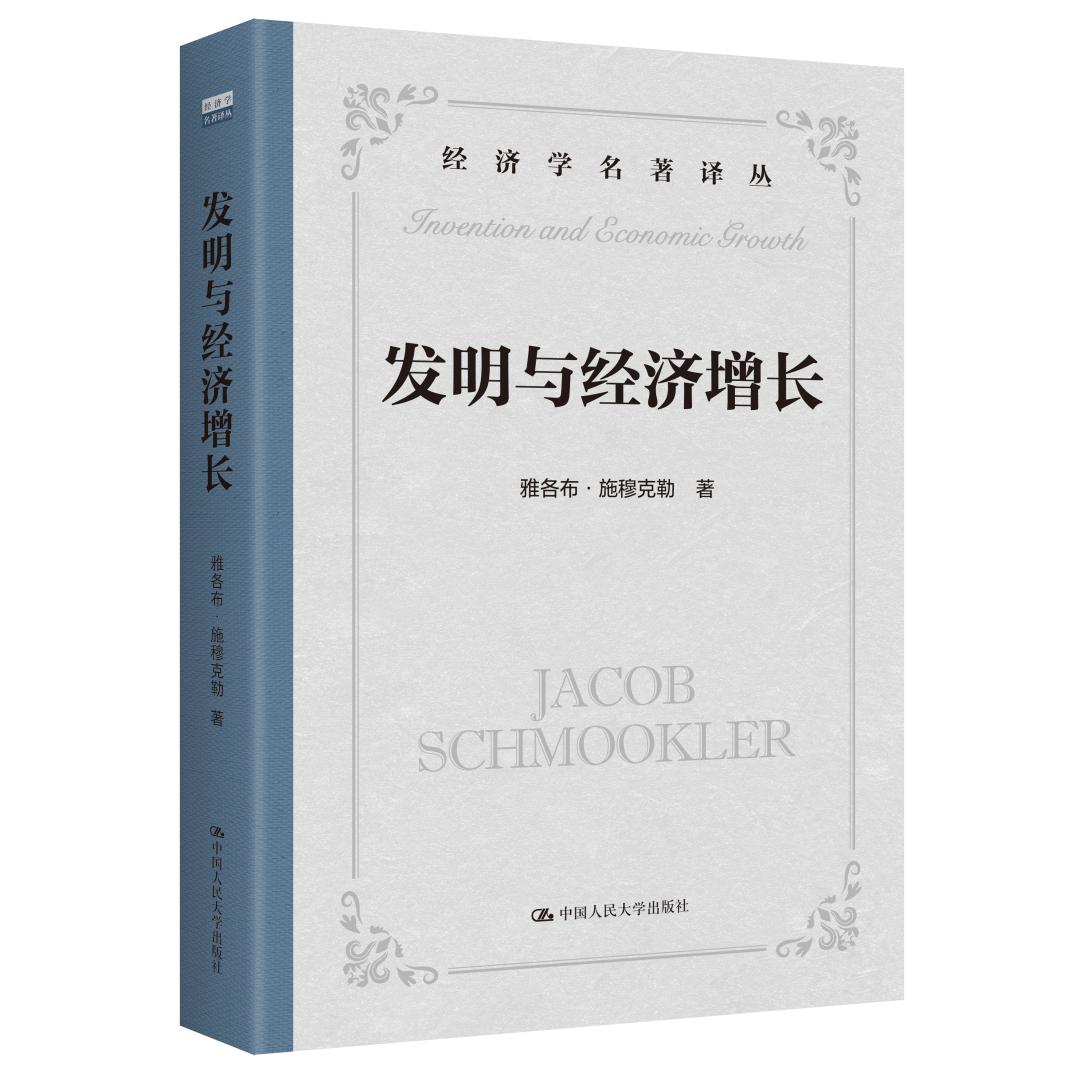
“Invention and Economic Growth”
Written by Jacob Schmookler
Translated by Chen Jin and Jiang Zhiyong
Published by China Renmin University Press
Published in October 2025
NO.1
Patterns Discovered from Data
Schmookler's path to innovation was very different from that of traditional economists. While his contemporary economists were immersed in abstract theoretical models, he turned his attention to the real records of history: patent data, investment statistics, and industry development trends.
His most well - known research was an in - depth analysis of industries such as the American railway, petroleum refining, paper - making, and agriculture from the 19th century to the 1950s. By comparing the relationships between investment, employment, stock changes, and invention activities in these industries, Schmookler discovered a surprising pattern:
Investment in capital goods often precedes the peak of invention activities, rather than the other way around. In other words, changes in market demand affect the scale of investment, which in turn determines the direction and intensity of technological innovation.
This discovery directly challenged the then - dominant “technology - push” innovation model, which held that technological innovation mainly originated from the internal impetus of scientific discovery and technological invention itself.
NO.2
The Birth of the Demand - Pull Theory
In 1966, Schmookler published his masterpiece “Invention and Economic Growth”, in which he systematically expounded the “demand - pull hypothesis”.
The core idea of this theory is that technological innovation does not originate from the evolution of technology itself but from the signal transmission of market demand. When enterprises perceive changes in market demand, they adjust their investment strategies, and a part of this investment flows into technological innovation activities to seize market opportunities.
Schmookler described this process with a simple chain: “Demand → Investment → Invention”.
To verify this theory, he adopted the innovative method of patent statistical analysis, using the number of patents as an indicator to measure technological innovation. This method pioneered quantitative research in innovation economics, moving innovation research from pure theoretical discussions to empirical verification.
Schmookler's research showed that in most industries (especially traditional industries), the influence of demand - pull far exceeds that of technology - push.
NO.3
Dialogue with Schumpeter's Theory
To truly understand the revolutionary nature of Schmookler's contribution, we need to place him in a broader context of the history of economic thought.
Schmookler's theory does not exist in isolation but forms an interesting academic dialogue with Joseph Schumpeter's classic view of innovation. Schumpeter emphasized the “creative destruction” of entrepreneurs and the role of technology itself in driving innovation, while Schmookler showed through empirical data that market demand is the key factor affecting the direction and speed of innovation.
This debate ultimately led to a more comprehensive understanding. Modern innovation theory generally holds that technological innovation is the result of the combined action of technology - push and demand - pull.
The innovation process not only includes the development of technology itself but also involves the complex interaction of various factors such as market demand, corporate strategy, and policy environment. The importance of these two forces also varies in different industries and different stages of technological development.
NO.4
Influence and Legacy
Schmookler's research had a profound impact on later innovation policies. If market demand is an important driving force for innovation, then governments and enterprises can promote technological innovation by shaping the market environment and guiding demand.
This idea provided a theoretical basis for later policy tools such as R & D tax incentives and innovation procurement.
Schmookler's empirical research method also pioneered a new paradigm in innovation economics. After him, quantitative analysis and case analysis became the mainstream methods in innovation research, gradually developing innovation economics into an independent discipline.
Today, when we see governments around the world actively cultivating innovation markets and hear entrepreneurs talking about “innovation centered on user needs”, we can feel the echo of Schmookler's ideas. He helped us understand a key truth: technological innovation does not occur in a vacuum but is an inevitable result of responding to real - world needs.
Schmookler died in the 1960s and did not live to see how his ideas nourished later evolutionary economics and innovation system theory. But today, when we examine the successful model of Silicon Valley, we can see Schmookler's wisdom - the most successful technology companies are often not those with the most advanced technology but those that best understand market demand and can quickly transform technology into products that meet these needs.
In the industries that Schmookler once studied, his theory still retains its vitality. From smartphones to electric vehicles, market demand has always been the invisible hand pulling technological innovation. And technological breakthroughs themselves await the call of the market to be transformed into real innovation.
NO.5
New Book Release
This is not a dull economics book but an intellectual adventure about the essence of innovation. Through the century - long dialogue between Schmookler and Schumpeter, readers will gain a dual perspective on understanding technological progress - they can see both the invisible hand of market demand and the creative power of technological breakthroughs.
This book points out through rigorous analysis that invention is neither a sudden burst of inspiration nor a simple product of knowledge accumulation but is deeply rooted in the soil of social and economic needs. The author challenges traditional views and argues that market size and demand changes - rather than just the supply of technological knowledge - are the more critical factors affecting the speed and direction of invention. Through an in - depth analysis of patent data, the book reveals how “possible inventions” and “ideal inventions” intersect in social selection and summarizes six key steps in the generation of inventions.
This research not only subverts the traditional understanding of technological innovation but also provides a new theoretical perspective for understanding the source of economic growth and formulating effective innovation policies. Any reader interested in technological progress and the fate of human development can gain important insights from this work.
NO.6
Table of Contents
Chapter 1: Problem Setting
I. Technological Progress and Economic Growth
II. Invention and Technological Progress
III. Causes of Invention
Chapter 2: Patent Statistics
I. Patent Statistical Data and Important Inventions
II. Data Used in This Research
III. Interpretation of the Problem
IV. Inventions without Patents
V. Trends in Patent Grants to Individuals and Enterprises
VI. Trends from Empirical Inventions to Scientific Inventions and Patent Statistics
VII. Changes in the Number of Patent Applications and Technical Workers
VIII. Comparison between Patents and R & D Expenditure
IX. Commercial Applications and the Value of Patented Inventions
X. Summary and Conclusions
Chapter 3: The Role of Intellectual Stimulation
I. Two Hypotheses and Related Issues
II. Scientific Discovery as a Stimulating Factor
III. Important Inventions as a Stimulating Factor
Chapter 4: Important Inventions Drive the Emergence of Subsequent Inventions
Chapter 5: Productivity Progress: A Supply - Demand Issue?
Chapter 6: The Number of Inventions Is Determined by Market Size - Time - Series Evidence
I. A Brief Account of the Investigation Process
II. Possible Explanations for This Relationship
III. Time - Series Evidence
IV. A Brief Re - consideration of the Role of Important Inventions
Chapter 7: The Number of Inventions Is Determined by Market Size - Cross - Sectional Evidence
I. Invention and Investment
II. Patents and Value - Added
III. Summary, Conclusions, and Limitations
Chapter 8: The Sources of Invention and the Changing State of Knowledge
Chapter 9: The Role of Demand in Consumer Goods Inventions
Chapter 10: The “Inevitability” of Individual Inventions
Chapter 11: Overview and Conclusions
I. Problem Setting
II. Data Used
III. The Role of Intellectual Stimulation
IV. The Application of Important Inventions as a Cause for Further Inventions
V. Productivity Progress: Supply - Demand Relationship?
VI. The Number of Inventions and the Market Scope
VII. Explanation of the Relationship
VIII. Technological Change as an Economic Variable
IX. Inventions Classified by Use vs. Inventions Classified by Theoretically Relevant Fields
X. Consumer Goods Inventions
XI. Further Insights
Appendix A: Statistical Appendix
Appendix B: Inventors in the Past and Present
Appendix C: Important Inventions in the Railway Industry
Appendix D: Important Mechanical Inventions in Agriculture
Appendix E: Important Inventions in the Oil Refining Industry
Appendix F: Important Inventions in the Paper - Making Industry
Scroll up and down to view more
NO.7
Long - Form Graphic Information

-END-
This article is from the WeChat official account “China Renmin University Press”, published by 36Kr with permission.