Who is the most aggressive state-owned capital in 2025, having made 5,400 investments in a year?
In 2025, state-owned assets demonstrated significant strategic initiative in primary market investments. Through the dual - wheel drive of "direct investment + fund guidance", they allocated over 600 billion yuan of funds, covering more than 10,000 enterprises, and continued to transform deeply into the roles of innovation ecosystem builders and industry integrators.
By reviewing the data of over 300 state - owned institutions in this year, CVSource of CVCAPITAL found six major trends.
State - owned assets remained active. In 2025, they made 5,444 direct investments in total, and the number of sub - funds they contributed to exceeded 4,100, increasing by 23% and 4% year - on - year respectively compared to last year.
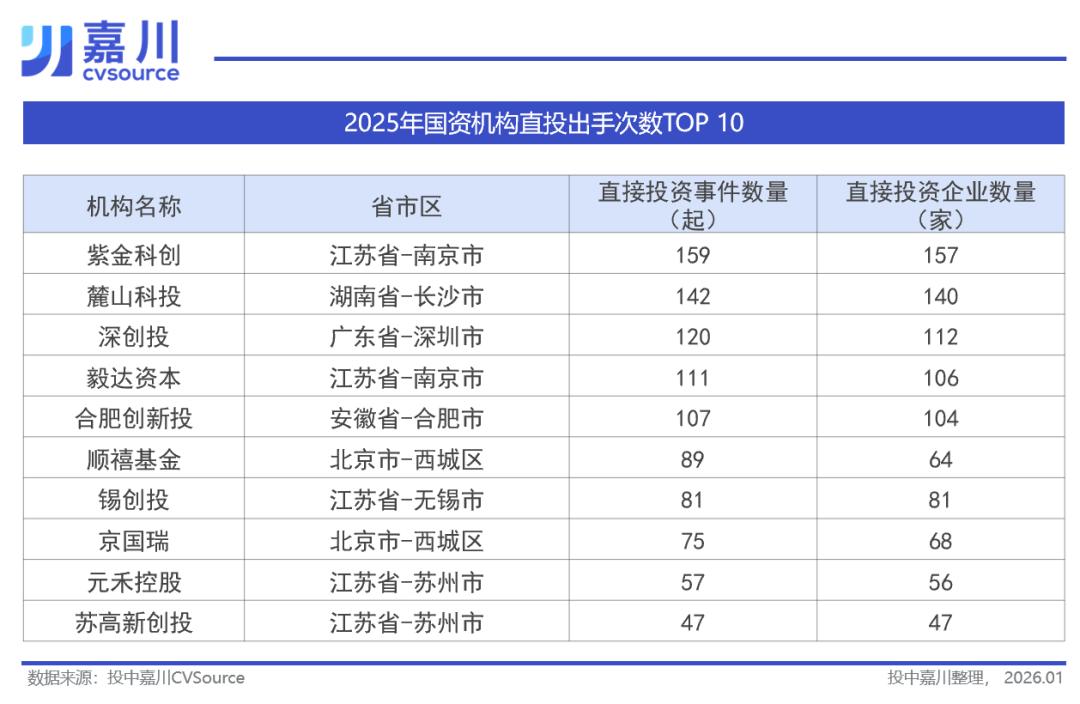
The trend of direct investment became more prominent. Hunan Lushan Science and Technology Investment Co., Ltd. rapidly emerged with its unique "university - fund" model, making 142 investments in a year. Jiangsu, relying on the advantages of its industrial clusters, consolidated its leading position. Five state - owned institutions in the province ranked among the top 10 in the country in terms of investment frequency.
At the level of fund contributions, state - owned assets built a hierarchical and linked capital ecosystem network. For example, Shenzhen Capital Group played a core hub role. It consolidated the local ecosystem through the Shenzhen Guidance Fund and, at the same time, allocated resources across regions through the Hubei Guidance Fund. Zhejiang Innovation Investment carried out strategic planning and jointly established a 50 - billion - yuan science and technology innovation fund with the National Council for Social Security Fund and the Agricultural Bank of China to build a high - level capital alliance.
Exit channels became more diversified. Throughout the year, more than 60 state - owned institutions achieved IPO exits, with Shenzhen Capital Group leading the way with 14 IPOs in a year. Merger and acquisition (M&A) exits also became an important exit strategy for state - owned assets. More than 130 institutions achieved project exits through about 320 M&A transactions.
Controlling stake acquisitions of listed companies by local state - owned assets became the norm. Jiangsu's state - owned assets participated in 9 transactions throughout the year and completed 7, demonstrating strong comprehensive strength and systematic thinking . Guangdong's state - owned assets, represented by Guangzhou Industry Control, quickly built a cross - regional industrial landscape through a series of acquisitions.
State - owned asset investments in cutting - edge technology fields are closely aligned with national strategies and regional industrial advantages. Beijing State - owned Capital Management Center is one of the most active investors in artificial intelligence and embodied intelligence.
These trends together indicate that state - owned assets are deeply involved in and promoting the development of China's new quality productive forces and the optimization and upgrading of the industrial structure through more systematic and market - oriented capital operations.
This article will specifically review and analyze the performance of state - owned assets in the primary market in 2025 from five dimensions: direct investment, fund contribution, diversified exits, controlling - type industrial M&As, and layout in cutting - edge tracks.
01. State - owned assets made over 5,000 investments, and Changsha institutions became the biggest dark horses
Let's first look at the overall investment situation of state - owned institutions in 2025.
According to CVSource data of CVCAPITAL, in 2025, state - owned institutions made 5,444 direct investment events, covering 4,989 enterprises, involving more than 600 billion yuan. The number of investments and investment amount increased by 23% and 28% respectively compared to the previous year.
Meanwhile, as the most active limited partners (LPs) in the market, state - owned assets contributed to more than 4,100 sub - funds throughout the year, a 4% year - on - year increase compared to more than 3,900 last year, indirectly supporting more than 8,000 enterprises through a multi - level capital network. These figures together depict an annual picture of state - owned assets deeply participating in and shaping China's innovation and industrial development through the dual - wheel drive of "direct investment + fund guidance".
In direct investment activities, the policy orientation of "investing in early - stage, small - scale, and hard - technology enterprises" has been translated into a common action consensus.
Under this trend, direct investments by state - owned assets remained active in 2025, and its investment map showed distinct structural features: Changsha rapidly emerged, while Jiangsu and Beijing continued to lead. Investment strategies were deeply integrated with regional industrial endowments, jointly depicting a capital map serving the development of new quality productive forces.
On the stage of state - owned direct investment this year, Hunan Lushan Science and Technology Investment Co., Ltd. (hereinafter referred to as "Lushan Science and Technology Investment") was undoubtedly the most eye - catching rising star.
According to CVSource data of CVCAPITAL, Lushan Science and Technology Investment ranked second in the country for the first time, second only to Zijin Science and Technology Innovation under Nanjing Innovation Investment Group, with 142 investments and a total investment in 140 enterprises.
This little - known institution was established as early as 2009 but only emerged in recent years. It is a science and technology innovation platform established by the Administrative Committee of Yuelu Mountain University Science and Technology City in Changsha, mainly providing "concept verification + investment incubation + enabling services" for science and technology achievement transformation projects. Official information shows that it has initiated and established 6 funds and invested in more than 300 early - stage projects, playing a key role in early - stage investment in Hunan.
Among the 6 funds it manages, the most prominent one is undoubtedly the first provincial - level college student venture capital fund in the country. With a scale of 505 million yuan, this fund has been operating with high efficiency since its establishment in December 2024. On the one hand, it has carried out more than 20 publicity activities in various universities in Hunan, collecting more than 11,000 projects in total; on the other hand, it has made 215 investment decisions, with a transaction amount of 76.2 million yuan.
This model, which uses the "college student venture capital fund" as a starting point to cover projects from the seed stage to the angel round on a large - scale and batch basis, is regarded by many as a local simplified version of the "YC model" (the model of the well - known US startup accelerator Y Combinator, which is famous for investing in early - stage startups and providing intensive startup training and resource docking).
In contrast to this emerging force in Hunan, traditional strong provinces in direct investment strengthened their positions.
Jiangsu Province continued to maintain an absolute lead, occupying five seats among the top ten institutions in terms of direct investment frequency. They are Zijin Science and Technology Innovation, Eden Capital, Wuxi Venture Capital, Yuanhe Holdings, and Suzhou High - tech Venture Capital, forming a group army advantage.
Zijin Science and Technology Innovation at the top of the list has concentrated 93% of its investments in the early stages from the seed stage to the A+ round since its establishment, with a highly focused investment in software, information technology services, and semiconductors. These investment tracks are closely related to the industrial foundation of Nanjing as a national software and smart grid industrial cluster base. The rich scientific and educational resources also provide an abundant source of projects for its early - stage investments.
Eden Capital continued to heavily invest in the semiconductor field, accounting for up to 40% of its total investments, and actively laid out in cutting - edge fields such as commercial aerospace. For example, it led the nearly 100 - million - yuan angel round investment in Starlight Remote Sensing, a manufacturer of commercial aerospace optical remote sensing payloads.
Wuxi's Wuxi Venture Capital, Suzhou's Yuanhe Holdings, and Suzhou High - tech Venture Capital were also active. Their common feature is that their investments closely revolved around local advantageous industrial chains. For example, they jointly invested in Ruici New Materials, which focuses on precision electronic ceramics, showing a trend of regional internal coordination and linkage.
The collective activity of Jiangsu's state - owned assets reflects that economically strong provinces have regarded the systematic direct investment network as a key infrastructure to enhance industrial competitiveness and capture early - stage innovation opportunities.
In addition to Hunan and Jiangsu, state - owned direct investments in other key regions also showed characteristic development. Shunxi Fund and Jingguorui under Beijing State - owned Capital Management Center also entered the top 10 in the number of state - owned direct investment events, making 89 and 75 investments respectively.
Overall, the intensity and scope of state - owned direct investments will continue to increase. This is not only a competition in capital investment but also a comprehensive competition in innovation ecosystem building, industrial resource integration, and long - term value discovery ability.
How to improve market - oriented operation efficiency while maintaining strategic focus, and how to ensure investment accuracy and risk controllability while achieving wide coverage will be the core issues faced by state - owned direct investment institutions in the next stage.
02. State - owned LPs' networked layout further strengthened the leverage effect of fiscal funds
While directly participating in investments, the role of state - owned assets as mother funds (contributing to sub - funds) in guiding and amplifying the capital effect is more crucial.
In terms of the scope and activity of contributions, Shenzhen Capital Group continued to lead the country. Relying on the Shenzhen Guidance Fund and the Hubei Investment Guidance Fund it manages, it contributed to 30 sub - funds in the year, ranking first.
The contributions of Shenzhen Capital Group showed distinct "hub - radiation" characteristics:
On the one hand, its Shenzhen Guidance Fund mainly supported excellent local market - oriented investment institutions, such as Tongchuang Weiye, Lihe Venture Capital, and Qianhai Ark, to consolidate the local venture capital ecosystem;
On the other hand, through the Hubei Guidance Fund, it exported capital and management experience to the middle reaches of the Yangtze River, contributing to local institutions such as Yangtze River Capital and Yangtze River Industrial Group, demonstrating the ability of the venture capital platform to allocate resources across regions and promote coordinated development.
Following closely was Suzhou Venture Capital Group. Through the coordinated operation of the Suzhou Angel Mother Fund and the Suzhou Talent No. 1 Fund, it built a portfolio of sub - funds covering different stages and types.
The Talent No. 1 Fund mainly empowered local state - owned investment platforms, such as Yuanhe Holdings and Changshu Guofa Venture Capital, to strengthen regional internal capital linkage; the Angel Mother Fund was more open, supporting both local private institutions such as Yinfeng Capital and Shunrong Capital, and attracting excellent external GPs such as Oak Investment, showing the strong attractiveness of Suzhou in gathering national innovation capital.
Jiangsu Province's overall advantage was also prominent in this field. In addition to Suzhou Venture Capital Group, active direct investment institutions such as Zijin Science and Technology Innovation, Eden Capital, and Wuxi Venture Capital also ranked among the top contributors, forming a three - dimensional investment pattern of "both direct investment and fund contribution".
This situation benefited from the top - level design at the provincial level, especially the 50 - billion - yuan Jiangsu Provincial Strategic Emerging Industry Mother Fund established in 2024 and its industry - specific mother funds implemented in various cities, which provided abundant and flexible capital ammunition for the province to build a new quality productive force development base.
The layout of state - owned asset contributions in Zhejiang Province highlighted the characteristics of "the whole province as one chessboard" and "the combination of capital and innovation". The provincial - level platform, Zhejiang Innovation Investment, played a core coordinating role. By managing the Zhejiang Industrial Fund, it jointly established "4 + 1" industry - specific mother funds and a science and technology innovation mother fund with city - county and social capital.
Notably, this year it innovatively jointly launched the Zhejiang Social Security Science and Technology Innovation Fund with a total scale of 50 billion yuan with the National Council for Social Security Fund and the Agricultural Bank of China. The operation of this fund not only marked the in - depth combination of long - term capital and local industrial capital but also extended its contribution scope beyond its own system, covering the Industrial Investment Group under Hangzhou Capital and the Fuzhe Capital under the Provincial State - owned Assets Supervision and Administration Commission, aiming to build a larger - scale and higher - level innovation capital alliance.
Meanwhile, district - and county - level state - owned platforms were also active. For example, Liangshan Private Equity in Anji County, through managing the Anji Economic Development and Innovation Investment Fund and the Anji Digital and New Economy Fund, contributed to market - oriented institutions such as Qingyuan Investment and Yihe Investment, extending its capital tentacles to more detailed industrial links; Hangzhou High - tech Financial Investment focused on the local area, continuously supporting the innovation ecosystem in Hangzhou.
In summary, the practice of state - owned assets at the fund contribution level in 2025 clearly showed an evolution from "single - point investment" to "networked ecosystem building".
Leading institutions such as Shenzhen Capital Group and Suzhou Venture Capital Group are becoming core nodes connecting capital of different regions and attributes; provincial - level platforms are strategically leading and coordinating provincial resources through the establishment of large - scale mother funds; while grass - roots state - owned institutions are flexibly playing the role of "capillaries" in characteristic industries.
This new - type hierarchical, classified, and linked investment network not only greatly amplifies the guiding effect of state - owned assets but also introduces excellent investment management talents and experience from across the country and even the world into the process of local industrial development through the market - oriented selection mechanism, paving an efficient and diversified capital channel for scientific and technological innovation and industrial upgrading.
03. Dual - wheel drive for state - owned asset exits: IPO harvest and M&A rise side by side
In 2025, as the previous - stage layouts entered the harvest period and the capital market reform deepened, state - owned assets experienced a landmark "dual - wheel drive" pattern at the exit end.
On the one hand, IPO exits achieved fruitful results, and leading institutions had brilliant performances; on the other hand, the M&A exit channel rose rapidly, with its strategic value and market activity reaching an all - time high.
This marked that state - owned venture capital platforms not only accompanied enterprises' growth as patient capital but also entered a new stage of systematic improvement in their professional exit and asset operation capabilities.
In terms of IPO exits, state - owned platforms generally had a bumper harvest season.
As a leading institution, Shenzhen Capital Group harvested 14 IPO projects throughout the year, fully demonstrating the depth and breadth of its investment portfolio. Among them, the investment in Moore Threads became a classic case. Through direct investment and the joint layout of the Zibo and Weifang funds it manages, the return multiple after listing was amazing, fully verifying its vision and determination in the forward - looking layout of the hard - technology track.
Following closely, Eden Capital also harvested 11 IPOs, and its investment strategy focusing on small - and medium - sized technology enterprises bore fruit.
Statistics show that more than 60 state - owned platforms achieved IPO exits throughout the year, and the projects they harvested were an important part of the 294 Chinese - funded enterprises listed throughout the year. This report card not only demonstrated the key role of state - owned assets in supporting scientific and technological innovation and capital market construction but also objectively reflected the uneven distribution of results among institutions - about 30% of the platforms harvested 2 or more IPOs, while more platforms were still in the project cultivation and preparation period.
This indicates that in the context of the full - fledged registration system and stricter supervision of listed enterprises, the ability to make forward - looking judgments on the long - term value of hard - technology enterprises and accompany them throughout the entire cycle will become the core factor determining the IPO exit results of state - owned platforms.
Compared with the spotlight effect of IPOs, the M&A exit market showed more vigorous and structurally significant vitality in 2025, evolving from an auxiliary channel to a key pillar supporting the capital cycle.
The total number of M&A exit events throughout the year reached 2,749, a significant 40% year - on - year increase, and an active exit ecosystem was taking shape. State - owned institutions have become indispensable participants in this ecosystem. More than 130 institutions achieved project exits through M&As, involving about 320 transactions.
Leading institutions represented by Lushan Science and Technology Investment, Shenzhen Capital Group, and Eden Capital each promoted more than 10 M&A exits with their profound industrial networks and active management capabilities. They not only passively waited for exit opportunities but also actively grafted strategic resources for invested enterprises, designed and led industrial integration