The recall schedule has been arranged until 2026. BYD, XPeng, Mercedes-Benz, Li Auto and others have conducted frequent recalls.
In 2025, the number of recalls of new energy vehicles was quite high.
On November 28th, BYD filed a recall plan with the State Administration for Market Regulation in accordance with the requirements of the "Regulations on the Recall of Defective Automobile Products" and the "Measures for the Implementation of the Regulations on the Recall of Defective Automobile Products". It decided to recall some Qin PLUS DM-i models starting from that day, totaling 88,981 vehicles.
During the same period as BYD's recall, BMW also recalled some of its i7 and i5 new energy pure - electric models. The reason was a problem with the detection mechanism for insulation faults. Under specific working conditions, the vehicle's high - voltage system might shut down incorrectly, causing the electric drive unit to lose power.
Data from the State Administration for Market Regulation showed that in the first half of this year, there were 48 recalls of domestic new energy vehicles, a year - on - year increase of 20%.
In the second half of the year, more car companies announced recalls: In September, brands such as Xiaomi, Mercedes - Benz, Toyota, Subaru, Land Rover, Jaguar, and XPeng all issued recall announcements; in October, Li Auto recalled more than 10,000 MEGA models due to the "fire incident".
The new energy vehicle industry is undergoing a "major test" of safety and trust. What consumers are most concerned about is whether the vehicle's safety and daily use will be affected during the waiting period for the recall.
Car owners whose vehicles are being recalled are in a dilemma.
Waiting for the recall: Afraid to drive but can't do without it
"Dear car owner, due to a problem with the consistency of the power battery pack during the production process of your Qin PLUS DM - i, there is a safety hazard. Please come to the store for an upgrade." On December 2nd, Zhang Shun (a pseudonym), an owner of a BYD Qin PLUS DM - i in Anhui, received a recall text message. The mid - range model with a 120 - kilometer range that he purchased in 2022 was one of the batches being recalled.
Zhang Shun told a reporter from "IT Times" that previously, his BYD Qin PLUS DM - i had experienced a power limitation fault. In July this year, the car suddenly broke down on the road, but after being inspected at the 4S store, no major problems were found. "At that time, I thought it was due to improper charging operations and that the battery wasn't fully charged, so I didn't pay much attention. It wasn't until I received the recall text message that I realized the seriousness of the problem."
After receiving the text message, Zhang Shun went to the 4S store immediately. The store told him that they would replace the entire battery pack for free and upgrade the vehicle - end detection software. However, from the detection to the application, and then to the manufacturer's allocation and delivery of goods, it would take at least 10 days, which brought a lot of inconvenience to Zhang Shun.
Compared with the first batch of car owners who received the recall notice, Wang Ming (a pseudonym), a car owner in Fujian, was not so lucky. After seeing the news, he asked the customer service on the App and found that his car was also within the recall scope. "Since OTA (over - the - air upgrade) is pushed in batches, I don't know when it will be my turn. I was only told that the recall period is from November 28th this year to May 27th, 2026."
This put Wang Ming in a dilemma: on the one hand, he was worried about the safety hazards of the vehicle and didn't dare to drive it on the road easily; on the other hand, he couldn't do without this car for his daily commute, as he relied on it to go to work and pick up his children every day.
This contradictory psychology of "afraid to drive but can't do without it" is not an isolated case in new energy vehicle recall events. Li Auto owners are also in the same predicament.
On December 2nd, "Old Tangge Tango", the person in charge of Li Auto's product line, posted on Weibo that the "Recall Query" function had been launched on the Li Auto App, allowing car owners to check the estimated maintenance time of their vehicles.
Car owners have been posting their waiting times on social media. Some people even have to wait for 17 - 18 weeks. Li Kang (a pseudonym), an owner of a MEGA, told the reporter that the system showed that his vehicle had been confirmed for recall, but he had to wait for 10 - 11 weeks. Although there were no obvious abnormalities in the vehicle at present, he still felt uneasy. "Every time I drive, I'm on tenterhooks, afraid that the battery will malfunction."
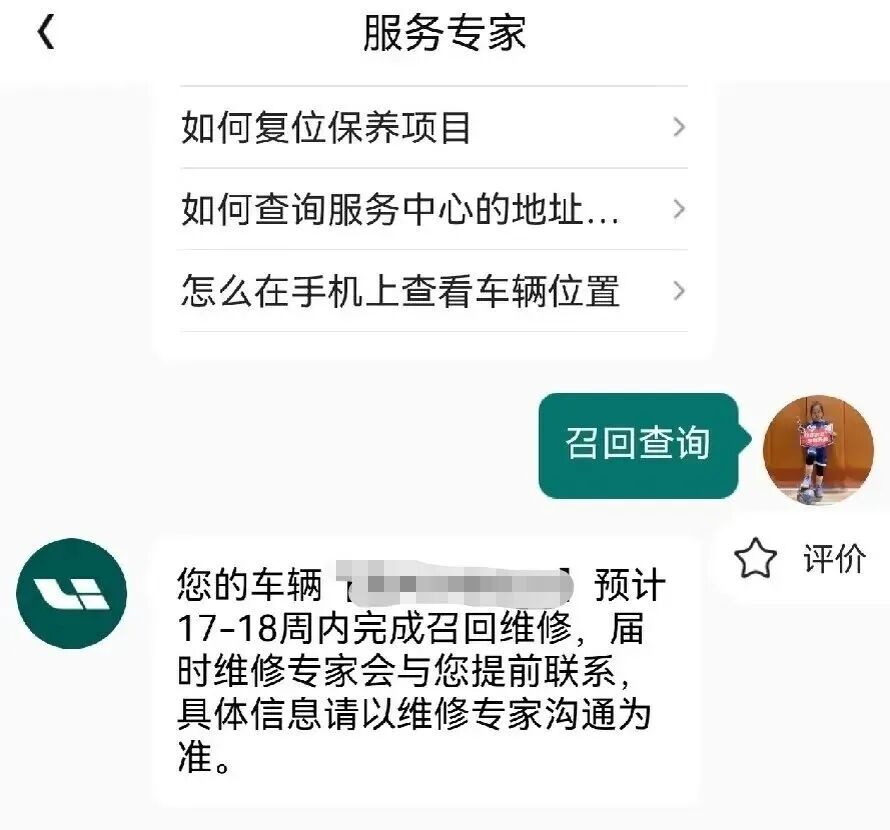
Li Kang's workplace is far from home, and public transportation is inconvenient. This car is his only choice for daily commuting. Checking the coolant has become a must - do action before driving every day.
The customer service told Li Kang that during the waiting period for the recall, the cloud would monitor the battery status at any time. If any abnormalities occurred before the recall, they would notify him immediately via phone, text message, or the vehicle's infotainment system to recall and repair the vehicle and arrange for a tow truck to take it to the nearest repair center.
Fang Li, a lawyer from Shanghai Duan & Duan (Hongqiao International Central Business District) Law Firm, once told the reporter that according to the "Regulations on the Recall of Defective Automobile Products", after an automobile product is confirmed to have a defect, the reasonable transportation costs incurred when transporting the vehicle to the repair location should be borne by the car company, but it is not a direct economic compensation.
The new standard may alleviate the "anxiety" about battery safety
According to statistics from the State Administration for Market Regulation, in the first half of the year alone, there were 25 recalls of pure - electric vehicles, a year - on - year increase of 8.7%; and 25 recalls of hybrid vehicles, a year - on - year increase of 47.06%.
With the recalls by multiple car companies, potential defects in various aspects of new energy vehicles have been gradually exposed, among which battery safety has attracted particular attention.
Xi Ming, a senior engineer at the Defective Product Recall Technical Center of the State Administration for Market Regulation, said at the Third Power Battery Quality and Safety Conference that through technical analysis of defective new energy vehicle products, it was found that defects in the "three - electric system" (electric drive, power battery, and electronic control system) accounted for 35% of the reasons for new energy vehicle recalls. Among them, defects in the power battery system accounted for as high as 82.7%, while defects in the electronic control system and electric drive system accounted for 13.5% and 3.8% respectively. In addition, thermal runaway defects in power batteries accounted for 10% of the total number of new energy vehicle recalls.
"The reason given for BYD's recall this time is a problem with battery pack consistency. The core of it is the voltage inconsistency between the battery cells and the battery pack." An industry insider in the battery industry explained to a reporter from "IT Times". The matching degree of all battery cells or modules that make up the battery pack in key parameters such as voltage, capacity, and charge - discharge efficiency is what is commonly referred to as the "synchronization of performance" of the battery cells.
A problem with battery pack consistency will lead to a sharp reduction in the vehicle's range and a significant decrease in the battery's lifespan. In extreme cases, the battery cells may be over - charged, causing the battery to bulge or even catch fire.
Some car owners said that the Qin PLUS DM - i they bought in 2023 had only been driven for a little over a year. The official marked pure - electric range was 55 kilometers, but in reality, the battery was empty after driving more than 20 kilometers.
The self - ignition of power batteries involves complex factors such as battery cells, components, and system management. Component short - circuits may be the main reason. If various components short - circuit due to factors such as processing technology defects or long - term vibration, a large amount of heat will be generated instantly, leading to thermal runaway. Especially when the vehicle is in motion, if the insulation parts fall off, it is very easy for components with different potentials to come into direct contact, forming a short - circuit loop.
"The solution is not difficult. By 'equalizing' all the battery cell voltages to the standard value and replacing the battery cells with poor performance, the problem can be solved." The industry insider said. This requires car companies to strengthen the monitoring of the battery cell status by the BMS (Battery Management System).
In July 2026, the new national standard "Safety Requirements for Power Batteries for Electric Vehicles" in China will be officially implemented. Compared with the previous standard, the core change in the new national standard is a significant increase in the safety threshold: the original standard only required the battery system to provide a 5 - minute escape time after an alarm was issued for thermal runaway, while the new rule clearly requires the battery system to be "fire - proof and explosion - proof".
In addition, the new national standard also adds new items such as a bottom impact safety test and a short - circuit safety test after 300 fast - charging cycles. These new assessments mainly target the consistency and long - term use safety of the battery system. Models that fail to pass will not be allowed to be sold on the market.
Photos / IT Times & Qianwen AI
This article is from the WeChat official account "IT Times" (ID: vittimes), author: Shen Yibin. Republished by 36Kr with authorization.