JIA Zhifeng, Chief Technology Officer of Yixin: Agentic Capability Enables Global Intelligence in the Auto Finance Industry | WISE2025 King of Business
From November 27th to 28th, the 36Kr WISE 2025 King of Business Conference, known as the "annual technology and business trendsetter", was held at the Conduction Space in the 798 Art Zone in Beijing.
This year's WISE is no longer a traditional industry summit but an immersive experience centered around "technology hit drama short plays". From AI reshaping the boundaries of hardware to embodied intelligence opening the door to the real world; from the globalization of brands in the wave of going overseas to traditional industries equipping with "cyber prosthetics" - what we restore is not only trends but also the insights honed through numerous business practices.
In the following content, we will dissect the real logic behind these "hit dramas" frame by frame and explore the unique business landscape of 2025 together.
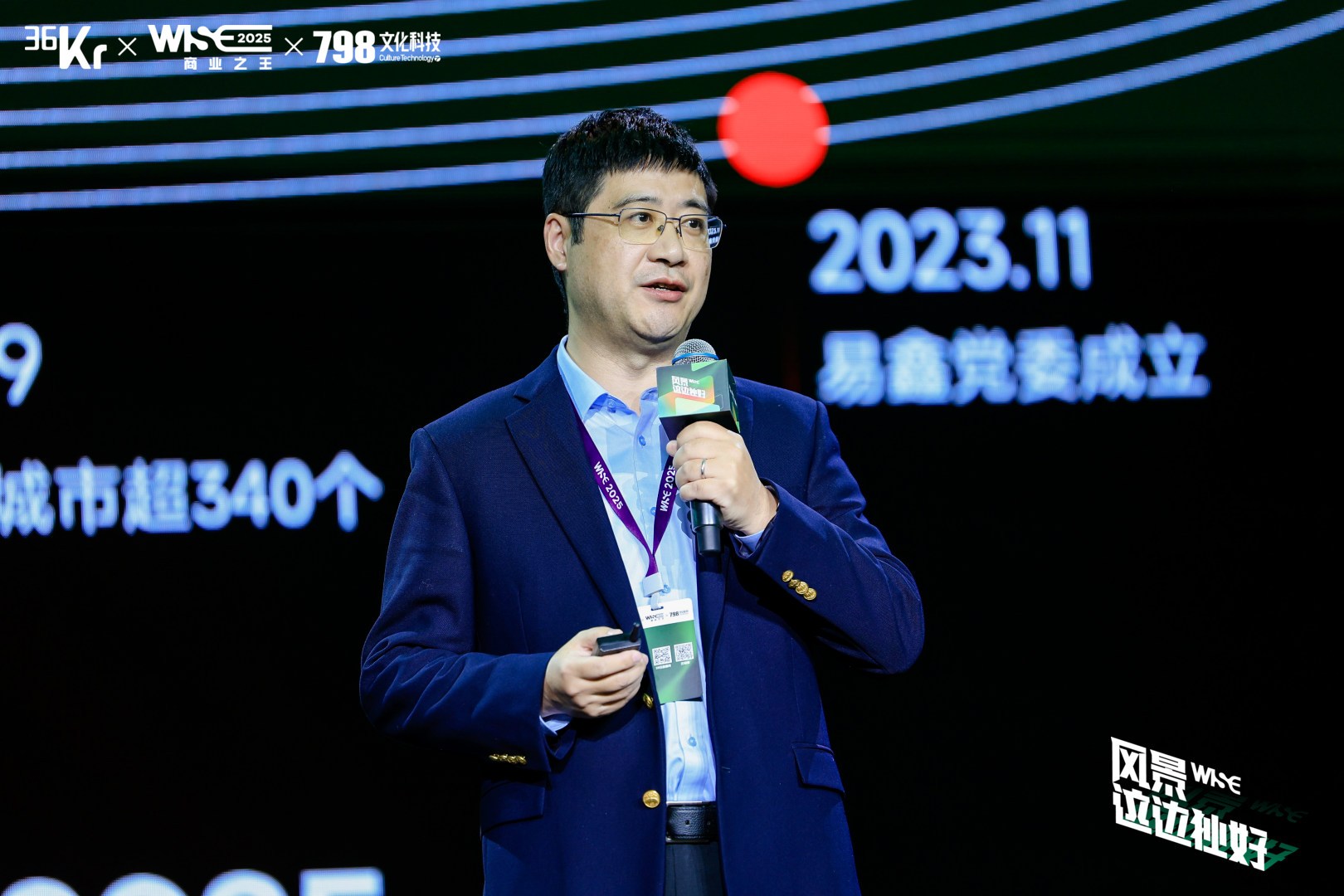
Jia Zhifeng, Chief Technology Officer of Yixin
The following is the transcript of the speech by Mr. Jia Zhifeng, Chief Technology Officer of Yixin, edited by 36Kr:
Jia Zhifeng: Hello, everyone! I'm Jia Zhifeng from Yixin. I'm very glad to be here to share with you Yixin's AI applications in the financial industry.
Yixin is a fintech platform in the auto finance industry. We serve over 40,000 new and used car dealers across the country and more than 100 financial institutions. Our annual transaction volume has reached 70 billion RMB, and we have over 5,000 employees globally.
The company was founded in August 2014 and became the first auto finance fintech platform in China to be listed on the Hong Kong Stock Exchange in November 2017. By October 2018, our cumulative auto financing transaction volume exceeded 1 million units. In September this year, our transaction volume exceeded 5 million units.
Currently, we can be regarded as the largest auto finance fintech platform in China and even globally.
Since its establishment, Yixin has always attached great importance to the role of technology and R & D in its business.
As of now, we have invested a cumulative R & D cost of 2 billion RMB, and we have over 400 R & D employees globally, more than 80% of whom come from leading internet companies, auto companies, and technology companies.
In terms of AI, we have done the following things:
First, we became the first company in the industry to pass the national large - model filing last year.
Second, in April this year, we simultaneously open - sourced the first vertical base model in the auto finance industry, which is a 72B large model.
Third, at the World Internet Conference Wuzhen Summit in early November, we were the first to release and apply the first Agentic large model in the auto finance industry. In addition, after strict evaluations by multiple rounds of professional judges, Yixin won the only first prize in the open - source model track of the "Direct Access to Wuzhen" Global Internet Contest.
Next, I'll focus on some of our practices and insights in the AI field.
First, we believe that intelligence is still the main line of this technological wave. We can see that the development trend of AI intelligence basically evolves from discriminative AI 1.0 to generative AI 2.0. In the 1.0 stage, we used discriminative AI capabilities to build our risk control models. In the 2.0 stage, we use AI capabilities to generate copywriting, videos, and voices for marketing and communication with customers. Currently, starting this year, we have witnessed the initial application and practice of agent - type AI in the industry.
We have found that the financial industry has the following characteristics. A large amount of data generated in the business process exists within enterprises due to reasons such as compliance and personal privacy protection.
This has led to a phenomenon - the base large models in the market, with a large amount of corpora, often have strong general capabilities. However, when entering vertical fields, especially the financial field, due to the lack of specific public - domain financial industry data, their capabilities in this regard are often relatively weak.
Based on this observation, we believe that if we want to apply this new large - model technology in the auto finance industry, we need to build full - stack AI capabilities within the enterprise.
What does it include?
It includes building our own training and inference clusters from the bottom up, and training proprietary industry models based on a large amount of private data from the enterprise and the industry according to the characteristics of this industry to form our own model matrix.
It also includes, at the model governance level, having a series of platform - level products that enable new models to quickly undergo small - traffic testing and AB verification, and be put into real business scenarios under controllable risks, generate benchmarks, and then feed back to model training to achieve rapid model iteration.
Moreover, at the application layer, we need to seamlessly and effectively combine the capabilities of the model and human capabilities. By using the copilot + human - in - the - loop approach, we can deeply integrate humans and AI to provide users with a complete and reliable service.
These are all the full - stack capabilities we have realized need to be built in the financial industry - from computing power to the application layer, a series of infrastructures such as model training, model management, model governance, and human - computer interaction are required.
So, since 2020, we have been following the AI wave step by step to build platform - level capabilities, including the training and launch platforms for risk control models and the Chatbot platform for robots. We have gradually improved intelligence and achieved integration in management and processes.
Over the past few years, we have gradually formed a model matrix in the auto finance industry, which includes a 70B and a 420B MOE base model at the bottom. On the basis of these two base models, we have further trained multiple models of different sizes, called Domain - Specific Models. In different scenarios, we select the balance of different sizes and capabilities to enable them to be flexibly, large - scale, and low - cost applied in real business scenarios.
We also have some multimodal models, including semantic models, which are the basis for our Voice Agents, models for text - to - image and text - to - video generation, and models for marketing. We have conducted a lot of exploration and practice in the multimodal field.
At the beginning of this year, we open - sourced our first Reasoning Model, which is a 72B model and leads the industry in mastering professional knowledge in the financial field. By November, we were the first to release our own Agentic model at the Wuzhen Conference.
We believe that this model matrix will also evolve continuously with the continuous evolution of intelligence. That is to say, this model matrix should be dynamic and should continuously evolve and develop with business requirements and technological progress.
Speaking of Agentic, as many people in the industry believe that this year may be the first year of Agentic, there is much talk about general agents. In the auto finance industry, we have also carried out corresponding implementation and practice of single - point intelligence. Here are some of our insights and experiences to share with you:
First, before Agentic, all these improvements in intelligence were more considered as single - point intelligence. Whether in intelligent calls, intelligent face - to - face audits, or intelligent customer service, it was to improve intelligence, increase AI coverage, and enhance business efficiency and effectiveness at a certain business process point.
This model has been applicable in the past few years. Especially in the auto finance industry, often referred to as the "credit factory", from the initial customer reach, to credit review, to the final loan disbursement, and post - loan management, we have divided the very long chain of the financial industry into different links, and used AI to enhance capabilities at each link.
This was the paradigm we usually used before Agentic. After the emergence of Agentic capabilities, we found that there may be another greater opportunity, which is to make the whole system smarter.
Why is this a relatively large opportunity? There are three reasons:
First, full - modal perception. In the original financial process, more structured data in the form of forms was used to transmit information. However, with the recognition capabilities of multimodal AI, the auto finance industry can for the first time incorporate multimodal information into decision - making. For example, our emotional information, whether we are lying, may be more determined by our emotions.
You've seen lie detectors in many movies. How you answer questions is more important, your emotions are more important, and your answers are actually not that important. This kind of multimodal information and perception can be applied in decision - making in a digital way for the first time. This is multimodality.
Second, full - process collaboration. After connecting this information, at each link, we can make decisions using full - process data. If I'm a risk control credit reviewer, I can fully know what the customer said and what their emotions were in the previous sales interaction, which is more conducive to my judgment in the risk control link. That is to say, the full - process data is interconnected and fully perceptible, which is full - process collaboration.
Third, global scheduling. Agentic has global scheduling capabilities, which can organically integrate tasks that originally required multiple steps and multiple job types into one link.
For example, as a salesperson, when collecting customer information in the past, they could only do information collection. Now, as an AI agent, they can interact with customers, perceive their emotions in real - time, sense whether their information needs to be supplemented, and know whether to ask some special questions in the risk control link. They can communicate with customers in one interaction and enable customers to receive corresponding services in a shorter time.
Because Agentic has full - modal perception, full - process collaboration, and global decision - making capabilities, I believe that if driven by Agentic AI, the auto finance industry, or the financial industry, will see a new paradigm that surpasses the past "credit factory" model. We are very glad to have the opportunity to use it in our business.
Since Q4, we have implemented the models we trained in business scenarios. Here is an example. When a lead enters the process, our Agentic brain can drive these three agents, mobilize a series of interactive and judgment tools, and complete in one process what originally took two to three processes to handle.
Finally, we all know that the financial industry has a characteristic. When using capabilities, everyone hopes to keep data within their own enterprises. However, due to various compliance requirements and risk control measures mentioned above, many partners want to use our capabilities but cannot directly call the tool APIs. So, on this occasion today, we officially open - source our Agentic large model.
Its parameters are as follows: It is a relatively small - sized 14B model based on Qianwen 3, characterized by very low latency and high single - card performance. It has been strengthened with a proprietary dataset of nearly 100,000 tokens. Compared with models of the same size, we basically lead in various benchmarks, and are far ahead in the financial industry benchmarks.
It is small in size and good in performance, making it easy for everyone to deploy on their own servers at a relatively low cost for large - scale application.
Moreover, we have carried out some vertical training for the financial industry. For example, there are many instructions in the financial industry, such as product instructions and SOP instructions, which are expressed in relatively complex text. When this text is input into other large models, we find that they often have hallucinations in understanding them because they do not handle the logical relationships as well as our self - trained model.
In addition, the model may be the core of the problem, but it is definitely not the whole. In addition to having an excellent brain, the Agentic model also needs corresponding tools, corresponding hands and feet. So, we also provide a series of tools related to the financial industry.
During the training process, we also used some relatively innovative methods, including No Answer Distillation Training. It means that during the training process, the model needs to clearly know when it should answer NO instead of improvising.
We also adopted the On - Policy knowledge distillation method based on process supervision. The idea is that we hope it can not only get the results right but also get the process right because the process is also very important. We don't want it to guess randomly or get the result through a strange process. So, we have strengthened some key SOPs and key processes.
Third, we have achieved multi - stage efficiency to ensure that the efficiency and convergence of the model are stable and reliable, and at the same time, it can also make its own exploration and play.
Finally, I'd like to share that as of this year, we have open - sourced two models. We welcome all partners in the industry to use them more and give us valuable suggestions and comments.
Since 2023, Yixin has started globalization and has businesses in Singapore, Malaysia, Japan, etc. So, next, we will also adapt all the model capabilities mentioned above locally in each country, using local laws and regulations, local toolkits, and local risk control interaction data for localizing these models. We very much look forward to more international partners contacting us next year to make this open - source community more prosperous and contribute more to the auto industry.
Thank you all!