Having once jointly "captured" the middle-class consumer group, how have HOKA and On Running ended up running on increasingly different tracks?
In the past two years, HOKA and On Running have been two almost unavoidable names in the sneaker cabinets of China's middle class.
One rose to fame with its thick cushioning midsoles, while the other gained popularity for its highly recognizable hollow-out CloudTec sole. These two types of running shoes, which often cost over 1,000 yuan a pair, have gradually evolved from professional running gear into choices for commuting, travel and even daily outfits for many people.
But the brands that once grew in tandem have now started to move at completely different paces.
On October 22, HOKA's parent company Deckers released its latest financial report. HOKA's sales from July to September this year increased by 6.8% year-on-year, a significant slowdown from the previous growth rate of over 20%. On the other side, On Running's sales from April to June this year increased by 13.5% year-on-year, and the growth rate in the Asia-Pacific market even reached 43.1%.
Beyond the figures, the recent moves of the two brands are also worth attention and reflection: in the Chinese market, HOKA continues to consolidate its professional sports image through running events and runner communities; On Running, while accelerating its layout in core business districts, is extending its business to more sports fields. In September this year, On Running even signed football superstar Kylian Mbappé, officially announcing its entry into the football market.
However, this new layout of On Running soon encountered a test. In late October, Mbappé sparked controversy due to inappropriate remarks related to China. On Running removed relevant promotional content from Chinese social platforms, but did not make it clear whether it would continue the cooperation. For On Running, which is accelerating the expansion of sports categories and attaches great importance to the Chinese market, how to balance its global business layout and the trust of Chinese consumers has become a new problem.
Once, they both became the new favorites of China's middle class with a pair of running shoes; now, when thousand-yuan running shoes are no longer rare, the two brands are starting to look for the next group of consumers in different ways, and the challenges they need to face are becoming more and more specific.
01 From the running track to the shopping mall, both brands of running shoes are starting to look for new customers
In September this year, more than 2,000 runners gathered at Mount Emei in Sichuan. This is the 4th HOKA Fly Run Carnival, and it is also the first time that the event has come to Southwest China. Runners can choose 12km or 24km cross-country tracks, including senior players who pursue performance and novices who try cross-country running for the first time.
A few months ago in Shenzhen, On Running did another thing. In March, On Running opened its largest flagship store in China at MixC World in Shenzhen, with an area of 802 square meters. In addition to running shoes, the store also displays products of different categories such as tennis, cross-training, outdoor and sports lifestyle.
One brings consumers into the mountains and wilds, while the other displays a richer and richer range of sports goods in core business districts. Neither of the two brands has left the running track, but they have started to expand their consumer groups in different ways.
But at the beginning of the story, HOKA and On Running actually had quite similar starting points in the Chinese market.
In 2017, HOKA officially entered China, and a year later, On Running also began to layout the Chinese market. Both started with professional running shoes, with their main shoe models priced at around 1,000 yuan, and established distinct product recognition with thick cushioning midsoles and CloudTec hollow-out soles respectively.
What really made these two brands, which originally belonged to the professional running circle, gradually enter the vision of the wider public, is actually the pursuit of the middle class.
On the one hand, as running, fitness and outdoor sports are gradually integrated into the lives of urban consumers, people are willing to invest more budget for professional performance and comfortable experience. On the other hand, compared with Nike and Adidas, which have long gone deep into the mass market, HOKA and On Running at that time were still relatively niche. The professional sports background, unique appearance design, plus the price positioning of around 1,000 yuan, also gave them attractiveness different from traditional sports brands.
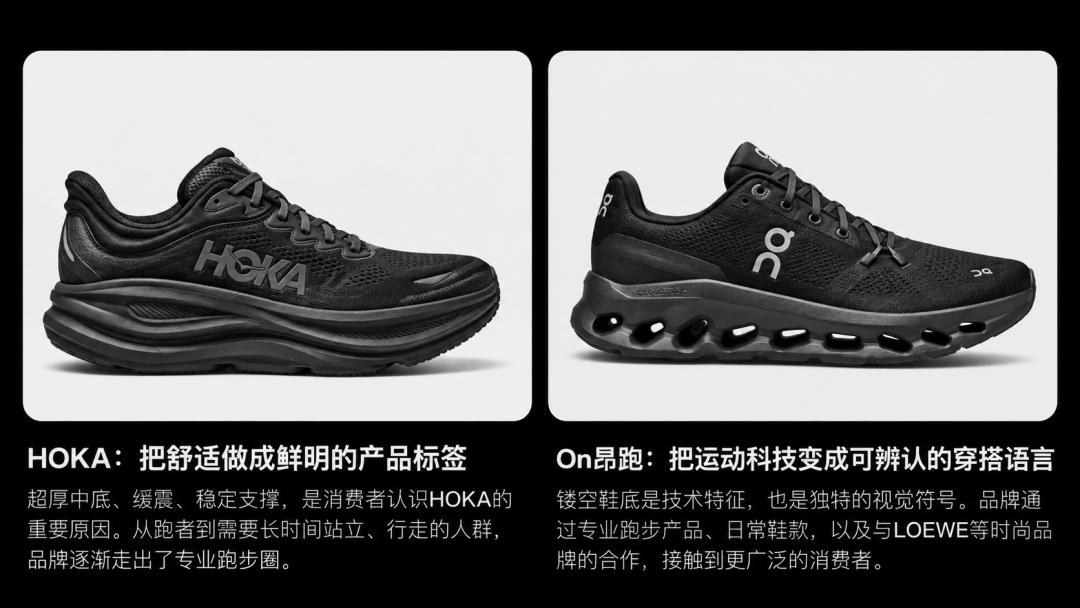
The paths to break out of the niche circle are similar, but each has its own characteristics.
HOKA first accumulated reputation through cross-country running and long-distance running. In 2018, its co-branded shoe model with the fashion brand Engineered Garments entered the vision of the fashion circle, and then it continued to use celebrity outfits and co-branding cooperation to make professional running shoes appear in more daily scenarios.
On Running, with its highly recognizable sole design and cooperation with tennis star Roger Federer, fashion brand LOEWE and other parties, continues to strengthen the connection between professional sports and fashion outfits.
As a result, these two pairs of running shoes originally designed for professional sports began to appear frequently in office buildings, shopping malls and on travel trips. For many users, wearing HOKA or On Running can not only meet the actual sports and walking needs, but also fit their pursuit of health, comfort and dressing style.
02 HOKA's next pair of shoes, On Running's next playing field
But after breaking out of the niche circle, for consumers who already own a pair of HOKA or On Running shoes, what reason do they need to buy another pair of shoes from them? This seemingly simple question is actually becoming a test for the next stage of growth of the two brands.
On October 22, HOKA's parent company Deckers announced its latest quarterly results. HOKA's sales reached 677 million US dollars, a year-on-year increase of 6.8%. Although it still maintains growth, the slowdown is quite obvious compared with the previous growth rate of more than 20%.
What deserves more attention than the figures is the management's reflection on products at the financial report conference call.
Deckers admitted that the updates of some of HOKA's shoe series this year did not get the feedback expected by consumers and retail partners. Among them, the performance of products such as Transport, Kawana and Solimar was lower than expected, while core series such as Bondi still maintained good sales performance.
For a brand that made its name with professional running shoes, this may be more worthy of attention than the growth slowdown in a single quarter.
In the past, HOKA relied on thick cushioning midsoles and comfortable experience to make consumers willing to pay thousands of yuan for a pair of running shoes. But when these designs are widely known, and more and more products emphasizing cushioning, support and comfort appear on the market, consumers' requirements for new products will naturally increase.
When buying HOKA for the first time, consumers may value its distinctive wearing experience; but for the second and third pairs, they need to see sufficiently specific improvements to have a reason to buy again.
HOKA is obviously aware of this. According to the plan disclosed by the brand, new generation running shoes such as Bondi 10 and Mach Pro will be launched one after another in 2027, and lifestyle products will be further enriched, including the retro shoe model Cielo 70, as well as updates on materials and colorways of classic series.
What is more noteworthy is that HOKA is also preparing to widen the price gradient of its products. On the one hand, it will launch Fly Pace priced at 115 US dollars to attract more consumers who are new to the brand; on the other hand, it plans to use Bondi Ultra X priced at 325 US dollars to continue to explore the high-end cushioning running shoe market. This means that HOKA not only hopes to make more people afford and willing to try its products, but also continue to provide upgraded choices for consumers who pursue professional performance.
In addition, in April this year, HOKA launched the SPEEDGOAT 7 cross-country running shoe around the UTMB event in Mogan Mountain, and organized activities such as training camps and runner stations. At the Mount Emei Fly Run Carnival in September, the brand specially set up a 12km track suitable for first-time cross-country runners. Obviously, HOKA is also trying to get more consumers to actually participate in running, and establish continuous connection with the brand in the process from entry to advanced level.
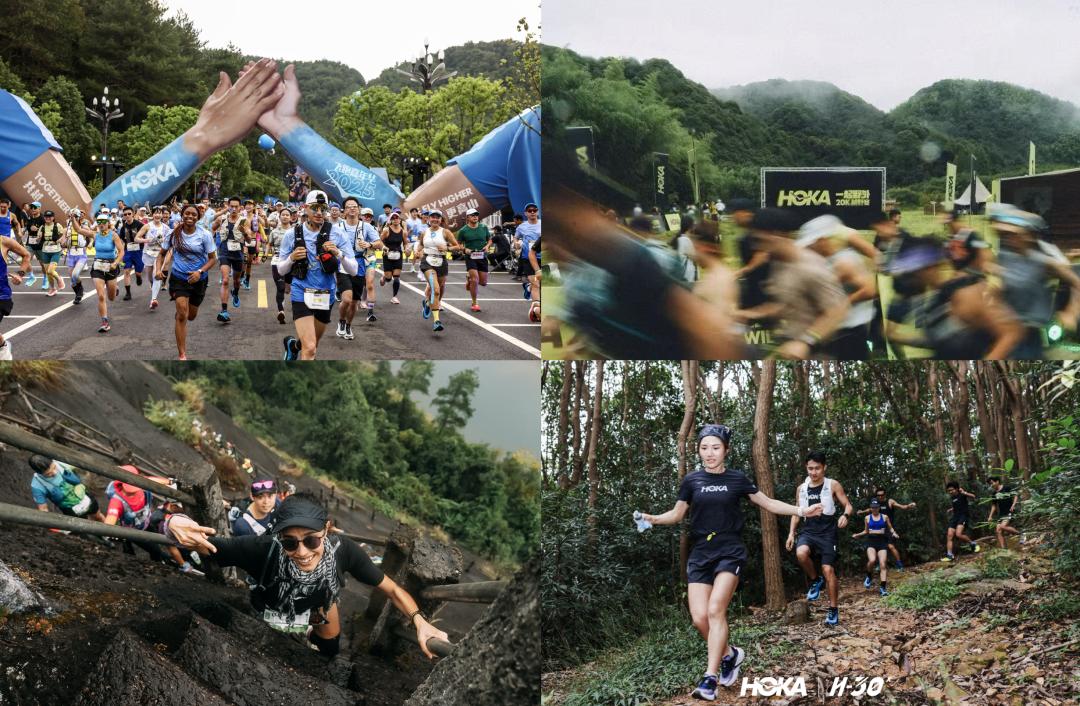
For On Running, it is answering a similar question, but running in a different direction.
In the second quarter of this year, On Running's global sales reached 850 million Swiss francs, a year-on-year increase of 13.5%, and a 21.6% increase at constant exchange rates. Among them, the Asia-Pacific market grew by 43.1% year-on-year, continuing to be one of its faster growing regions. At the same time, On Running's apparel business increased by 47.7% year-on-year, direct-to-consumer channels grew by 26%, and direct sales accounted for 45.7% of total sales.
These figures to a certain extent explain why On Running is keen to open large flagship stores and continuously enrich products beyond running shoes. As of March this year, On Running has entered more than 30 cities in China, with more than 80 stores, and plans to increase the number of stores to 100 by the end of 2026.
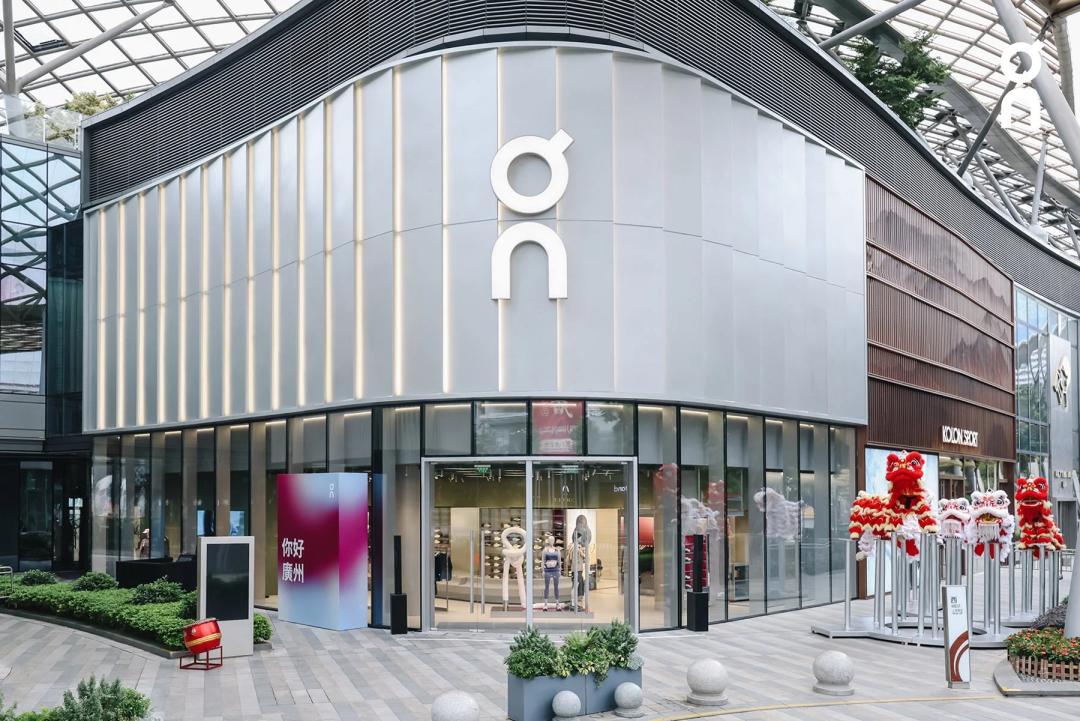
For a mid-to-high end sports brand, the significance of direct-operated stores is not just an additional sales channel. Through the stores, the brand can more completely display its products, sports culture and dressing styles, and reduce the dependence of product experience and price system on external retailers.
What On Running wants is obviously not just to let consumers take away a pair of running shoes, but to let them continue to choose the brand beyond running shoes.
In September, On Running announced the signing of French football superstar Kylian Mbappé to officially enter the football field, and invited former French international Thierry Henry to serve as the head of its football business. From entering the tennis field through cooperation with Federer to now laying out the football field with Mbappé, On Running is trying to extend the technology and brand awareness originally established in the running field to more sports events.
In response to the recent controversy, On Running Asia-Pacific responded that the athlete's remarks represent his personal views, the brand is glad to see Mbappé make an apology, and said that it respects the Chinese people and China's rich cultural heritage. However, On Running did not give a clear answer as to whether it will continue the cooperation.
But this does make On Running face a more complex situation in the Chinese market. On the one hand, Mbappé is not only a brand ambassador, but will also participate in the development and testing of football products, and is an important partner for it to enter the football field; on the other hand, the Chinese market is an important growth driver for On Running in recent years. How to take into account the global business layout and the trust of Chinese consumers has become a new test question in the process of brand expansion.
Judging from the actual business structure, On Running's cross-category expansion is still in the early stage. Although the apparel business is growing rapidly, in the second quarter of this year, its footwear revenue still reached 782 million Swiss francs, accounting for more than 90% of total sales. Therefore, moving from running shoes to more sports categories currently mostly reflects On Running's future growth direction, rather than a completed transformation.
Putting the two brands together, you can find an interesting difference. HOKA is covering more demands for its running shoe business by upgrading classic shoe models, enriching price gradients, and developing lifestyle products; On Running is trying to extend professional sports technology to other playing fields, and expand consumers' purchase scope through apparel and direct-to-consumer channels.
HOKA wants to convince consumers that the next pair of running shoes is still worth buying; On Running wants to convince consumers that besides running shoes, it has more things worth buying.
The Chinese market has precisely become a key position to observe these two paths.
In the past few years, both brands have become thousand-yuan running shoes familiar to the urban middle class by virtue of their professional background and unique design. Now, as their popularity in China continues to increase, consumers' choices will also be more specific: whether a pair of shoes is really more suitable for running, whether a sports suit is worth the price, and whether a newly entered sports category can provide sufficiently professional products.
Although the sales data of the two brands in the Chinese market currently disclosed is not sufficient, the growth rate gap in the global financial report cannot be directly equated to the competition result in the Chinese market. But what is certain is that when brands no longer only rely on a distinctive running shoe design to attract consumers, how to continuously provide new purchase reasons has become a problem that both HOKA and On Running need to face.
03 Conclusion
Moving from the professional running circle to the daily shoe cabinets of middle-class consumers, both HOKA and On Running have proved that a pair of running shoes with distinct characteristics can help a new brand stand out in the mature sports market.
But when more and more people get to know them, the once niche advantage also begins to face new tests.
HOKA chooses to continue polishing its running shoe business, while On Running sets its sights on the broader sports market. Neither of the two paths is necessarily more clever, and it is not yet time to decide the winner.
After all, what is more difficult than making the middle class willing to spend thousands of yuan to try a new brand is that they are still willing to pay for it when the sense of freshness fades away.
This article is from the WeChat official account "New Consumption Daily" (ID: ibrandi), the author is Global Brand Empowerment, and 36Kr publishes this article with authorization.