Food delivery platforms are starting to think that a cup of coffee is too cheap.
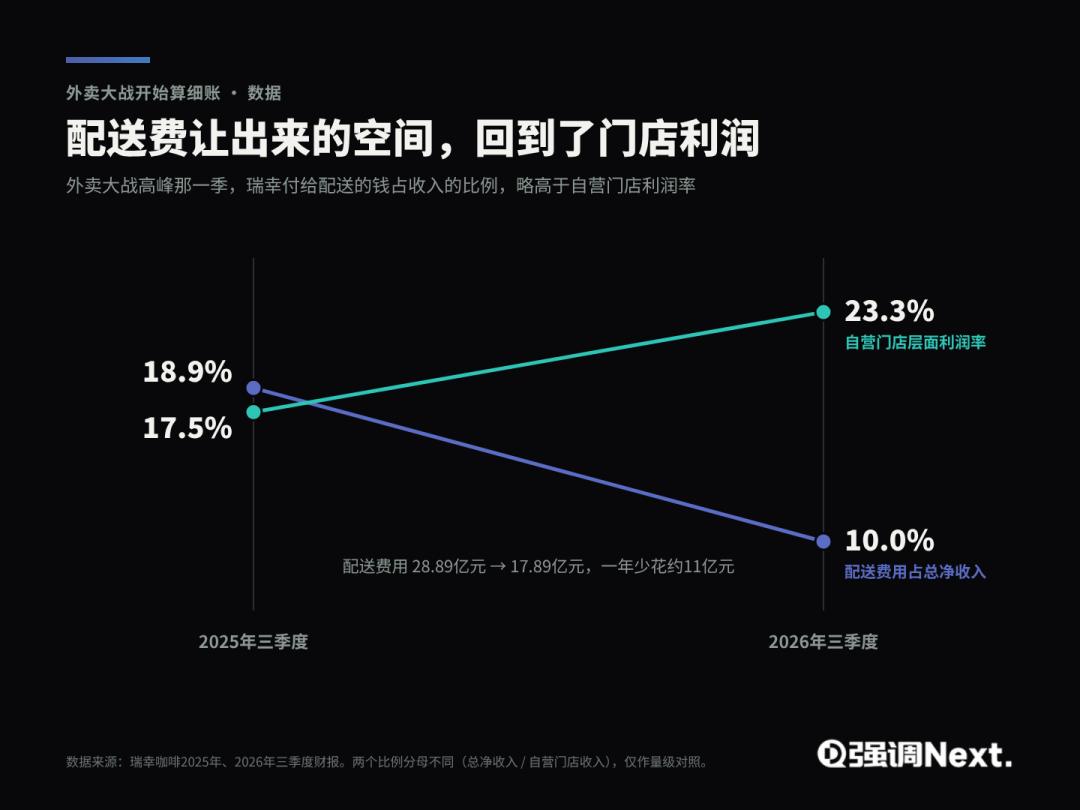
In the Q3 financial report released by Luckin Coffee on November 3, one line item of delivery fee best illustrates the changes that have taken place in the food delivery industry this year. Luckin's delivery fee in the third quarter was 1.789 billion yuan, compared with 2.889 billion yuan in the same period last year, and its proportion in total net revenue dropped from 18.9% to 10%.
The third quarter of last year saw the most intensive round of subsidies in the food delivery sector. Platforms distributed coupons, users placed orders, and a large volume of coffee was delivered to doorsteps by riders. This year, subsidies have been scaled back, and the order structure has shifted back toward in-store pickup. While same-store sales of Luckin's self-operated stores fell by 11.1%, the company's operating profit rose by 55.1%, and the operating margin at the self-operated store level rebounded from 17.5% to 23.3%. The management stated that the profitability of stores has basically returned to the level before the era of heavy food delivery subsidies.
A day later, Guo Qing, head of JD's local life business, left his post. He joined JD in January 2024, and has since witnessed the launch, expansion and transformation of JD's food delivery business. A person close to JD told the media that the follow-up business will pay more attention to supply chain innovation, refined operation and efficiency.
As the popularity of low-price orders fades, platforms have started to rearrange their kitchens, warehouses and delivery capacity. The new businesses launched by the three platforms in the past two to three months all revolve around similar issues: If the delivery cost per food delivery order cannot be reduced, the only way out is to maximize the value of each delivery trip.
Orders worth a dozen yuan cannot afford a dedicated single delivery trip
The same-store growth rate of Luckin over the past two years can almost be regarded as a trend chart of subsidy intensity. The four quarters of 2025 were 9.2%, 13.8%, 14.3% and 1.3% respectively, and the first three quarters of 2026 were -0.1%, -5.3% and -11.1%. Guo Jinyi explained on the earnings call that subsidies in the third quarter of last year drove up both the volume of delivered coffee cups and the unit price per cup. This year, as subsidies are withdrawn, the volume of delivered coffee cups has declined, and although in-store pickup has rebounded, it has not yet fully made up for the gap.

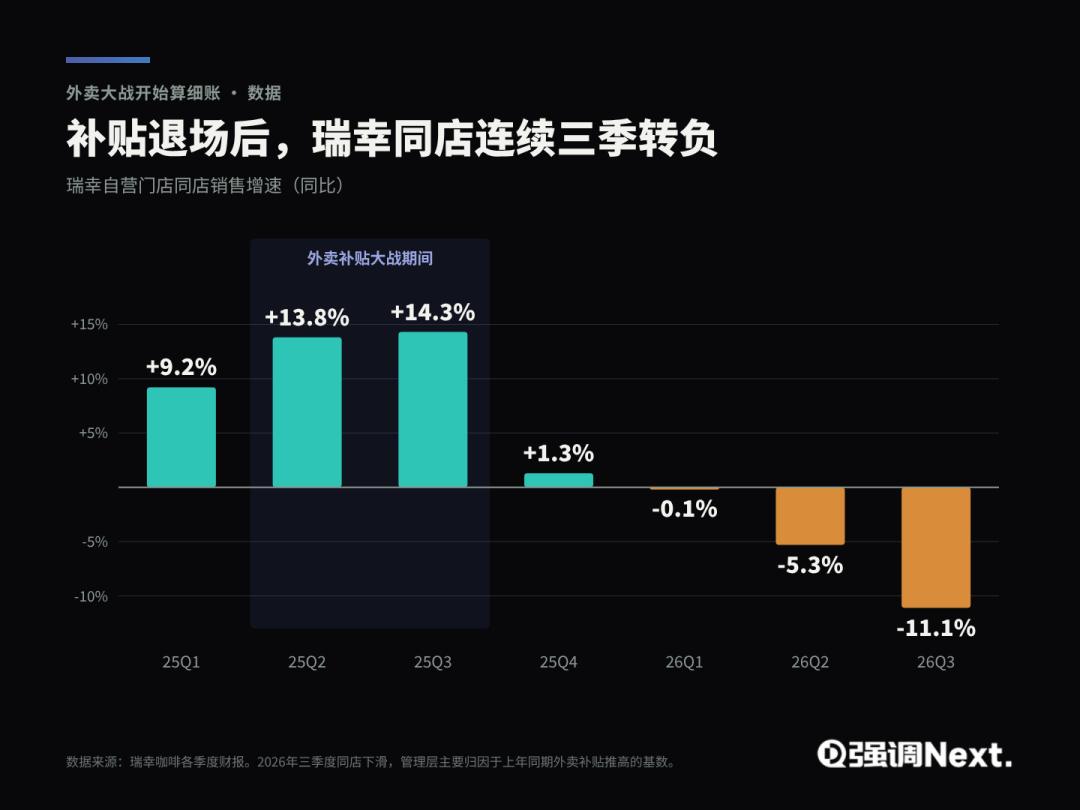
After the subsidies were withdrawn, the number of people drinking coffee did not decrease significantly, and more people chose to pick up their orders in stores. Many of the extra delivery orders last year would have been completed at the counter in the first place. The subsidies shifted these orders to riders, adding a delivery cost to each cup of coffee.
In the third quarter of last year, Luckin's delivery expenditure accounted for 18.9% of its revenue, slightly higher than the 17.5% profit margin of its self-operated stores. Although the denominators of these two figures are different, their magnitudes are roughly the same, which means that sending a dedicated rider to deliver a coffee worth a dozen yuan alone costs almost as much as the profit earned from that coffee in the store.

Brands that did not join the price war were also affected. Bawangchaji did not participate in short-term discounts last year, and part of its customer base was diverted by low-priced drinks on food delivery platforms. The average monthly GMV per store in Greater China in the fourth quarter of 2025 decreased by 25.5% year on year. The response of Guming was to attract customers back to physical stores, by launching 1-yuan iced water and 2.5-yuan lemonade that are only available for in-store consumption and not sold on food delivery platforms.
The peak daily order volumes announced by platforms last year kept hitting new highs. The financial reports of beverage companies are gradually revealing the truth: how many of these orders represent new consumption, and how many are just orders placed through a different channel.
The order structure disclosed by platforms has already changed. At the Meituan Food Delivery Industry Conference on October 22, Xue Bing, General Manager of Meituan Delivery, revealed that among the food delivery orders of catering merchants this year, the proportion of low-price orders below 15 yuan halved year on year, and the average actual payment per order rebounded in the first half of the year.
Some orders have returned to physical stores as in Luckin's case, while others have turned into higher-priced orders. For example, Micun Rice Bowl increased the portion of beef in its signature beef pot from 100g to 150g, and added more products in the 15-20 yuan price range. Its actual payment transaction volume on Meituan Delivery in August rose by 32.4% year on year.
According to forward-looking data reported by the media, Citi expects that the operating margin of Meituan's food delivery business in the third quarter will be around 1.1%, and the economic benefit per order is about 0.08 yuan. With profit margins this thin, the more orders worth a dozen yuan there are, the harder it is for platforms to make profits. Meanwhile, regulatory restrictions on long-term large-scale subsidies also prevent platforms from relying on coupon distribution to maintain such order volumes.
Therefore, to make the business profitable, platforms can only find solutions from their own fulfillment and supply side.
Density can only be created from the supply side, and platforms have to get involved directly
Creating density from the supply side generally has three approaches, which match the new businesses launched by the three platforms recently.
Gather stores together. At its food delivery conference, Meituan launched the "Super Kitchen" initiative, which integrates multiple food categories in one store to achieve a daily order volume of thousands of units, and plans to build the first 1,000 such Super Kitchens together with full-service catering brands. On October 16, JD opened the first 7FRESH Food MALL in Maliandao, Xicheng District, Beijing, where multiple food stalls prepare meals in the same space. Food delivery orders are automatically aggregated and combined via overhead hanging conveyor belts, and riders can pick up multiple orders at a dedicated pickup port at one time. The store aims to control the order pickup time within 10 minutes. Riders no longer need to wait for meals at different stores back and forth, and can carry orders from multiple stores in one trip, which naturally reduces the cost per order.
Place inventory closer to customers and increase the order size at the same time. By the end of July this year, Xiaoshi Supermarket has covered more than 100 cities, with a total of over 1,000 online and offline stores. Meituan also announced this year that it plans to acquire the China business of Dingdong Maicai for 717 million US dollars. According to reports, Xiaoshi has raised the free shipping threshold to 35 to 39 yuan in most cities, and opened a large store of about 4,500 square meters in Wanliu, Beijing, with plans to open 20 new large stores this year to develop integrated warehouse-store operations.
Allow orders to be scheduled in advance. Taobao Flash Purchase's Home Feast program started internal testing in Beijing in mid-October, with more than 50 stores of 27 brands across the country. Users need to place reservations one day in advance, and dedicated riders will deliver the food in constant temperature boxes. The 7FRESH Chef program released by JD on September 16 goes even further: AI generates meal plans based on users' physical examination reports and dietary preferences, full-time JD riders deliver pre-prepared fresh ingredients via cold chain as scheduled, and cooking robots at home are responsible for cooking the meals. Immediate orders are turned into planned orders, so riders' routes and schedules can be fully arranged in advance.

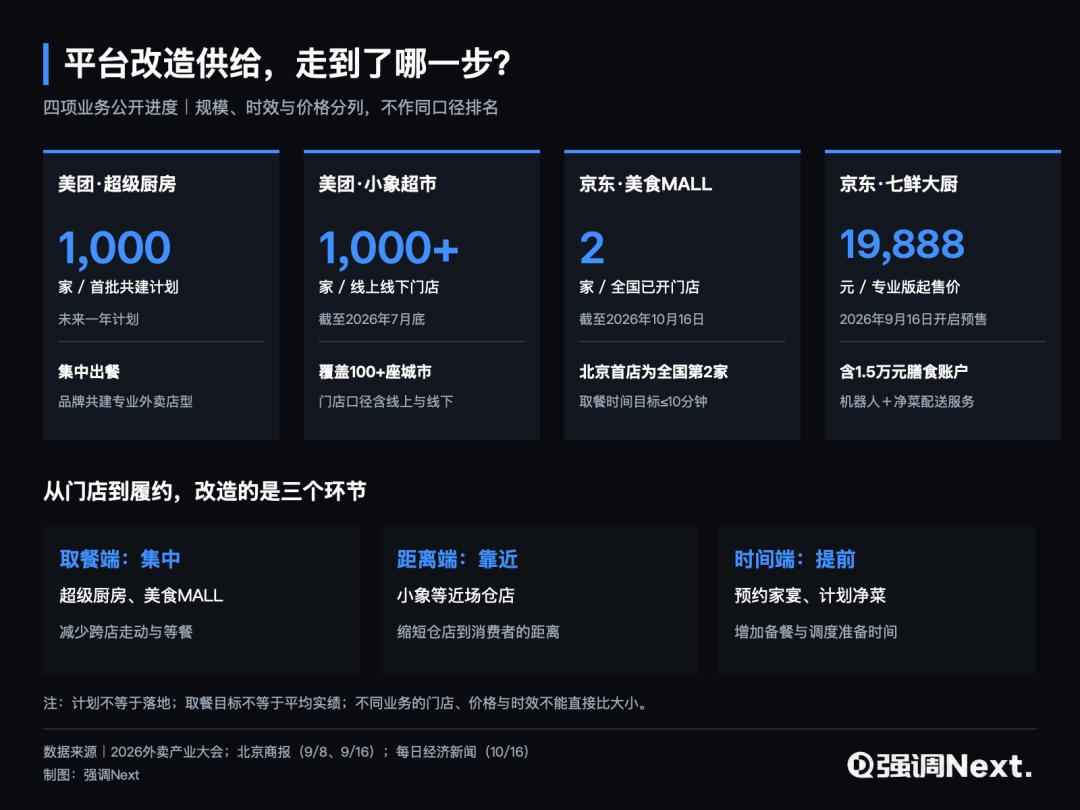
None of these three approaches can be achieved by individual merchants, and only platforms are capable of organizing such operations. Platforms need to step in to secure venues, define store formats, and arrange delivery capacity, shifting their role from transaction-matching intermediaries to supply organizers, and even operators.
There is another more practical reason: on open platforms, both merchants and delivery capacity are shared. Partner merchants of Taobao Convenience Store can accept orders from both Meituan and JD at the same time. JD merged its on-demand delivery riders into JD Logistics at the end of last year, and they have directly served third-party merchants since the beginning of this year. After the withdrawal of subsidies, the only remaining competitive edge that can differentiate platforms from each other is the exclusive supply that others cannot take away. Wang Xing also said at the earnings call that self-operated supply is becoming increasingly important in the instant delivery ecosystem.
Platforms are increasingly resembling retailers, and so are their profit margins
When supply is controlled in-house, the business model changes accordingly.
The traditional business of platforms is to charge commissions and advertising fees from merchants, featuring light assets and high gross margins, with most expansion spending going to subsidies and ground promotion. Operating Super Kitchens, front warehouses and Food MALLs earns operating income, which requires platforms to bear rent, inventory, spoilage and labor costs, so their profit margins will converge with those of the retail and catering industries.
Direct involvement in operations will also change the relationship between platforms and merchants. Platforms that open their own stores and sell their own products act as both referee and player within the same traffic entry. Alibaba has made its position very clear on this matter: Taobao Convenience Store has stated publicly that the platform will not build warehouses, open stores, or compete for profits with merchants, and that venues, inventory and daily operations will be undertaken by partner merchants. The Home Feast program is also built on top of existing high-end restaurants.
In this way, the positioning of the three platforms is clear. Meituan has the heaviest asset structure and the most controllable supply, but its profit margin will move toward the retail sector, with investments in Xiaoshi Supermarket, large-format stores and Super Kitchens all borne by itself. Alibaba has the lightest asset structure, with fast expansion and low burdens, but light assets mean that its supply is not exclusive: merchants can accept orders from Taobao Flash Purchase today, and accept orders from Meituan tomorrow. JD has also chosen the self-operated path, with 7FRESH Food MALL, 7FRESH Chef and 7FRESH Supermarket forming a connected ecosystem, but its market share in the food delivery sector is far smaller than the other two, so its self-built supply lacks sufficient demand to fill the capacity.
Meituan's management has set a long-term goal for Xiaoshi Supermarket to achieve a sustainable low single-digit profit margin. When a platform sets a supermarket-level profit target for its most valued self-operated supply, the profit ceiling of the food delivery and instant retail business is roughly at this level.
-END -
This article is from the WeChat official account "Emphasis Next" (ID: leo89203898), written by Yi Xiu, and published with authorization from 36Kr.