SLG accounts for nearly 50% of overseas revenue. After the decline of MMO, how will major game makers achieve transformation?
Over the past period, MMORPG has long been a critical revenue source for Chinese game developers. However, as this once mature genre begins to face growth pressure, whether game companies can build the next growth curve relying on new products, new markets and new technologies has become a new focus of observation across the industry.
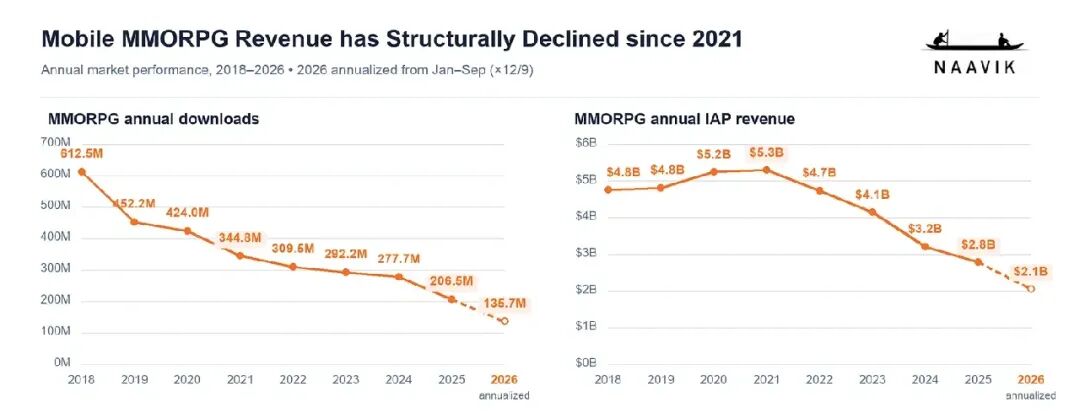
According to Naavik's analysis of the global mobile game market, from 2021 to 2025, in-app purchase revenue of global mobile MMORPGs dropped from 5.3 billion USD to 2.8 billion USD, shrinking by about 47% over four years; during the same period, downloads fell from 345 million to 206 million, a decline of about 40%. This does not mean that all MMORPGs have lost their market, but the overall contraction of the genre has indeed brought greater challenges to the growth model that relies on a small number of long-running hit products.
At the same time, SLG and mini-games are demonstrating different market opportunities — according to the *2025 China Game Industry Report*, among the top 100 self-developed Chinese mobile games by overseas revenue in 2025, strategy games accounted for 49.96% of total revenue; the domestic mini-program game market revenue reached 535.35 billion yuan, a year-on-year increase of 34.39%. While traditional dominant genres are under pressure, other tracks are still generating incremental revenue, and the business layout of game manufacturers has changed accordingly.
From this perspective, industry changes are not a simple replacement of one genre by another, but a differentiation of growth logic across different tracks. MMORPG still has value for long-running hit products and IP operation, but manufacturers can no longer pin all their growth on the same type of product. How to reuse existing R&D, distribution and commercialization capabilities while entering new genres and markets has become a question that leading enterprises need to answer.
01
The End of MMO Giants' Transformation: Mid-to-Light SLG?
Taking 37 Interactive Entertainment and Century Huatong as examples, the business layout of leading manufacturers is reflecting the path for China's game industry to find new growth curves. However, if we expand our vision from individual enterprises to the entire industry, we will find that manufacturers are not facing a simple multiple-choice question of genre selection, but a comprehensive test among product life cycle, market space and operation capabilities.
37 Interactive Entertainment: From Operation of Mature MMO Products to Parallel Layout of SLG and Mini-Games
In the past, MMORPG was undoubtedly an important label for 37 Interactive Entertainment. Up to now, MMORPG is still part of 37 Interactive Entertainment's product portfolio. In January 2026, the company's self-developed *Ragnarok: World Journey* was launched in Hong Kong, Macao and Taiwan regions of China, and once topped the free list and bestseller list of major local app stores. Classic IP can still provide user awareness and market foundation for new products, but IP value does not equal a guarantee of success: how to update gameplay while retaining the original emotional connection, adapt to user habits in different regions, and extend the life cycle through continuous operation is still the key to determining product performance.
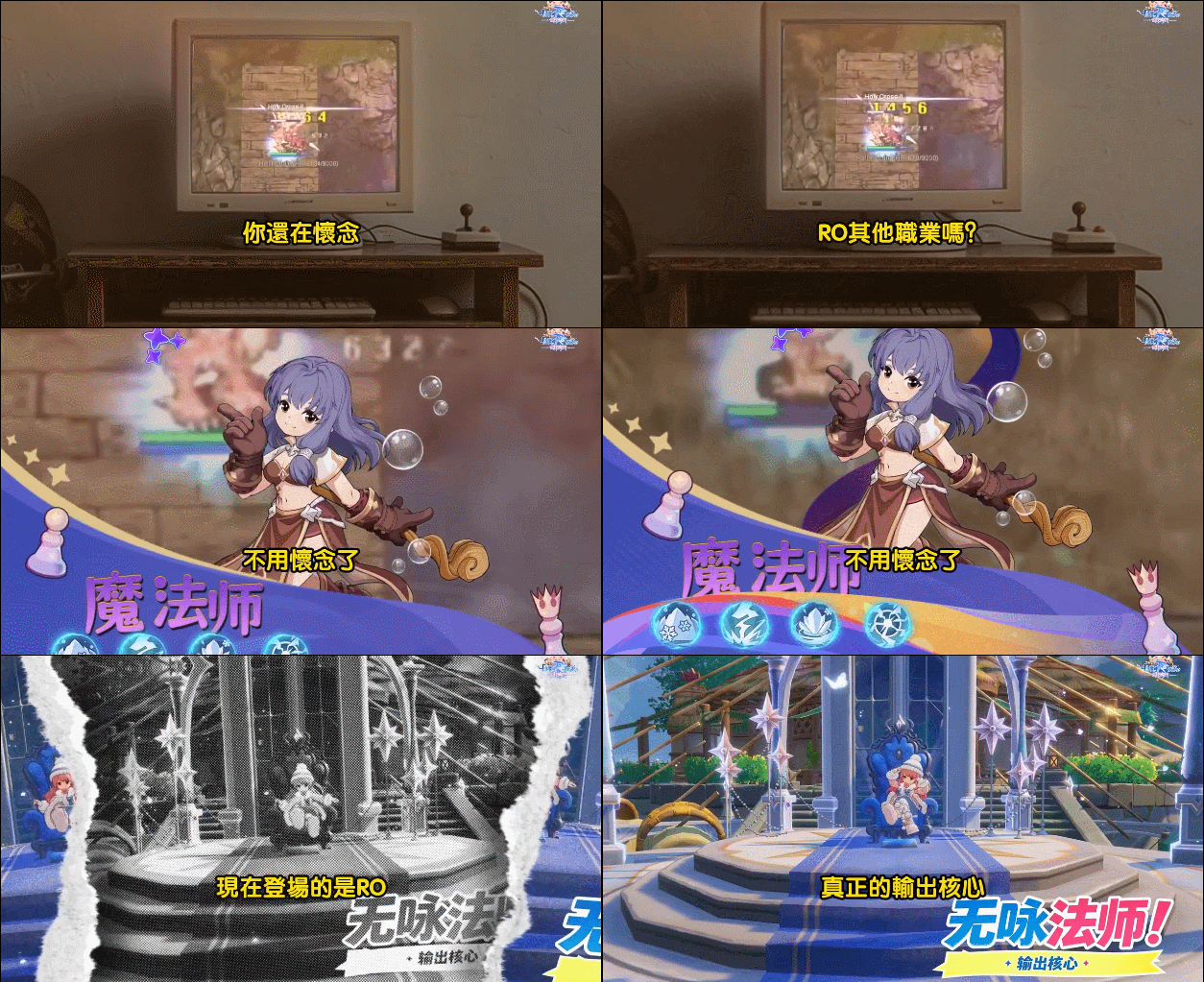
Creative display of promotion materials for *Ragnarok: World Journey* in the Hong Kong, Macao and Taiwan markets (from ADX Overseas Version)
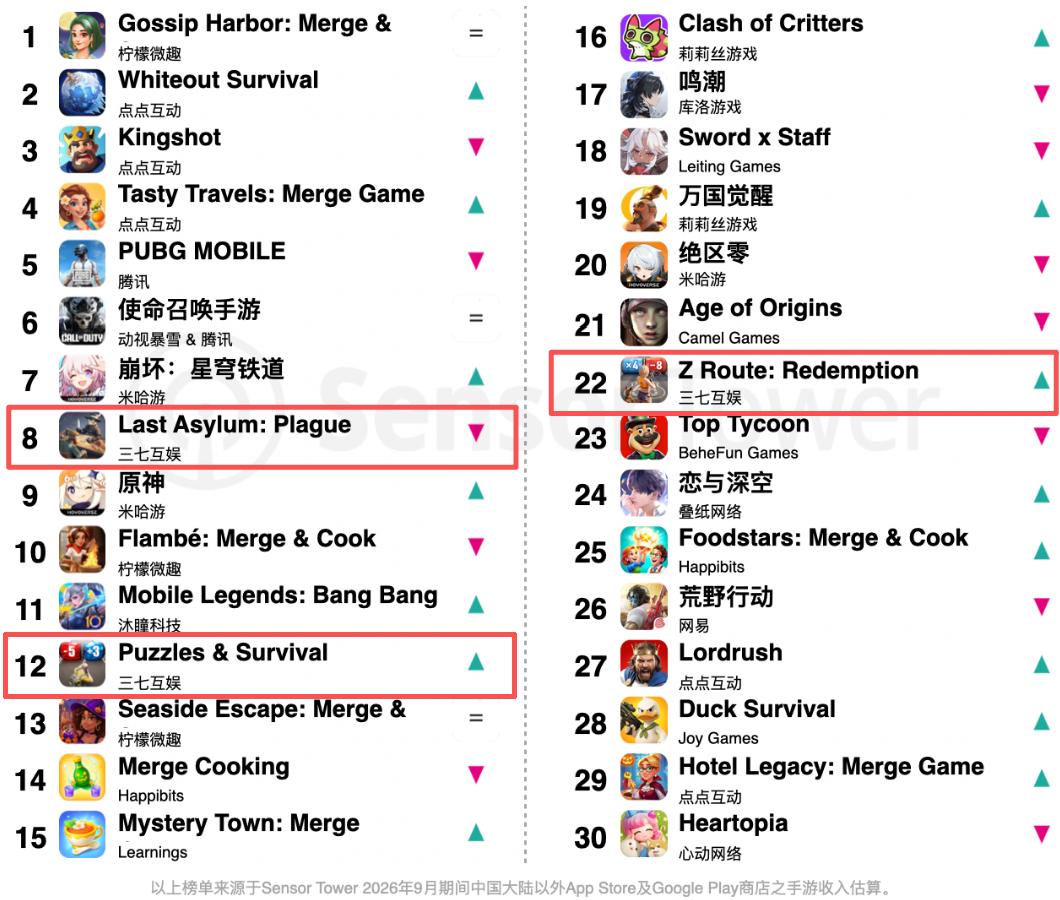
Secondly, SLG going global is moving from accumulation of mature products to relay of new products. In Sensor Tower's Top 30 Chinese Mobile Games by Overseas Revenue in September 2026, 3 SLG titles from 37 Interactive Entertainment made the list.
The steadily performing *Puzzles & Survival* has accumulated more than 75 million total users and over 16.8 billion yuan in total revenue by mid-2026 since its launch, and has long accumulated overseas SLG operation experience for 37 Interactive Entertainment; new titles such as *Last Asylum: Plague*, whose overseas revenue exceeded 26 million USD and hit a new high in September, and *Z Route: Redemption*, which made its debut on the list, provide a window to observe its subsequent growth capabilities.
For SLG, the integration of themes and gameplay can help products reach a wider range of users, but what truly determines long-term performance is still whether the product can establish stable social relationships, continuously update content, and find a balance between user acquisition cost and user life cycle.
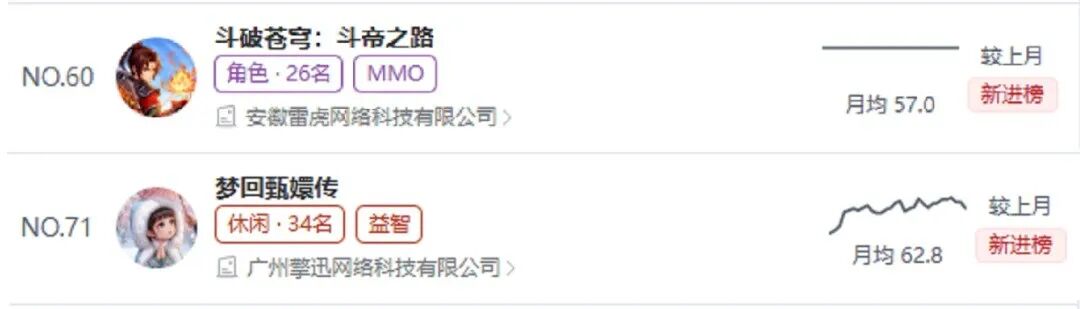
Thirdly, mini-games provide 37 Interactive Entertainment with another continuous product delivery path. ADX data shows that in the top 100 WeChat mini-games list in October 2026, 8 products under 37 Interactive Entertainment were on the list, including products with mature existing player bases such as *Legend of Seek Dao*, *Survival 33 Days* and *Dream Weaving Forest*, as well as new games that just entered the list such as *Battle Through the Heavens: Path of the Battle Emperor* and *Dreaming of Empresses in the Palace*.
From the number of products to the layout of themes, 37 Interactive Entertainment's mini-game products are no longer limited to a single type, but cover different IPs, themes and gameplay directions. This also reflects that it is exploring a growth model for its mini-game business that shifts from single hit-driven to continuous multi-product supply through multi-genre product layout, continuous new product launch and distribution operation capabilities.
Therefore, 37 Interactive Entertainment is forming a product portfolio of MMORPG, SLG and mini-games operating in parallel. The commercialization rhythm of different genres also varies: some MMORPG products may generate revenue relatively quickly relying on mature IP and existing user bases; SLG often requires a longer period of tuning and operation to build long-term returns. There is no absolute distinction between good and bad between the two. What really matters is whether an enterprise can make products with different life cycles and different business models complement each other.
Century Huatong: Undertaking Different Growth Opportunities with Different Business Entities
Century Huatong's business layout reflects another diversification path: different business entities within the group undertake different growth tasks. Shengqu Games has long operated classic IPs such as *Legend of Blood* and *Dragon Nest*, while Century Interactive has formed a product portfolio centered on SLG and extending to casual games in overseas markets.
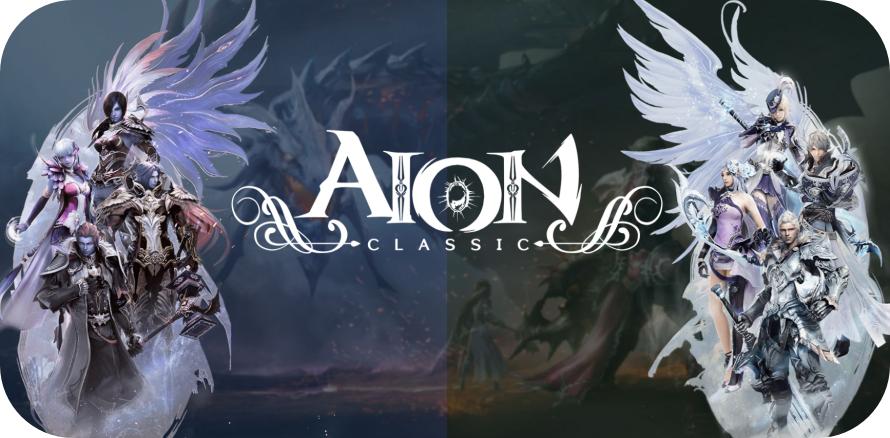
*Aion: Wilderness*, co-developed by Shengqu Games and South Korea's NCsoft
Century Huatong's 2026 semi-annual report shows that in the first half of this year, the company's internet game business achieved revenue of 21.342 billion yuan, a year-on-year increase of 29.87%. Among them, Century Interactive and Century Games contributed a combined revenue of 18.441 billion yuan. *Whiteout Survival* hit a new high three years after its launch, and topped the global mobile game revenue list in June 2026; *Kingshot* has long been firmly ranked in the top three of the Chinese mobile game overseas revenue list. The significance of these two core SLG products is not only about revenue scale, but also that they demonstrate the ability of Chinese manufacturers to build product advantages through long-term operation, continuous iteration and global distribution in the fiercely competitive overseas market.
It is worth noting that Century Huatong does not limit growth opportunities to specific genres. In Sensor Tower's Top 30 Chinese Mobile Games by Overseas Revenue list for September 2026, 5 games under Century Huatong made the list, including 3 SLG titles and 2 casual games. The outstanding performance of synthesis games such as *Food Travel Diary* and *Restaurant Adventure* means that a mature overseas distribution and operation system can be reused in different genres, without having to rely entirely on a single track.
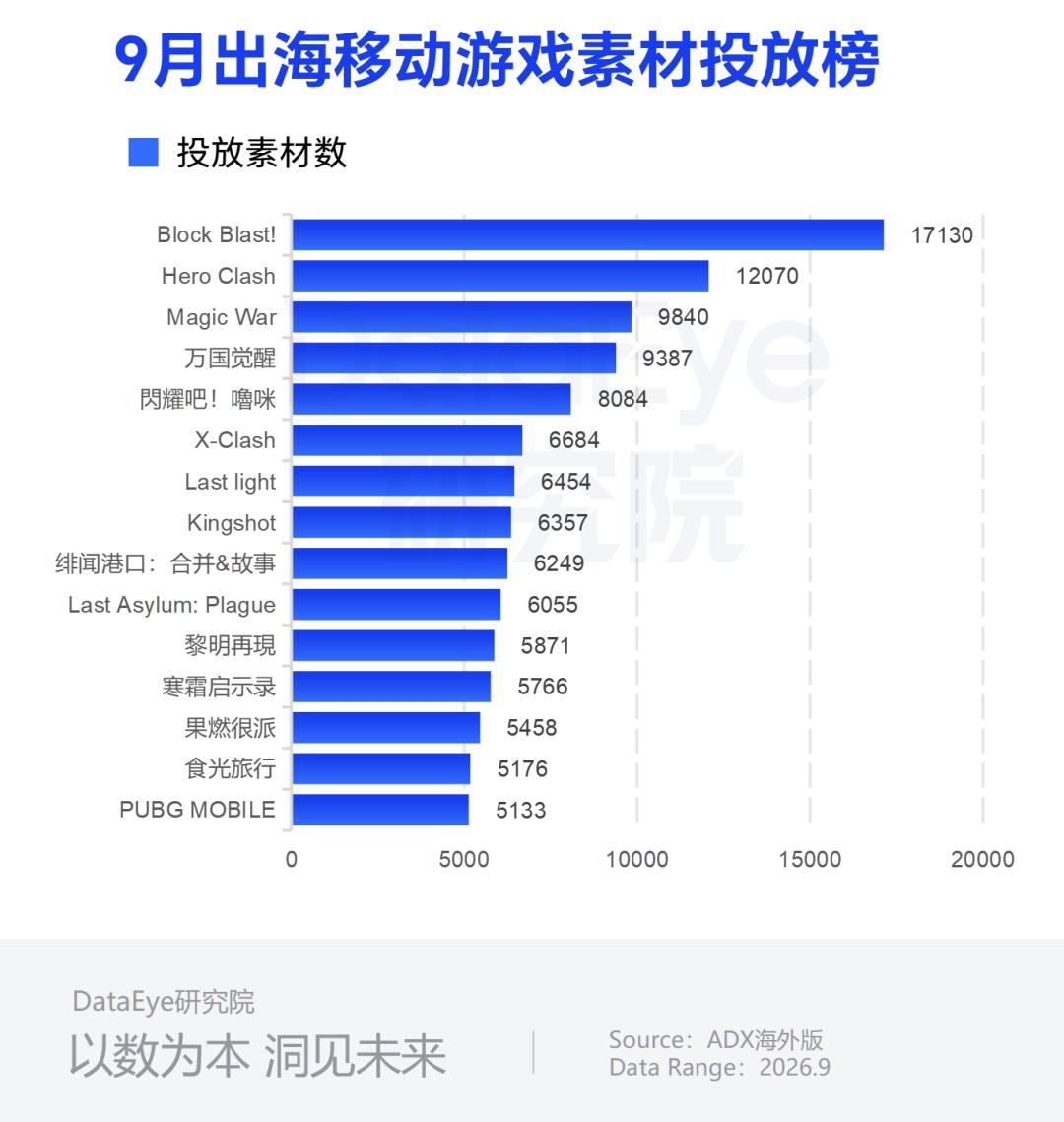
ADX data shows that *Food Travel Diary* entered the top overseas game promotion list in September
From the group level, Century Huatong does not make all business entities shift to the same genre, but through business division, it makes traditional IP operation complement overseas SLG and casual games. This also reminds us that the so-called transformation does not necessarily mean that the original team collectively changes the R&D direction, but it may also make traditional business coexist with new growth engines through internal resource allocation of the group.
The two companies have this in common: from relying on a single product or genre to moving towards a multi-product portfolio; from operating in a single market to differentiated layout in domestic and overseas markets; from launching new games to continuous reuse of R&D, distribution, commercialization and long-term operation capabilities.
——Why can SLG undertake growth, and why is it not a simple transformation answer?
SLG has become an important revenue source for Chinese manufacturers going global, which is related to its long-term operation and commercialization model. However, for manufacturers shifting from MMORPG to SLG, genre change brings not only gameplay adjustments, but also changes in the rhythm of product R&D, market verification and revenue release.
MMORPG relies on mature IP, existing user awareness and a relatively clear growth system. Some products can accumulate users relatively quickly in the early stage of launch and enter a relatively stable operation stage earlier; SLG relies more on continuous content iteration, alliance social interaction, competition mechanism and long-term goal building. Products often need to go through a longer period of tuning and user accumulation to gradually release long-term value.
This difference also determines that transformation cannot only focus on the short-term performance after product launch. For SLG, the early stage needs to verify the theme, gameplay and customer acquisition efficiency, the middle stage needs to improve retention through version iteration and social ecology construction, and then there is an opportunity to form more stable revenue relying on player relationships, continuous content and commercial design.
User acquisition can help products reach users, but it cannot replace product polishing and long-term operation. Therefore, expanding from MMORPG to SLG is not only the migration of product capabilities, but also the re-adaptation of business rhythm: R&D and operation teams need to leave enough space for verification and growth for products, and continuously evaluate the relationship between user retention, payment performance and customer acquisition cost.
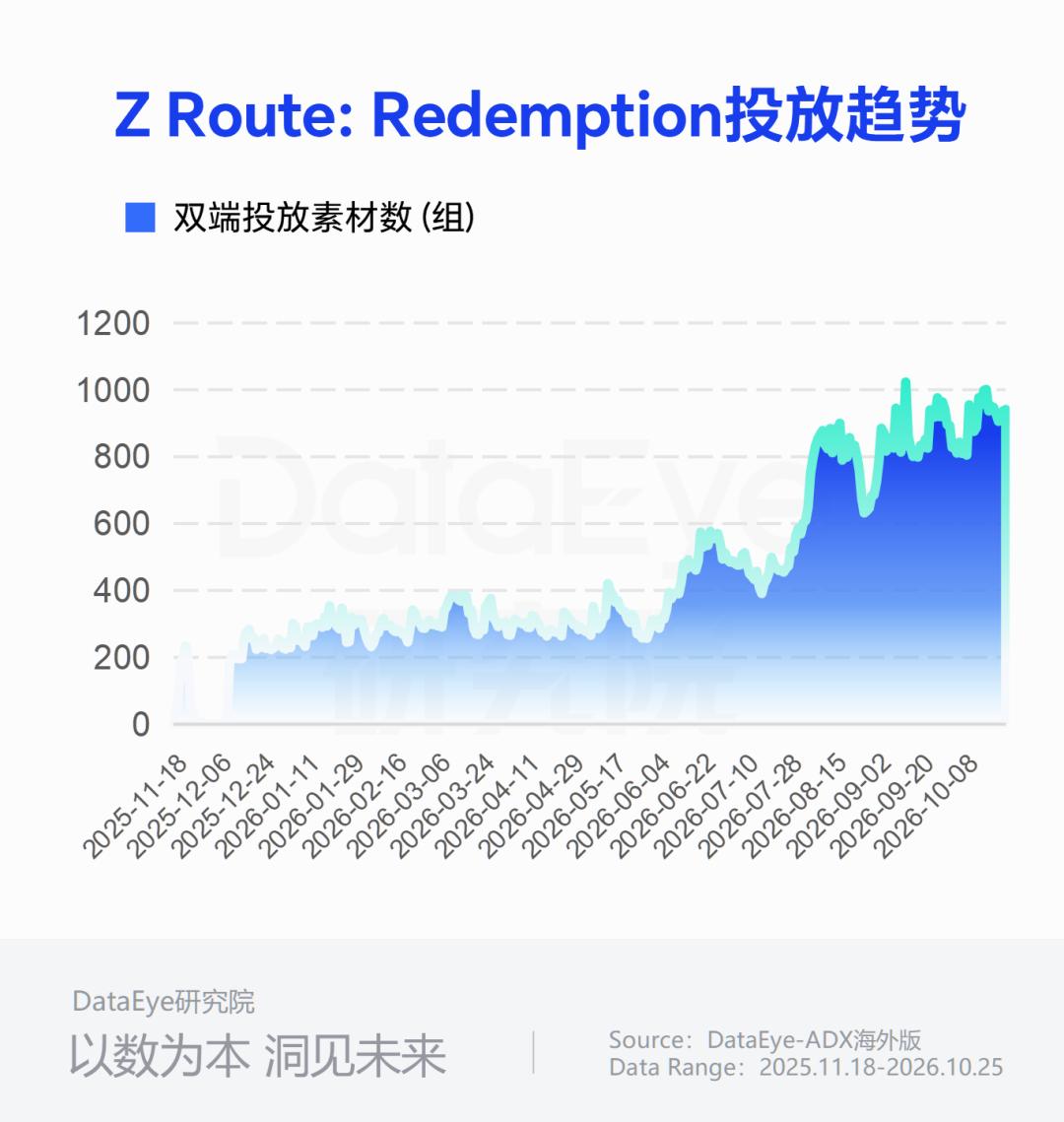
ADX Overseas Version shows that *Z Route* significantly increased its promotion efforts in August this year, successfully boosting the commercial performance of the game; its long period of tuning and polishing in the early stage is the key to laying the foundation of product quality
From the perspective of industry data, the market space of SLG is worthy of attention, but it does not mean that transformation can replicate success quickly. The data that strategy games account for 49.96% of revenue in the top 100 self-developed mobile games by overseas revenue reflects the revenue structure of top overseas products, not the general performance of all overseas games.
For manufacturers that are laying out SLG, what is really worth paying attention to is not only whether new products can boost revenue in the short term, but also whether they can gradually complete product tuning, accumulate stable users, and build sustainable long-term operation and commercialization capabilities. The growth cycles of different genres are different, and the effectiveness of transformation also needs to be observed in the corresponding product cycle.
02
Giants Are Undergoing Transformation, The Next Direction: AI
If SLG and mini-games represent the growth exploration of game companies in product genres and markets, then AI may further change the way enterprises produce games, acquire technologies and create content. For game companies, AI does not have only one direction: it can not only enter existing R&D and marketing processes, but also may give birth to new content forms, and help enterprises connect external technical resources through investment.
AI Is Reshaping The Game Production Chain
At present, the most observable value of AI in the game industry is still the improvement of production efficiency. Links such as art materials, video advertisements, text localization, customer service and promotion often involve a large number of repetitive tasks, which are suitable for improving output efficiency through models and automation tools.
This change has gradually evolved from individual manufacturers' attempts to the R&D and operation layout of leading game companies. Entering 2026, manufacturers such as NetEase and Tencent have successively disclosed the application progress of AI in their game businesses — NetEase mentioned that AI has been integrated into game R&D links such as art, design, programming, animation and quality assurance, and applied to dynamic interactive gameplay in some games; Tencent also stated in its full-year performance materials released in 2026 that AI is accelerating its game content production, improving user experience and enhancing marketing efficiency. It can be seen that the application of AI in the game industry is extending from single-point efficiency improvement such as material generation to multiple links such as R&D production, in-game interaction and user operation.
However, the improvement of production efficiency is only the first step. The increase in material output does not necessarily mean the improvement of material quality; the reduction of generation cost does not mean that the R&D cost of the entire game drops proportionally. Whether AI can further shorten the product iteration cycle, improve promotion ROI, and allow teams to devote more time to gameplay innovation is the key to judging its commercial value.
AI May Give Birth To New Product Forms
If production efficiency is the direct impact of AI on the game industry, then the change of content form may bring longer-term imagination space.
With the development of video generation, real-time interaction and dynamic narrative technology, the boundary between games and film and television content may be further blurred. AI video can lower the production threshold of some visual content, and language models may make character dialogues, plot branches and task feedback more flexible. For game companies with interactive design experience, this provides exploration space for interactive film games, AI-native narratives and the integration of games and short drama content.
