For the same transaction value of 100 yuan, why do the operating costs of different platforms differ significantly?
As competition for internet traffic shifts to user time, leading content platforms continue to expand their attention advantage and gradually convert it into commercial revenue. Differences in platform traffic attributes and monetization mechanisms also lead to significant disparities in merchants' operating costs. Content e-commerce merchants have relatively high expenditures on ad placement and creator commissions, with costs more concentrated in the traffic acquisition link. Faced with the customer acquisition capacity and return on investment of different channels, some brands are optimizing their marketing budget allocation to balance business growth and operating efficiency.
To achieve the same RMB 100 of merchandise transaction value, the operating costs of merchants on different platforms may differ several times.
In 2025, measured by the payment GMV caliber, for every RMB 100 of GMV realized by Douyin E-commerce merchants, the corresponding full-link comprehensive cost is about RMB 30 to 60, while the figures for Taobao & Tmall, JD.com and WeChat E-commerce are RMB 10 to 22, RMB 6 to 20 and RMB 6 to 20 respectively. These costs include advertising and marketing, transaction commissions and creator service fees, which are not all directly collected by the platforms.
What really widens the cost gap is the traffic acquisition methods of different platforms and their corresponding commercialization mechanisms. As user attention gradually concentrates on leading content platforms, how traffic is monetized, how merchants acquire customers, and what kind of operating returns different channels can bring have become important entry points for observing platform competition and merchant operations.
iResearch's "Research on Internet Traffic Concentration, Platform Monetization and Merchant Operating Costs" analyzes the internet traffic pattern, platform commercialization mechanisms and merchant operating costs, revealing the monetization characteristics of platforms under different traffic modes and their impacts on merchant operations.
For the same RMB 100 of sales, where does the cost difference lie?
The cost structure of merchants on content e-commerce and shelf e-commerce differs significantly, and traffic marketing expenditure is the core reason.
Taking Douyin E-commerce as an example, in 2025, for every RMB 100 of GMV realized by merchants, the corresponding advertising and marketing fee is about RMB 10 to 12, the commission for creators and MCNs (including content, operation agency and other service fees) is about RMB 18 to 48, and the transaction commission and technical service fee is about RMB 2 to 3. Advertising and marketing and creator service expenditures constitute the main part of the comprehensive cost, while transaction commissions account for a relatively low proportion.
In horizontal comparison, the advertising and marketing fees corresponding to every RMB 100 of GMV for merchants on Taobao & Tmall, WeChat and JD.com are RMB 2 to 4, RMB 2 to 3 and RMB 1 to 2 respectively. Compared with the investment in advertising marketing and creator services, the gap in transaction commissions and technical service fees across platforms is not equally wide. The difference in the full-link comprehensive cost of merchants mainly comes from the traffic acquisition link, not the transaction commission itself.
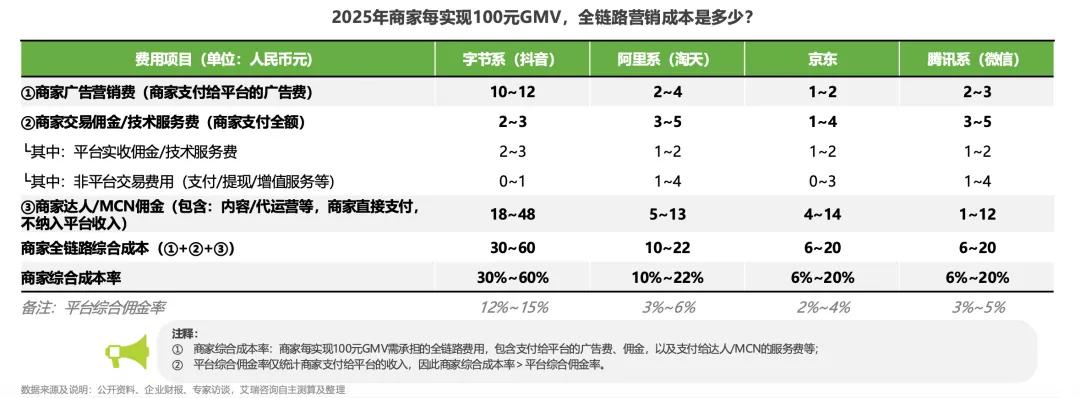
This cost structure is closely related to the traffic modes of the two types of e-commerce platforms. Content e-commerce stimulates consumption demand through short videos, live streams and algorithm recommendations, making users who do not have clear shopping plans may also generate purchase intentions. Merchants can obtain new passenger flow and sales opportunities through this, but product exposure and transaction conversion often require the support of ad placement, content production and creator cooperation, and the operating effect is closely related to the efficiency of marketing investment.
Shelf e-commerce, on the other hand, mostly undertakes the existing consumption demand of users. Users complete purchases through search, price comparison and product browsing, organic search can form a certain transaction foundation, and paid promotion is more used to expand exposure and improve ranking. As a result, the two types of platforms have also formed different commercial revenue structures: content e-commerce relies more on advertising monetization, while shelf e-commerce takes transaction services and search ads as important revenue sources.
In 2025, the ad commission rate of Douyin E-commerce is about 10% to 12%, higher than the 2% to 4% of Taobao & Tmall; after adding transaction commissions and technical service fees, the comprehensive platform commission rates of the two are about 12% to 15% and 3% to 6% respectively. It should be noted that the comprehensive platform commission rate only reflects the commercial revenue obtained by the platform, while the full-link comprehensive cost of merchants also includes fees paid directly to creators, MCNs and other entities, and the two cannot be confused.
How does traffic concentration affect merchants'
customer acquisition cost?
Different traffic modes form differentiated merchant cost structures, and the concentration of user attention on leading platforms further affects merchants' traffic acquisition and marketing investment.
China's mobile internet has entered the stage of stock competition. From June 2022 to August 2026, the monthly user scale (measured by the number of monthly independent devices) increased from 1.39 billion to 1.48 billion units, the growth of user scale slowed down, and the focus of platform competition gradually shifted to user time. In the same period, the share of ByteDance ecosystem in the Top 50 apps by user time increased from 23.7% to 39.8%, surpassing the Tencent ecosystem. Content products such as short videos, short dramas and online reading form synergy, continuously expanding their user attention advantage.
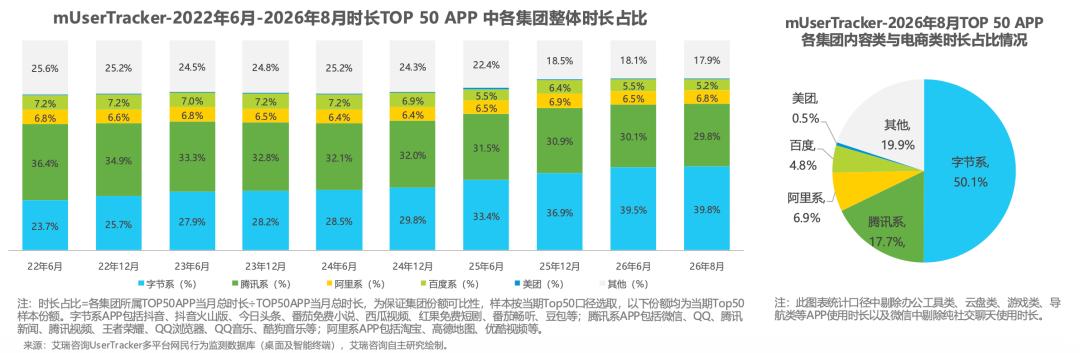
The concentration of user time provides more commercialization opportunities for content platforms. In 2025, according to the measurement caliber of the report, the domestic commercial revenue of ByteDance ecosystem is about RMB 650 billion to 700 billion, with a compound annual growth rate of about 26% from 2023 to 2025, and the revenue scale is about twice that of Taobao & Tmall. Content platforms can not only obtain a large number of exposure opportunities through continuous content consumption, but also integrate product recommendations into consumption scenarios, converting user attention into advertising and transaction opportunities.
This traffic advantage also affects the customer acquisition methods of merchants. As consumers' attention concentrates on leading platforms, merchants pay more attention to the new demand brought by these channels, and strive for exposure through ad placement, creator cooperation and other methods. At the same time, similar merchants compete for traffic resources, and ad bidding, traffic distribution and continuous marketing investment have become important factors affecting customer acquisition costs.
For merchants, the value of traffic investment is ultimately reflected through effective transactions and operating returns. The advertising monetization of content platforms can occur before the final transaction is completed, while merchants still need to face uncertainties such as insufficient conversion and product returns. Therefore, although content platforms have the advantages of creating consumption demand and acquiring new customers, higher marketing investment also requires merchants to pay more attention to traffic conversion efficiency.
Similar cost differences are also reflected in the local life service sector. Douyin Local Life focuses on stimulating consumption demand through content planting, while Meituan In-store Services mostly relies on search to undertake existing consumption demand. Different traffic acquisition methods enable merchants to form differentiated cost structures in advertising placement, creator cooperation and transaction services, which also provides a basis for merchants to allocate operating resources across different platforms.
Balancing growth and efficiency,
how do merchants adjust channel investment?
Differences in traffic attributes, customer acquisition capacity and cost structure between platforms also enable merchants to form differentiated channel strategies in their operations.
A leading domestic Chinese makeup brand accounts for 45% to 50% of its total online GMV on the Douyin platform, but due to high costs such as in-site ad placement and creator commissions, its comprehensive cost rate reaches 60% to 68%, higher than that of Taobao & Tmall and JD.com channels in the same period. The investment reduction test shows that after cutting down Douyin advertising investment, the brand's GMV drops by more than 30% within 1 to 3 days, and it takes 3 to 7 days to return to the normal level after resuming investment.
Faced with high marketing costs and traffic dependence, the brand began to adjust its placement structure, reduce general traffic investment, and shift more resources to the mall and search scenarios to improve overall operating efficiency.
Similar channel division also exists in the local life service sector. A catering chain brand with more than 1000 directly-operated stores mainly acquires new customers through content planting and paid promotion on Douyin, and relies more on search to undertake existing consumption demand and repurchases on Meituan. The group coupon redemption rate of this brand on Douyin is about 55% to 60%, and that on Meituan is 75% to 85%. As the ROI of Douyin live streams dropped from 5.8 to 6.0 in 2022 to 3.8 to 4.1 in 2026, the brand gradually reduced part of its live stream and content placement, and turned to search-based shelf operation.
The two cases reflect the differentiated value of different channels in merchant operations. Content platforms can help brands acquire new customers and expand sales scale through demand creation, while search and shelf scenarios have advantages in undertaking clear consumption demand and improving transaction certainty. For merchants, the key to channel adjustment is to rationally allocate marketing budgets across different platforms in combination with their own business objectives, rather than simply choosing based on traffic scale or cost level.
At the same time, content platforms are improving their mall and search capabilities, and shelf platforms are also strengthening the construction of content scenarios such as live streams and short videos. The mutual penetration of the two modes also provides more options for merchants to optimize customer acquisition and transaction conversion.
Conclusion
The difference in merchant costs across different platforms reflects the differences in traffic attributes, commercialization mechanisms and customer acquisition methods. Under the background that user attention is concentrated on leading platforms, content marketing creates more growth opportunities for merchants, but also puts forward higher requirements for placement efficiency and operating returns. How to rationally allocate channel resources according to business objectives and strike a balance between new demand, effective transactions and long-term returns has become an important topic for merchants to sustain their operations. For platforms, the continuous improvement of commercialization capabilities also depends on higher traffic allocation efficiency and merchant service capabilities.
This article is from the WeChat Official Account "iResearch" (ID: iresearch-), written by iResearch, and published with authorization by 36Kr.