Founded by a professor from Southern University of Science and Technology, Shenzhen-based LiDian, a flexible haptics enterprise, has secured another tens of millions of yuan in the Pre-A++ round of financing | Hardkr Exclusive First Release
Written by Nan Huang
Edited by Silai Yuan
Hard Krypton learned that flexible tactile sensor firm Saisense Technology has completed tens of millions of yuan in Pre-A++ round financing, with Guangzhou Industrial Control as the sole investor in this round. The funds will be mainly used for the R&D of electrolitic flexible technology and the iteration and implementation of new-generation products, continuously promoting cross-industry customer verification and industrialized market expansion, and accelerating multi-scenario industrial penetration.
As an industrial investor, Guangzhou Industrial Control simultaneously brings deterministic scenario implementation access to the team. The first batch of orders has been finalized and will be deployed in the automobile manufacturing process. This also means that the application boundary of tactile sensors is extending outward from the embodied intelligence track, and gradually penetrating into multiple scenarios such as industrial quality inspection and safety perception.
Founded in 2023, Saisense Technology's technology originates from the Ultra-Flexible Electronics Laboratory of Southern University of Science and Technology. The company focuses on the R&D, production and sales of electrolitic flexible tactile sensors and robot electronic skin, and has completed the full-chain technology layout from materials, devices to the system level.
Guo Chuanfei, Founder and Chief Scientist, is a tenured professor in the Department of Materials Science and Engineering of Southern University of Science and Technology and a recipient of the National Distinguished Young Scholars Fund. He has been deeply engaged in flexible electronics research and has applied for more than 40 patents in total. Xiong Gengchao, CEO, has many years of industrial operation experience in the Haier system. The team brings together more than 20 doctoral and postdoctoral scientific research backbones.
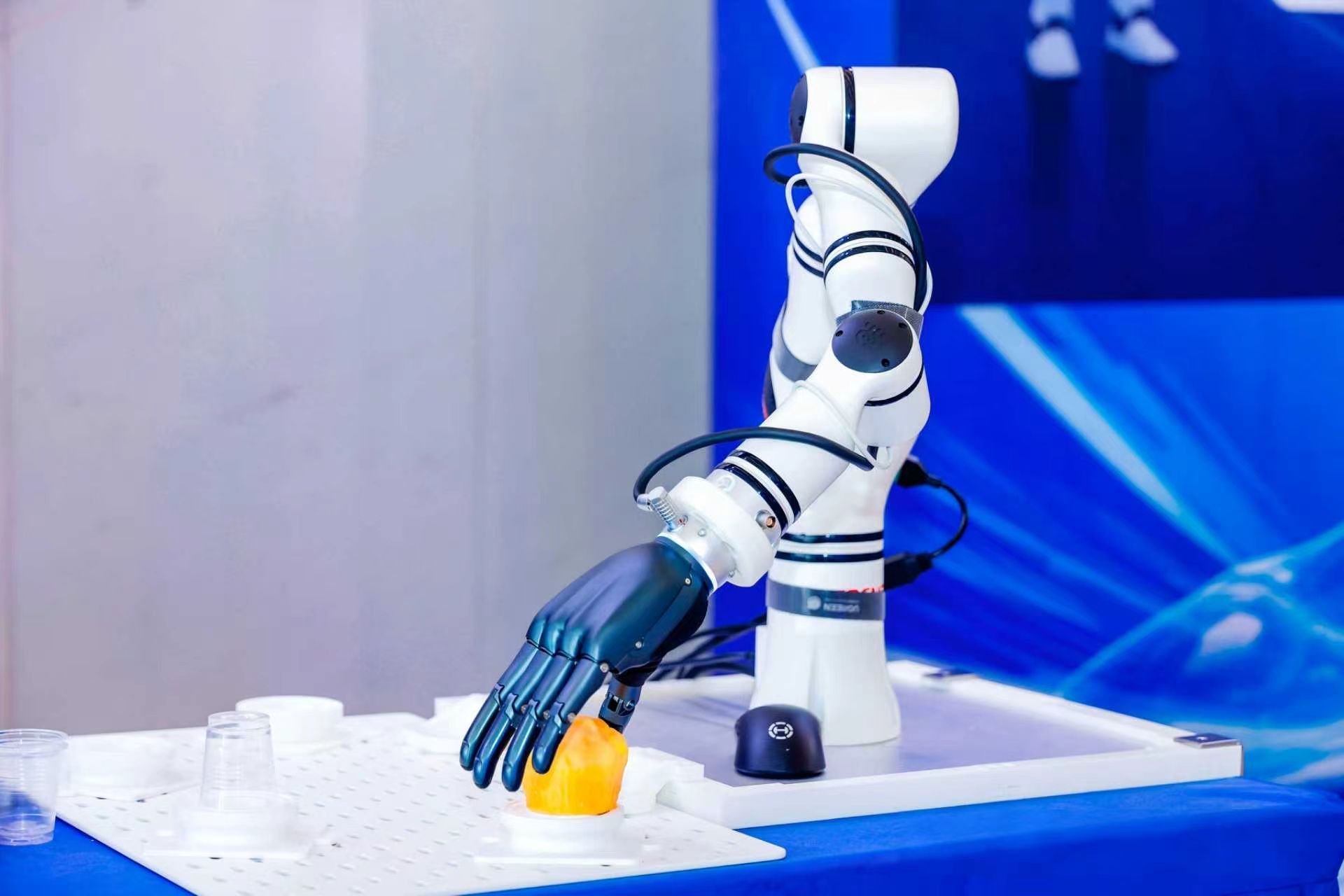
Dexterous hand equipped with Saisense Technology tactile sensor (Source from the enterprise)
In embodied intelligence, the perception of tactile has completed the cognitive shift from "optional" to "mandatory". "Last year we still needed to explain to customers why robots need tactile, but after March this year, this is no longer a problem that needs to be demonstrated. The real divergence has shifted to another level, that is, how tactile signals are actually utilized." said Xiong Gengchao, CEO of Saisense Technology.
The real engineering challenge has just begun. It is an undeniable fact that the time scales of tactile and vision are not consistent: the update frequency of vision is usually relatively low, while tactile feedback requires a higher frequency to support closed-loop control. Simply splicing tactile information into the vision-dominated VLA model is prone to frequency mismatch, where tactile not only fails to generate gains, but may interfere with the original decision-making.
Tactile is not an auxiliary channel for vision, it requires independent data flow, processing frequency and model interface. This means that when tactile signals enter the embodied foundation model, it is not as simple as adding an input channel, but to solve the problem of compatibility with the vision time scale while retaining the high-frequency characteristics of tactile from the data pipeline level.
In order to ensure that the tactile signal itself is sufficiently stable and available, the Saisense Technology team starts from the device structure. Its core electrolitic interface capacitance technology generates sensing signals through the change of the contact area between electronic conductors and ionic conductors, which can achieve simultaneous improvement in sensitivity, range and linearity different from traditional routes.
Xiong Gengchao told Hard Krypton that traditional flexible sensors have long been trapped in the structural contradiction that high sensitivity, large range and high linearity cannot be achieved at the same time, while the electrolitic solution can maintain a linear response in the full range from milligram-level perception to hundred-kilogram-level load bearing.
In terms of specific indicators, both Saisense's single-point sensor and array electronic skin feature low detection limit, high sensitivity, large range and high linearity: the detection limit is as low as about 1mg, the response frequency can reach 1KHz, and the range can maintain a linear response within 1MPa. This performance can still be maintained in the form of tactile gloves, while the device thickness and wearing burden are significantly lower than traditional solutions that require heavy structures for isolation.
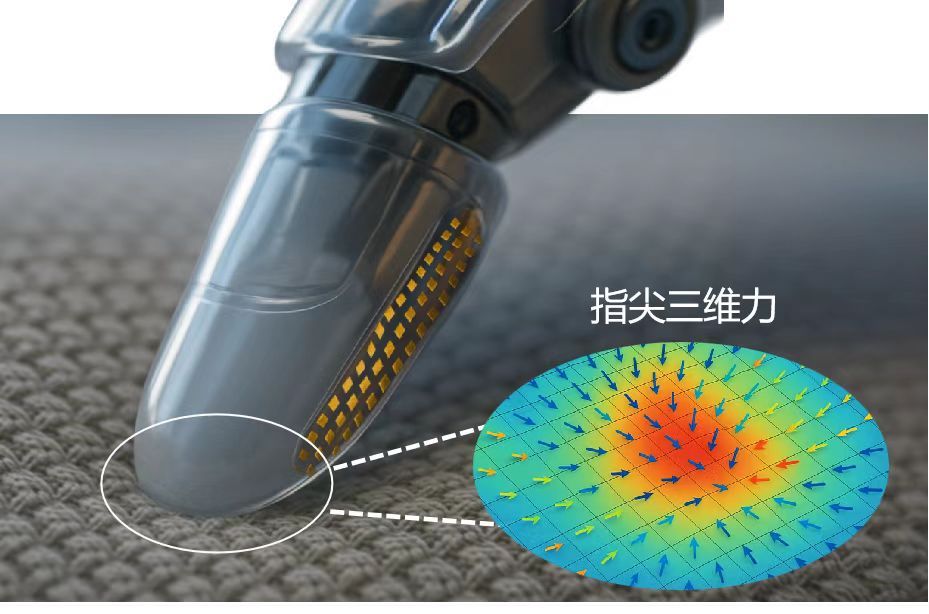
Electrolitic flexible tactile technology (Source from the enterprise)
"We found that the indicators such as tangential force, friction, centripetal force and temperature listed by customers in the requirement documents are not low, but when they actually enter real interaction, the core of acceptance often falls on stability and consistency first." Xiong Gengchao pointed out that the engineering value of tactile sensors does not lie in how high the single peak indicator is, but in whether the data across devices and batches are comparable. "If the cross-device consistency is insufficient, the larger the data scale, the higher the cleaning and alignment cost on the model side, and the training value will be diluted instead."
This performance boundary is further transmitted to the delivery strategy of the Saisense Technology team. The company does not focus its competition on continuously raising the upper limit of single-point precision, but sets stability and consistency as pre-constraints for commercial design, and optimizes precision performance on the basis of reproducible and calibratable devices.
Accordingly, Saisense Technology adopts the fingertip module form with integrated sensor, board card and package for delivery, which completes factory calibration. Commercial customers can directly add this tactile module to the main body without device assembly, calibration and debugging. By moving part of system integration and consistency control to the device end, the engineering coupling of downstream customers and the cost of cross-device data alignment are reduced.
A more noteworthy change occurs in the physical coverage of tactile. Xiong Gengchao told Hard Krypton that in the past, the order demands of embodied companies were mainly concentrated on the fingertips of dexterous hands. Since the second half of the year, tactile demands for finger pads, palms, arms and even shoulders, torsos and soles have emerged simultaneously. The full-size humanoid robot electronic skin system first released by Saisense Technology in mid-2026 has extended tactile perception from fingertips to the whole body, covering pressure perception, collision detection and gait feedback.
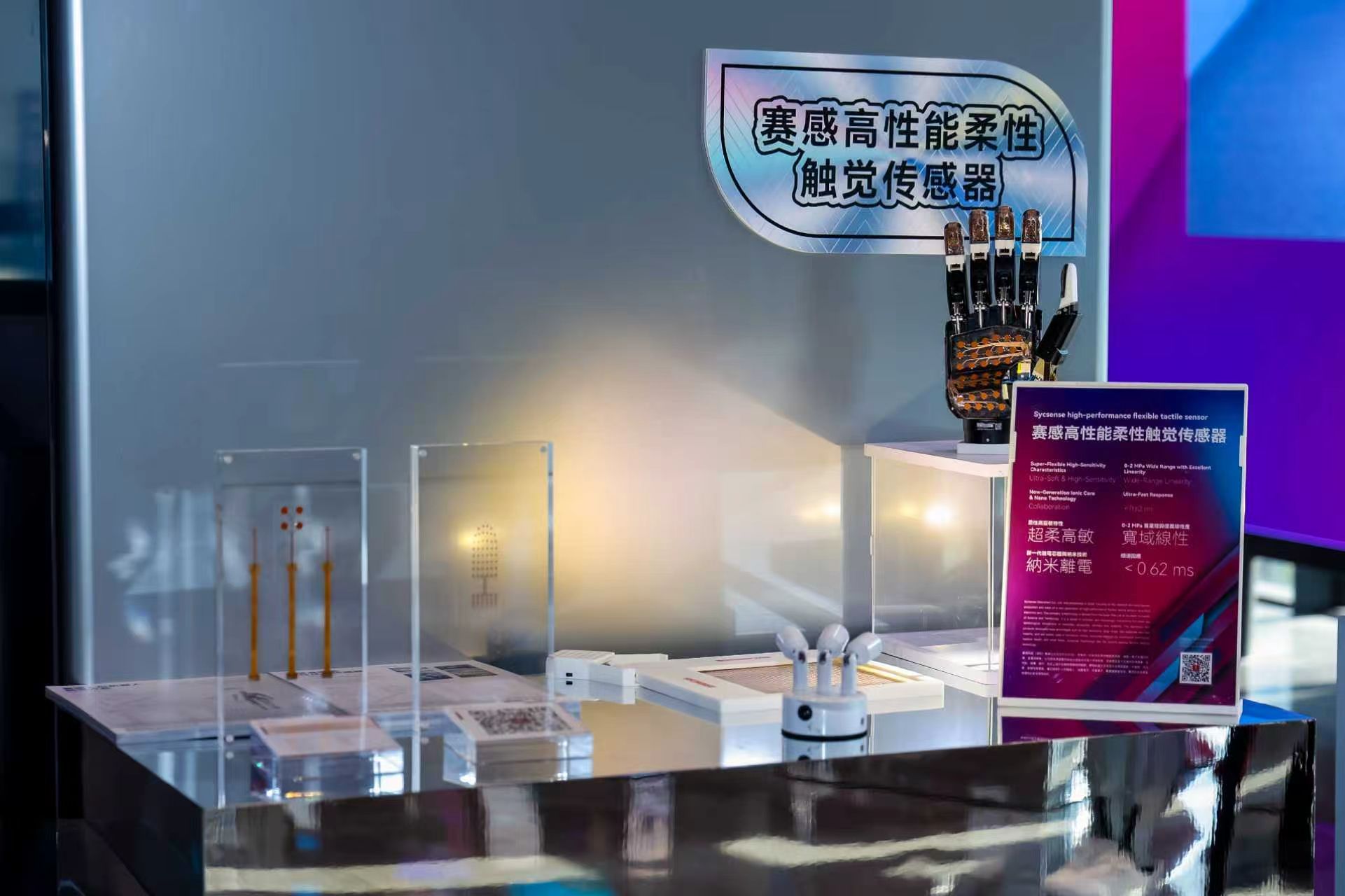
Saisense Technology flexible tactile sensor (Source from the enterprise)
When flexible tactile technology evolves from single-point fingertip perception to full-body electronic skin deployment, sensors will face a whole new set of physical constraints. The degrees of freedom of dexterous hands are continuously increasing, and the internal space of fingers is continuously occupied by motors and transmission structures, leaving less and less installation space for traditional rigid substrate sensors. At the same time, the humanoid bionic form puts forward requirements for the perception layer of curved surface fitting and stretchability, and the signal drift must be maintained within a controllable range during bending and stretching deformation.
Saisense's flexible skin covering solution is designed for this set of constraints. It supports direct attachment to curved surfaces, instead of pre-reserving plane slots in the mold and then embedding sensors. This capability eliminates the need for the ontology structure to reserve separate installation positions for sensing units, greatly improving the flexibility of body iteration and curved surface laying, and enabling rapid deployment of full-body tactile perception for humanoid robots of different configurations.
"Just like vision, tactile is becoming a foundational perception channel for embodied intelligence, but the two are not in a substitution relationship, but a complementary relationship." said Xiong Gengchao. Vision allows robots to see the world, and tactile allows robots to touch the world. In the main line of evolution from VLA to VTLA, the VTLA model is not limited to simply adding tactile to the vision architecture, the key is to make the two types of information cooperate at the correct frequency and semantic level.
The position that Saisense Technology tries to occupy is to provide system-level solutions from fingertip modules, full-body electronic skin to tactile data flow on the basis of electrolitic materials and device processes, and verify the engineering boundary of tactile under extreme load and long-term reliability in non-embodied scenarios such as automobile manufacturing and battery safety.
When tactile enters the stage from "whether it is useful" to "whether it is easy to use", what determines whether the perception solution can be deployed on a large scale is not only the sensitivity figure, but also the device consistency, delivery rhythm and the depth of coupling with the downstream model layer.
The following is an edited excerpt of the interview between Hard Krypton and Xiong Gengchao, CEO of Saisense Technology:
Hard Krypton: Tactile is expanding from fingertips to the whole body, and customer demands are shifting from single-point precision to stability and consistency. How do you understand this change?
Xiong Gengchao: These two directions are actually two sides of the same problem.
The real engineering value of tactile sensors does not lie in the peak accuracy of a single sampling, but in the comparability of data across devices and batches. Once the consistency is insufficient, the larger the dataset, the higher the cost of data cleaning and alignment on the model side, and the training value of the data itself will be diluted instead. At present, the industry has reached a consensus on basic indicators, such as 5 to 10 grams of tactile detection capability and 30 Newton range. The load of most dexterous hands is in the range of 3 to 5 kg, and the stability gap between different solutions is significant.
Saisense's idea is to set stability and consistency as pre-constraints for commercialization, ensure that the devices are reproducible and calibratable first, and then optimize the accuracy. In terms of delivery, we adopt an integrated fingertip module integrating sensor, board card and package, some products are calibrated before leaving the factory, and customers can directly integrate them without self-assembly and calibration work. By moving integration and consistency control to the front end, we reduce downstream engineering coupling and the cost of data alignment for multiple devices.
When tactile extends from fingertips to finger pads, palms, shoulders, arms, torsos and soles, the sensor faces another set of constraints. For the shoulder scenario, the core demand is not heavy load, but light contact recognition in human-robot interaction. In addition, different parts of the whole body have different requirements for range, sensitivity, flexibility and cost, so it is impossible to simply cover them all with the same type of sensor. On the other hand, the internal space of dexterous hands is occupied by motors and transmission structures, making it difficult to arrange rigid substrate solutions; the humanoid ontology also requires the perception layer to be curved-surface attachable, stretchable, and signal drift under deformation is controllable.
Saisense's flexible skin covering solution can be directly attached to curved surfaces without reserving installation grooves during mold opening, which releases the binding between the sensing unit and the ontology structure, facilitating the rapid deployment of full-body tactile perception for robots of different configurations.
In short, stability and consistency solve the problem of whether tactile data can be effectively used by the model, and flexible skin covering solves the problem of whether tactile perception can be widely deployed on the robot ontology. The two together form the engineering foundation for tactile to evolve from single-point fingertip perception to full-body electronic skin.
Hard Krypton: In the VTLA model, why can't tactile only serve as an auxiliary input channel for vision, and what is the core significance of layered processing of tactile data?
Xiong Gengchao: There are essential differences between tactile and vision in their perception timing and response logic.
Vision tends to be environmental perception, with relatively limited acquisition frame rate, serving for relatively slow cognitive decisions such as spatial understanding and scene reasoning. Tactile, on the other hand, belongs to contact perception, where interaction events often occur transiently, requiring millisecond-level high-speed feedback to support physical closed-loop control. If tactile signals are used as additional input and stuffed into the vision-dominated VLA model, temporal mismatch is very likely to occur: high-frequency tactile events are diluted synchronously by low-frequency vision frames, which not only fails to give play to the unique interactive value of tactile, but also the extra introduced noise will interfere with the reasoning stability of the original model.
Therefore, when tactile is connected to the multimodal model, it is not adding an additional auxiliary signal, but building a set of independently adapted data pipelines, which should not only achieve temporal alignment to complete the collaboration with the vision information flow in the semantic space of the model, but also fully retain the native high-frequency transient characteristics of tactile, instead of smoothing the dynamic signal at the moment of contact to adapt to the rhythm of vision.
At the delivery level, Saisense's solution is compatible with customers' existing data interfaces on the one hand, ensuring smooth access to the existing VLA system; on the other hand, it outputs standardized tactile data flow for the native VTLA architecture, adapting to the unified multimodal perception framework.
We have clearly seen that clear demands have been formed downstream. For high-frequency reflex actions that require immediate response such as touching, slapping and slipping, it is not suitable to upload all of them to the large model main brain for reasoning. The fault tolerance window for such events is extremely short, and local recognition and local closed loop on the end side can meet the real-time requirements of robot physical interaction. This has given rise to a layered processing architecture for tactile data: low-frequency interactive decisions that require comprehensive environmental information understanding are completed by the VLA large model; high-speed closed-loop logic such as millisecond-level contact reflex and safety protection is sunk to the edge end for execution.
Tactile must first become an independent, controllable information flow with its own timing characteristics, rather than an auxiliary supplement to vision, so that it can form real complementary collaboration with vision in the VTLA system, rather than simple splicing.