Anthropic's Prospectus Is Finally Disclosed: Can Large Models Actually Make Money?

9 p.m. Beijing time last night (9 a.m. Eastern Time on October 26), Anthropic publicly submitted its prospectus to the U.S. Securities and Exchange Commission, planning to list on NASDAQ under the ticker symbol ANT. This is one of the two most cutting-edge large model companies in the world, laying out its full performance to the public for the very first time.
The day the prospectus was released, it almost rekindled AI sentiment in the U.S. stock market: the NASDAQ Composite Index rose 0.82%, and the PHLX Semiconductor Index climbed 2.82%; just last Thursday, the PHLX Semiconductor Index had posted a 6.72% single-day drop. This autumn, amid the unease in the AI market, the listings of other companies have been put on hold one after another, leaving only Anthropic pushing forward, while OpenAI plans to go public in 2027.
The significance of this prospectus lies in the fact that several of the most fiercely debated topics around AI over the past three years — whether large models can truly make profits, whether computing power will eat up all revenue, and whether enterprises are actually using these technologies — have received official answers for the first time. Moreover, this listing will become a benchmark for Wall Street to price leading AI companies, and bring secondary market investors into a competition that was previously funded mainly by venture capital firms, sovereign wealth funds and tech giants.
At least in the first half of this year, the performance was quite strong. In 2023, Anthropic's full-year revenue was only 41 million U.S. dollars, while in the first half of this year it reached 162.86 billion U.S. dollars, 14 times that of the same period last year; its GAAP operating profit in the second quarter was 9.74 billion U.S. dollars. The net loss of 807.48 billion U.S. dollars on the books in the first half of the year mainly came from the accounting revaluation of financing instruments, which involved no cash outflow.
In the understanding of many people, this is "a beautiful financial report of a growth stock". But in my opinion, this statement is only half right. By the end of June, its signed computing power procurement commitments and unstarted leases totaled about 5.87 trillion U.S. dollars, which will be paid gradually over the next nearly 20 years, and the total amount is more than four times its cash on hand and short-term investments. After June, in order to lock in more computing power, it signed new contracts and added additional amounts to existing contracts, adding at least another 2.45 trillion U.S. dollars to its future payable amount.
This figure is likely to rise further. AI demand has repeatedly exceeded expectations, and even Anthropic itself has underestimated it. A September column in the Financial Times wrote that a year and a half ago, Anthropic expected its full-year revenue in 2027 to be only 120 billion U.S. dollars, while its revenue in the first half of this year has already exceeded that number. If demand continues to rise in this way, it will only need to buy more computing power.
This prospectus proves that its revenue can already afford the computing power it is currently using, but there is still no answer as to where the money for these next batches of computing power will come from.
So far, most of the money for purchasing chips and building data centers is paid by cloud vendors and chip manufacturers first, and Anthropic pays according to the contracts afterwards. After the listing, part of this sum will be covered by secondary market investors. How much they are willing to pay and at what price will ultimately depend on whether its most powerful model can always be sold at a premium higher than its peers.
01 Revenue has temporarily outpaced computing power costs
Anthropic's business is divided into three layers: the bottom layer is the models, the middle layer is the platform for developers to build applications, and the top layer consists of its own products such as the chat interface Claude.ai and the programming tool Claude Code. The models are divided into four tiers: Mythos, Opus, Sonnet and Haiku, with different capabilities and prices, and customers choose the tier according to their tasks.
In the first half of 2026, 80% of revenue was charged based on usage, measured by tokens and priced according to the selected model, which the company calls "pay for intelligence"; the remaining 20% came from subscriptions. From the perspective of revenue channels, 48% of revenue was sold through the cloud marketplaces of Amazon, Google and Microsoft, and collected by cloud vendors on behalf of Anthropic.
The main customers contributing revenue to Anthropic are enterprises. As of September 30, 2026, there were more than 11,900 customers who paid more than 100,000 U.S. dollars in the past 12 months, compared with more than 950 a year ago. As of the end of June, there were more than 6,000 such customers, contributing about 74% of the revenue in the first half of the year. The prospectus did not name customers whose revenue accounted for more than 10% of total revenue, but customer concentration is declining: in 2025, two customers each accounted for 12% of revenue, totaling about 1.1 billion U.S. dollars; by the first half of 2026, only one customer accounted for more than 10%, taking up 11% of total revenue.
In full-year 2024, Anthropic's revenue was 386 million U.S. dollars, and it reached 45.85 billion U.S. dollars in 2025, representing a year-on-year growth of 1088%; its revenue in the first half of 2026 was 162.86 billion U.S. dollars, 14 times that of the same period last year. Broken down by quarter, its single-quarter revenue has increased by about 30 times in five quarters.
According to the description in the prospectus, the revenue in the third quarter of this year is 86 times the 197 million U.S. dollars recorded in the fourth quarter of 2024, which is estimated to be about 169 billion U.S. dollars. The quarter-on-quarter growth rate has dropped from 144% in the second quarter to about 46%, but the incremental revenue has not actually collapsed, the third quarter added about 54 billion U.S. dollars more than the second quarter, and the second quarter added about 68 billion U.S. dollars more than the first quarter. In my opinion, the base effect has played a certain role here.
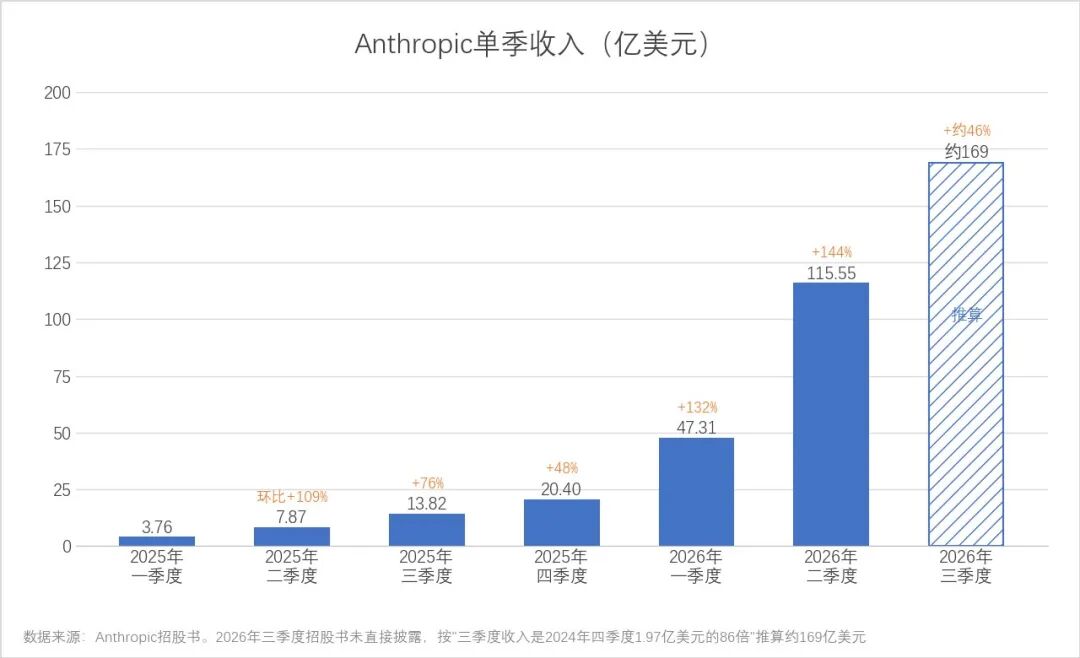
The prospectus did not explain the slowdown in quarter-on-quarter growth in the third quarter, but I believe several factors may be related: customer usage usually drops during the summer vacation; from August to September, the company strengthened the cleanup of non-compliant customers, which accounted for about 5% to 7% of revenue in the first nine months; in June, the U.S. Department of Commerce imposed global export restrictions on Fable 5 and Mythos 5, and the company disabled these two models for all customers until the security measures were updated and the restrictions were lifted.
Such a revenue growth rate has almost no precedent in human history; people often compare today's large models to the railway and the internet, but from the perspective of the revenue growth rate of representative companies, neither of these two technological revolutions can match the large model industry.
The prospectus clearly states that as soon as a new model is released, enterprise customers will migrate to the latest and most powerful version. After Opus 4.5 was released in November 2025, the quarter-on-quarter revenue growth rate accelerated from 48% in the previous quarter to 132%; in the third quarter of 2026, more than 80% of revenue came from model versions released within the past six months.
In terms of revenue quality, the business of directly serving customers is highly profitable on its own. The prospectus does not disclose gross margin, but calculated according to the supplementary table by function in the notes to the financial statements, revenue in the first half of the year was 162.86 billion U.S. dollars, and the cost of revenue was 23.80 billion U.S. dollars, which means that for every 1 U.S. dollar of revenue, the computing power cost of directly serving customers is only about 15 cents, with a gross margin of about 85% (the cost of revenue does not include channel fees paid to cloud vendors). The money is mainly spent on next-generation models, and the computing power for model training is recorded in R&D expenses. The R&D expense in the first half of the year was 97.41 billion U.S. dollars, accounting for about 60% of revenue.
In terms of operating profit, in the second quarter of 2026, Anthropic's GAAP operating profit was 9.74 billion U.S. dollars, with an operating margin of 8%, and the adjusted caliber excluding equity incentives and other items was 19%; it still recorded a loss of 16.67 billion U.S. dollars in the first quarter. Such profitability is also an unusual point for the company: when technology companies are growing at their fastest pace, they usually invest the most heavily and suffer the largest losses, but Anthropic is the opposite, and its total operating loss in the first half of the year has narrowed to 693 million U.S. dollars.
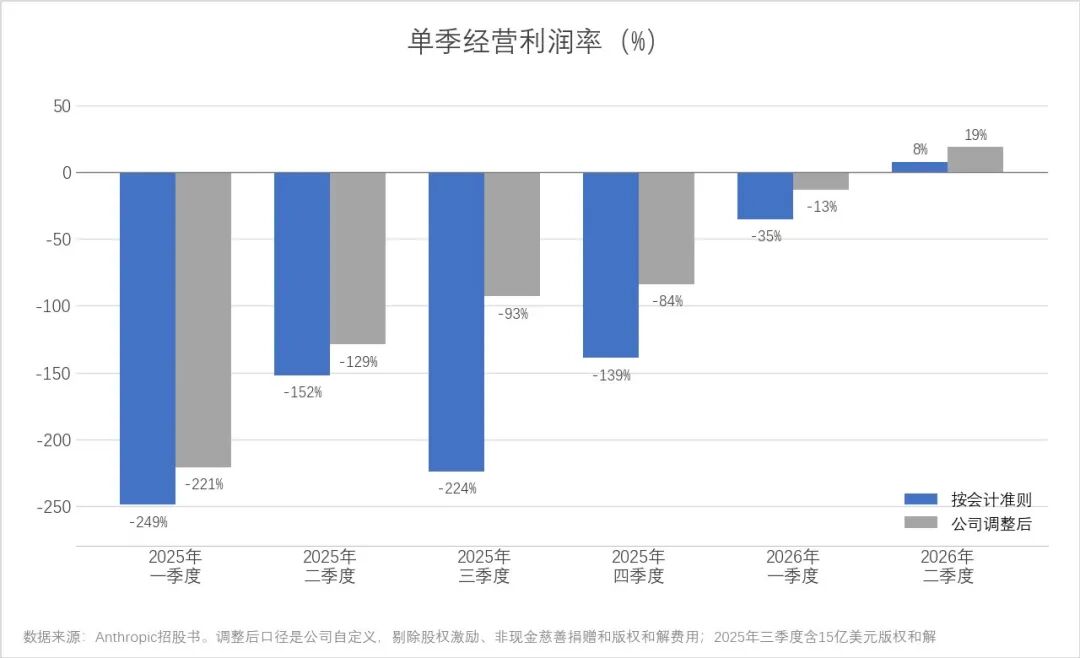
Looking through the company's three financial statements, an important contribution to profits comes from the time difference. Most of Anthropic's computing power is covered by multi-year long-term contracts, which are usually booked 12 to 18 months in advance. From the day the supplier delivers this batch of computing power and it is ready for use, payment shall be made according to the contract, no matter how much is used; while revenue is collected based on how much customers use in the current period.
Therefore, the amount of computing power fee to be paid in a quarter was basically determined more than a year ago. In the first half of this year, customer usage increased much faster than the pre-booked computing power, so the revenue generated by every 1 U.S. dollar of computing power fee has increased several times. In the first quarter of 2025, for every 1 U.S. dollar of Anthropic's revenue, the money spent on computing power and infrastructure was 2.51 U.S. dollars; by the second quarter of 2026, it only needed 0.48 U.S. dollars.
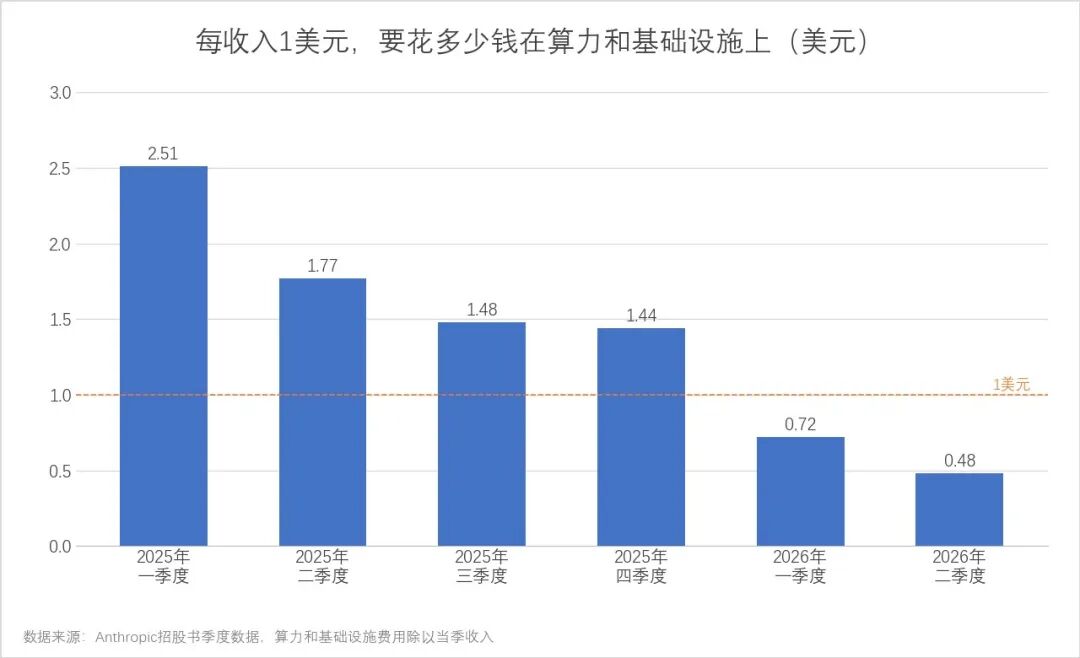
But this only applies to the current batch of computing power. The company warned in the prospectus that when the next large batch of new computing power goes online, expenses will be recorded before revenue, and profit margins may be significantly compressed. Given the current relatively meager profit, it is not ruled out that the company will return to losses.
As for the 807.48 billion U.S. dollars net loss that went viral last night, it is mainly an accounting revaluation. Companies that use tools such as convertible notes for financing generally have this item on their books before listing. When the valuation rises, the shares that the notes can be converted into in the future become more valuable, and the liability is revalued accordingly, with the increased part recorded as a loss.
In terms of cash flow, as of the end of June this year, Anthropic's total cash and short-term investments amounted to 1316.51 billion U.S. dollars, and the net inflow from financing activities in the first half of the year was 1107.74 billion U.S. dollars, most of which came from the issuance of preferred shares. In the same period, the cash flow from operating activities was positive at 3.929 billion U.S. dollars, which was the first positive value in all reporting periods of the prospectus. It was still negative 2.637 billion U.S. dollars for the whole year of 2025, indicating that the operation itself can already generate cash, and the cash generated in half a year is at this magnitude.
This sum of money seems large, but there are far more places to spend it. As of the end of June, the company's signed computing power procurement commitments and unstarted leases totaled about 5.87 trillion U.S. dollars, which will be paid gradually over the next nearly 20 years. The amount to be paid before 2030 is still blank in this version, and the total amount is more than four times its cash and short-term investments.
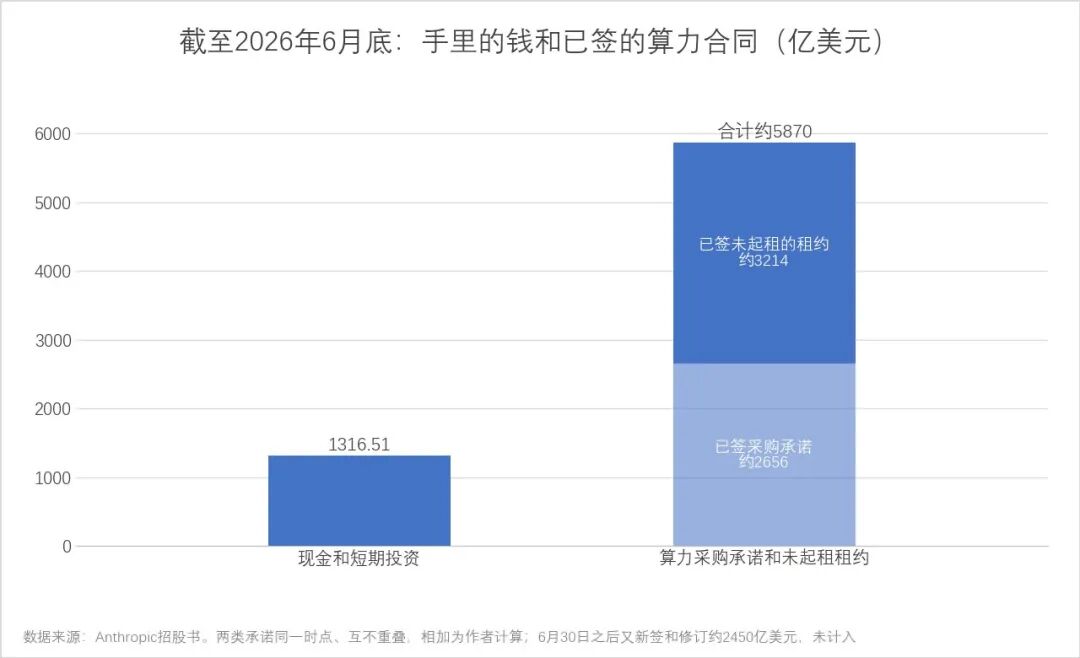
Anthropic's revenue has caught up with the computing power it is currently using, which has been confirmed by both profits and operating cash flow. However, for the next approximately 5.87 trillion U.S. dollars of computing power commitments, the money earned from operations is far from enough to cover it. Where the money comes from and at what pace it arrives is the most realistic problem for this company after its listing.
02 Can the most powerful model always be sold at a high premium?
In January 2020, Jared Kaplan, Sam McCandlish, Tom Brown, Dario Amodei and others published the paper "Scaling Laws for Neural Language Models" at OpenAI. This paper is one of the most important theoretical cornerstones of large models today; it is exactly this group of people who left OpenAI in 2021 due to conceptual differences and founded today's Anthropic.
At the beginning of Anthropic's prospectus, their judgment is quite romantic: for the first time in human history, intelligence has become something that can be built, and the capabilities of reasoning, analysis, decision-making and creation can be produced on a large scale and accessed on demand, whose impact on the global economy will exceed that of industrialization, electricity, semiconductors and the internet.
There are two ways to interpret this sentence: one is that Anthropic's management is drawing a grand empty blueprint; the other is that this is their sincere belief. This group of people wrote the scaling law at OpenAI, and after leaving to found Anthropic, they wrote "advance safety and capabilities together" into the foundation of the company; now, they are betting according to this rule and have signed computing power contracts far exceeding their cash holdings.
The underlying color of Anthropic's growth miracle today is the revenue from cutting-edge models, where enterprise customers are willing to pay a high price for the latest and most powerful models; the huge long-term contracts the company signed for computing power are also betting on exactly this point. The expectation behind these contracts is not that "AI demand will grow", which no one will question; it is that cutting-edge models can always be sold at cutting-edge prices.