Can CATL and automakers go back to the way they used to be?
On October 21, 2026, CATL's A-share stock price dropped by 12%, marking the second-largest single-day decline since its listing. The Q3 financial report released the previous night showed that the revenue in the third quarter reached 1652 billion yuan, a year-on-year increase of 58.6%; the net profit attributable to shareholders was 212.5 billion yuan, a year-on-year increase of 14.5%, while the gross margin declined to some extent.
The slowdown in profit growth stems from multiple factors: low-priced long-term energy storage orders signed in the past two years have entered the concentrated delivery period, and the proportion of energy storage sales has risen to about a quarter, leading to double dilution of the overall gross margin from low-margin businesses. In addition, the launch of consumption tax in September and the reduction of export tax rebates also increased the current-period costs.
CATL also stated, "We are actively communicating with customers to share the relevant impacts together, and at the same time, we are promoting the implementation of new technologies and new products to reduce the impact on profitability."
Negotiating with customers to share costs ostensibly aims to cope with short-term profit pressure, but behind it lies a longer-term issue in the power battery industry chain: how the value of the industry chain is distributed, and who holds the initiative.
In the past, CATL occupied a pivotal position in the battery supply chain by virtue of its scale and technological advantages. However, this pattern is not static. In the past month, automakers have taken increasingly intensive actions around self-developed batteries, supplier selection and system integration. The so-called "de-CATL trend" is becoming a new force affecting the division of labor in the industry chain.
This does not necessarily put automakers and CATL in opposition, but it may redefine the cooperation boundary between the two sides, and also becomes a key factor affecting CATL's future profit model.
Automakers and CATL Start to Redraw Boundaries
The "de-CATL trend" consists of a series of specific actions taken by different automakers.
Li Auto has gone the farthest in this direction.
At the earnings call in March this year, Li Auto stated that starting from 2026, all models of Li Auto will adopt a dual-battery route with both the "Li Auto brand" and the CATL brand. At the interim results call on August 26, Li Xiang said that starting from the second half of this year, Li Auto's self-developed batteries will be successively installed in all models.
Later, Li Auto made a strategic capital increase of 2.65 billion yuan in Sunwoda Power. Combined with its previous shareholding, Li Auto holds 11.17% of the shares of Sunwoda Power, making it the second largest shareholder.
At a communication meeting in September, representatives of Li Auto reiterated that starting from the new generation L8, all Li Auto models will be equipped with its self-developed batteries.
The self-development model of Li Auto brand is that Li Auto takes the lead in cell design and R&D, while battery companies such as Sunwoda and CALB are responsible for cell production and manufacturing. At the battery pack level, BMS, thermal management and even insulating materials are independently developed, designed and produced by Li Auto. Judging from the current list of partners for Li Auto's self-developed batteries, CATL is no longer included.
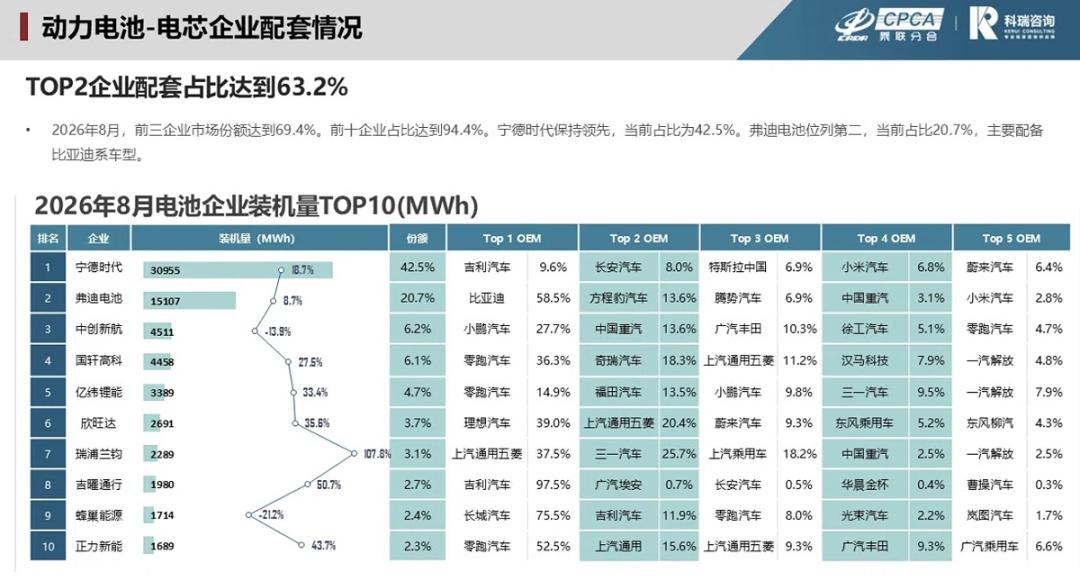
Reflected in the installation data, in June this year, Li Auto was still the fourth largest customer of CATL (accounting for 6.8%) and the fifth largest customer of Sunwoda (accounting for 6.4%). By August, Li Auto disappeared from the top five customers of CATL and became the largest customer of Sunwoda (accounting for 39%).
XPeng Motors holds a similar attitude to Li Auto. In September 2026, He Xiaopeng publicly announced that "we will develop batteries independently starting from this year". Its route is similar: it takes the lead in defining the battery system, while cells continue to be purchased from external sources, and suppliers such as CALB and EVE Energy have been introduced.
Xiaomi adopts a layered strategy. The newly launched range-extended products Pengcheng N70 and N90 will adopt the "Dragon Armor Battery", while according to previous reports, CATL remains the primary supplier for pure electric models under the main brand such as SU7 and YU7.
For the "Dragon Armor Battery", cells are developed and manufactured by CALB and Sunwoda, but the product definition rights of battery pack structure, thermal management and BMS are in the hands of Xiaomi.
AITO, which previously had close cooperation with CATL, also broke the pattern of "exclusive supply for all models" in 2026. The announcement from the Ministry of Industry and Information Technology shows that the pure electric version of AITO M6 has been equipped with an 81kWh LFP battery pack from Gotion High-Tech, and CALB has also entered AITO's supply system.
Among traditional automakers, GAC's ENPOWER battery plant has been put into operation, realizing independent R&D and production; Geely integrated its battery assets to establish Jiyao Pass in 2025, and continues to promote independent R&D.
Looking back at these actions of automakers, their purpose is not necessarily to kick CATL out of the game. More of them want to reduce their dependence on a single supplier, which does not mean that CATL has lost its product competitiveness.
The most important means is to separate "cell procurement" from "battery pack manufacturing". Through this separation, automakers have redrawn the boundary of the supply chain, clarifying which manufacturing links can be outsourced and which definition rights and integration rights must be kept in their own hands, thus changing the power relationship between automakers and battery manufacturers.
Self-developed Batteries: How to Calculate the Accounts?
The most direct reason why automakers are eager to take back some links and change their cooperation mode with CATL is cost.
In the first half of 2026, the average profit margin of China's domestic vehicle manufacturing sector has dropped to 1.5%, hitting a new low in nearly a decade. Power battery is one of the most important cost items of new energy vehicles.
CATL has long occupied a large share of China's domestic power battery market. Its products and supply capacity have undeniable advantages, but when automakers rely too much on a single supplier, their procurement prices, delivery rhythms and cooperation terms are vulnerable to restrictions. Under the environment of compressed profit margins, this may also increase the cash flow pressure on automakers.
For automakers, introducing a second supplier and separating cell procurement from PACK manufacturing has the potential to reduce costs and retain more profits for themselves.
Secondly, automakers want stronger product definition rights.
Batteries are no longer just a component installed in vehicles. The structure of battery packs, thermal management schemes and BMS control strategies not only affect range, charging experience and safety performance, but also affect chassis layout and space utilization.
Especially with the gradual popularization of 800V high-voltage platforms and ultra-fast charging technologies, the matching between batteries and complete vehicles has become more important. The thermal management pressure brought by high-rate charging, the performance boundary of cells, and the cooperative control of high-voltage systems all need to be considered as a whole at the vehicle development stage. In other words, the physical boundary of the battery is one of the starting points of vehicle design.
If automakers hand over the entire system to suppliers, it will be difficult for them to design completely according to their own product requirements, and they may also be restricted by the technical routes and development rhythms of suppliers.
Third, automakers want to take back data sovereignty.
In the era of "software-defined vehicles", battery operation data is the key input for vehicle energy management, performance optimization and even intelligent driving system matching, and is also the pricing basis for a series of after-market businesses, such as residual value and used car transactions, insurance and damage assessment.
Compared with installing the supplier's assembly into the vehicle, automakers prefer to define how hardware, software and data collaborate at the same time. Mastering battery data is also an important foundation for automakers to extend from vehicle manufacturing to full life cycle services.
However, when various rights such as initiative and bargaining power are taken back, responsibilities will also follow.
When automakers take back PACK and system integration, the division of labor in the supply chain becomes more detailed, and the responsibility boundary may also become more complex. Once a failure occurs, it may not be easy to clarify whether the problem lies in cell quality, production process, or system design and control strategy.
The dispute between Geely's VREMT and Sunwoda is a typical example.
VREMT accused Sunwoda of inconsistency problems in cells, and the two sides had disputes over the responsibilities of cell quality and battery pack integration. Finally, the two sides reached a settlement, with Sunwoda paying 608 million yuan, but the settlement does not constitute a confirmation of product quality responsibility.
This does not mean that splitting the supply chain will inevitably bring quality risks, but it shows that when cells and PACK are responsible for different entities, once a problem occurs, responsibility identification and subsequent recourse may be more complicated.
For consumers, the internal division of labor in the supply chain cannot be a reason for automakers to be exempted from responsibility. Consumers may not care who produces the cells and who integrates the PACK, they only recognize the complete vehicle brand.
In response to this situation, Ma Donghui, President of Li Auto, clearly stated at the self-developed battery media communication meeting that Li Auto is the first responsible party for vehicle safety.
Recently, Li Auto launched the "Lianshan Battery Guarantee Plan", which clearly stipulates that "in case of spontaneous combustion caused by self-developed battery quality problems and the vehicle is scrapped, a new car with the same configuration will be compensated". While Xiaomi launched the "Dragon Armor Battery", it also supported a similar peace of mind guarantee plan.
On the one hand, compensation is a layer of endorsement, but it is not the whole answer. It is more like a commitment of responsibility, not a proof of safety. Whether consumers will accept it ultimately depends on the actual safety performance of the product, long-term reliability, and whether the brand can fulfill its promises.
On the other hand, the guarantee plan also means additional costs for verification, management and risk disposal.
In addition, automakers may face diseconomies of scale in the initial stage of switching. Self-made PACK means that automakers have to bear the fixed costs brought by production line investment, yield ramp-up, and capacity utilization fluctuation. Although it is not as capital-intensive as cell manufacturing, the battery packs of different models have differences in structure, size and process, so the production lines may not be flexibly shared. Once the output is not enough to dilute the investment, the saved procurement cost may be offset by the newly added manufacturing cost.
After automakers take back the dominance of the battery system, they also have to bear the quality responsibility, after-sales compensation and the cost of self-built production capacity. Whether the accounts are cost-effective depends on the judgment of each enterprise.
After the De-CATL Trend, How Can CATL Maintain Its Advantages
The de-CATL trend did not start in 2026. However, this round of supply chain adjustment in 2026 coincided with a noteworthy time node.
In July 2022, Zeng Qinghong, Chairman of GAC, said at the Power Battery Conference that "we are working for CATL", which pushed the "de-CATL trend" to a climax.
In 2023, CATL launched the "Lithium Ore Rebate" plan for some strategic customers, taking part of the batteries settled at 200,000 yuan/ton of lithium carbonate as the condition, in exchange for automakers' commitment to purchase about 80% of their batteries in the next three years. According to the period disclosed at that time, some agreements may expire successively in 2026.
This means that for automakers that have signed relevant agreements, procurement constraints may begin to loosen.
As automakers gradually take back the battery pack manufacturing and system integration links, CATL's role in some cooperations may also shift from a full battery system supplier to a cell supplier.
The cooperation between CATL and Leapmotor on D99 is exactly a sample of this "new division of labor mode": CATL is responsible for the cell manufacturing link, while the battery pack (PACK), BMS and CTC body integration are all fully dominated by Leapmotor.
Although Leapmotor has implemented diversification at the supply chain level, it has chosen to deeply bind with CATL in its D series that impacts the high-end market. According to reports, CATL has become the exclusive cell supplier for the D series. This cooperation based on clear boundaries has deepened the connection between the two sides in underlying technologies.
To a certain extent, Leapmotor's choice is also a reflection of other automakers.
In the first half of 2026, CATL's domestic ternary power battery installation share reached 75.2%. In high-end models, high-rate ternary lithium batteries are still an important technical choice. The first batch of deliveries of Li Auto i9 are still equipped with CATL's 5C ternary lithium batteries, and will be switched in stages after the self-developed battery capacity ramps up; the ternary solution for Audi E5 Sportback is still in the hands of CATL.
The de-CATL trend occurs in mass-produced models, but in high-end models, CATL's position as the technical backstop is relatively stable.
A senior executive of Li Auto once admitted frankly: "We do have a relatively large gap with CATL in cutting-edge technologies for the future, and we admit this frankly."
Besides maintaining the competitiveness of cells, CATL is also looking for new sources of value.
The first is consumers' awareness of battery brands.
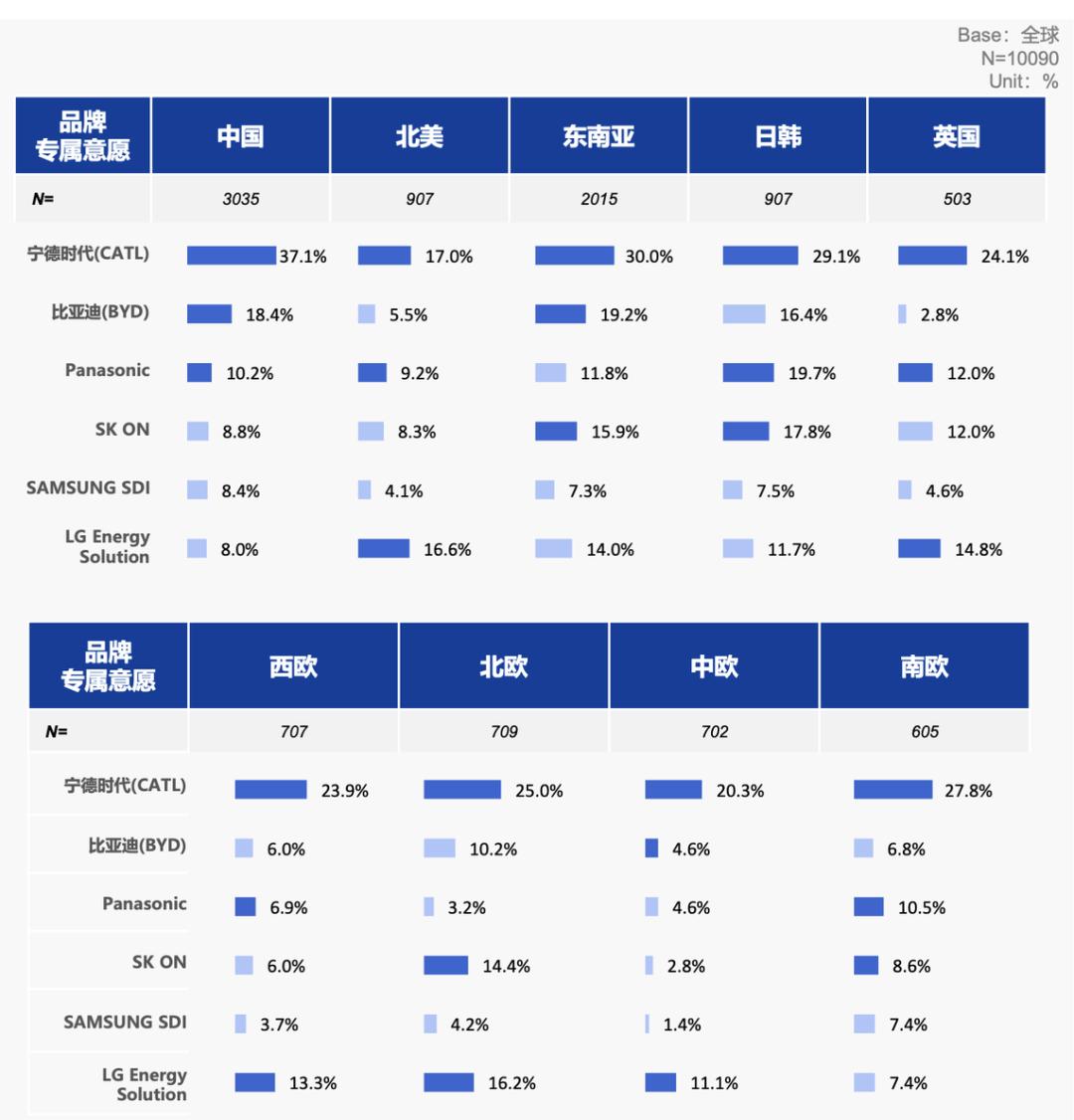
The 2026 Global New Energy Vehicle Consumer Research Report released by NielsenIQ shows that in Chinese consumers' car purchase decisions, the weight of power batteries reaches 13.8%, which is more important than intelligence (8.7%) and driving performance (8.6%), second only to vehicle safety.
The report also shows that CATL's unaided top-of-mind awareness in the Chinese market is 40.9%, and its brand trust degree is 81%; 37.1% of respondents said that if their favorite model is not equipped with CATL batteries, they will give up buying it.
This means that CATL's influence exists not only in the procurement departments of automakers, but also in the cognition of consumers.
The second is technology licensing, which converts manufacturing experience into revenue.
The battery factory built by Ford in Michigan, the United States, adopts a technology licensing model in cooperation with CATL: the factory is owned and operated by Ford, and CATL provides relevant technology licenses, process specifications and training.
This allows CATL to make money not only by producing and selling batteries on its own, but also by exporting manufacturing processes and quality control capabilities. Battery manufacturing not only relies on equipment, but also involves production line commissioning, yield improvement and product consistency, so the long-accumulated process experience has the opportunity to be converted into technical service revenue.
The third is the battery swapping network, extending from selling batteries to operation services.
As of September 29, 2026, CATL's chocolate battery swapping service has built more than 2520 battery swapping stations, covering 200 cities. Many automakers including Changan, Chery, GAC and BAIC have joined its cooperation system.
Battery swapping involves site layout, battery asset management, standard adaptation and user operation. It is relatively easy for automakers to change cell suppliers, but to access the existing battery swapping network, they also need to consider coverage and service capabilities. Thus, CATL has the opportunity to extend a single battery transaction into long-term cooperation. However, the number of stations is only the foundation, and utilization rate and operation efficiency determine whether the network can achieve sustainable profitability.
The fourth is the Rock Chassis, further entering the vehicle development field.