Situated at the southernmost tip of China, this cross-sea high-speed railway is finally up and running.
According to Hainan Special Zone Daily, the Ministry of Ecology and Environment recently publicized the accepted EIA information for construction projects, and the Environmental Impact Report of the new Zhanjiang-Haikou cross-sea ferry and related line project (Zhanjiang-Haikou High-speed Railway) has been officially accepted. At present, the EIA of the project has entered the approval stage. If it is successfully approved, it will lay a solid foundation for the project to start construction at the end of the year. The total investment approved in the feasibility study of the project is 39.97 billion yuan, and the construction period is 4 years.
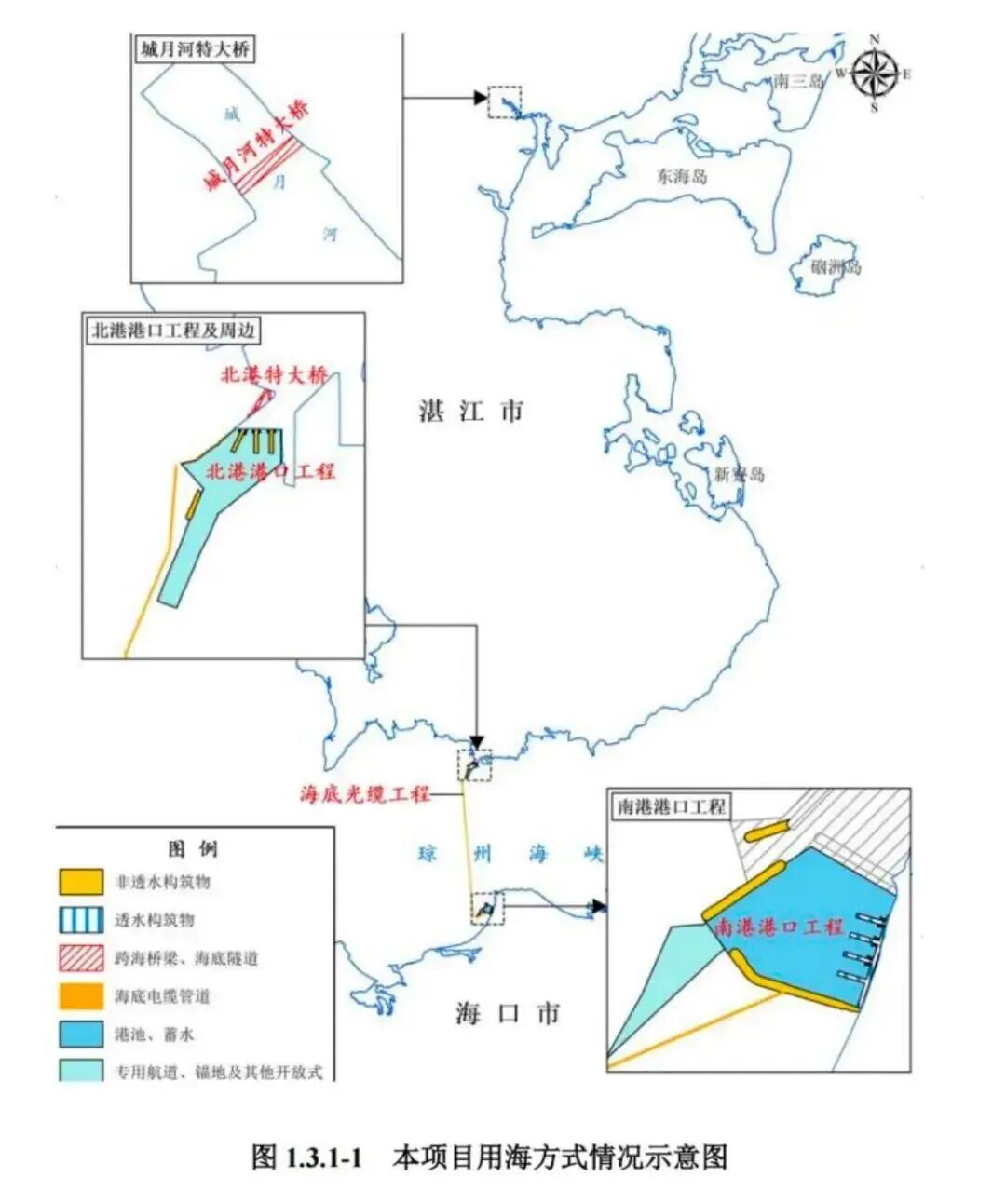
The total length of the new main line on land of the project is 132.904 kilometers, of which 129.102 kilometers is in Guangdong section and 3.802 kilometers in Hainan section. There are no tunnels along the whole line, which is dominated by bridge works, and the designed speed of the on-land main line is 350 km/h. New high-speed railway ports will be built on the north and south banks of Qiongzhou Strait, with 6 30,000-ton passenger-roll berths at each of the north and south ports. The south port is equipped with 2 maintenance berths and 6 30,000-ton two-way navigation passenger-roll ships. The project will adopt the "passengers crossing the sea" mode to realize cross-sea transportation of high-speed railway passengers, and the ships can carry EMU passengers, cars and large trucks.
For a long time, the exchanges between Hainan and other provinces have mainly been through sea and air. It was not until January 2003 that China's first cross-sea railway, the Yuehai Railway, was officially opened to traffic, ending Hainan's history of no connection with railways outside the island.
It should be pointed out that the Yuehai Railway adopts the transportation mode of "two lines and one ferry", that is, the Zhanjiang-Hai'an line is connected to the railway line on the island (Haikou-Sanya) through ferries, which consists of the south and north ports and ro-ro ships. The whole transportation process takes a long time and has limited transportation capacity.
As early as 2014, Guangdong and Hainan provinces had contacted each other about the Zhanjiang-Haikou High-speed Railway, and news came out from time to time afterwards. Especially in recent years, with the development of the Guangdong-Hong Kong-Macao Greater Bay Area and the customs closure operation of Hainan Free Trade Port, the demand for economy and trade, logistics and tourism has grown rapidly, and the demand for unobstructed transportation between the two places has become increasingly urgent ——
Taking the peak holiday period represented by the Spring Festival as an example, statistics show that during the 40-day Spring Festival travel rush this year, the passenger ro-ro transport of Qiongzhou Strait has made a total of 12457 voyages, transporting 4.6523 million passengers and 1.1747 million vehicles, with a year-on-year increase of 13.1%, 11.9% and 10.6% respectively, and the transportation pressure continues to increase.
At present, four new stations will be built along the whole line of the Zhanjiang-Haikou High-speed Railway project, namely Leizhou North Station, Longmen West Station, Xuwen South Station and Haikou North Station, and the existing stations and supporting facilities will be reconstructed simultaneously. As the ferry technical operation hubs, Xuwen South Station and Haikou North Station undertake the functions of EMU waiting for ferry, passenger transfer between train and ship, customs inspection and other functions.
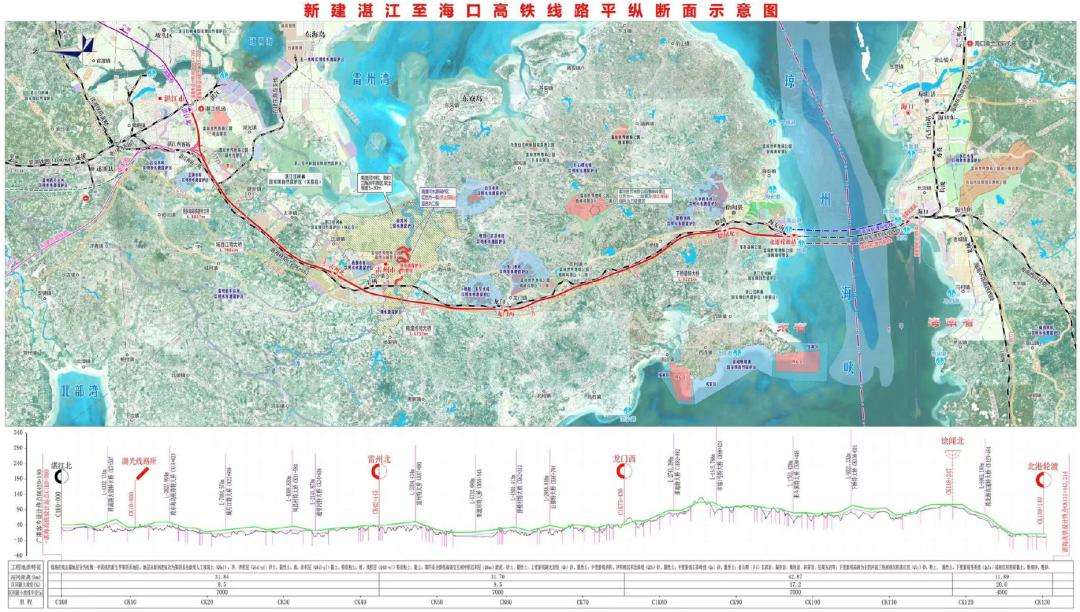
After the project is completed, the travel time from Zhanjiang to Xuwen is expected to be shortened from about 2 hours to less than half an hour, and the travel time from Zhanjiang to Haikou is expected to be shortened from 3-4 hours to less than 2 hours, forming an efficient traffic closed loop across the Qiongzhou Strait.
It is not only efficient. If we look at the Zhanjiang-Haikou High-speed Railway in the context of the national railway network, its corridor effect will be clearer. As an integral part of the Baotou (Yinchuan)-Haikou Corridor in the "Eight Vertical and Eight Horizontal" high-speed railway network, the Zhanjiang-Haikou High-speed Railway starts from Zhanjiang North Station in the north, connecting the Guangzhou-Zhanjiang, Hezhou-Zhanjiang, Jiangmen-Zhanjiang high-speed railways and the Hainan Island Ring High-speed Railway.
After the completion of the Zhanjiang-Haikou High-speed Railway, it will realize the seamless connection between Hainan Island Ring High-speed Railway and the national high-speed railway network, deeply connect the Guangdong-Hong Kong-Macao Greater Bay Area and Hainan Free Trade Port, build a fast channel for resource sharing and industrial coordination between the two places, and promote the pattern of "complementary advantages, differentiated development and win-win collaboration".
This article is from the WeChat official account "Urban Evolution Theory", written by Yang Huan, and published by 36Kr with authorization.