The rear wheel falls off while the car is driving on the road? Carmakers that are busy competing by offering free refrigerators and color TVs as promotional perks must never neglect to prioritize product quality.
"It takes 10 years to build trust, but it may collapse in just a split second."
In the past half month, Chery has recalled nearly 9,000 vehicles in Malaysia due to rear axle detachment, Zunjie has been subject to joint investigation by three government departments over the fracture of its brake pedal bracket, and Lynk & Co has sparked heated public discussion after a vehicle fell off a cliff in Luzhou, Sichuan, with all occupants unharmed and the battery not catching fire. While successive quality defects have been exposed one after another, the safety performance of vehicles in extreme accidents has also been widely noticed.
Both advantages and disadvantages have been placed under the magnifying glass this autumn, making automotive quality an unavoidable topic.
For a car driving at 80 kilometers per hour on the highway, the entire rear axle together with two rear wheels suddenly detaches from the car body and falls into the middle of the road. Right after that, the car sways from side to side due to the loss of rear support, and finally breaks down by the roadside. This is not a thrilling scene in a crime action movie, but a real scenario in the real world.
At noon local time on October 6, in Johor Bahru, the capital of Johor State, Malaysia, a 2023 Chery OMODA 5 (known as "Omoda" in China) fully "reproduced" the above scene. Although no personal injury was caused in the accident, the footage recorded by the dashcam still brought huge visual impact to the public.
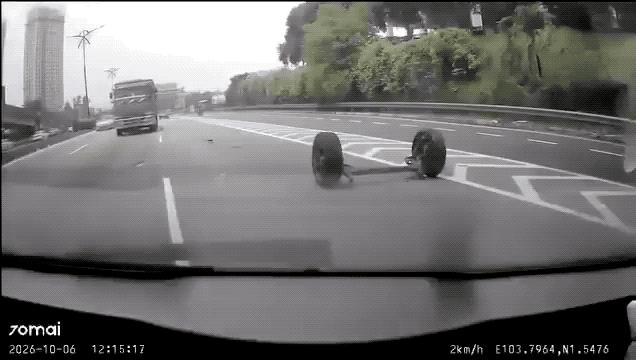
The dashcam footage from the rear of the accident vehicle circulating online fully recorded the thrilling scene of the vehicle losing control after the rear axle detached. (Photo from overseas social media)
The Road Transport Department of Malaysia (JPJ) later intervened in the investigation, announced the suspension of model certification and new car registration for the OMODA 5, and launched a technical investigation into Chery's production line in Malaysia and the rear axle parts supplier. According to reports from Singapore's *Lianhe Zaobao*, OMODA 5 "is not allowed to carry out new car registration or sales" before the completion of the technical investigation.
On the evening of October 11, Chery Automobile released a situation statement through its official Weibo, stating that after investigation, it was found that the welding strength at the local welding position of the rear axle trailing arm of this batch of vehicles was insufficient, and there was a risk of weld seam tearing under extreme conditions. The statement also said that the Malaysian subsidiary has launched a recall procedure for the 8,878 affected OMODA 5 units, and at the same time launched a special risk investigation for the same batch of OMODA 5 in China and relevant markets.
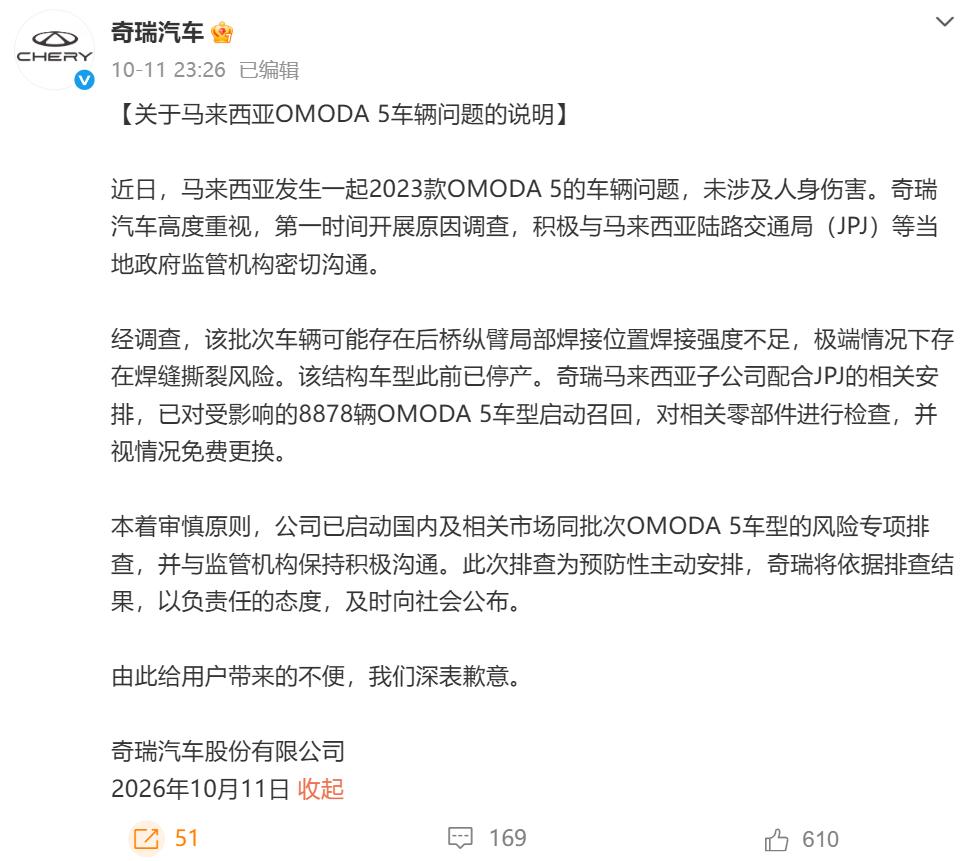
Chery Automobile released an accident statement on its official Weibo, stating that the Malaysian subsidiary has launched a recall procedure and started risk investigation for the same batch of vehicles in China and relevant markets. (Photo from Chery Automobile official Weibo)
The reason why rear axle fracture is so serious is that it does not have premonitory signs like braking and steering systems. It is hidden under the chassis, invisible and untouchable in daily use. Once a problem occurs, it often happens without any warning during high-speed driving. The driver has no time to react before the vehicle may lose control instantly.
At present, the Zunjie brake pedal incident is still evolving, and the Chery incident has added more fuel to the discussion. The superposition of the two incidents has made automotive safety a topic of high public concern in Chinese society this autumn.
Within two years, the same car was "tripped up" by rear axle problems twice
Five days after the incident, Chery released the situation statement in a timely manner, with a fairly fast response and a very low-profile attitude. At least this time, its recall did not make people wait too long.
However, when Chinese and foreign netizens jointly checked the historical records, they found that Chery was not "tripped up" by rear axle problems for the first time.
In April 2024, also in Malaysia, also for the OMODA 5, a rear axle fracture occurred while the vehicle was driving. The investigation found that the problem was in the welding link — after the equipment replaced the welding head, the calibration was wrong, so the welding quality of the rear axles of some vehicles failed to meet the standards.
After the incident, Chery cooperated with JPJ's requirements to recall 600 relevant vehicles, and the investigation found that 60 of them had such problems. All these 60 OMODA 5 units later had their rear axles replaced.
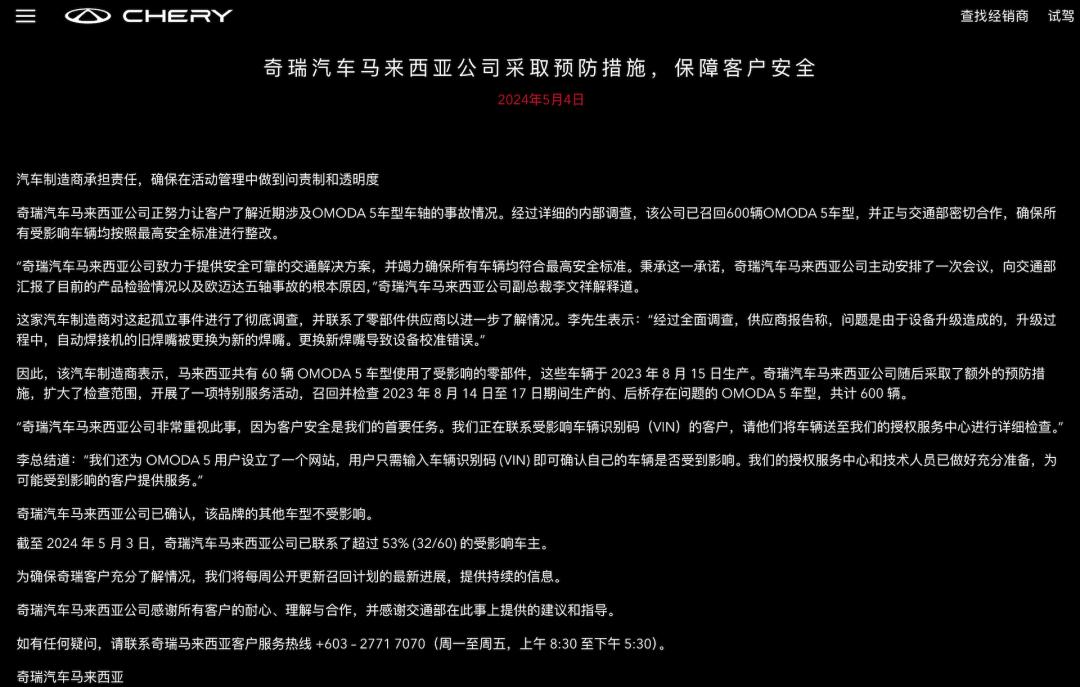
After the rear axle fracture accident in 2024, Chery cooperated with JPJ's requirements to recall 600 relevant vehicles, and the investigation found that 60 of them had such problems. (Photo from Chery Malaysia official website)
Two years later, the same rear axle and the same type of welding strength problem reappeared on the same model in the same market, and the recall scale expanded to 14.8 times that of two years ago. Although it cannot be confirmed at present whether the two incidents are caused by the same manufacturing defect, it is difficult for the outside world not to raise a series of questions:
Was the OMODA 5 that had the accident this time recalled last time, and was it one of the 60 vehicles confirmed to be equipped with problematic parts in 2024?
If it had been recalled and confirmed to have no safety hazards, why did the rear axle fracture still occur?
Did the rectification measures taken by Chery after the last recall really plug the core loopholes of OMODA 5?
……
Under the attention of the outside world, on October 14, Chery Malaysia disclosed the latest progress of the recall through its official website, stating that the first batch of spare parts has been shipped and will be delivered to all authorized service centers one after another. The statement also said that Chery has locked the list of relevant vehicles and will arrange for car owners to go to the stores for replacement through active invitation.
Public information shows that OMODA 5 is one of Chery's global strategic models. Since its official launch in July 2022, it has been sold in more than 40 countries around the world, with cumulative sales exceeding 250,000 units.
In China, the Omoda, which focuses on youthful and technologically-oriented design, has an official guide price starting from 79,900 yuan, but the low price has not been converted into considerable sales. At present, Omoda has been out of sale in China, and from its launch in 2022 to its discontinuation in 2024, the cumulative sales volume is only about 17,200 units.
However, in overseas markets, OMODA 5 is a well-deserved "light of domestic products". When Chery re-entered the Malaysian market in 2023, OMODA 5 was one of the first launched models, helping Chery gain a firm foothold in the Malaysian market.
According to data disclosed by Chery Malaysia, by the end of 2025, Chery's cumulative car sales in Malaysia exceeded 30,000 units, ranking among the fastest-growing automotive brands in Malaysia; and in the whole year of 2025, Chery delivered 12,930 new cars to Malaysian customers.
According to data from the ASEAN Automotive Federation (AAF), in the first nine months of 2026, Chery's new car registration volume in Malaysia was 7,958 units, ranking 10th in the brand list. According to reports from Malaysian automotive media Paultan, OMODA 5 has actually been out of production in Malaysia, replaced by the new model CHERY O5 released in September 2025. Compared with the old model equipped with a torsion beam rear suspension, the new model uses a multi-link independent suspension for the rear axle, which is better in terms of stability and comfort.
In other words, JPJ's announcement to suspend the model certification and new car registration of OMODA 5 will not prevent other Chery models from continuing to sell in Malaysia. But the impact caused by this rear axle detachment accident is probably impossible to calm down with just a few situation statements.
Chery, the earliest "king of Chinese automotive exports"
When the rear axle detachment accident occurred, it was at a critical node when Chery proposed a new global automotive strategy. On October 7 this year, Chery Automobile adjusted the division of responsibilities of domestic and overseas business and brand leaders, and integrated the main Chery brand into the global market system as a whole.
Some people interpret this move of Chery as a change in management mode, that is, globalization is no longer the responsibility of a certain department under the group, but the business of Chery Automobile itself. Different from most Chinese independent automotive brands, Chery's business focus has long been shifted to overseas markets.
The 2026 interim performance released by Chery in August this year shows that in the first half of the year, Chery Automobile achieved a revenue of 143.28 billion yuan, with a total of 1.2751 million cars sold, of which overseas market revenue was 98.968 billion yuan, accounting for 69.1% of the total revenue; 940,000 cars were exported, and overseas sales accounted for more than 70% of the total.
Most people are familiar with the fact that the wave of Chinese auto exports has been concentrated in recent years, but this well-known car company headquartered in Wuhu, Anhui Province, started its overseas expansion earlier than many Chinese independent brands — in 2001, the first batch of 10 Chery Fengyun sedans set off from Tianjin Port and were sold to Syria by sea.
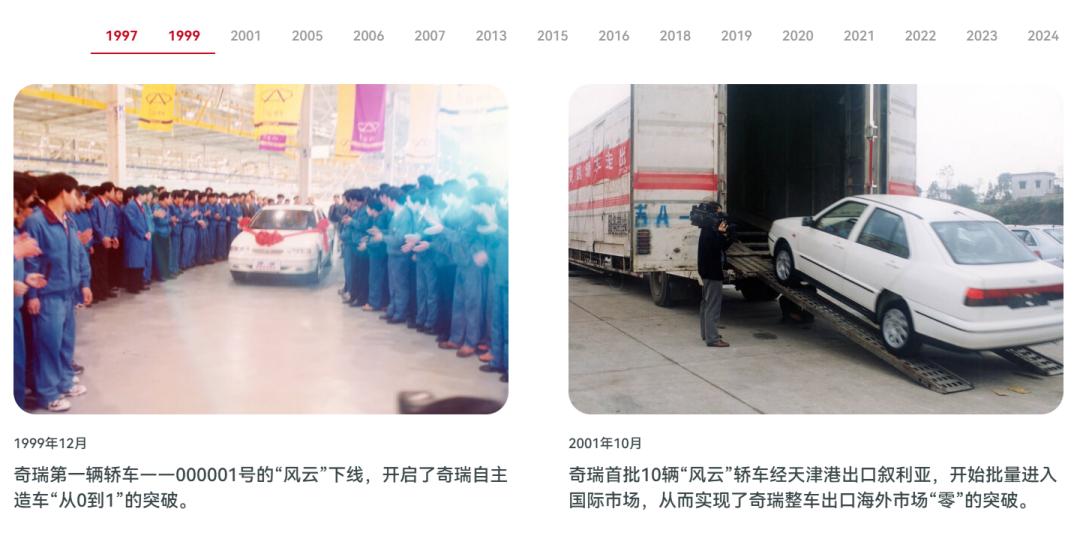
When Chery made its first overseas expansion, less than 2 years had passed since the first Fengyun sedan rolled off the production line. (Photo from Chery official website)
Since 2003, Chery has put into production CKD factories overseas, spreading from Iran to Egypt, Brazil, and Russia. Its factories have been built on almost all continents in the world, and its auto export volume has been rising steadily. Many car companies have followed this path. Its title of "king of Chinese automotive exports" has also been surpassed by BYD in recent years.
Overseas expansion for local car companies is a profound knowledge. Chery, which has been going global for more than 20 years, has its own unique secret. Chery once summarized it as "In Somewhere, For Somewhere, Be Somewhere". In addition to leaving industries and jobs locally, it also integrates localized adaptation into the production of every car. For example, it adjusts the parameters and power of the engine according to the actual situation, selects materials that meet local standards, to adapt to the local auto sales rhythm and regulatory requirements.
Building cars according to this idea is obviously a required course for Chinese car companies to gain a firm foothold in overseas markets. However, the challenges faced by Chinese cars overseas are far more than just making good cars. The automotive markets in the European Union and Southeast Asia are mature, and their regulatory systems are relatively complete; the markets in the Middle East, Latin America, and Africa have broader prospects, but their regulatory rules are uneven.
The various quality supervision modes also lead to different consumer rights protection awareness in different regions. In markets with strict supervision and strong consumer rights protection awareness, once a car has a major safety defect, the impact on recall cost, penalty intensity, brand image, and even used car residual value and dealer confidence is far greater than that in China, and may even spread to other regions.
After all, in essence, automobiles are always transportation tools for carrying people, and safety is the bottom line of trust in any scenario. Once consumers lose confidence in automotive quality, no matter how strong the statements are, they often won't help.
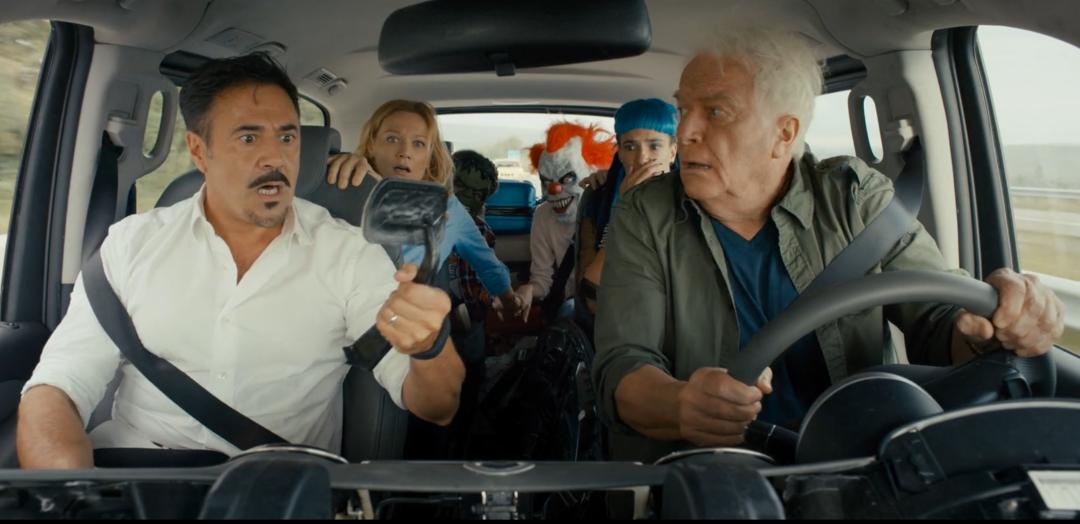
Automobiles are essentially transportation tools for carrying people, and safety is the bottom line of trust in any scenario. (Photo from *Non-Stop to the North*)
In the words of Li Bin, founder and CEO of NIO: "It takes 10 years to build trust, but it may collapse in just a split second."
When Chinese car companies go global, what they need to focus on most is not just safety
Although it has been out of production, Chery OMODA 5, which is now in the center of public opinion, is making Chery face a huge trust test. Whether Chery can get through this level is related to the transparency of the subsequent investigation of this accident, the execution of the recall, and the feedback of local car owners.
If this was just an isolated incident, the public outcry might have dissipated long ago; but this autumn, emergencies around Chinese automotive safety have occurred one after another, and Chery's rear axle detachment accident in Malaysia is only one of them.
Before that, there was the incident of the Zunjie brake pedal breaking, followed by Chery's rear axle detachment accident in Malaysia. The two incidents occurred one after another. Although they are independent of each other, they both point to the same problem: why do such serious defects appear in the core hardware of Chinese domestic cars? Is the safety performance of the car reliable?
It is not a childish act that can be fooled by a phrase of "free upgrade" for car companies to make things clear and take the initiative to recall and investigate, which is not only a conventional operation but also a legal obligation.
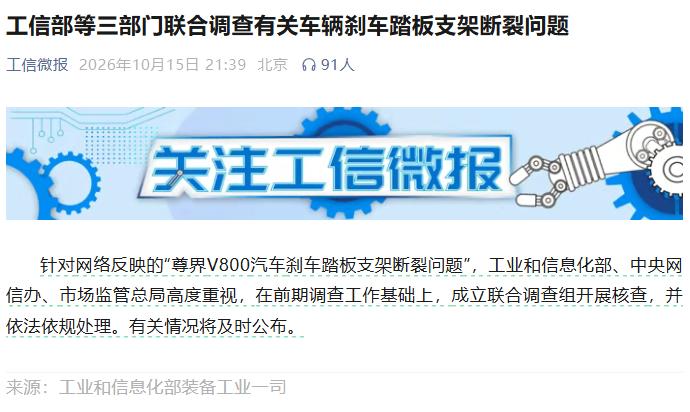
The Ministry of Industry and Information Technology, the Cyberspace Administration of China, and the State Administration for Market Regulation have now set up a joint investigation team to verify the fracture problem of the brake pedal bracket of the Zunjie V800 vehicle. (Photo from the official WeChat account of MIIT News)
As overseas expansion becomes an option for more and more Chinese car companies to develop markets, many people think of the painful lesson of Chinese motorcycles' failure in Southeast Asia.
In the late 1990s, domestic motorcycle brands such as Loncin, Jialing, and Zongshen successively entered Southeast Asia, seizing 80% of the market share with extremely low prices of 500-700 US dollars. However, the competitive logic of seizing