Kuaiji, Shangji, Bibu: Three Thousand Years of Auditing System
During the just-concluded National Day holiday, the topic "Former China Telecom employee reports executives for embezzling 38 million yuan in fiscal funds under real name" topped the Weibo hot search list. Although China Telecom responded on October 6 that the reported content had been verified internally in 2024 and was "inconsistent with the facts", countless netizens still hoped to wait for the final result. The public resonates with this incident because it hits three pain points: fiscal fund security, internal supervision of central enterprises, and whistleblower protection. What auditing practitioners see is another hidden pain — when the internal audit line of defense fails, the problem can only be forced to be solved at a higher cost of full-network public opinion and disciplinary inspection and supervision intervention.
In fact, this game of "money, power and supervision" has been staged on the land of China for thousands of years. From the "Kuaiji" where Dayu gathered feudal lords to assess their achievements, to the "Bubu" in the Tang Dynasty that was responsible for auditing all revenues and expenditures across the country, to the National Audit Office known as the "special forces" of economic supervision today — what has changed is technical tools, and what remains unchanged is the original aspiration to be responsible for public funds and check and balance power. This history is an important part of China's economic governance history.
In this article, we discuss four questions:
First, how did China's audit system evolve from ancient times to modern times?
Second, what is the relationship between regime governance, regime change and the audit system?
Third, what are the widely praised audit stories in the long history?
Fourth, what is the impact of the time-honored audit system on contemporary China?
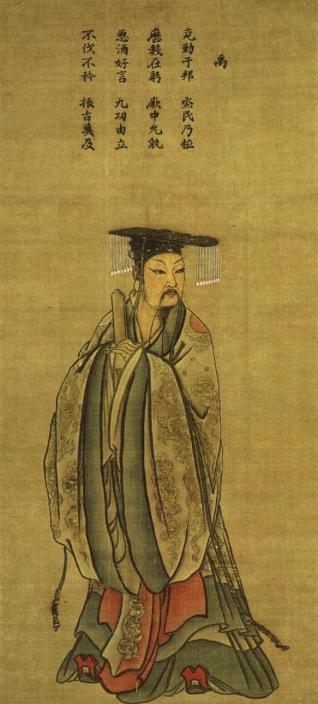
Figure 1: Portrait of King Yu of Xia painted by Ma Lin of the Southern Song Dynasty. The place "Kuaiji" where Dayu gathered feudal lords and assessed their achievements is regarded as the germination of Chinese audit thought.
I. Changes of the Audit System
The origin of ancient Chinese audit is often traced back to a mythical place name — "Kuaiji". According to *Historical Records · Xia Benji*, "Since the Yu and Xia dynasties, tributes and taxes have been well established. Some people say that Yu gathered feudal lords in the south of the Yangtze River, assessed their achievements and then passed away there, so he was buried there, and the place was named Kuaiji. Kuaiji means accounting." It means that Dayu gathered feudal lords in the south of the Yangtze River, was buried there after assessing their achievements, and the place name "Kuaiji" contains the meaning of gathering and assessment. The main object of "Kuaiji" at that time was "tributes and taxes", which is regarded as the germination of Chinese audit thought.
The Shang Dynasty advocated sacrificial rites and divination, and the character "sheng" which means inspection and observation appears many times in oracle bone inscriptions. The contents of "sheng" include cattle, fish, fields, granaries, millet, etc. These records are regarded as traces of audit activities in the Shang Dynasty.
In the Western Zhou Dynasty, there was a clear symbol of national audit — the post of "Zaifu" appeared, which was responsible for inspection and audit work. According to *Rites of Zhou*, Zaifu "takes charge of the legal system to assess the governance of all government offices, capitals, counties and suburbs, and checks the income and expenditure of their property. Anyone who loses property and goods or makes false accounts shall be reported to the prime minister by official punishment and punished. Those who make full use of resources, increase wealth and manage goods well shall be rewarded..." In addition to Zaifu, officials such as Dazai, Xiaozai and Sihui all performed audit supervision functions to varying degrees.
In order to ease social conflicts and consolidate the ruling position of the royal family, the rulers of the Western Zhou Dynasty ordered the minister Lü Hou to formulate criminal laws under the order of King Mu of Zhou, and restrained all officials with the thought of "valuing virtue and cautiously applying punishment" to strengthen political assessment and economic supervision. *Lü Xing* written by Lü Hou is the earliest existing monograph on criminal law in the history of our country. The book points out the phenomenon of "five excesses" in judicial activities at that time, namely "partiality for official connections, revenge for personal grievances, partiality for relatives, taking bribes, and yielding to personal requests". "Partiality for official connections" means officials protect each other and enforce the law unfairly; "revenge for personal grievances" means taking advantage of handling cases to repay gratitude or resentment; "partiality for relatives" means case handlers favor their close relatives; "taking bribes" means case handlers extort property; "yielding to personal requests" means accepting others' entrustment and bending the law for personal gain. *Lü Xing* requires that the above behaviors of seeking personal gain by taking advantage of power, offering and taking bribes should be "punished equally", that is, punished the same as the offenders.
From the Spring and Autumn and Warring States periods to the Qin and Han dynasties, the rise and fall of the Shangji audit system was recorded. With the transformation from the enfeoffment system to the centralized prefecture and county system, the "Shangji" system adapted to centralization of power came into being. Although the official systems of various countries are not exactly the same, a group of officials from the central government to the local government assisted the monarch to participate in Shangji, such as Neixiang, Neishi and Yushi. As the head of all officials, one of the main responsibilities of the prime minister is to assist the monarch in supervising national financial affairs and assessing all officials.
The Shangji audit is divided into three steps:
The first step is to make the voucher. Before the new year, the main officials of all regions and departments write the budget figures for the next year on wooden vouchers and present them to the monarch. The monarch divides the wooden voucher into two parts, the officials keep the left voucher to act, and the king keeps the right voucher for standby.
The second step is to submit the accounting books. At the end of the year, the main officials of all regions and departments report their work conditions within the year to the monarch.
The third step is the monarch's hearing of the report. The monarch reviews the accounting books according to the right voucher, and makes decisions on the appointment, removal, promotion, demotion, reward and punishment of officials accordingly. For the accounting books with doubts, the monarch will send personnel to inspect on the spot.
During the Qin and Han dynasties, the Shangji system was widely promoted and developed maturely. Since the Qin Dynasty, the Censor Supervision and Audit System was established, which lasted for more than 2000 years until the end of the Qing Dynasty. In the Han Dynasty, not only the post of "Jixiang" was specially set up, which was held by Zhang Cang who was proficient in arithmetic, but also the special regulation *Shangji Law* closely related to audit was promulgated. Liu Che, Emperor Wu of the Han Dynasty, attached great importance to the role of supervision. According to *Han Shu · Annals of Emperor Wu*, Emperor Wu of the Han Dynasty presided over four acceptance ceremonies of Shangji in his capacity as emperor. He also set up the new post of Chengxiang Sizhi, whose main responsibility is to assist the prime minister to discover and report the illegal acts of all officials. However, in the late Eastern Han Dynasty, due to the dictatorship of relatives of the emperor and eunuchs and the corruption of the bureaucratic system, the Shangji system gradually declined, and the audit function also weakened accordingly.
From the Wei, Jin, Southern and Northern Dynasties to the Sui and Tang Dynasties, "Bubu" rose and reached its peak. During the Wei, Jin, Southern and Northern Dynasties, various regimes began to set up "Bubu". Although its subordinate relationship swung between the Ministry of Civil Affairs, the Ministry of Revenue and the Ministry of Justice, it had partially performed the audit function. In the Tang Dynasty, Bubu was subordinate to the Ministry of Justice, engaged in full-time audit work and developed to the peak. In the Tang Dynasty, Bubu "was in charge of auditing all revenues and expenditures including tributes and taxes, funds, salaries... as well as military supplies and equipment". The warehouses in the capital were audited every three months, and all prefectures made a general audit at the end of the year, with a very wide audit scope. However, after the Anshi Rebellion, the centralization of power was weakened, and the function of Bubu gradually shrank. It could only audit part of the taxes retained in prefectures, and no longer had the national financial audit power.
From the Song Dynasty to the Ming and Qing Dynasties, audit institutions were gradually virtualized and transformed. The Southern Song Dynasty changed the "Special Audit Department for All Armies and Agencies" to "Audit Department" (later called Audit Academy), from which the term "audit" officially became a special noun for financial and fiscal supervision. However, the Yuan, Ming and Qing dynasties basically did not set up special audit institutions, and most of the audit functions were merged into the censor supervision system, which was in a period of decline.
After the 1911 Revolution, the modern audit system began to sprout. In 1912, the Beiyang Government set up the "Audit Office", and in 1914, it was changed to "Audit Academy" and promulgated the *Audit Law*. During the period of the Nationalist Government, the Ministry of Audit was subordinate to the Control Yuan, and the completeness of audit regulations reached an unprecedented level. However, due to the lack of a stable political foundation and constitutional support, the audit system often became a tool for partisan disputes. For example, in the "Jiangsu Eight Percent Public Debt Case" in the early Republic of China, although the Audit Office found out the account problems of the Jiangsu Provincial Government in the mortgage of debt certificates, it was eventually marginalized due to political intervention. During the Liberation War, the audit institutions were even "nominal", and there were even farces such as the director of the Jiangxi Provincial Audit Office taking bribes while supervising bidding, and Guangdong civil servants attacking the Audit Office.
After 1927, in the revolutionary base areas led by the Communist Party of China, the audit system became an important tool to consolidate the red regime. In 1934, the *Audit Regulations of the Executive Committee of the Central Government of the Chinese Soviet Republic* was promulgated. After the founding of the People's Republic of China, audit was once replaced by accounting inspection. It was not until the Audit Supervision System was established by the Constitution in 1982 and the National Audit Office was established in 1983 that China's modern audit got on the right track. In 2018, the Central Audit Committee was established, marking the systematic and overall reconstruction of the audit management system, and building an audit supervision system that is "unified, fully covered, authoritative and efficient".
II. Audit and the Governance Capacity of the Central Government
The rise and fall of the audit system is highly positively correlated with the governance capacity of the regime and the degree of centralization of power. From Bubu in the Tang Dynasty to the Audit Department in the Song Dynasty, from the Kedao system in the Ming Dynasty to the public audit of the Soviet Republic, to today's Central Audit Committee — after 3000 years, a logic is becoming clearer and clearer: the independence of audit does not depend on the integrity of honest officials, but on institutional design. Power needs checks and balances, and supervision needs independence, which is the common code for all regimes to maintain long-term stability.
In the early Tang Dynasty, the reason why Bubu could "audit all revenues and expenditures across the country" was that it was supported by strong centralization and complete laws. However, after the Anshi Rebellion, the feudal towns were separatist, and the finance was diversified. Bubu lost the audit foundation, and its authority was greatly reduced. This confirms that the independence of audit depends on the centralized and unification of politics.
The Song Dynasty made a more bold attempt — to "separate" audit from the financial system.
In the early Northern Song Dynasty, the national financial accounting was under the control of the three departments of Salt and Iron, Expenditure and Household Registration. Under the three departments, each set up a "Check Court" responsible for checking the national revenue and expenditure accounts. In other words, the people in charge of money and the people in charge of checking accounts worked in the same yard — this is called "integration of finance and audit". During the Yuanfeng period of Emperor Shenzong of Song (1078-1085), the Yuanfeng official system reform carried out by Shenzong spread to the audit field: The imperial court restored and developed the functions of Bubu of the Ministry of Justice, put the final financial audit power under the judicial system, and implemented the external audit system of "separation of finance and audit". In the first year of Jianyan of the Southern Song Dynasty (1127), in order to avoid the name taboo of Zhao Gou, Emperor Gaozong of Song, the "Special Audit Department" of all armies and agencies was renamed "Audit Department" (also known as Audit Academy), which became the first full-time institution named "audit" in the history of Chinese audit.
Audit in the Song Dynasty also had its fatal flaw. During the period of the three departments, the audit institutions "were set up and abolished with the will of the chief financial and accounting officials", lacking stability. According to *History of Song Dynasty*, in the fifth year of Xining (1072), Zeng Bu set up the Accounts Supervising Department to clean up the backlog of accounts. "After seven or eight years, there were only 600 officials, costing 390,000 min of money, but the lost money checked out was only 10,000 min" — the input-output ratio was seriously unbalanced.
At the beginning of the Yuan Dynasty, the official system followed the Han system. The central government set up the Zhongshu Province to take charge of government affairs, the Privy Council to take charge of military affairs, and the Censorate to take charge of supervision. On the surface, the audit supervision power is shared by multiple departments such as the Censorate, the Branch Censorate, the Left Department, and the six ministries, which seems to be "multi-departmental check"; but in fact, this decentralization means that no department is really responsible for audit. Although the local government set up the Branch Censorate to lead the local audit, audit was no longer an independent institutional force, but an appendage of the supervision power. After the bold attempt of China's audit system in the Song Dynasty, it declined significantly in the Yuan Dynasty — this history reminds us: once the audit power is split too much, supervision will become "everyone is responsible, but no one is responsible".
Zhu Yuanzhang, the Taizu of the Ming Dynasty, came from the bottom and knew that the corruption of officials in the late Yuan Dynasty was the root cause of the country's subjugation. After he came to power, he focused on reconstructing the supervision system: in the 15th year of Hongwu (1382), the Censorate was changed to the Metropolitan Procuratorate. Before that, in the 6th year of Hongwu (1373), the "Six Sections Supervising Secretaries" had been independently set up, forming a "Kedao Dual-track" pattern in which the Metropolitan Procuratorate and the six sections stood side by side, did not belong to each other, and restricted each other.
The subtlety of this design is the separation of powers. The Metropolitan Procuratorate focuses on investigating officials all over the country, and the 13 Circuits Supervising Censors focus on supervising localities; the Six Sections Supervising Secretaries supervise the six central ministries in a targeted manner, and are directly responsible to the emperor. Among them, the Household Section Supervising Secretary is responsible for "checking and canceling" various revenues and expenditures of the Ministry of Revenue, such as land tax, grain transported by water, salt tax, official salaries and military pay. The Engineering Section Supervising Secretary is responsible for auditing the engineering construction expenses of the Ministry of Works. What's more, the Six Sections Supervising Secretaries do not receive salaries from the six ministries, but from the General Administration of Transmission, and their working lunches are provided by the Imperial Household Department — Zhu Yuanzhang even thought of "who pays the salary", for fear that the auditors would be "familiar with" the supervised objects.
The lack of independence is the structural defect of Ming Dynasty audit. After the early Ming Dynasty abolished "Bubu", no independent audit institution was established again. The Ministry of Revenue was in charge of both financial revenue and expenditure and financial supervision. Although the Metropolitan Procuratorate and the six sections had the audit and supervision power over the Ministry of Revenue, the Ministry of Revenue in turn also had the financial audit power over the Metropolitan Procuratorate. It seemed that they restricted each other, but in fact, neither side was thorough. Hai Rui once served as the governor of ten prefectures in Yingtian, inspected warehouses and checked money and grain. He was a model of honest officials among the supervising officials in the Ming Dynasty — but such characters were rare after all, and the innate deficiency of the system itself could not