Reaching 92.5 billion US dollars in the first three quarters, global private financing for commercial aerospace is expected to break through the 100-billion-dollar mark for the first time.
The Commercial Space Investment Boom: Where Does China Stand Globally?
On October 13, early-stage venture capital institution Space Capital released its Q3 report, noting that global private financing for commercial aerospace is expected to exceed 100 billion U.S. dollars for the first time in history this year.
This institution has been tracking aerospace investment data since 2017 and publishes the "Space IQ" (Quarterly Space Investment Report) every quarter. It currently operates one of the longest-running consecutive private aerospace investment datasets in the industry.
A rather inconspicuous line in the report, "China's financing in the space infrastructure sector in the first three quarters has reached 2.7 times the full-year figure of 2025", is listed as the first highlight in Asia.
How this 2.7x figure is calculated and where domestic companies rank on this list are the most noteworthy questions for readers to unpack in this report.
Space Capital is an early-stage VC focused on the aerospace track. It has published the Space IQ report quarterly since 2017, breaking down global private financing invested in commercial aerospace companies into three tiers for statistics: Infrastructure (launch, satellite manufacturing, ground equipment), Distribution (constellation operation, communication network), and Application (remote sensing data, navigation services, downstream scenarios).
Chad Anderson, its CEO, is the primary author. The "investment" metric in the report refers to private financing from VCs and sovereign funds invested in startups, not secondary market market capitalization.
To understand the scale of this year's market, we need a historical reference frame.
Anderson said: "We all thought 2021 was a crazy market, but compared to now, that year was just a tiny blip."
The 2021 boom was driven by SPAC backdoor listings, and many companies failed to deliver on their performance promises after going public, leading to a sharp drop in their share prices.
This round is completely different. This summer, SpaceX completed its $85.7 billion IPO, marking the largest exit in the history of venture capital.
In the second quarter alone, $31.6 billion flowed to 129 aerospace companies. With sovereign funds and defense spending providing underlying support, the industry is seeing an influx of cash and government orders.
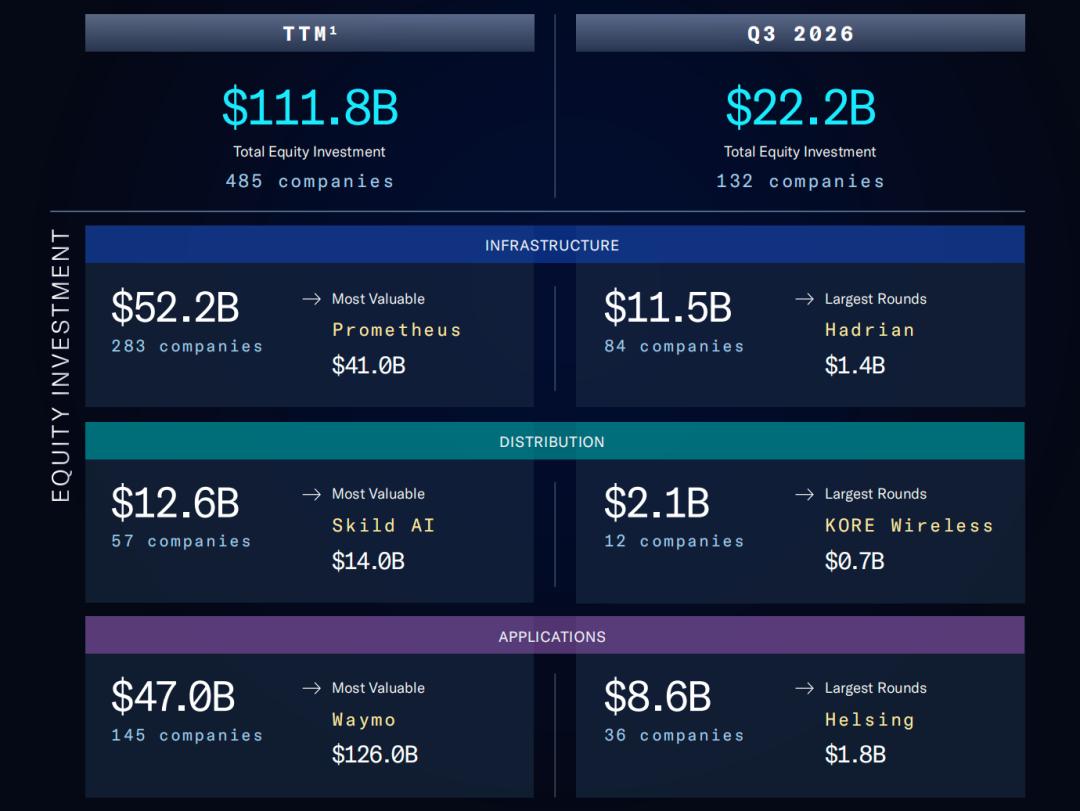
The total global private financing for commercial aerospace in the first three quarters reached 92.5 billion U.S. dollars, with 22.2 billion in the third quarter alone, covering the three tiers of infrastructure, distribution and application.
Among them, pure launch companies are the most sought-after, raising a total of 7.8 billion U.S. dollars across 58 financing rounds, setting a new record for this segment. The number of aerospace companies reaching unicorn level also hit a new high over the same period.
In terms of representative transactions, SpaceX's $85.7 billion IPO is listed separately as a public market deal. On the private financing metric, the two largest deals in the space infrastructure sector this year are Blue Origin and Stoke Space respectively.
In September, Blue Origin completed its first external financing round in the 26 years since its founding, raising 10 billion U.S. dollars with a post-money valuation of approximately 140 billion U.S. dollars.
Jeff Bezos personally invested 2 billion U.S. dollars in the round, and hedge fund Coatue subscribed for approximately 4 billion U.S. dollars. The company plans to resume the flight of its New Glenn rocket before the end of the year after its failed launch in May.
On September 8, Stoke Space announced the first close of its Series E round, raising 1 billion U.S. dollars and bringing its total accumulated financing to 2.3 billion U.S. dollars. Its Nova rocket targets full two-stage reusability, with an actively cooled metallic heat shield on the upper stage, belonging to the same generation as SpaceX's Starship.
In addition, the two lines of regional distribution and mergers & acquisitions are also quite clear.
European companies raised 6.3 billion U.S. dollars in financing in the third quarter, accounting for 28% of the global total; in Asia, China's space infrastructure financing in the first three quarters reached 2.7 times the full-year figure of 2025, driven by super-large financing rounds from commercial satellite manufacturers.
The report shows that in the first three quarters, strategic acquirers and tech giants completed a total of 92 acquisitions with a total expenditure of 17.4 billion U.S. dollars, and the full year is expected to become the busiest year in the history of aerospace M&A.
Rocket Lab is pending the acquisition of Iridium Communications, Amazon is pending the acquisition of Globalstar, and SpaceX has just acquired Mesh Optical, a startup founded by former Starlink engineers that emerged from stealth mode only a few months ago.
Why is there a financing boom for commercial aerospace companies other than SpaceX right now?
Because SpaceX stopped accepting rideshare launch orders for post-2028 missions in July, prioritizing launch capacity for its V3 Starlink constellation deployment and Starship rollout, pushing commercial rideshare to the margins within the company.
The "launch capacity shortage" is forcing the market to look for second-tier players, which has led to the large financing rounds for Stoke Space and Blue Origin. The $85.7 billion IPO has revalued the valuation anchor of the entire sector, while defense spending and sovereign constellations form the government-side underlying support.
Anderson said: "This is the best thing that has happened to the launch industry in a decade, and this is exactly how the second, third and fourth place players emerge."
China's financing in the space infrastructure sector in the first three quarters has reached 2.7 times the full-year figure of 2025. Per the report's metric, this "2.7 times" figure refers to the "space infrastructure" track, with the main driving force being super-large financing rounds from commercial satellite manufacturers.
There are quite a few corresponding events in China arranged in chronological order.
In February, i-Space completed its 5.037 billion yuan D++ round of financing, setting a new record for the largest single-round financing of a Chinese private rocket company. In August, it completed the first tranche delivery of its nearly 1 billion yuan Series E round. Arrowspace Technology raised more than 2.3 billion yuan in cumulative financing over the past six months. Other players including LandSpace, CAS Space, Galactic Energy, and Space Pioneer are also lining up for IPOs.
Why are rocket companies like i-Space included in the infrastructure category? Because the report lists launch capacity itself as part of infrastructure. Chinese private rocket companies are engaged in both launch services and satellite platform development at the same time, which is different from the market segmentation in the U.S. aerospace track.
When we map China's domestic progress into Space Capital's three-tier framework of "Infrastructure - Distribution - Application", the structure becomes much clearer.
Infrastructure Layer: The Hainan Commercial Space Launch Site has been put into operation. The Long March 12 rocket successfully launched 27 groups of SatNet low-orbit satellites on October 10. Private rocket companies are lining up for IPOs, and the launch and launch capacity sector is being rapidly expanded.
Distribution Layer: SatNet plans to build a 12,000-satellite constellation, and the Qianfan constellation is under continuous deployment. The corresponding "satellite manufacturing + constellation operation" sector is exactly the main source of the 2.7x increment.
Application Layer: Large-scale application of BeiDou, remote sensing data services, and low-altitude economy eVTOL are being gradually implemented, but a fully closed commercial loop has not yet been achieved.
The 2.7x increment is mainly concentrated in the infrastructure and distribution layers, while the application layer remains a valuation depression, which is the area where domestic companies can truly create competitive differentiation in the next stage.
The structures are similar, but the development paths are not identical. Restricted by export controls on dual-use items, Chinese rockets cannot directly take over third-party launch orders spilled over from SpaceX in the short term. The actual opportunities lie more in sovereign constellation clients in the Global South and the Middle East, as well as exports of satellite manufacturing and ground equipment.
This is exactly the window for China to expand its "distribution layer": wherever constellation clients are located, orders for satellites and ground equipment will follow.
Anderson warned that some companies that have received financing now have their entire business model built on the assumption that "Starship will open up its launch capacity in the future", and "I have no idea when they will make that capacity available".
The mismatch between high valuations and first flight timelines is a widespread hidden risk, and the New Glenn failure in May is the most recent example.
The valuations of Chinese domestic rocket companies are also built on the assumption that "the deployment density of SatNet and Qianfan constellations will continue". Once the constellation deployment pace is adjusted, the valuation anchor will loosen.
Data source of this article: Space Capital 2026 Q3 Space IQ Report
This article is from the WeChat official account "Xingdong Wuji", author: UniLym, published by 36Kr with authorization.