Are Tencent, Alibaba and ByteDance starting to besiege Ctrip?
Recently, Tencent, Alibaba and ByteDance have been making intensive layouts for Personal Agent, all aiming to become users' private AI butlers.
Seeing these news, I suddenly thought of a question:
If in the future everyone has their own AI butler that can directly help us book flights, hotels, hail taxis and plan trips, how much necessity does an independent App like Ctrip still have to exist?
Let's take an example.
I plan to take my family to Chengdu for a three-day trip next month. In the past, I might first go to Xiaohongshu to find travel guides, then open Ctrip to compare flights and hotels, then use Gaode Map to check routes, and finally study attraction tickets and local food.
After all that trouble, I might not even have booked the hotel properly.
What about in the future?
I can just tell my AI butler directly: "Find a weekend next month and arrange a 3-day-2-night family trip to Chengdu for me. Don't book flights too early, the hotel should be clean, preferably near the subway, and the total budget should be controlled within 5000 yuan."
The AI will automatically query flights, compare hotels and plan routes based on my travel habits, and finally provide me with a complete set of plans. After confirmation, it will help me complete the bookings of flights, hotels and attraction tickets.
Even before departure, it can remind me of the weather, help me check in, and track flight changes. In case of flight cancellation, it will actively find alternative solutions.
Although it is not possible to guarantee that the above process is fully automated at present, the technology is developing in this direction.
Throughout the whole process, I may not need to open Ctrip even once.
But interestingly, the flights and hotels I book may still come from Ctrip.
This is a bit awkward.
Over the past two decades, Ctrip has been working hard to help users form a habit: open Ctrip immediately when you need to go on a business trip, travel, or book flights and hotels.
Now big AI companies come, and this habit may be changed with just one sentence.
01 Are Tencent, Alibaba and ByteDance starting to take business away from Ctrip?
Chinese tech giants have indeed made quite intensive moves in the Personal Agent direction.
Let's look at ByteDance first.
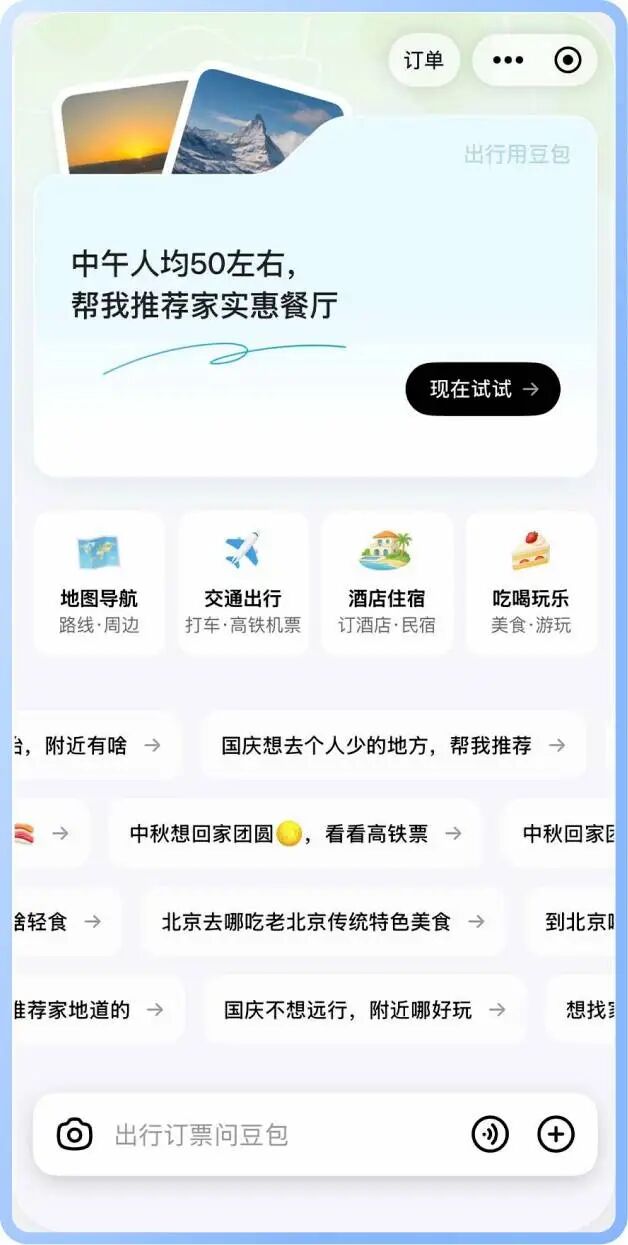
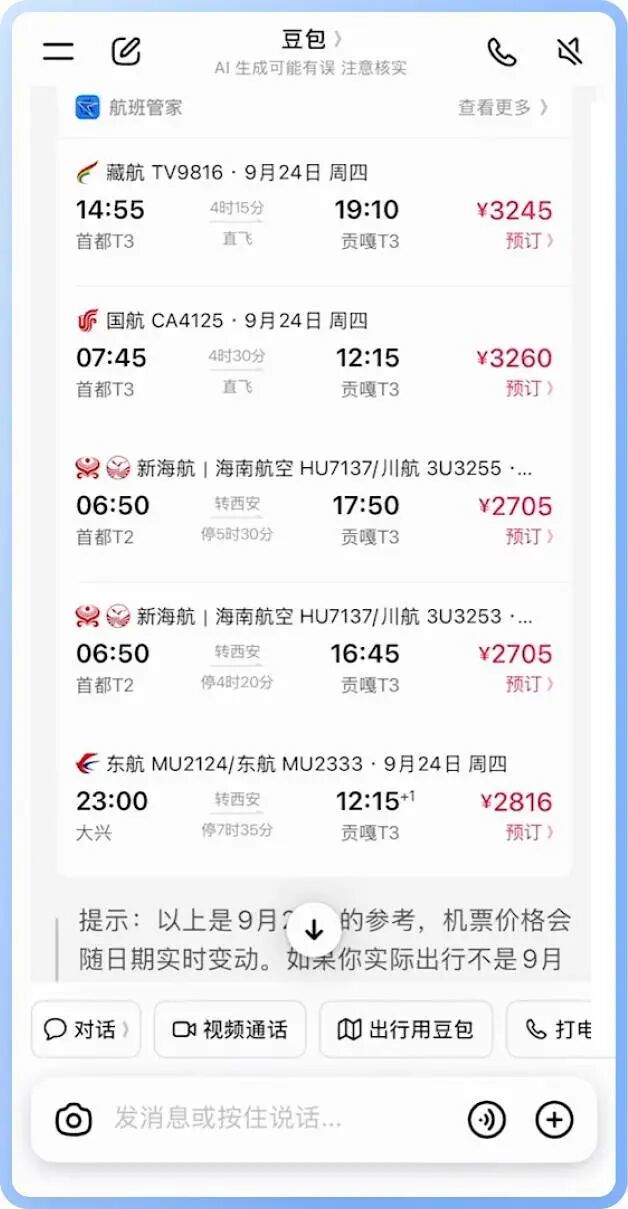
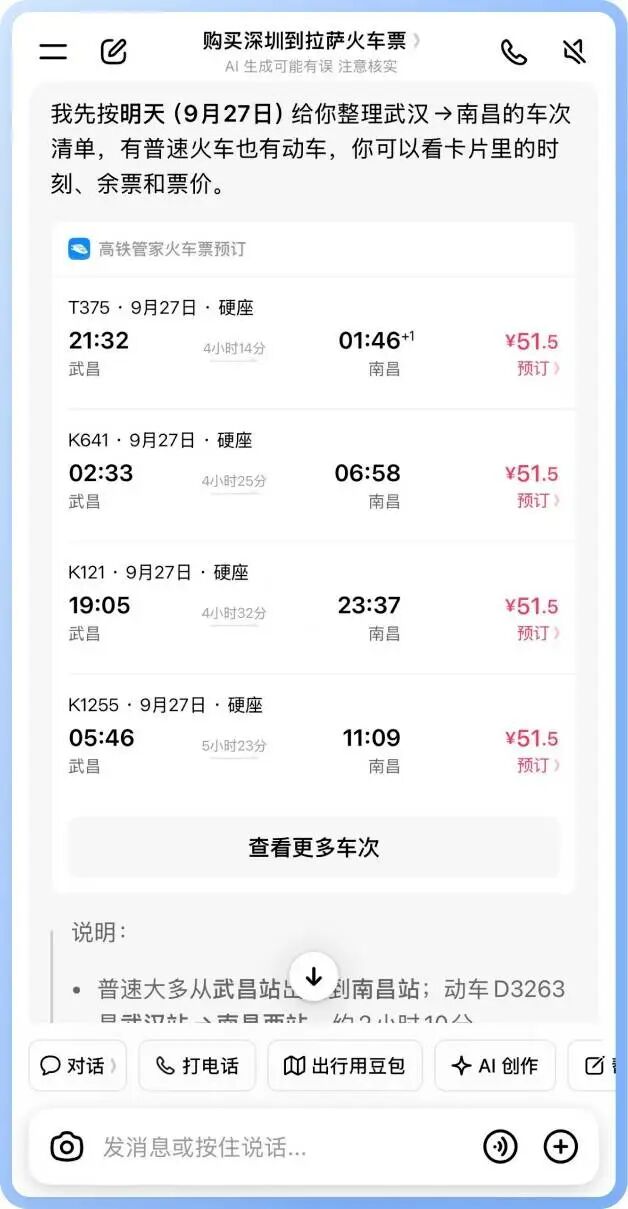
On September 30, Doubao officially launched the "Doubao for Travel" entrance, integrating services such as flights, hotels, train tickets, ride-hailing, navigation, food and entertainment into its own App.
Users can directly put forward travel demands in natural language, and Doubao will call corresponding services. At present, the flight and train ticket services cooperate with Flights Manager and High-speed Rail Manager respectively, and the ride-hailing and navigation services are also connected to partners such as Caocao Mobility and Baidu Maps.


Images from the official WeChat public account
Although it still relies on third parties to complete transactions and fulfillment at this stage, ByteDance has already moved travel and tourism services into the AI entrance.
At the same time, ByteDance is also developing a personal AI assistant named "Xiaodou", which is reportedly planning to launch an independent App.
Alibaba is not idle either.
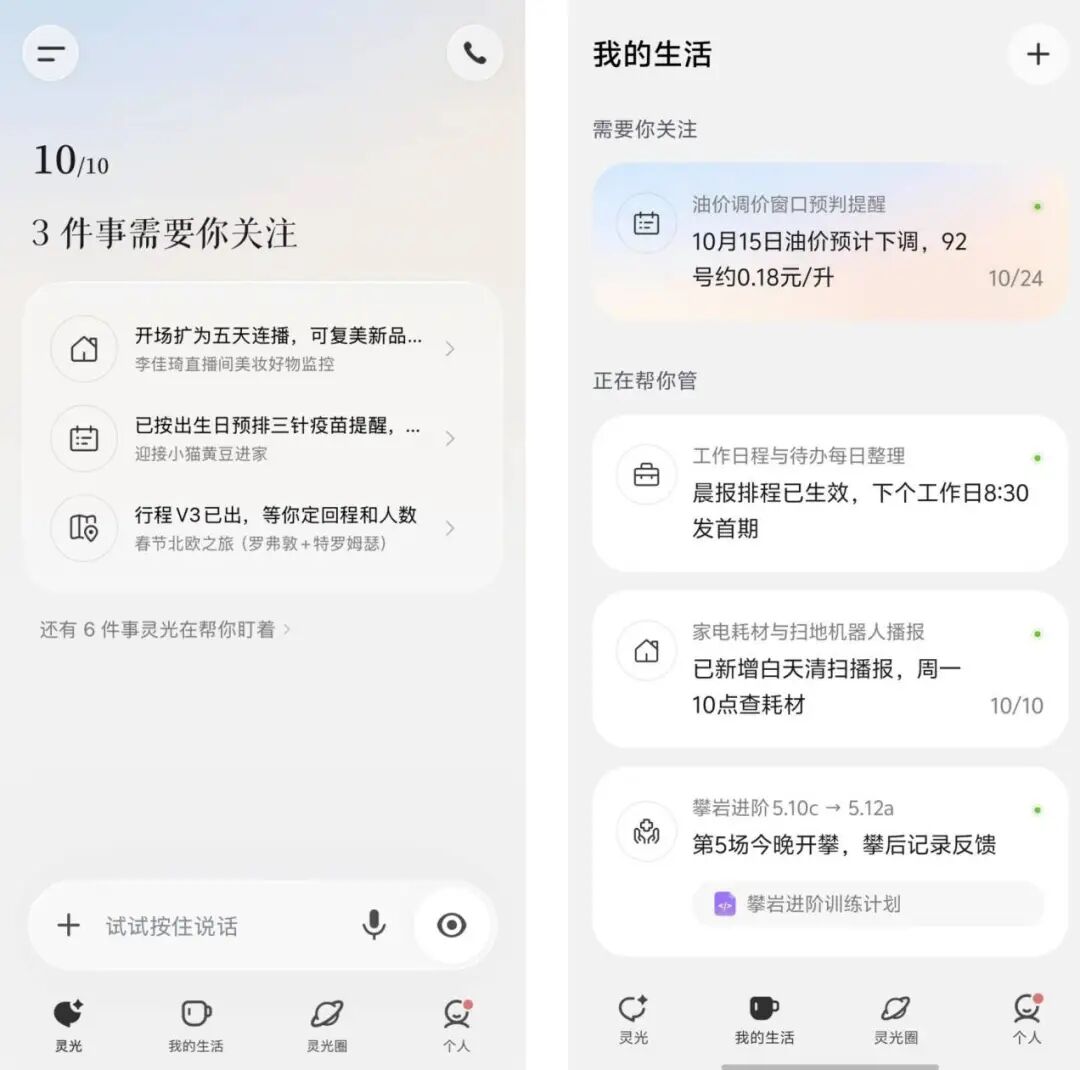
On October 11, Lingguang under Ant Group was exposed to be in the internal test of version 2.0, adding a new "My Life" entrance, focusing on enhancing capabilities such as long-term memory, active reminders and continuous task execution.
For example, users can ask it to follow up on long-term travel plans, and adjust the itinerary when encountering flight delays or scenic area flow restrictions.
It can also call external applications and devices through Skill and MCP.
Coupled with the Personal Agent layout of Alibaba's Qwen, Alibaba obviously does not want to miss this entrance.
Screenshots of Lingguang 2.0 App are from "Du Jia"
Tencent is also taking action.
It is said that Tencent's Yuanbao team is developing a Personal Agent product called "Yuanbao Assistant", and plans to launch an independent App, focusing on carrying capabilities such as long-term memory and long-cycle tasks.
Other teams within Tencent are also exploring similar directions.
Of course, not all of the above products have been officially launched, and some capabilities of Tencent and Alibaba are still in the development or internal test stage.
But the trend of domestic big tech companies collectively betting on personal AI butlers is already very obvious.
Overseas players are moving faster.
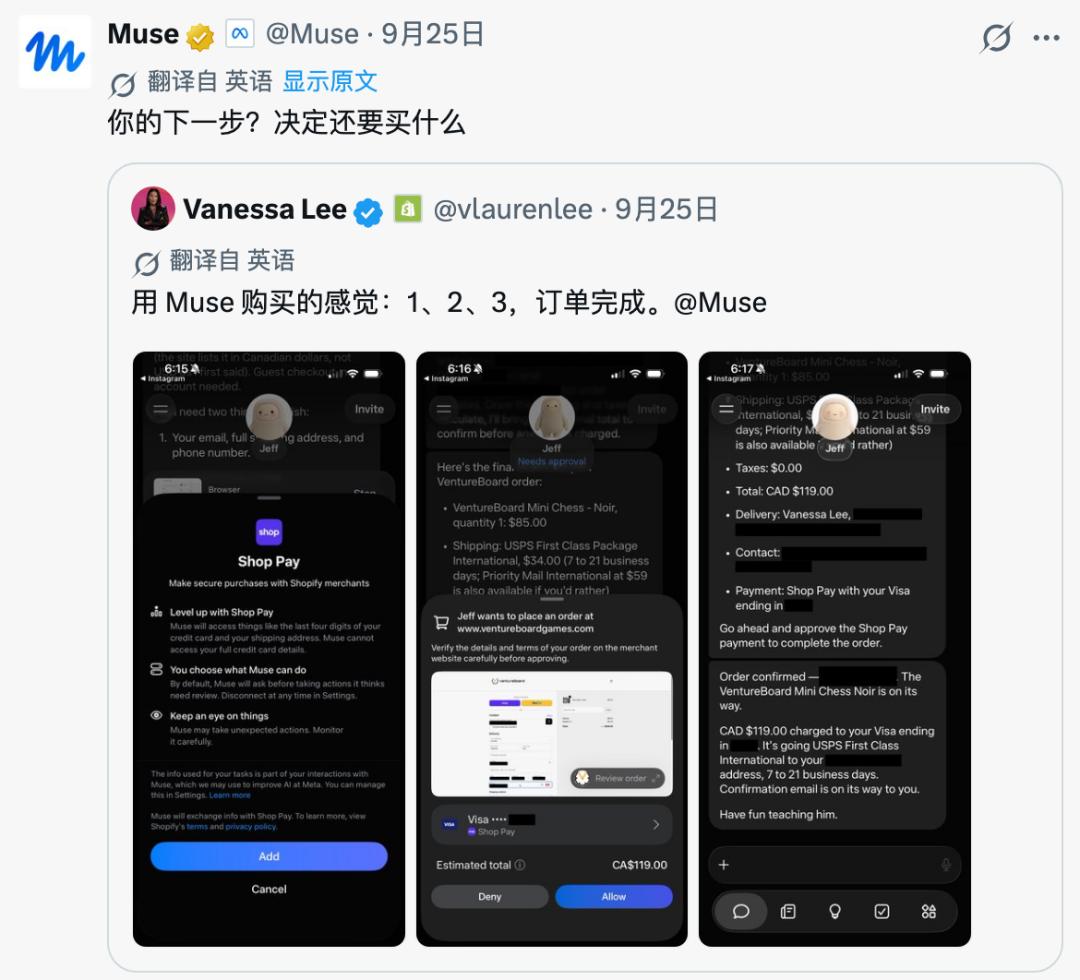
In September, Meta launched Muse, which can operate web pages, connect applications, manage schedules, and even book trips and complete shopping after user authorization.
Elon Musk's Grok Bot can also operate websites and software through its own cloud computer to help users handle cross-application tasks.
Dots launched by OpenAI can also continuously execute long-term tasks, connect external services, and complete some purchase operations after user authorization.
These products are all trying to let AI step out of the chat box and really do things for users.
Travel happens to be a very suitable scenario for AI Agent.
Because users often have clear goals, but they need to spend a lot of time searching for information, comparing prices, planning routes and completing bookings.
Once AI can understand demands, call services and complete transactions, the whole process can be greatly shortened.
Looking back, Tencent, Alibaba and ByteDance in China are also developing in this direction.
This brings a very interesting change.
In the past, platforms such as Ctrip, Fliggy and Tongcheng competed with each other, fighting for which App users would open first when they wanted to book flights and hotels.
Now, Tencent, Alibaba and ByteDance all want users to go directly to their own AI butlers.
Moreover, booking flights and hotels is just one of the many functions of Personal Agent.
For Ctrip, travel booking is almost its entire business; for big AI companies, travel booking is just a small thing to help users complete.
If one day users get used to letting AI butlers handle all kinds of affairs in their lives, the traffic entrance value of independent Apps like Ctrip will probably need to be recalculated.
02 The most valuable asset of Ctrip may be taken away by AI
What does Ctrip rely on to make money?
The transaction service revenue generated by flight and hotel bookings is of course important.
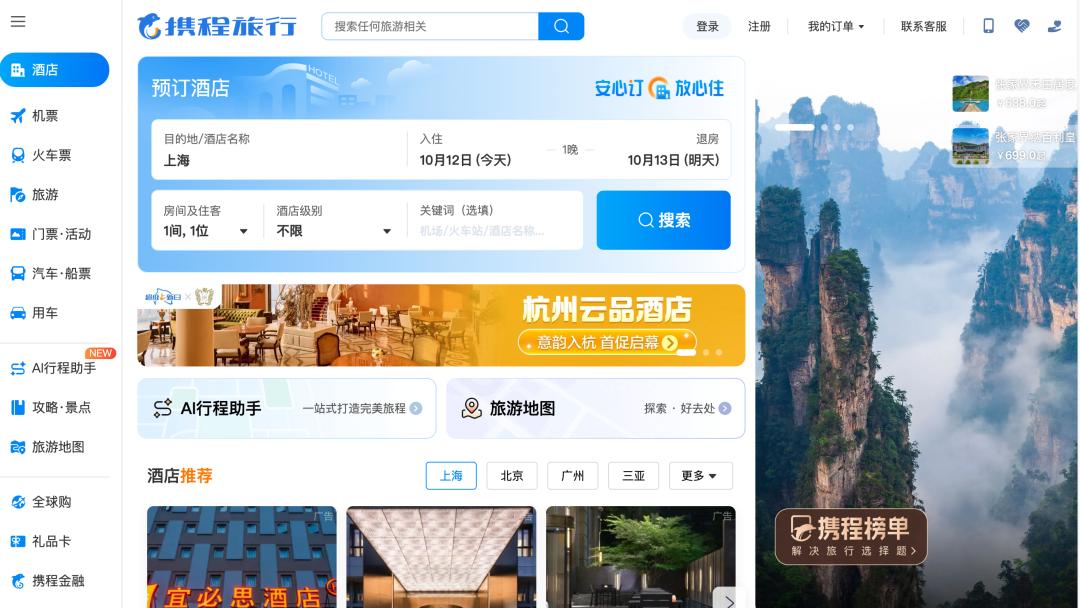
But from the commercial logic of Internet platforms, Ctrip also has a very valuable asset: a large number of users with clear consumption demands.
When a person opens Ctrip, he usually already has a relatively clear travel plan.
He may need to go to Shanghai on a business trip, or plan to travel abroad.
For hotels, airlines and travel service providers, such users have high commercial value.
Therefore, Ctrip can not only get revenue from transactions, but also provide commercial services such as advertising and marketing promotion.
The platform has a large number of users, so suppliers are willing to access it; as more and more suppliers join, more and more users are willing to come.
This business model has been running for more than 20 years.
But Personal Agent may break this cycle.
Suppose I use Doubao, Yuanbao or Qwen for a long time, and it already knows my work schedule, family members, travel habits, consumption preferences, and even knows what grade of hotel I usually stay in and what time of flight I prefer.
When I put forward travel demands, the AI can query product information from Ctrip, Fliggy, airlines and hotel groups at the same time, and then compare based on price, service, reviews and membership benefits.
At this time, Ctrip may become one of the many candidate suppliers.
In the past, users took the initiative to go to Ctrip to choose hotels; in the future, Ctrip may bring hotels and prices to fight for AI recommendations.
This change is very critical.
Because whoever controls the recommendation right may have greater say in the transaction chain.
In the past, in order to get more orders, hotels needed to study the search ranking and marketing promotion rules of Ctrip.
In the future, Ctrip may also need to study the recommendation mechanisms of Doubao, Qwen and Yuanbao, and find ways to make its own products appear in the AI recommendation results.
If AI platforms establish a commercial promotion system in the future, will Ctrip still have to pay traffic fees to these platforms?
Ctrip itself is already a traffic platform, but in the end it still has to buy traffic from another traffic platform.
It's quite interesting to think about it.
Moreover, AI platforms will not necessarily rely on Ctrip forever.
For highly standardized products such as flights and chain hotels, if airlines and hotel groups directly open real-time inventory, price and booking capabilities to AI, some orders can even bypass OTA platforms.
At that time, the intermediate links originally occupied by Ctrip may also be challenged.
I think the situation that Ctrip most needs to guard against may not be as serious as a large loss of App users.
What is more likely to happen first is: Ctrip's orders are still growing, but more and more orders come from third-party AI, while user relationships and recommendation rights are gradually controlled by others.
Users remember Doubao, Yuanbao and Qwen that helped them book hotels.
As for which platform provides the housing resources behind it, they may not care at all.
This will further affect Ctrip's brand recognition, user stickiness, and its bargaining power with suppliers.
Of course, the new AI entrance may also bring more incremental orders to Ctrip and reduce customer acquisition costs.
However, once AI platforms master more and more transaction entrances, the commercial revenue sharing mechanism between the two sides will probably be renegotiated sooner or later.
Who is qualified to take more profits may need to be rearranged.
03 Ctrip hasn't lost yet, but it has already taken action
Of course, if we judge now that Ctrip is going to be replaced by AI, I think we are underestimating this company too much.
After all, tourism is a very complex service industry.
You can ask AI to write an article for you, and if it is not well written, you can regenerate it.
But if you ask AI to book a flight for you, if the date is wrong, the passport information is filled incorrectly, or the flight is cancelled and the hotel refuses to check in, things will not be so simple.
Especially for scenarios such as international travel, multi-city connecting trips, and corporate business travel, a series of issues are involved behind, including real-time inventory, price changes, refund and rescheduling, cross-language communication, and after-sales guarantee.
The moment the user clicks to pay is just the beginning of the service.
Many of the really troublesome things happen after payment.
After years of accumulation, Ctrip has established a huge supplier network, transaction system and customer service fulfillment system.
AI can quickly learn to help users book hotels, but it is not so easy to build a global travel supply chain and after-sales system.
In fact, Ctrip has long been laying out AI as well.
Its Trip.com has launched the AI travel assistant TripGenie, and there are also products such as Ctrip Wenwen in the Chinese market.
According to the data disclosed at Ctrip's earnings call in September this year, the number of orders assisted by TripGenie in the second quarter increased by about 400% year-on-year, and nearly 60% of the interactions are related to hotel, flight and attraction bookings.
This growth rate is really amazing, although we don't know what proportion AI orders account for in Ctrip's overall orders.
What's more interesting is that Ctrip's management has begun to discuss the impact of Personal Agent on the industry.
At the earnings call on September 16, Liang Jianzhang, executive chairman of Ctrip's board of directors, clearly stated that AI will change the way users discover, search and book travel products. Ctrip is expanding cooperation with AI platforms and exploring the Agent-to-Agent mode, that is, the direct collaboration mode between intelligent agents.
Moreover, Ctrip has begun to connect its own services to the external AI ecosystem.
In September this year, Ctrip Business Travel demonstrated the docking results with Doubao Work. Corporate employees can put forward business travel demands in natural language, and Doubao Work will call the professional services of Ctrip Business Travel to complete operations such as business travel consultation, itinerary planning