Will chatting with AI when you feel lonely make people even lonelier?
At 2 a.m., you feel like talking to someone. AI is always online, ready to answer any question, never gets annoyed by you, and will never leave abruptly. Can this kind of companionship really ease loneliness, or will it make people increasingly difficult to build connections with real humans? Four studies, starting from different time scales and research designs, provide conclusions that are not entirely consistent.
It's 2 a.m. and you can't fall asleep. You scroll through your contact list, then lock the screen again.
At this moment, it is really hard to turn down a companion that you can talk to at any time, who never gets annoyed by you, does not require you to take care of its emotions, and can remember what you have said.
What AI companions provide is exactly this kind of companionship: they are always available when called, give stable responses, and hardly have those exhausting frictions in interpersonal communication.
But the problem arises from here: it takes away your loneliness, then what comes next?
To answer this question, we cannot only look at whether your mood gets better after one chat. Loneliness may be relieved within a few minutes, or change over a longer period of time. The immediate comfort is not the same as long-term social connection.
From 2025 to 2026, four studies examined this question from different directions: one tracked adults for a full year, one analyzed the chat records of real users, one asked participants to use AI companions for three consecutive weeks, and the last one directly compared the effects of chatbots, real human peers and diary writing.
Putting these studies together, we can draw a limited but important conclusion: short-term experiments found that AI companions may bring certain benefits, while some experiments did not detect overall differences; in direct comparisons, interaction with real humans works better in reducing loneliness. In long-term tracking, increased use of chatbots for social purposes predicts a higher sense of emotional isolation later; in the real user study, taking companionship as the main purpose of use is associated with lower well-being, but it is not sufficient to determine causality.
To understand these results, we need to look at them separately.
One year later, what changes have taken place in loneliness?
The longest observation comes from psychologists Elizabeth Dunn and Dunigan Folk at the University of British Columbia.

Elizabeth Dunn, Professor of Psychology at the University of British Columbia, co-author of the longitudinal tracking and real human control experiments. Source: Official website of the Department of Psychology, UBC.
The two tracked 2,149 adults in four English-speaking countries for 12 months, conducting a survey every four months. The researchers asked the participants: In the past few months, how often have you used chatbots for social purposes? For example, talking about your day, or asking it for advice on life decisions.
At the same time, they also measured the participants' sense of loneliness and social connection. The study was published in Psychological Science.
Two paths in the results are worth distinguishing:
The first path involves the sense of emotional isolation. The more participants used chatbots for social interaction, the higher the sense of emotional isolation they reported later. This measurement uses only one question, asking participants to what extent they feel emotionally isolated from others.
The second path involves a broader sense of social connection. People with a lower sense of social connection are more inclined to increase their use of chatbots later; but in turn, the study did not detect a significant relationship between increased use and a subsequent decline in the sense of social connection.
The two paths use different measurements and cannot be combined into a simple two-way cycle. The study does not present a proven causal chain either. This is an exploratory study, and both the use of chatbots and psychological states come from self-reports.
Longitudinal data can help us observe the association of variables over time, but we cannot judge causality solely by this association. Therefore, a more prudent understanding is: the use of AI companionship is correlated with a stronger sense of emotional isolation later, and people with a lower sense of social connection are also more likely to increase their use of AI companions.
Who is more inclined to treat AI as a companion?
If long-term tracking focuses on the changes that occur in people over time, another study turns its attention to people who are already using AI companions.
In August 2026, a study by the Diyi Yang Lab at Stanford University was published in Nature Human Behaviour. The study surveyed 1,131 adult American users of Character.AI, 237 of whom donated their chat records, totaling 4,664 conversations and about 460,000 messages.
This study has a notable methodological feature: when researchers analyze human-AI conversations, they also use large language models to assist in topic classification, and then the researchers review and verify the classification framework.
The analysis found that people with smaller real-life social networks are more likely to use AI mainly for companionship; and taking companionship as the main purpose of use is associated with lower well-being. The more frequent the interaction and the more self-disclosure, the stronger this association is. According to the official press release of Stanford University, more than 80% of the donated conversations involve emotional or social support.
This is a correlational study. Smaller real-life social networks, more use of AI for companionship, and lower well-being appear at the same time, but the study cannot determine who causes whom: it is possible that AI companions affect people's social lives, or that people who originally lack social support are more inclined to seek companionship from AI, or other factors affect both at the same time.
To distinguish these explanations, randomized controlled experiments are needed. However, experiments also have boundaries: they can test the effect of a specific product within a specific period of time, but may not be able to explain what changes long-term natural use will bring.
After three consecutive weeks of use, what did the experiment detect?
Rose Guingrich and Michael Graziano from Princeton University conducted a pre-registered experiment (currently a preprint, not peer-reviewed): 183 adults were randomly divided into two groups, one group chatted with Replika for at least 10 minutes every day, and the other group played word games every day for 21 days, with a completion rate of 85%. Participants submitted timestamped screenshots of the start and end of each activity every day; those who completed the whole process clocked in an average of 6.6 days per week, and the compliance of the two groups was similar.
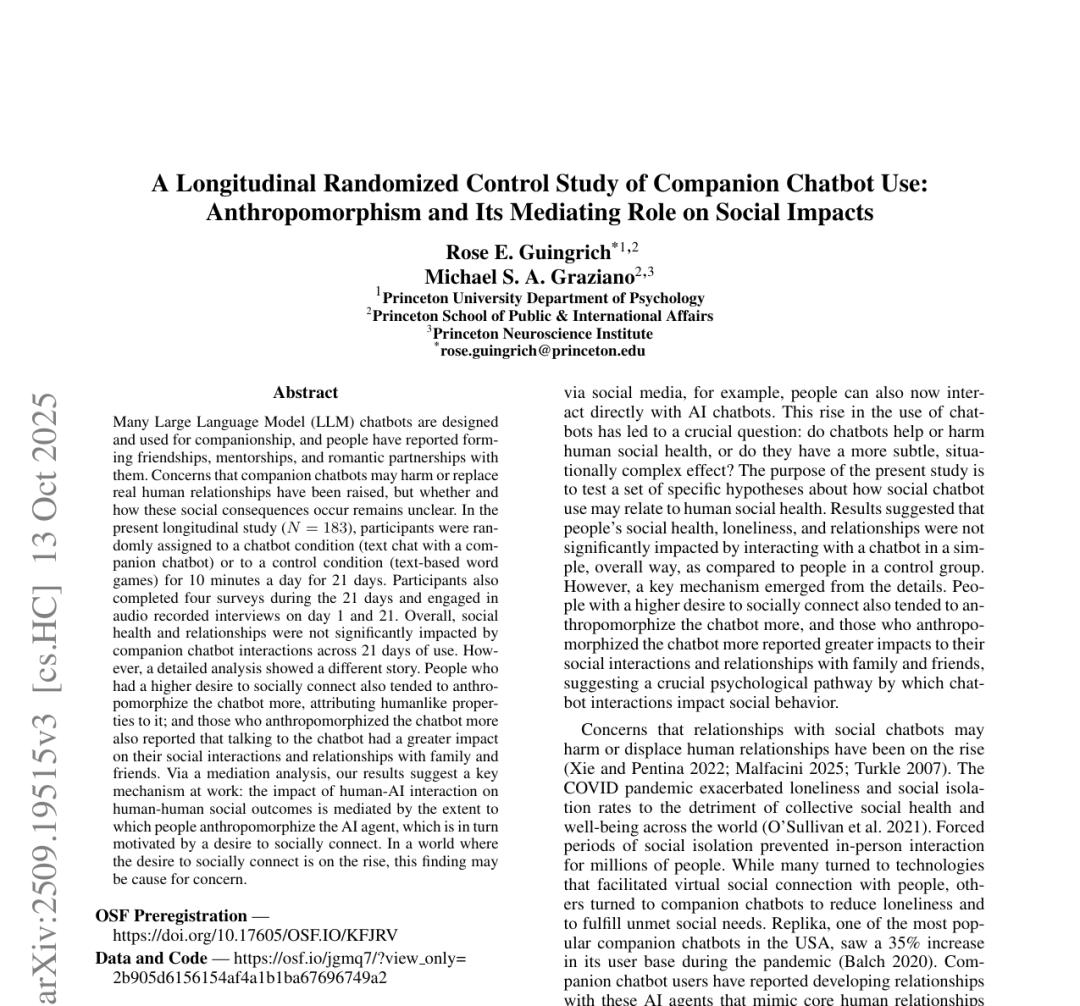
The homepage of the preprint by Guingrich & Graziano (arXiv:2509.19515, not peer-reviewed), the OSF pre-registration number is listed at the top of the page.
After three weeks, there were no significant differences between the two groups in loneliness, social health, and self-reported impact on interpersonal relationships. The chatbot group scored higher on the "desire to connect with others at the moment" scale on day 7 and day 14 (1.95 vs 1.46; 1.94 vs 1.49), but by day 21, the difference was no longer significant. Under this sample, duration and control conditions, the study did not detect a significant impact of Replika on these overall indicators; this does not prove that it has no impact.
The four-week follow-up also found that 62% of the people in the word game group were still playing, while only 22% of the people in the Replika group were still using it. This difference reflects the re-use rate of the two groups, and the study did not determine the reasons behind it.
Intra-group analysis also found that: The more eager participants were to connect with others at the beginning, the easier it was for them to anthropomorphize the robot later; the higher the degree of anthropomorphism, the greater the self-reported impact of the robot on their interactions with family and friends.
When the opponent is a real human, what will the result be?
The previous studies all have their own limitations. Long-term tracking is difficult to determine causality alone, real user data reflects the situation of existing users, and the three-week experiment compared AI companions with word games.
So what will happen if we compare AI companions with real human communication?
Ruo-Ning Li, Folk, A. Singh, L. Ungar and Dunn published a pre-registered randomized controlled experiment in Journal of Experimental Social Psychology.
The study recruited 296 freshmen, asking them to complete an activity every day for two consecutive weeks. Participants were assigned to three conditions: communicating with Sam, a highly supportive chatbot designed by the research team based on the principles of relationship science; communicating with a randomly matched real human peer; or keeping a diary.
After two weeks, the researchers compared the changes in loneliness of the three groups.
The results are: Compared with keeping a diary, chatting with Sam is more helpful to reduce loneliness, but the effect size is small; compared with chatbots, communicating with real human peers has a better effect.
This result has an implication worth noting.
Sam in the experiment is not a randomly assembled chatbot, but a highly supportive robot specially designed according to the principles of relationship science. In contrast, the real human peers are only randomly matched freshmen, which does not mean that the other party is necessarily good at listening or providing support.
Even so, on the loneliness indicators measured in this experiment, the improvement range of the real human peer group is still larger. However, this study examines the changes in loneliness of a specific group of people, a specific robot, specific activities, and within a two-week period.
For our understanding of AI companionship, this is more meaningful than simply discussing whether robots are "human enough": when the question is how to reduce loneliness, at least under the conditions of this study, real human communication still performs better.
What exactly can these studies illustrate?
The four studies point to the same question, but did not measure the same thing.
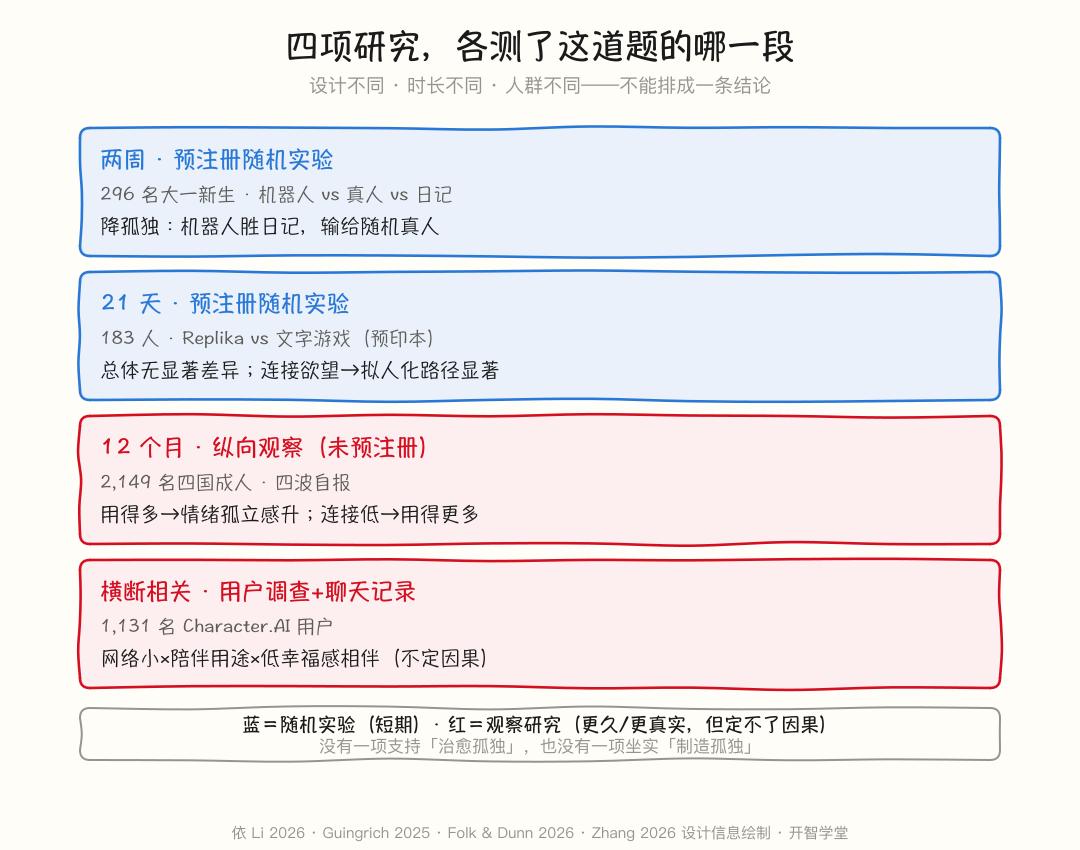
Drawn based on the design information of the four papers; all findings are subject to their respective limitations, see the main text for details.
The populations of the four studies are different: there is a long-term sample of adults from four countries, existing users of Character.AI, and college freshmen. The research subjects are different, the products used are different, the control conditions are different, and the measurement methods of loneliness are also different.
Random experiments answer: under specific conditions, what average changes will happen if people are assigned to use a certain product for a period of time. Longitudinal tracking answers: in the process of natural use, whether certain variables can predict subsequent changes. The real user study reveals the correlation within existing users.
They complement each other but cannot replace each other.
Two common misinterpretations deserve special attention.
First, no detection of a significant effect does not equal proof that there is no effect. The three-week experiment did not find an overall difference between groups, so we cannot claim that AI companions are harmless based on this.
Second, finding a correlation does not equal proof of harm. Long-term use is correlated with increased emotional isolation, and companionship-oriented use is correlated with lower well-being, neither of which can independently prove that AI use leads to these changes.
In addition, these studies target specific products and usage conditions from 2025 to 2026. The capabilities and interaction methods of chatbots are still changing, and the existing results cannot be generalized to all AI companions without distinction, let alone directly infer the effect of future products.
The current evidence is neither sufficient to claim that AI companions can cure loneliness, nor sufficient to prove that it will inevitably create loneliness.
What they can support is a more specific question: For what kind of people, under what kind of usage conditions, is AI companionship a supplement to real relationships, or gradually replaces real relationships?
This question is closer to what we really need to figure out than simply judging whether AI companions are beneficial or harmful.
The signal sent by loneliness, where does it point?
Psychologists John Cacioppo and William Patrick once compared the sense of loneliness to hunger in their book Loneliness: it is a painful experience, and it may also be a signal that prompts people to seek social connection again.
Yutong Zhang from the Stanford research team used a lighter metaphor in the official press release of the related study: AI companionship is like "social snacks", which can temporarily satisfy your needs a little. This statement is a metaphor, not a conclusion that has been verified by the study.
Putting the two metaphors together, the problem becomes clear.
If loneliness is a signal, relieving it does not necessarily mean responding to the need it points to. A person may feel temporarily better after talking to AI, and may therefore be more willing to contact friends; similarly, we cannot rule out the possibility that some people will gradually take AI as their main source of companionship.
Existing studies cannot yet tell us who these changes will happen to respectively, and how long they will last. But the two-week experiment provides a specific reference: even when facing a specially designed chatbot that can provide high support, communicating with a randomly matched real human peer is still more helpful to reduce loneliness.
Real humans do not always give perfect responses. Communication may be awkward, may fall into awkward silences, and may be disappointing. But what real human relationships provide is not just timely replies. This experiment only measured the changes in loneliness under specific conditions, and cannot be used to judge whether AI can replace real relationships.
So next time when you feel lonely and are about to open that familiar dialog box, you might as well ask yourself one more question: After this conversation, will I be more willing to reach out to others, or will I increasingly feel that there is no need to reach out to others anymore?
References
Folk, D., & Dunn, E. W. (2026). How does turning to AI for companionship predict loneliness and vice versa?Psychological Science, 37 (4), 276–286. https://doi.org/10.1177/09567976261427747
Zhang, Y., Zhao, D., Hancock, J. T., Kraut, R., & Yang, D. (2026). Interaction with AI companions and psychological well-being.Nature Human Behaviour . Advance online publication. https://doi.org/10.1038/s41562-026-02516-2
Li, R.-N., Folk, D., Singh, A., Ungar, L., & Dunn, E. W. (2026). Is a random human peer better than a highly supportive chatbot in reducing loneliness over time?Journal of Experimental Social Psychology, 125 , Article 104911. https://doi.org/10.1016/j.jesp.2026.104911
Cacioppo, J. T., & Patrick, W. (2008).Loneliness: Human nature and the need for social connection . W. W. Norton.
Guingrich, R. E., & Graziano, M. S. A. (2025). A longitudinal randomized control study of companion chatbot use: Anthropomorphism and its mediating role on social impacts (arXiv:2509.19515) [Preprint].