Why does Tencent still need to borrow money when it has 500 billion yuan lying in its accounts?
Tencent is preparing to raise funds again.
And this time, the amount it plans to raise hits 33.5 billion yuan as soon as it speaks.
According to Bloomberg's report on October 8, Tencent is considering issuing offshore bonds of up to 50 billion US dollars (about 335 billion yuan), which will be launched as soon as this month. The bonds may be denominated in US dollars and offshore RMB.
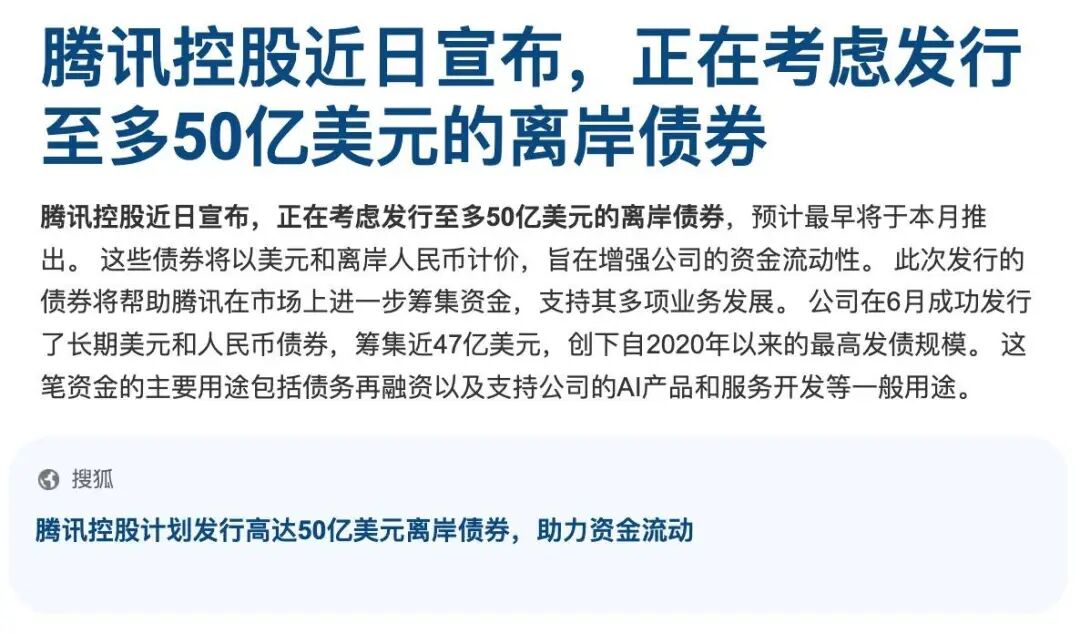
It is worth noting that Tencent just raised nearly 4.7 billion US dollars (about 315 billion yuan) through bond issuance in June this year.
If this financing is finally completed at the maximum scale, the total financing of Tencent through two bond issuances this year will be close to 650 billion yuan.
Of course, this 335 billion yuan is still under consideration, Tencent has not officially confirmed it, and the final issuance scale and use of funds have not been announced. The financing in June also includes debt refinancing, and the 650 billion yuan cannot be simply counted as all new AI investment.
But when I saw this news, I was still a little surprised.
Is Tencent short of money now?
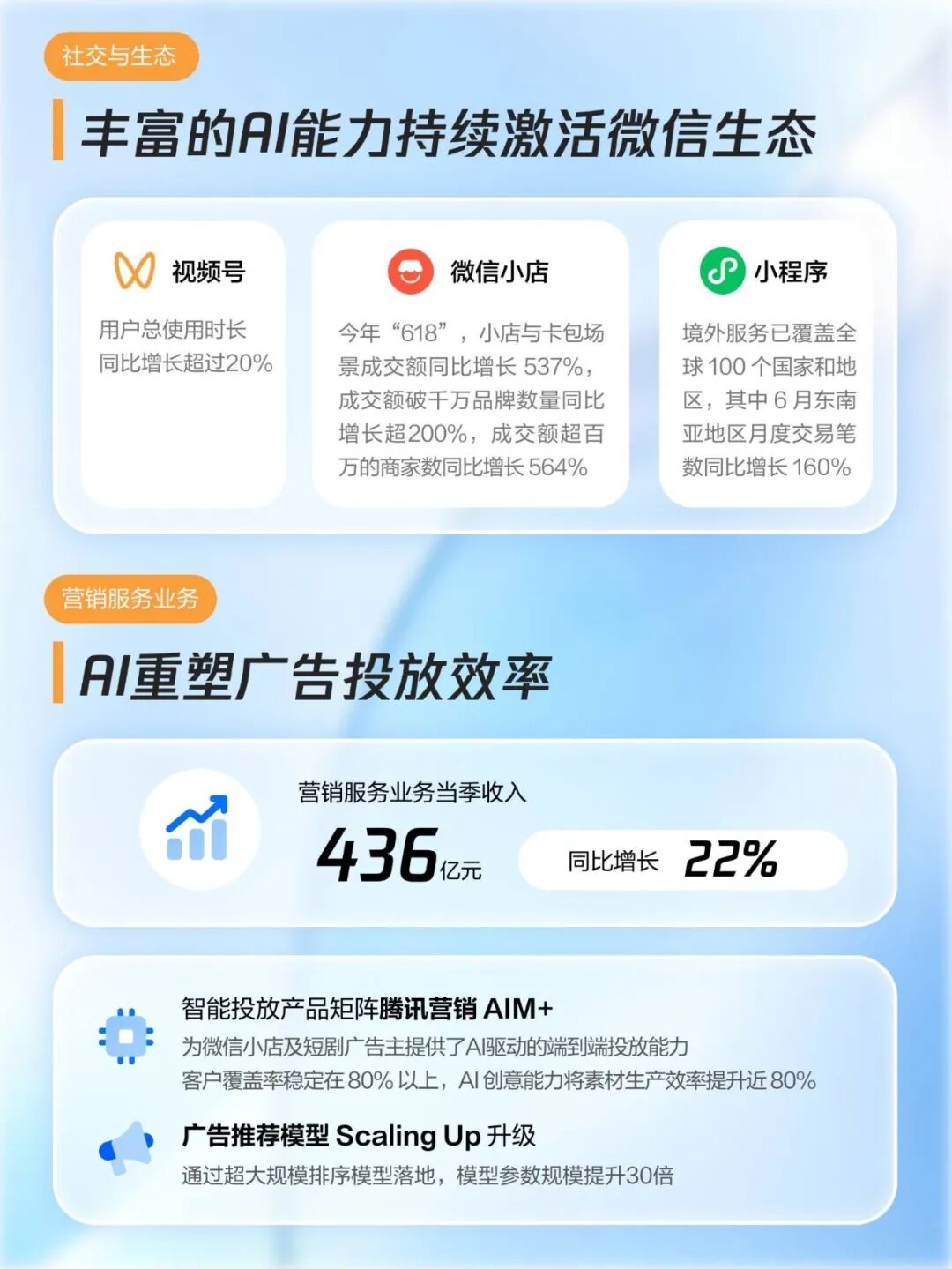
Obviously not. WeChat, games, advertising, fintech, each of them has a very strong profitability.
A company with quarterly revenue exceeding 200 billion yuan and more than 500 billion yuan in cash on its books, why does it need to borrow money on such a large scale?
What's more interesting is that Tencent is not the only one that has been busy raising money recently.
ByteDance led by Zhang Yiming and Alibaba are also carrying out large-scale financing through different ways.
In the past, people always thought that the Internet giants were the ones with the most abundant capital. Unexpectedly, in the AI era, these giants have begun to raise funds from the capital market one after another.
It seems that AI is really a capital-consuming business.
01
How capital-consuming is Ma Huateng's AI business?
Let's look at several sets of figures first.
In August this year, Tencent released its financial report for the second quarter of 2026.
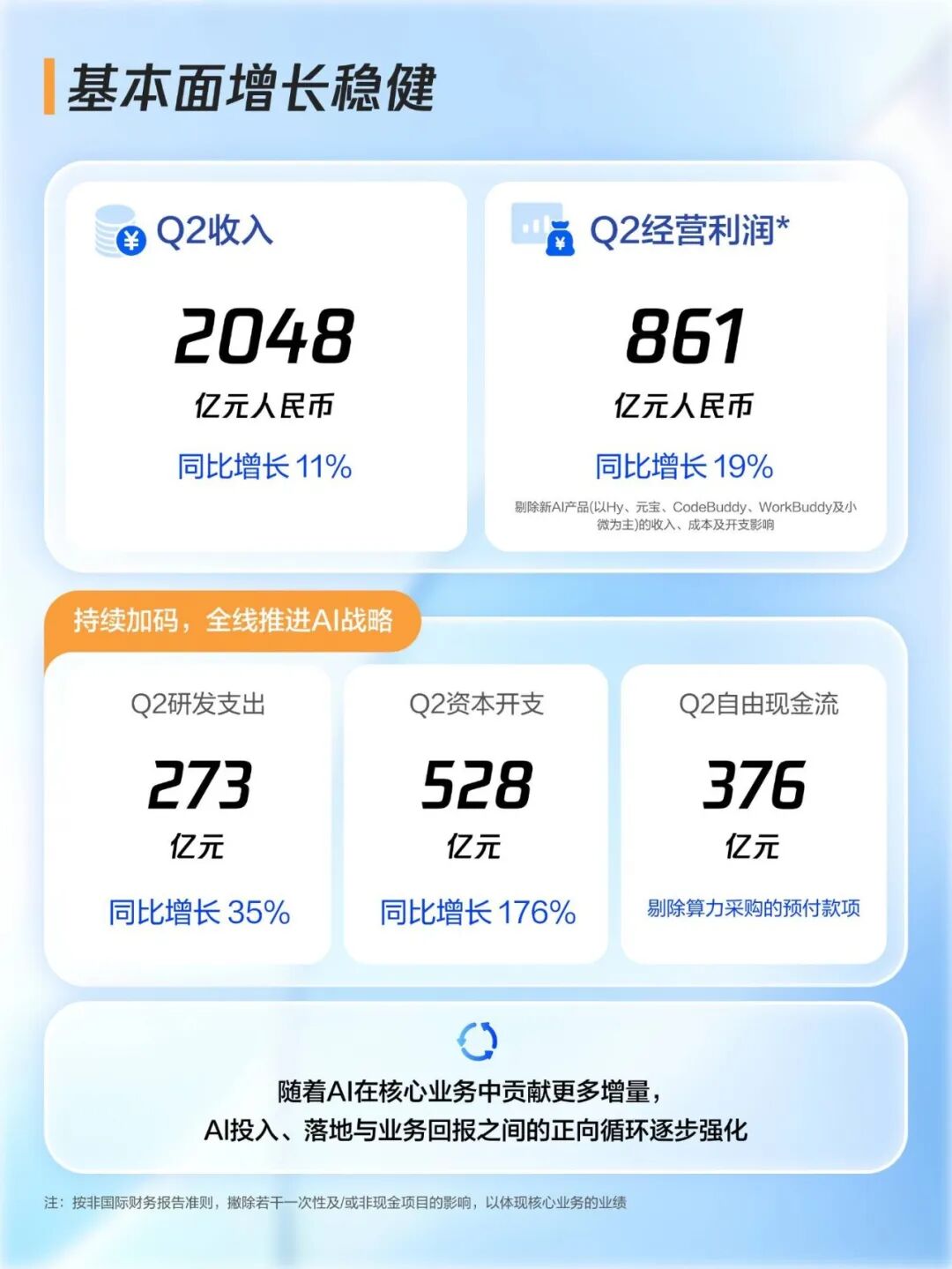
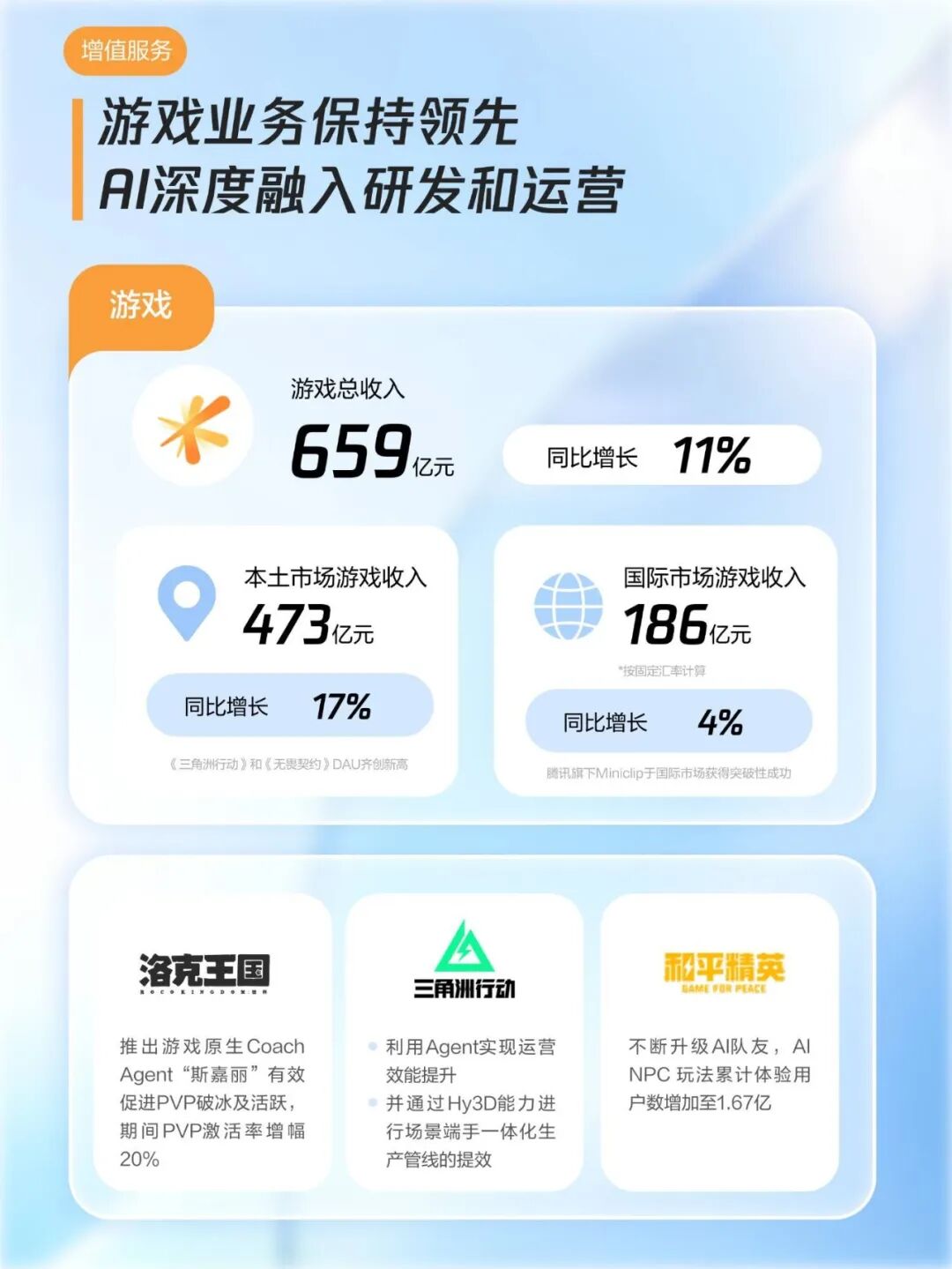
The revenue was 204.8 billion yuan, a year-on-year increase of 11%; the net profit attributable to shareholders was 56 billion yuan. On the whole, Tencent's traditional businesses are still very profitable.
But one set of data is quite eye-catching.
Tencent's capital expenditure in the second quarter reached 52.8 billion yuan, a year-on-year increase of 176%.
Note that this is only the expenditure scale of a single quarter.
What is the concept of 52.8 billion yuan? It has exceeded a quarter of Tencent's revenue in that quarter.
What's more interesting is that Tencent's free cash flow in the second quarter was negative 13.8 billion yuan.
Tencent's official explanation shows that the cash flow includes a large number of AI-related prepayments, which are mainly used to purchase computing power and related infrastructure.
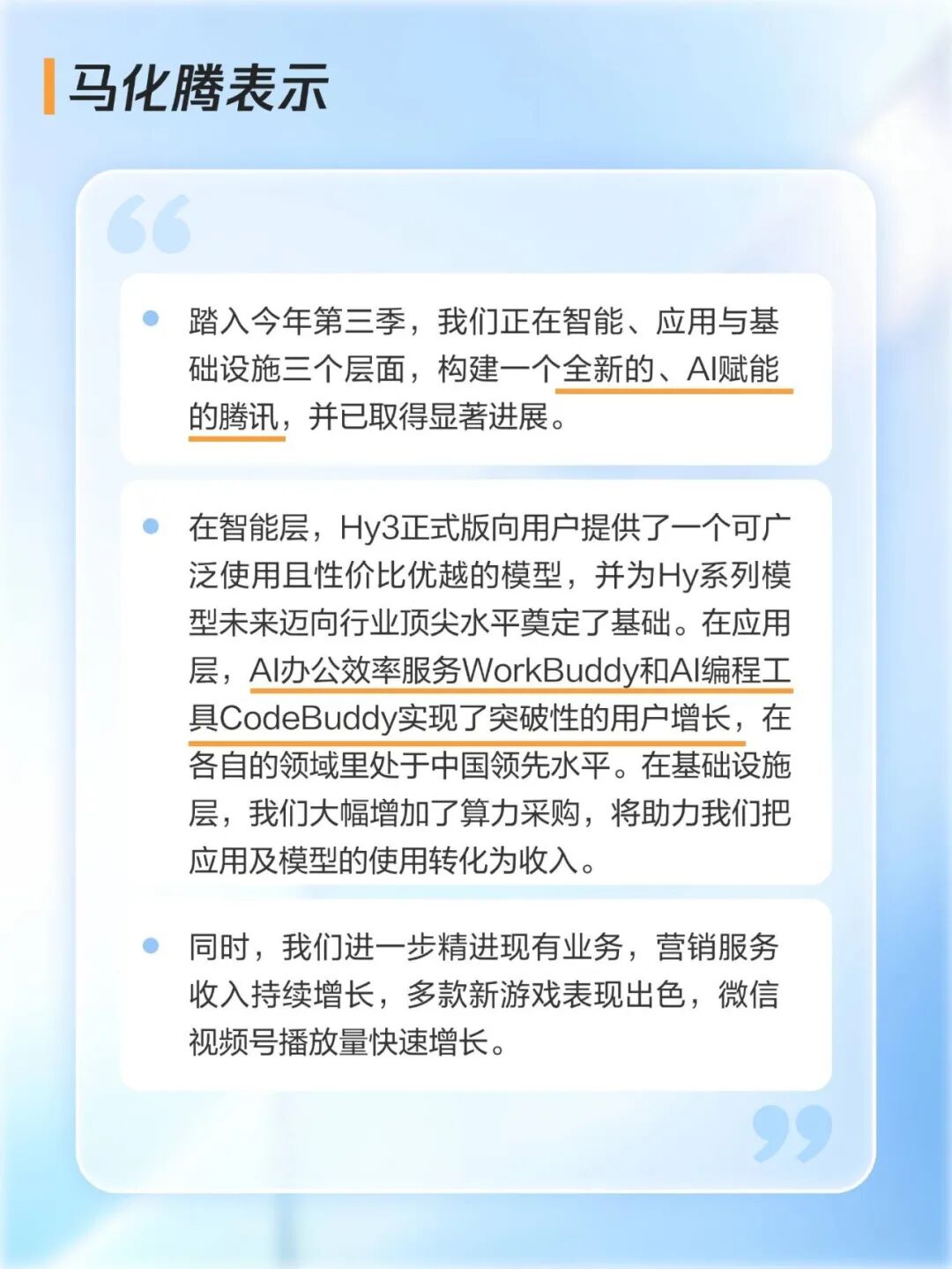
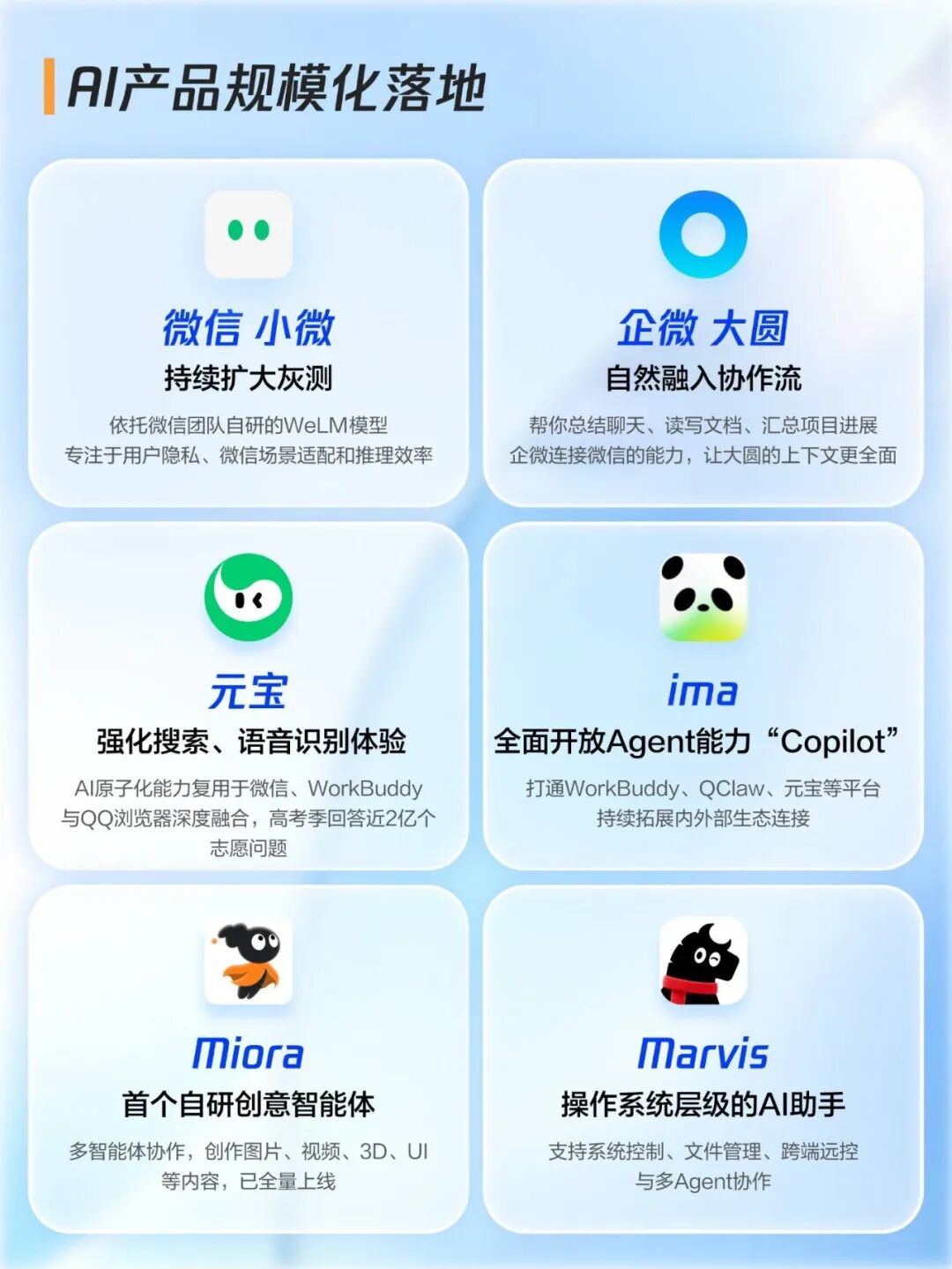
The financial report even clearly mentions the targets these investments serve: the upgrade of Hunyuan model, the reasoning demands of WorkBuddy and CodeBuddy, WeChat AI, as well as the demands of external customers of Tencent Cloud.
Tencent also specially explained that if the prepayment for computing power procurement is excluded, the free cash flow will still be 37.6 billion yuan.
This shows that Tencent's main business still has strong profitability, but AI has begun to significantly change its capital expenditure rhythm.
In the past, we often heard that AI companies such as OpenAI and Anthropic spend huge sums of money, after all, model training, data centers, and computing power procurement are all very expensive.
Now, Internet giants like Tencent are also investing more and more real money in AI.
And Tencent has just begun to promote the commercialization of AI products on a large scale.
It is really hard to say how much money will be spent in the future.
02
ByteDance borrowed 200 billion yuan, and Alibaba also raised 80 billion Hong Kong dollars
In fact, Tencent is by no means an isolated case.
Just last month, there was news that ByteDance had obtained a huge loan.
According to reports from media such as Caixin and Reuters, ByteDance has obtained financing support of 29.6 billion US dollars through a syndicated loan, which is equivalent to about 200 billion yuan.

This loan is coordinated by Citigroup and JPMorgan Chase, attracting nearly 30 banks to participate. The initial term is three years, and it can be extended to five years at most.
What's more interesting is that ByteDance originally only planned to raise 20 billion US dollars.
As a result, the subscription from banks was so enthusiastic that the financing scale directly increased to 29.6 billion US dollars.
According to public reports as of early September, relevant banks are still confirming the final loan share, and the agreements have not all been signed.
It seems that banks are also very willing to lend money to Zhang Yiming.
After all, ByteDance has mature businesses such as Douyin, TikTok, and Toutiao, with quite strong profitability.
Then what does Zhang Yiming do with so much money?
The officially disclosed use of funds is mainly for general corporate purposes, but under the background of ByteDance's AI investment in the past two years, it is easy to understand the importance of this financing.
According to previous media reports, ByteDance is considering raising its capital expenditure in 2026 to a maximum of 70 billion US dollars, equivalent to about 470 billion yuan, more than double that of 2025.
These new investments will focus on data centers, computing power infrastructure and other fields.
Of course, 70 billion US dollars is still the potential budget scale reported by the media, not the confirmed actual expenditure for the whole year.
It is normal to think about it.
Doubao, Doubao Work, Jimeng, and ByteDance's own large model system consume a lot of computing power every day.
Especially AI products like Doubao with a huge user base, every additional use by a user may generate an additional model reasoning cost in the background.
The more users there are, the greater the demand for computing power.
What's more, ByteDance also wants to bring AI into more scenarios such as office work, programming, video, and search.
If Zhang Yiming wants to maintain competitiveness in the AI era, relying solely on product innovation is far from enough, and sufficient capital reserve is needed behind it.

Then let's take a look at Alibaba.
Alibaba led by Jack Ma is also actively raising funds.
On August 26 this year, Alibaba officially completed the new share placement financing of 80 billion Hong Kong dollars.

Note that this time the financing is carried out by issuing new shares, which is different from Tencent's bond issuance and ByteDance's bank loan.
But there is a more noteworthy point about this financing.
Alibaba clearly stated that 100% of the net raised funds will be used to invest in AI.
Specifically, about 60% will be used to expand global computing power infrastructure, and the remaining 40% will be used to build ultra-large-scale AI data centers and upgrade cloud computing-related infrastructure.
Last September, Alibaba had already issued about 3.2 billion US dollars of zero-coupon convertible preferred notes.
At that time, the plan was to use about 80% of the raised funds to enhance cloud infrastructure capabilities, and the rest for international commercial businesses.
Such convertible bonds may be converted into stocks in the future, but they are still debt financing instruments before conversion.
Earlier, Alibaba also announced that it would invest at least 380 billion yuan in the next three years to build AI and cloud computing infrastructure.
How huge is this amount of money?
Alibaba itself said that the planned investment scale exceeds the sum of its investment in cloud and AI infrastructure in the past ten years.
In the second quarter of this year, Alibaba's capital expenditure has reached 67.678 billion yuan, a year-on-year increase of 75%.
The main reason is the continuous expansion of investment in AI infrastructure to meet the growing customer demand.
Putting the data together makes it more intuitive.
In the second quarter of 2026, the total capital expenditure of Tencent and Alibaba alone has exceeded 120 billion yuan.
Although all these capital expenditures cannot be classified as AI, AI is undoubtedly an important factor driving the growth of investment.
In the past, Internet companies competed for traffic, users and business models.
Now, they have to compete for who can afford more GPUs, who can build more data centers, and who can bear the continuously growing model reasoning costs.
Tencent, ByteDance and Alibaba all have very considerable annual profits, but they still choose to use large-scale external financing.
I think this is the most interesting part of this round of AI competition.
Of course, the giants have abundant capital, but the scale of AI investment is so large that these giants also need to plan the capital sources for the next few years in advance.
03
Products such as WorkBuddy and WeChat Xiaowei all need sufficient capital support
In fact, people who pay attention to Tencent's AI products should clearly feel that Tencent has been launching AI products at an increasingly fast pace recently.
WorkBuddy, CodeBuddy, Hunyuan, Yuanbao, WeChat Xiaowei...
There is also a series of Buddy products launched around different scenarios.
In particular, WorkBuddy has taken very frequent actions in recent months.
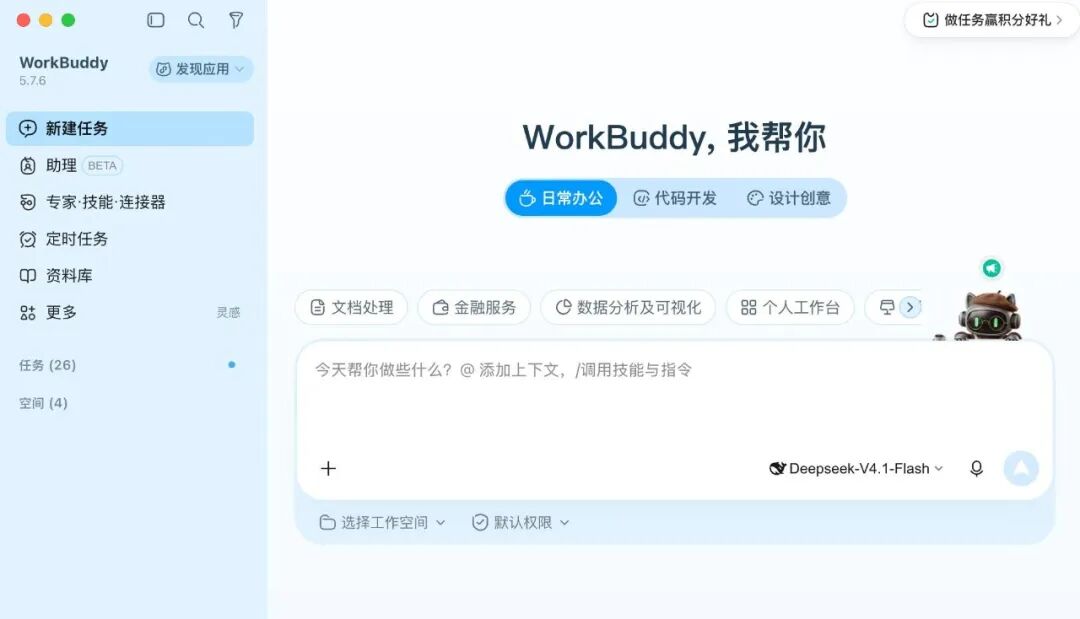
From supporting different models, to continuously enriching Skills, to various free quotas and membership subscriptions, Tencent is indeed working hard to attract more users.
For us users, this is certainly a good thing.
There are more and more models that can be used for free, and the tasks that AI can complete are becoming more and more complex.
But here comes the problem.
Who on earth is paying for these free Tokens?
For example.
In the past, when we used Tencent Docs, opening a file and editing a few lines of text, the computing cost that the server needed to bear was relatively limited.
Now when using WorkBuddy, you may ask it to generate dozens of pages of PPT, analyze hundreds of files, and even develop a website from scratch with one sentence.
Behind a single task, multiple rounds of model calls, code execution, file processing, and other