Conversation with Bambu Lab R1 Product Manager: When Everyone Participates in Creation
Everyone participates in creation — this is a great yet somewhat distant dream. To a certain extent, it is also the ultimate state that maker tools pursue.
For handicraft creativity enthusiasts, the present is the golden age of creation. By the end of 2025, Etsy, a creative goods platform, had about 5.6 million active sellers, ranging from hobbyists who occasionally sell their works to merchants who make a living from this business. The consumer market is also booming: the proportion of household users of 3D printers in China has climbed from less than 20% in 2023 to 45% in 2025.
The first step to realize the dream is to "create" the tools for creation
The endless crowdfunding projects for maker tools on Kickstarter, ranging from 3D printers, laser engravers, laser welders, UV printers to CNC, covering additive manufacturing, subtractive manufacturing and inkjet printing technologies. These industrial technologies originating from the last century seem old and outdated, but they have been transformed by generations of engineers, and discovered and excavated by Chinese entrepreneurs. Maker tools are no longer toys for a small number of people, and all tools are designed to make the realization of creativity easier.
In the current hardware industry, "creation" is obviously a magnificent fantasy. Diligent Chinese entrepreneurs have tried almost every field that hardware can cover, and the "iPhone" moment seems far out of reach. More often, they work like ascetics, identifying problems, solving problems, and iterating products continuously. There is no optimal solution, only a better one.
There is no doubt that hardware development is a tough job.
However, Niu Wei, product manager of Bambu Lab R1, can still feel the joy of "creation". For example, to solve the problem of automatic light calibration, the team developed the sensor completely in-house. When multiple groups of electrical signals of this sensor are continuously aligned with the laser position, everyone feels that "no effort is wasted".
Of course, he also has to bear the pain of "creation". When the industry-leading vibration compensation technology that Bambu Lab has achieved on 3D printers cannot be smoothly "replicated" on the R1, they spent half a year releasing a new version of the solution every week. Big problems masked small problems, and problems emerged one after another, so the entire company had to mobilize all relevant personnel to tackle key technical difficulties.
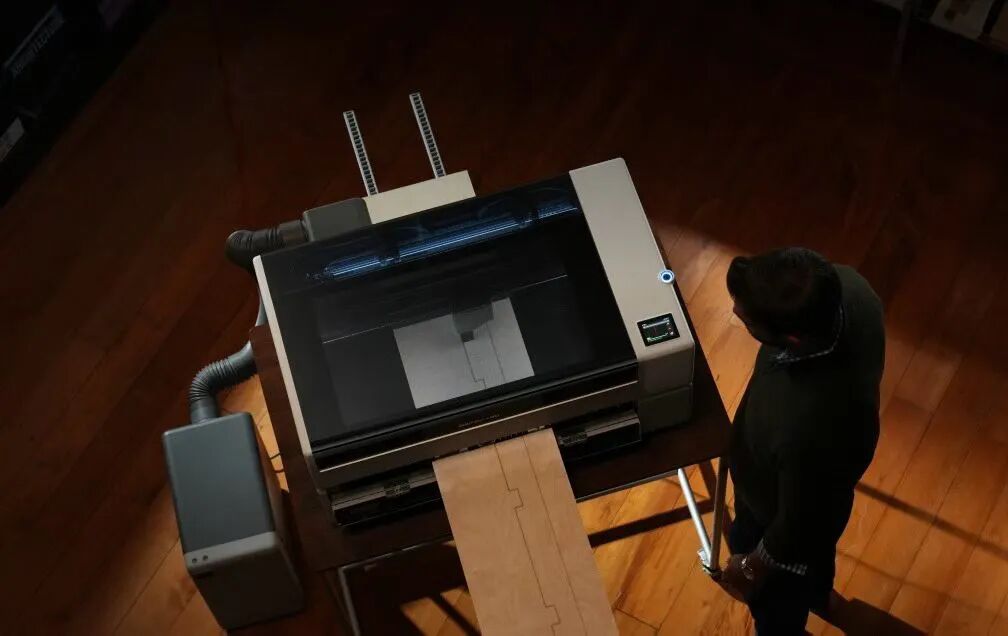
Bambu Lab R1
On September 22, Bambu Lab released the R1 equipped with a CO₂ light source. The laser is no longer just an optional module on 3D printers, but has become an independent product.
This is a product that has to withstand both expectations and doubts. For the first time, Bambu Lab extends its "creation" boundary to products beyond 3D printing.
Laser equipment is not a brand-new category. It has a long history in the industrial field with a large number of related enterprises; in the consumer-grade field, according to xTool's prospectus, in the first nine months of 2025, it has occupied 47% of the global desktop laser engraving and cutting equipment market share calculated by GTV.
At the end of last year, Bambu Lab responded to the question of whether it would develop products beyond 3D printing. Tao Ye, the founder, answered very restrainedly in the interview with LatePost: "You do this to satisfy users, not to satisfy some kind of assumption of your own."
Additive manufacturing and subtractive manufacturing seem to be completely opposite technical logics, but when placed on the user's desk, they are just maker tools that meet different steps of the creative process.
So, will the R1 bring the product methodology that Bambu Lab has verified in the 3D printing market, or will it find that laser processing requires a completely different set of solutions?
The answer is both.
1. Starting from an unresolved pain point
As a veteran who once participated in the H2D laser R&D, Niu Wei was full of confidence when he joined the R1 project team, even though nearly half of the team members were new hires and campus recruits.
After all, just like what Bambu Lab did when it first started with 3D printers, they are good at discovering user "pain points".
After sorting out all kinds of machines that the public has or has not seen, they found a highly prominent but unresolved problem in CO₂ laser cutting equipment — light calibration.
CO₂ laser can cut a wide range of materials, including wood, paper, leather, fabric and acrylic, which is a common solution for non-metal cutting and engraving.
However, the light calibration step has stumped many new users in the initial stage of use.
CO₂ laser adopts the spatial light guide scheme. The laser tube is fixed on one side of the fuselage, and the light beam has to be deflected several times through the reflector before entering the continuously moving cutting head.
After the machine is transported or used for a long time, the angle of the lens may change slightly.
The light beam seems to be aligned at a close distance, but it may deviate from the light inlet at the cutting head, resulting in reduced cutting ability, or even failure to emit light normally in severe cases. This is why many CO₂ laser equipment needs frequent light calibration.
36Kr learned that when traditional CO₂ laser cutting machines perform light calibration, masking tape is usually pasted on the test position of the mirror holder, the laser is allowed to emit light briefly, the landing point of the light beam is judged according to the scorch mark left on the paper, and then the reflector is adjusted. Some models are also equipped with a visible red indicator light to help users observe the position of the light spot; but it is still necessary to confirm that the red dot is consistent with the actual laser landing point.
For new users, this process often takes nearly an hour.
Bambu Lab wrote in the product introduction of R1 that this generation of products is equipped with its exclusive automatic laser calibration technology. Specifically, Bambu Lab designed an optical path calibration sensor with a crosshair. After installing the calibration sensor on the laser head, one click can start the calibration. R1 will read the light beam on the crosshair, find out the optical path deviation and correct it, and the whole process can be completed within 1 minute.
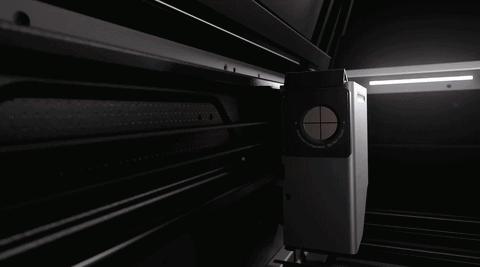
Automatic optical path calibration
Little known is that this optical path calibration sensor with crosshair is completely developed in-house by Bambu Lab.
They considered many solutions at first. The CCD solution they first considered was very costly, mostly used in scientific research scenarios, and it was not realistic to apply it to consumer-grade equipment. Developing the optical path sensor from scratch became a necessary solution.
However, this is not new for Bambu Lab. When they were making 3D printers before, they had independently designed many parts and components.
Looking back on the process of "developing the sensor in-house", Niu Wei described it as both complicated and simple: "It is just like what the textbook teaches you how to make a sensor." Find suitable sensing materials, determine the structure of the sensor, design the back-end modulation circuit...
The biggest variable is the selection of sensing materials. After excluding solutions such as CCD, the progress once stagnated. So Niu Wei asked for help in the company's R&D group, and soon received a reply: a colleague once accidentally shone a laser pointer on a certain material when developing another product, and an electrical signal came out.
But the challenge is yet to come.
After finding the idea of material selection, the solution can be verified quickly, but mass production cannot be achieved overnight. When Niu Wei got the first batch of processed sensors, some had no signal, and some wires broke directly in his hand. They spent a lot of time later to optimize the production problems of the sensors.
Throughout the R&D process of R1, developing the sensor in-house became the most "fun" thing in Niu Wei's memory. When seeing multiple groups of signals of the sensor align with the laser little by little and the signal quality getting better and better, everyone felt that no effort was wasted. "Everyone wants to create something creative."
At the moment when people pay more attention to engraving speed and processing area, developing the sensor in-house is not the most cost-effective choice, nor a mandatory parameter, even just an extra bonus.
"For Bambu Lab, the product that cannot achieve (automatic light calibration) is unqualified." Niu Wei told 36Kr.
Go back to five years ago, on the eve of Bambu Lab launching the X1, no one thought that automatic bed leveling for 3D printing was a must-have feature.
2. Reuse, but more than reuse
To a certain extent, the automatic vibration compensation technology applied by Bambu Lab on 3D printers has changed users' expectations for the entire industry: stable and consistent printing effect has gradually changed from the result after repeated debugging to what the machine should achieve by default.
Laser equipment also faces the same problem. Although additive manufacturing and subtractive manufacturing stack materials and remove materials respectively, they will encounter the same trouble during high-speed movement: when the tool head moves rapidly along the X and Y axes, once it stops suddenly or turns, the beam and the tool head may generate slight vibration due to inertia. On 3D printers, resonance will leave ripples on the surface of the model; while on laser cutting machines, resonance will amplify the processing defects.
At first, the R1 team thought this problem was not difficult to solve, which was nothing more than reusing the automatic vibration compensation technology on 3D printers to the laser cutting machine, which is Bambu Lab's core competence.
As the number of engraving samples increased during the experiment, they found that the automatic compensation technology reused on the laser equipment could not fully meet the product requirements.
Essentially, the laser cutting has stricter requirements for motion accuracy than 3D printing. The lines extruded by 3D printing are relatively wide, while the engraved lines after the laser is focused are much thinner. The same amplitude of offset falling on this thin line may make the edge obviously rough.
It is extremely urgent to develop new technologies.
For a long time, the people in the control group were solving the problem of vibration patterns every day, and they could see the vibration patterns decreasing and the debugging effect improving every day, but they found that there were still vibration patterns that could not be completely solved.
The problem of vibration patterns on the laser is like throwing a stone into the lake. The first ripples are obvious enough problems. After locating the cause and solving them, you will find that the vibration brought by the stone is still continuing, and the small ripples hidden by the large ripples will appear circle after circle...
The first mold opening of R1 was in February, and the vibration compensation team was debugging until August. All technical experts in the company came to check the problem halfway.
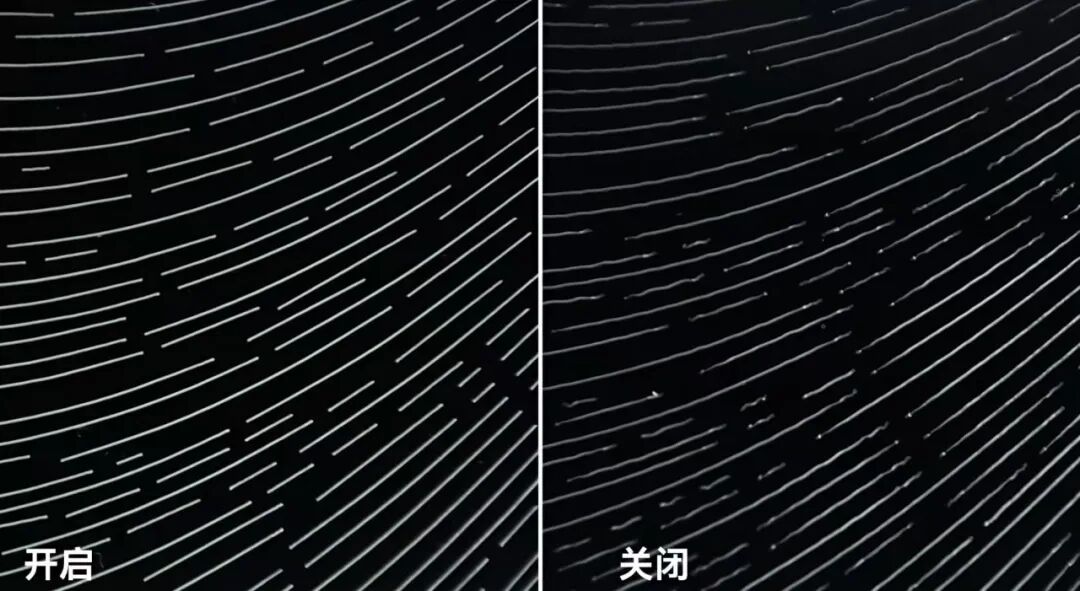
Active vibration compensation
At the most difficult time, Niu Wei once thought about giving up solving part of the vibration pattern problem and reducing the engraving speed, "but I was a little unwilling after all, we have come this far; and reducing the speed will make the user's processing time very long, you can get the result quickly but have to wait for a long time. Thinking of this, I feel very unwilling."
36Kr learned that at present, while ensuring accuracy, the engraving speed of R1 is 70% faster than laser cutting machines in the same price range.
More importantly, the automatic compensation technology accumulated in this generation of R1 products not only broadens Bambu Lab's technical moat in this field, but also will be fed back and applied to 3D printer products. In addition to the well-known shared MakerWorld accounts and the inherited Bambu Suite workflow, these technologies also tell a story of homologous symbiosis.

The picture frame and petals are all cut by laser
Like all hardware products, there are few dramatic moments that can be captured during the R&D process of R1, and there are many rather boring stories. For example, they let R1 travel back and forth from Shenzhen to Xinjiang in the car, just to solve the problem of camera positioning deviation caused by long-distance transportation; after noticing the wood cutting smoke smell remaining on their hair, they tried every means to figure out how to solve the problem of smoke exhaust and smoke accumulation in a limited space...
The presentation of creation in the foreground is romantic: it is the translucent sci-fi shell on the laser tube, it is the creator using laser combined with 3D printing to make the breaking-frame Van Gogh's Sunflowers. The creation in the background is also boring: it is the endless tests and adjustments of engineers, it is the countless problems that have been located, it is the moment when the current signal is finally aligned with the laser beam.
At the end of the interview, 36Kr asked Niu Wei: "Do you think the whole process is interesting?"
"It's interesting." He answered quickly.
It has only just begun, and so has creation.