China Mobile open-sourced the embodied intelligence Open-RAIL framework, filling the gap in industrial implementation.
The "First Year of Deployment" for Embodied AI: China Mobile Officially Open-Sources the Open-RAIL Framework
Multiple recent industry reports on embodied AI all point to the same trend: in 2026, the industry's focus of discussion has shifted from "whether robots can be manufactured" to "whether they can run stably and be replicated at scale". A widely cited judgment notes that the embodied intelligence industry in the first half of 2026 is still in a verification period of "high activity and low scale realization"; the unaddressed shortcomings widely recognized by the industry at present include end-side deployment latency, cross-robot adaptation, data pipeline, and evaluation benchmark system.
Many of these shortcomings are not model capability issues, but engineering problems — the "last mile" between models leaving the lab and being deployed on real robots, a segment no one is willing to claim but no one can bypass.
Recently, China Mobile officially open-sourced a framework named Open-RAIL, aiming to fill this foundational gap first.
Most of the Shortcomings Highlighted in Industry Reports Are Addressed by Open-RAIL
Listing the shortcomings mentioned in several industry reports and comparing them with the capabilities introduced in Open-RAIL's official documentation:
· Industry shortcoming: end-side deployment latency and motion stuttering — Open-RAIL: three-thread parallelism + two-level online smoothing. According to the official project introduction, the standard deviation of joint acceleration can be reduced from more than 10 rad/s² to 0.1 rad/s²
· Industry shortcoming: fragmented data pipeline, disconnection between data collection and training — Open-RAIL: data collection is embedded in each inference execution, and automatically archived in a format that can be directly used for training
· Industry shortcoming: long cross-robot adaptation cycle — Open-RAIL: lightweight hardware abstraction layer, which has been adapted to 4 heterogeneous robots as introduced, and the access of new models is shortened to "counted in hours" (referring to adaptation at the interface level)
· Industry shortcoming: evaluation benchmark system — This open source release does not cover this part. According to the project's public roadmap, the evaluation benchmark for real robots, scenario library and scoring standards are already in the plan, which is the next puzzle piece to be completed.
This does not mean that Open-RAIL has solved all these shortcomings, but most of its capabilities match the actual unmet needs of the industry, rather than listing a bunch of irrelevant self-claimed capabilities.
What It Specifically Is: An Intermediate Layer That Only Focuses on "Connection"
According to China Mobile, Open-RAIL has a clear and restrained positioning: it does not lock any specific robot, nor bind any specific model, and only serves as the connection layer between VLA/WAM models and real robots. It adopts a Server-Client distributed architecture in design — model inference runs on the Server side, while robot perception and execution run on the Client side. The two sides communicate through the network without interfering with each other. The benefit of this division is that the software environment required by the model and the software environment required by the robot driver no longer need to conflict in the same system.
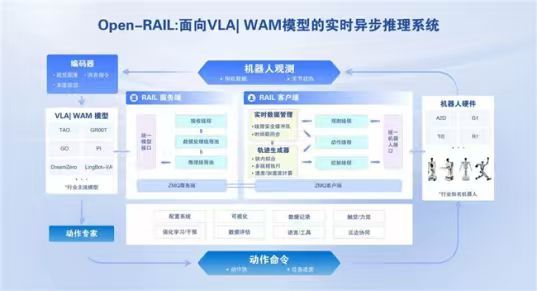
Open-RAIL Technical Architecture Diagram (Image Source: China Mobile)
Specific Implementation of Four Core Capabilities
Motion Smoothing: VLA/WAM model inference usually takes hundreds of milliseconds per step, while robot control requires millisecond-level response, with a gap of 30 to 50 times between them. Open-RAIL splits observation, inference and control into three parallel pipelines that do not wait for each other, and adds a two-level real-time smoothing algorithm without modifying the model itself throughout the process. According to official data, the standard deviation of joint acceleration is reduced from more than 10 rad/s² to 0.1 rad/s², which is a difference of two orders of magnitude.
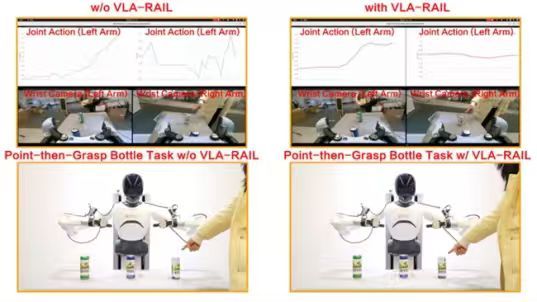
Video: Comparison of motion fluency before and after smoothing for the pointing and grasping task
Computing Power Decoupling: This capability is not included in the four highlighted shortcomings listed earlier, but it is also a deployment constraint often mentioned by practitioners. At present, most VLA models that can be actually deployed on real robots have a parameter size of around 3B. The bottleneck is not that the model cannot be larger, but that the embedded device on the robot side cannot support it. Open-RAIL moves all inference to the Server side, and the Server can be deployed on the robot body, edge server or cloud, only requiring modification of the network address. Theoretically, computing power is no longer a hard constraint when selecting models.
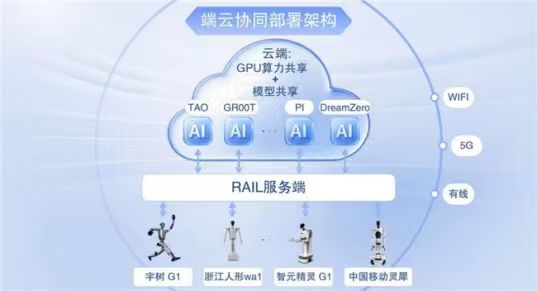
Schematic Diagram of End-Edge-Cloud Collaborative Deployment
Heterogeneous Adaptation: Different brands of robots have different joint definitions, communication protocols and coordinate systems, and switching to a new robot usually requires redoing the entire interface. Open-RAIL introduces a lightweight hardware abstraction layer, so that accessing a new robot only requires completing the underlying driver and registration. It is currently claimed to have adapted to 4 heterogeneous robots including China Mobile's Lingxi folding wheel-arm robot, Zhiyuan Elf G1, and Unitree G1, supporting 10 mainstream VLA/WAM models. In addition, this solves the "connectability" at the interface level, not the "good generalization" at the model level — the motion quality of the same model on a new robot still depends on the model itself.
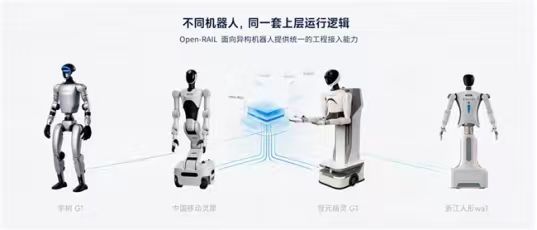
Adapted Heterogeneous Robots
Data Closed Loop: In the traditional process, inference and data collection are separated, and manual timestamp alignment is required after collection. Open-RAIL embeds data collection into each inference execution, and multi-view images, joint states, inference results and smoothing instructions are all automatically archived into a format that can be directly used for training; it also supports "hybrid inference and teleoperation", where humans can take over at any time when the model deviates. The corrected trajectory and the original trajectory are aligned and archived together, which means that every manual correction becomes a piece of targeted training data.
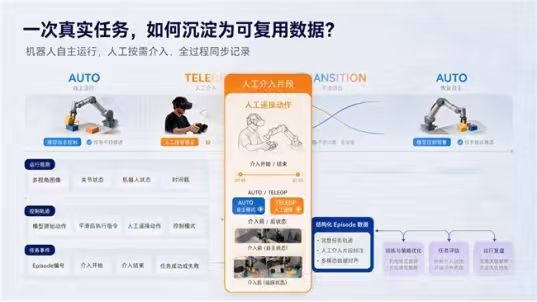
Schematic Diagram of Data Precipitation + Teleoperation Access
This Is Not the First Time China Mobile Has Developed "Unpopular but Indispensable" Infrastructure
Looking at the longer timeline, Open-RAIL is not an isolated event. In June this year, China Mobile, together with GSMA, Huawei, ZTE and other enterprises, open-sourced OpenAN in the Linux Foundation Networking community — a multi-agent collaboration framework oriented to communication network operation scenarios, which also follows the positioning of "not developing upper-layer services, but only solving collaboration and connection problems".
These two events belong to different fields (communication network and embodied AI), and are not a continuation of the same set of strategies, but together they show a clear trend: in the infrastructure layer characterized by "high engineering density, slow commercial return, and being indispensable for the whole industry", China Mobile has made at least two similar moves in the past six months, not only focusing on the embodied AI direction. This is also a supporting reference for judging whether Open-RAIL is a "one-off action" — the sample size is still small to draw a final conclusion, but it is more convincing than observing a single project alone.
It Is Claimed That a Real Scenario Has Already Been Running on This Foundation
According to China Mobile, its self-developed "Mobile Star Chef" robot runs on Open-RAIL: it has been exhibited at the Digital China Summit, Shanghai MWC, China-ASEAN Expo and other exhibitions, and has completed normalized deployment in the Hangzhou R&D park, producing more than 100 cups of coffee per day, with the whole process of a single latte shortened to less than 90 seconds, while supporting parallel processing of multiple orders. All the above data are unilaterally announced by the project party and have not been publicly verified by third parties, but at least it proves that it is not just a demo at the press conference.
Open source is only the first step, and the real test is yet to come: will robot companies and university teams really connect their own models, raise their own issues, and report the problems they have encountered on Open-RAIL? If not, it will only be a press release with a carefully written specification; if yes, it will truly start to become an industry foundation.
What can be confirmed at present is: a publicly accessible architecture description, four capabilities corresponding to the industry's shortcomings, a scenario that is claimed to be running in real operation, and similar actions that China Mobile has taken in other fields. Whether these are sufficient to support the claim of being an "industry foundation" will be answered in the following period of time, rather than by this article.