Keynote Speech: iReader · AI Short Drama Going Global | 36Kr 2026 East Forward Globalization Summit
In 2026, Chinese enterprises' overseas expansion is shifting from "pursuing incremental growth" to long-term global operations. On September 17, the 2026 East Forward 2nd 36Kr Global Expansion Summit, themed "Rising Tides, Shoreward Meetings", was held in Shanghai. Overseas-oriented enterprises, investment institutions from sectors including consumption, technology and manufacturing, as well as global service providers gathered at the event to discuss practical issues such as localized operation, user insight, supply chain, compliance, channels and global organizations. When "going global" is no longer a niche choice, enterprises need to face the real core issue: how to survive and take root in overseas markets, turn a one-off market breakthrough into sustained operation, and gradually build their own global competitiveness.
The following dialogue has been edited and organized by 36Kr:
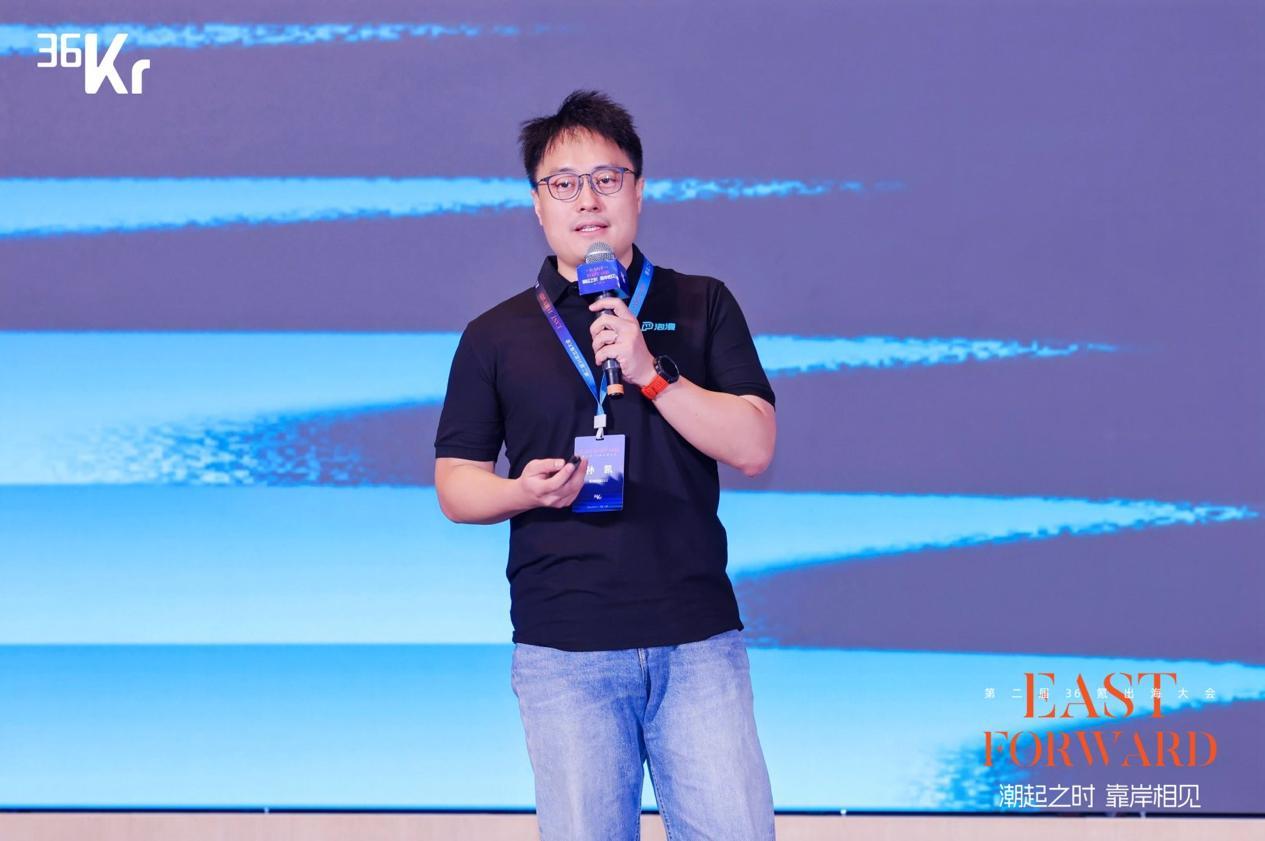
Speaker: Sun Kai, CEO of IReader Technology
Sun Kai: Hello everyone! Let me introduce myself first. I'm Sun Kai from IReader. Today I'd like to talk about the hot topics of AI implementation on the C-end and in the AI content field. Over the past year, especially the past six months, short drama and comic drama have become one of the fastest growing tracks in the content creation sector.
The implementation of large AI models in different industries is still under continuous trial, but there are not many cases that have formed a complete commercial closed loop and achieved PMF. Coding and search are among the few successful cases, and short drama is another one. My sharing will be mainly based on the perspective of IReader, talking about how we view this business, how we operate this business, and the revision of our self-cognition in the process of business operation.
First of all, I'd like to introduce IReader's short drama business. This year, this business still maintains a relatively fast growth rate. IReader used to focus on reading and IP operation, and was listed on the main board around 2017. After listing, we have been deeply engaged in the e-reading and IP sectors. The short drama business started around 2023, and has maintained a relatively high annual growth rate. At the beginning of 2026, which is this year, we began to add AI empowerment to this business, mainly by connecting large video models to the production process of short dramas. Under this trend, AI empowerment has become a core factor for the business to maintain rapid growth.
Before launching this business, IReader had some basic judgments. We thought that since we owned a large number of IP resources, as long as we converted them into short dramas and comic dramas through large AI models, we could obtain good returns. Facts have proved that things are not that easy, and even this original judgment was wrong.
Second, we once believed that the number of Chinese internet users was already very large, but there were still 6 billion users around the world. As long as we translated these contents and promoted them overseas, we could also get good returns. Facts have proved that this is not easy either, and this judgment was also wrong.
Third, we once thought that the short drama and comic drama market would experience a long dividend period, allowing every creator involved to benefit from it. Facts have proved that this judgment is also probably wrong.
Next, I'd like to share with you why these cognitions have changed, and why we still launched the PopoMint product after promoting the overseas expansion of AI short dramas and forming our own business line, so as to sort out the several cognitions mentioned above.
I will divide the following sharing into three dimensions. I think for business operation, if all competitors in the market carry out coopetition under the consensus state, it may be a zero-sum game, which is nothing more than a competition for efficiency and refined operation. But if we can show you some non-consensus perspectives, it may mean new opportunities.
The first dimension is content creation. The first question is: Is AI short drama a branch of traditional short drama? We used to think that it only has lower production cost. But now we find that it is not. My first point is: AI short drama is not a branch of traditional short drama, nor even a simple derivative of traditional short drama. Although it contains the word "short drama" in its name, I think we should no longer understand it with the logic of traditional short drama business.
The second question is: After the completion of content creation, how should the profits of the traffic end and the commercial end be distributed? After the cost is reduced, can most or even all creators benefit from the cost reduction? Later we found that this is not the case. As the supply becomes more abundant, profits will be further concentrated and tilt to the traffic end. In this process, we have also paid a lot of tuition fees.
The third question is: After producing a large amount of content in China, can we fully replicate the domestic success path as long as we translate the content well, promote it overseas and deliver it to global users? Facts have proved that this is not the case either. Therefore, the final conclusion is: With the change of production mode, the profit distribution mechanism and content creation logic need to be re-examined.
However, since AI short drama is not a branch of traditional short drama, how should we view it? First of all, let's look at the change of cost. Basically, in the past three months, the average production cost of AI short dramas has dropped by 75%, from the level of about 2000 yuan to several hundred yuan. Of course, what I'm talking about here is the average value, and there may be slight differences between different markets and different themes.
Along with the sharp drop in cost, the supply has also achieved very significant growth. In the past six months, the supply volume has increased by about 300%. At present, in mainland China, more than 70,000 new short dramas are launched every month, which is equivalent to more than 2,000 new dramas per day. Why do I say it may no longer be the same business as traditional short drama? Because this figure is roughly equivalent to the number of new live-action short dramas launched in one month in the past. In other words, the supply that used to take a month to produce can now be completed in one day.
In the process of content creation, there is another trend that cannot be ignored: large video models are bringing tremendous changes to content creation.
If we look back on the past six months, large video models can be roughly divided into two categories. One is the SOTA model, which is mainly responsible for raising the upper limit of capability. The possibilities it brings to creators are no longer limited to producing a good short drama. Now we can see that it is further penetrating into advertising, film and television, and may even enter different content creation fields such as games and VR in the future. This upper limit is being gradually opened up, which is the new possibility brought by SOTA models or flagship models. At the same time, some excellent open-source models can also achieve good quality delivery and image redrawing at lower cost. The low price further lowers the creation threshold and attracts more creators to enter this field.
Therefore, we will look at this matter from two directions: on the one hand, SOTA models are opening new industry boundaries; on the other hand, lower costs are attracting more creators to enter.
When these two factors happen at the same time, we can roughly draw a judgment: In the matter of video reshaping content creation, short drama is by no means the last stop; the creators pouring in today are by no means the final form, which may only be the beginning.
With so many creators entering and more and more cross-industry content works emerging, how will the profits be distributed? After the cost is reduced, can creators generally get more profits? The answer is also no.
Compared with the original live-action short dramas and other mixed-form short dramas, the "hit rate" of AI short dramas has dropped to one tenth of the original level or even lower in half a year. Why does this phenomenon occur? I will explain it further later.
Here I can put forward a judgment first: AI does lower the creation threshold and allow a large number of creators to enter, but the popular hits will be more concentrated. The ones who can finally get the profit distribution at the creator end are still those creators who can really make good use of IP and tell good stories.
But this is not entirely bad news. Although it has become more difficult to make money from a single piece of content, the entire industry is still growing continuously. The total market size last year has exceeded 100 billion yuan, and it is likely to further grow this year. The overseas market also shows a similar trend, with the overall month-on-month growth maintaining a double-digit level. In the six months since the beginning of this year, no matter the download volume or commercial revenue of the overseas short drama market, we have observed a phenomenon: after the increase of supply, the market is not just redistributing the original revenue and profits, but the entire market itself is still expanding rapidly. Therefore, we have formed a general judgment: Short drama may be the first stop for AI to verify content creation, this demand has been established, and the commercial closed loop has also been formed.
But we believe that the creator ecosystem of AI short drama has just started. At this time, we can look back at what happened in 2016 through the "rearview mirror". There is an APP in 2016 that you must all know, that is Douyin. At that time, people just got used to using mobile phones instead of professional cameras to complete content creation, record daily life and share personal experiences. The requirement for professional ability in content creation has dropped geometrically, which is very similar to today's situation where people use AI to create stories instead of gathering a whole offline crew to shoot.
From 2016 to 2025, what happened to the short video industry? The user coverage has approached the upper limit of the entire internet user scale, reaching about 1.1 billion people; the number of creators and MCN institutions has increased by about 60 times. After a large number of creators poured in, a very prosperous commercial ecosystem was derived, including e-commerce, live streaming e-commerce, interest-based e-commerce and so on. In 2016, live streaming e-commerce was hardly an independent track, but today the total market size has reached about 6 trillion yuan. This is the general trend. Looking at the changes AI brings to short drama today, I think the current moment is just like that moment in 2016. In 2016, a large number of creators entered the content industry with a mobile phone, and could share their life experiences, interesting memes and wonderful clips; today, the cost reduction brought by AI and the improvement of SOTA model capabilities are also attracting a large number of new creators to enter, and the two have similar effects.
Then let's look at overseas expansion. The speed of this round of overseas expansion is much faster than that of the round in 2016. In the first half of this year, several major overseas traffic platforms have successively opened traffic entrances for short dramas. The daily average view count of YouTube Shorts has exceeded 200 billion; the relevant data of Meta has not just doubled, but is continuing to grow rapidly; not to mention TikTok, whose short video product form is very close to Douyin, and has natural advantages in carrying short drama content and commercialization.
Because the domestic supply volume is already very large, the new short drama data on TikTok is also very amazing, and the number of new dramas launched every week is constantly refreshing the record.
In this context, although the creation end is becoming increasingly "involution", platforms still need high-quality content. In this process, IReader has gradually got through the operation links from IP to short drama, from short drama to AI short drama, and then from AI short drama to overseas AI short drama. We are also thinking about whether we can further open up this set of operation methods and capabilities to more creators.
As I mentioned earlier, AI short drama and live-action short drama are not completely the same business. For example, Chinese short dramas, dubbed dramas and local dramas may be adapted to different regions, which can roughly form four quadrants. This judgment has changed a lot before and after we actually carried out the business, which of course means we have paid a lot of tuition fees for it.
In the process of content adaptation, there are two factors that need to be considered together: After a piece of content enters the overseas market, should we let users pay to watch it, or realize commercialization through free viewing and advertising monetization, which is the model that Chinese netizens have been accustomed to?
From the overall download data, for every 100 downloads, only about 8% come from the United States, but 32% of the revenue comes from the United States. At present, most of the products put on the market still adopt the payment model. These judgments are all real business experiences we want to share with more creators.
It is precisely because of the migration in these fields and the continuous verification or falsification of those "non-consensus" views that we decided to open the PopoMint creator empowerment platform.
Our original intention is to open IReader's long-term experience in content operation, experience of using AI to empower content creation, and experience of content going global to more creators through the PopoMint product. These creators are not limited to in-house teams, but also include excellent external creators, excellent MCN institutions and so on. We hope everyone can really make good use of this product, not just produce a work or complete a short drama, but really make profits through it.
A trading network with initial scale is taking shape in this field, which can not only help creators complete their high-quality works, but more importantly, a good business model should benefit creators all over the world.
Finally, I want to use a metaphor from an ancient Chinese classic to share our current perspective on this matter. You may be more familiar with the name "Dragon Gate", but today I want to talk about "Mengmen". Mengmen is located on the Yellow River. Before the Dragon Gate was dredged, it was the first pass. Before the Dragon Gate was dredged by Dayu in the flood control project, Mengmen was a chaotic arena with overflowing floods; once Mengmen is opened, there is still a longer way to go afterwards, which also means that this trend has really taken shape.
I think in the process of AI empowering creators and content creation, short drama is the first pass. The answer IReader gives to this market is PopoMint. Short drama is the first stop for AI to empower content creation, and PopoMint is also our first stop to serve creators. The Chinese market has just started, and overseas opportunities are also opening up simultaneously. The short drama industry in 2026 is just like the short video industry in 2016, and the market space has just been opened. In the future, more content forms will be reshaped by AI, including more high-quality content, grander narratives, more interactive content forms, and more immersive user experiences. AI will bring new possibilities to all these contents. From the perspective of IReader, we especially hope to convert the business model that we have already got through into opportunities for creators around the world.
Advertisers, tool providers, creators present at the scene, as well as global localized operation partners, are welcome to participate in this empowerment process together with PopoMint.
I think when we look at the AI industry today, it can be summed up in one sentence: The Mengmen Pass has been opened, and all tides are flowing towards the sea.
Thank you all!