Behind Haidilao's stake reduction, "offshore wealthy individuals" are queuing up to pay supplementary taxes.
Author | Xie Yunzi
Editor | Zhang Fan
The unusual movement of Haidilao's stock price has taken the market by surprise.
On September 9, Haidilao's share price once fell by more than 10% in the morning trading, and plunged by as much as 12% to HK$10 during the session, hitting a new low since March 2022. The direct cause is a rare block trade by the founding family.
According to Haidilao's announcement after the market close on the same day, the Board was notified by SP NP Ltd., a member of the controlling shareholder group, that it had sold 259 million shares on September 8 via block trade at a price of HK$10.62 per share, accounting for approximately 4.65% of the total issued shares.
The announcement also states that SP NP Ltd. is wholly owned by UBS Trustees (BVI.) Limited, a subsidiary under UBS Group, acting as trustee of the Rose Trust, through the nominee UBS Nominees Limited.
This is a classic "three-layer drawer-style" equity structure.
Rose Trust is a discretionary trust established by Shu Ping, the wife of Zhang Yong and one of the founders of Haidilao, as the settlor for her family.
Regarding the reason for the share reduction, the announcement states it is "a private matter of the shareholder" and "purely for its own financial arrangements, which has nothing to do with the business or development of the Group". The announcement also emphasizes that after the completion of this sale, the controlling shareholder still holds 45.49% of the voting rights of the company, and "the control and management of the company remain unchanged".
Morgan Stanley stated bluntly in a research report — "The news came as a surprise to us".
After all, in May this year, Zhang Yong just increased his holdings of 11.35 million shares at a price of HK$13.39 per share, involving a total capital of about HK$152 million. The pricing of this share reduction is HK$10.62, which is about 20% lower than the previous increase price.
At the same time, this share reduction took place at a delicate moment of personnel changes.
According to a report by *China Entrepreneur* in August, Zhang Hanzhi (transliterated), the son of Zhang Yong and Shu Ping, joined Haidilao in the first half of this year, has participated in the management of multiple business lines, led the suspension of pet-themed stores, relaxed the restrictions on employee hairstyles, and promoted personnel transfers and adjustments to store management models. He is internally called "Little Mr. Zhang" within the company.
Previously, Zhang Yong had said he planned to retire between the ages of 60 and 65, that is, from 2031 to 2036. The founder's increase in holdings when the stock price was high and reduction at a relatively low point, coupled with the handover between the old and new management teams, make this equity reduction cannot be simply explained by the logic of "cashing out", but is more likely to be for a smooth transition.
A Tax Bill
Perhaps for this reason, some analysts have turned their attention to the recent policy background. Morgan Stanley also speculated in the research report that this share reduction may be related to the new regulations on personal income tax for offshore trusts in the Chinese mainland.
On July 24, 2026, the Ministry of Finance and the State Taxation Administration jointly issued the *Announcement on Matters Concerning the Individual Income Tax of Offshore Trusts*, which systematically stipulates the individual income tax issues of offshore trusts for the first time, and takes effect from the date of issuance.
The key points of this announcement cover almost all stages of offshore trusts.
In the trust asset transfer stage, when a resident individual transfers assets into an offshore trust, 20% individual income tax shall be levied on the balance after deducting the original value and reasonable expenses from the market value.
In the duration stage, the income generated before January 1, 2026 shall be declared as "interest, dividend and bonus income" without distinguishing the types of income, and 20% tax shall be declared annually; the unpaid tax shall be declared and paid within 90 days from the effective date of the announcement (i.e. before October 22, 2026). In the termination stage, 20% tax shall also be paid on the liquidation income.
In addition, the anti-tax avoidance clauses are more stringent: benefits transferred by non-resident trusts to resident individuals are also regarded as distributions; individuals who acquire foreign nationality but whose main economic benefits are derived from the territory of China can still be identified as resident individuals. This clause is almost tailor-made for some immigrant entrepreneurs.
The trust of Zhang Yong and his wife is a typical case under the new regulations.
Among the two offshore trusts Apple Trust and Rose Trust established by Zhang Yong, the two founders hold Haidilao's equity through two BVI companies respectively — ZY NP Ltd. and SP NP Ltd.
This structure was set up on the eve of the IPO. According to the prospectus, before Haidilao's global offering, Apple Trust held 44.01% of the company's shares through ZY NP Ltd.; Rose Trust held 13.66% of the shares through SP NP Ltd., and the couple transferred a total of 57.67% of the shares into the offshore trust.
After several rounds of share reduction and increase, as of the end of December 2025, Apple Trust held 32.33% of the company's shares through ZY NP Ltd.; Rose Trust held 12.57% of the shares through SP NP Ltd., and the couple's total 49.92% of the shares were placed into the offshore trust.
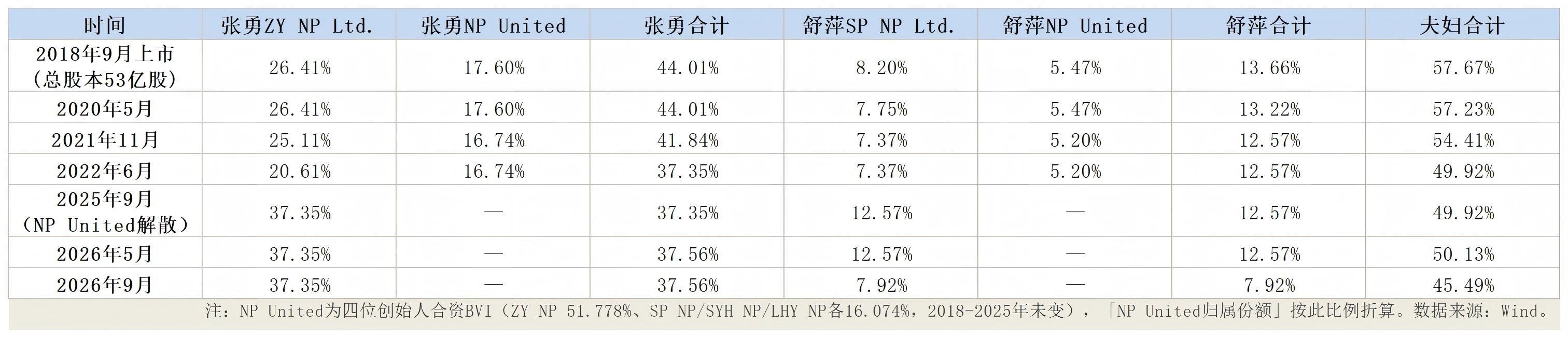
Changes in Haidilao's equity; 36Kr compiled according to Wind
The new regulations have two main impacts on this "richest couple".
First, Zhang Yong's trust was established in 2018, earlier than the retroactive starting point of January 1, 2023, so the tax for the asset transfer stage may not be retroactively collected. However, the income in the duration stage still needs to be supplemented.
According to 36Kr's calculation based on Wind, Haidilao has distributed a total dividend of about 14.11 billion yuan in the eight years since its listing. Roughly calculated based on the couple's shareholding of about 50%, the trust account has received at least 7.055 billion yuan, multiplied by 20% to get 1.41 billion yuan in tax payable.
This is an imminent tax bill that must be paid in cash.
The second part mainly involves "share reduction". The HK$2.75 billion (about 2.5 billion yuan) obtained from Shu Ping's share sale this time, if the trust's share transfer is identified as a taxable act, may also trigger corresponding individual income tax, requiring another 20% tax of about 500 million yuan.
The total tax payable for the two items is about 1.91 billion yuan, and the proceeds from the share sale are 2.5 billion yuan, leaving a slight surplus.
More Than Haidilao
Haidilao's structure is not unique.
Through legal structures, wealthy people mostly set up trusts in places like the Cayman Islands, BVI, Singapore and other regions to achieve purposes such as asset isolation, wealth inheritance, tax deferral, and information confidentiality. Over the past two decades, "offshore trust" has almost become the standard configuration for founders of Chinese listed companies.
*China Business Journal* once reported that in 2018, shareholders of at least 20 Hong Kong-listed companies newly established or transferred equity to offshore family trusts. Among them, 15 are domestic enterprises listed in Hong Kong, and the market value of the shares placed into the trusts is about 28.5 billion US dollars (about 200 billion yuan).
The recently listed Guming is also almost a sample "tailor-made" for the new regulations.
According to the prospectus, founder Wang Yunan holds shares through Modern Leaves Limited, 99% of the equity of the latter is held by Nascent Leaves Limited, which is wholly owned by the family trust established by Wang Yunan as the settlor; the three co-founders Qi Xia, Ruan Xiudi and Pan Pingping also adopted the structure of "99% trust + 1% personally wholly-owned BVI company".
The four mid-tier holding companies signed a deed of covenant on December 27, 2023 to join the concert party arrangement — which falls right after the retroactive starting point of the new policy (January 1, 2023).
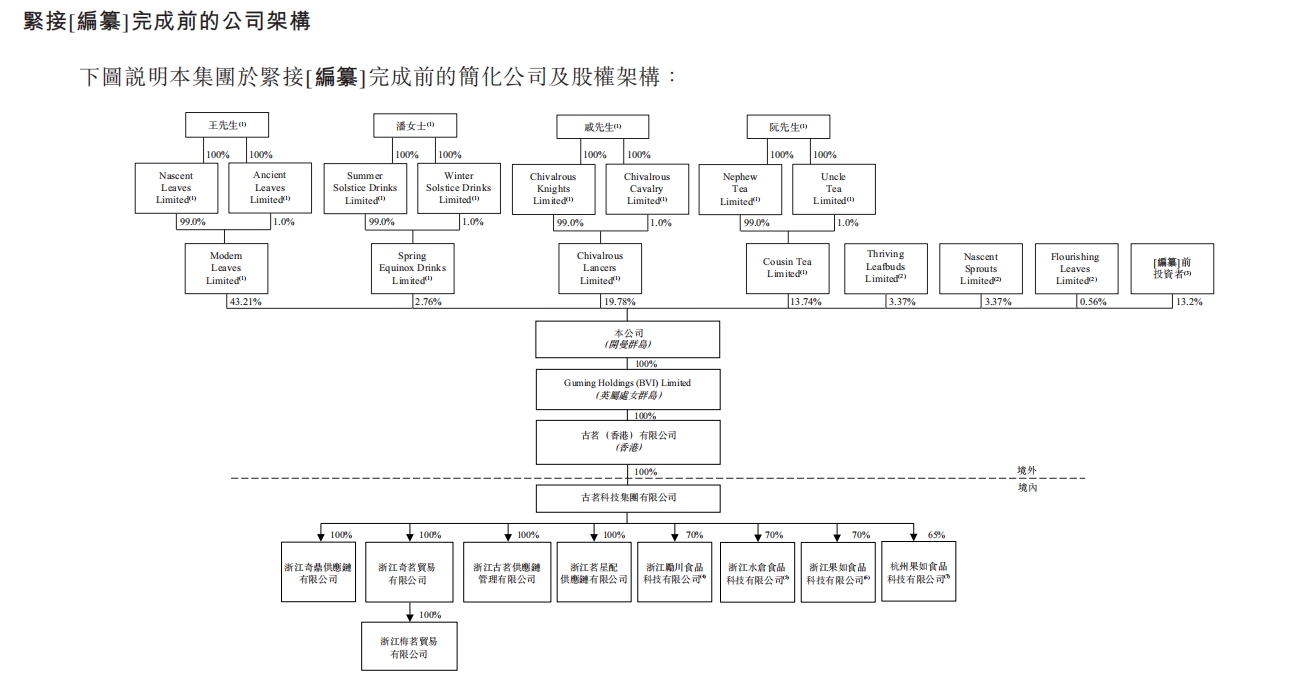
Screenshot from Guming's prospectus
Guming's dividend payout is also very substantial. On the eve of its listing in January 2025, the company declared a dividend of 1.74 billion yuan, of which Wang Yunan alone received 752 million yuan; in November 2025, Guming paid a special dividend of HK$2.212 billion, of which about HK$1.61 billion flowed into the overseas trusts of the four founders.
According to Wang Yunan's current 39.6% equity ratio, after the introduction of the new regulations, the amount involved in his "asset transfer stage" is about 1.63 billion yuan.
Atour is another sample.
All 73.68 million Class B shares of founder Wang Haijun are held by BVI company Express Ocean Universe Limited, whose upper layer is Dreamline Worldwide Ventures Limited, which is ultimately wholly owned by Eternal River Trust, with the trustee being Trident Trust Company (HK) Limited. At the same time, Wang Haijun personally holds 6.542 million Class A shares directly.
As of March 31, 2026, Wang Haijun holds a total of 19.4% of Atour Group's equity and 69.1% of the voting rights.
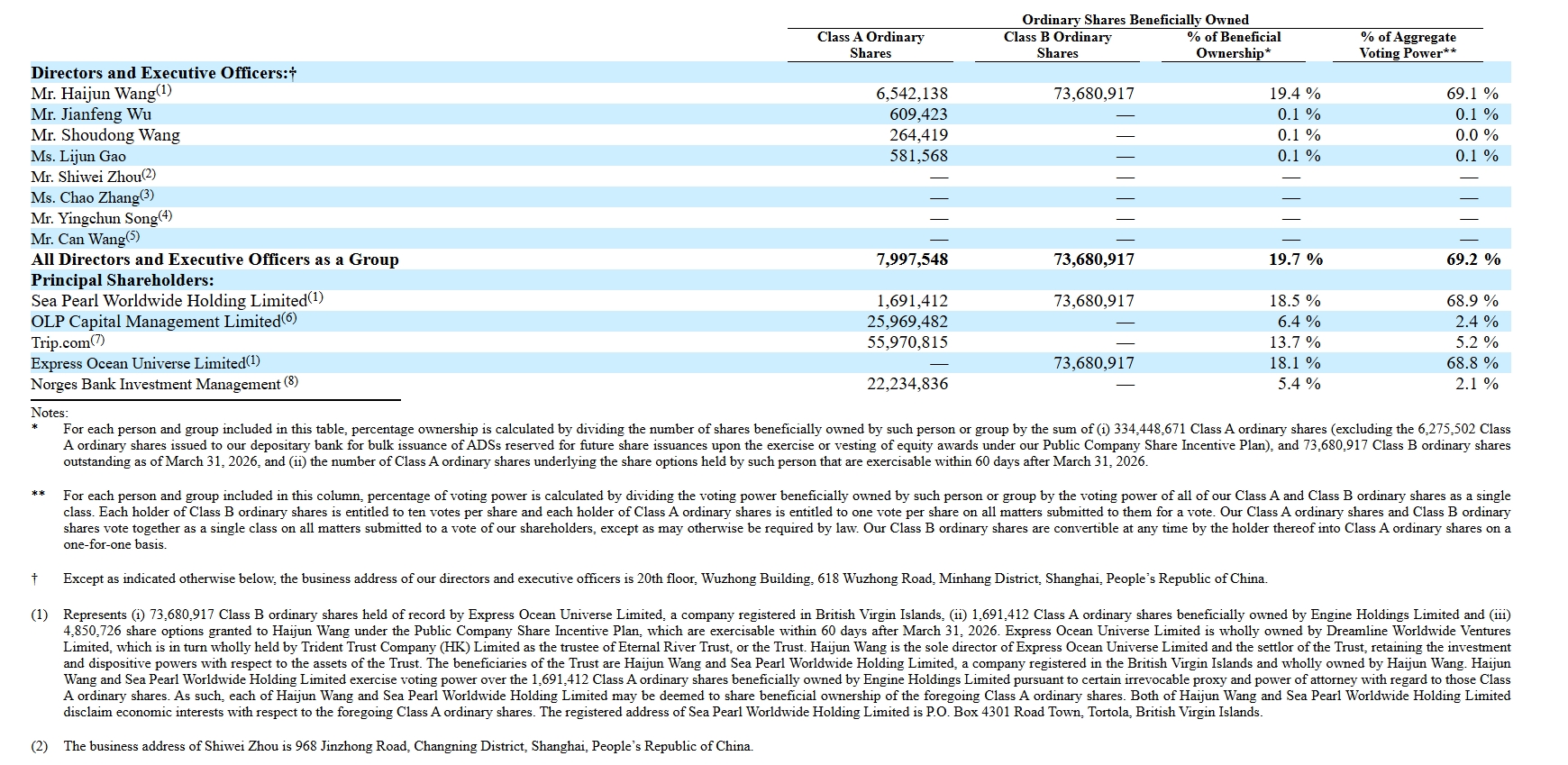
Screenshot from Atour's financial report
In addition, the most notable case is Wahaha.
Relevant materials show that Zong Qinghou gave a handwritten instruction in January 2024, planning to set up a US$700 million trust for each of his three US-citizen children, totaling US$2.1 billion. However, the trust was never formally established, and the corresponding funds were actually deposited in the Hong Kong HSBC account of BVI company Jianhao Venture Capital. In July 2026, the Court of Appeal of the High Court of Hong Kong dismissed Zong Fuli's appeal and upheld the asset preservation of the account, and the substantive dispute will be heard by the Hangzhou Intermediate People's Court.
According to the latest announcement, the unpaid taxes for assets transferred into offshore trusts since January 1, 2023, as well as the income generated before the end of 2025, must be declared and paid within 90 days from the effective date of the announcement — that is, before October 22, 2026, without late payment surcharge; a late payment surcharge of 0.05% per day will be imposed after the deadline, and a maximum fine of 5 times the tax payable will be imposed for tax evasion.
All of this means that all founding families that adopt similar structures will face the same deadline.
For consumer enterprises represented by Haidilao that were listed earlier and focus on cash flow, selling equity is undoubtedly a safe choice. This plunge in the company's stock price is more like a "misjudgment" by the capital market. Morgan Stanley's report also shows that considering Haidilao's solid fundamentals, it still maintains an "overweight" rating on the stock.
But for investors, this HK$2.75 billion share reduction is just the beginning. The period before October 22 will also become an observation window for listed consumer companies. From a tax perspective, share repurchases will be more attractive than "large-scale dividend payouts" in the future.
*Disclaimer:
The content of this article only represents the views of the author.
The market is risky, and investment needs to be cautious. Under no circumstances shall the information or opinions expressed in this article constitute investment advice to any person. Before making an investment decision, if necessary, investors must consult professionals and make decisions carefully. We have no intention of providing underwriting services or any services that require specific qualifications or licenses to engage in to all parties of the transaction.

Follow us for more information