Enable Agent to understand business scenarios, WPS aims to help office workers build office applications from scratch on their own.
Over the past year, various Agent products have entered enterprise office scenarios one after another, performing copywriting, summary making and dialogue response smoothly and freely.
But what enterprise organizations truly expect is never just chat and Q&A: colleges and universities need to realize that teachers of hundreds of internship schools complete leave approval by scanning codes; manufacturing plants need to support 100,000-level equipment business systems to maintain stable daily data submission; operation workshops need to realize automatic transfer of equipment repair work orders and the precipitation and retention of maintenance experience.
The common point of these real demands is not one-question-one-answer interaction, but deep embedding into the complete business process.
It is precisely at this link that a large number of Agents are blocked out of the business. A 2025 Deloitte survey shows that 38% of enterprises have tried Agents, but only 11% of them have actually been deployed in production environments. Gartner predicts that by 2027, more than 40% of Agent projects will be cancelled. The top three reasons are out-of-control costs, unclear value, and uncontrollable risks, none of which is that the model is not smart enough.
The business context is not in the chat window, but precipitated in the enterprise's own spreadsheets, processes and years of operating habits. Only the party that can take over this layer of precipitation can truly enter the door.
At WPS's media briefing on August 28, this long-standing problem has a sample worthy of analysis: the new feature of WPS Multi-dimensional Spreadsheet, Inspire App, can generate a complete business application with just one sentence. Different from the general generation mode, this application is not generated out of thin air, but built on the base of data, permissions and automation capabilities that have been precipitated by the multi-dimensional spreadsheet.
01
On Site: Generate a Business System with One Sentence
At the briefing site, Yang Ding, head of WPS Multi-dimensional Spreadsheet of Kingsoft Office, demonstrated how an application can be generated in natural conversation: input a sentence in natural language, and a rotatable 3D order cockpit will be up and running in a few minutes. The AI first interacts to clarify requirements, then demonstrates the thinking process, and finally lands on a verifiable system, without writing a single line of code throughout the whole process.
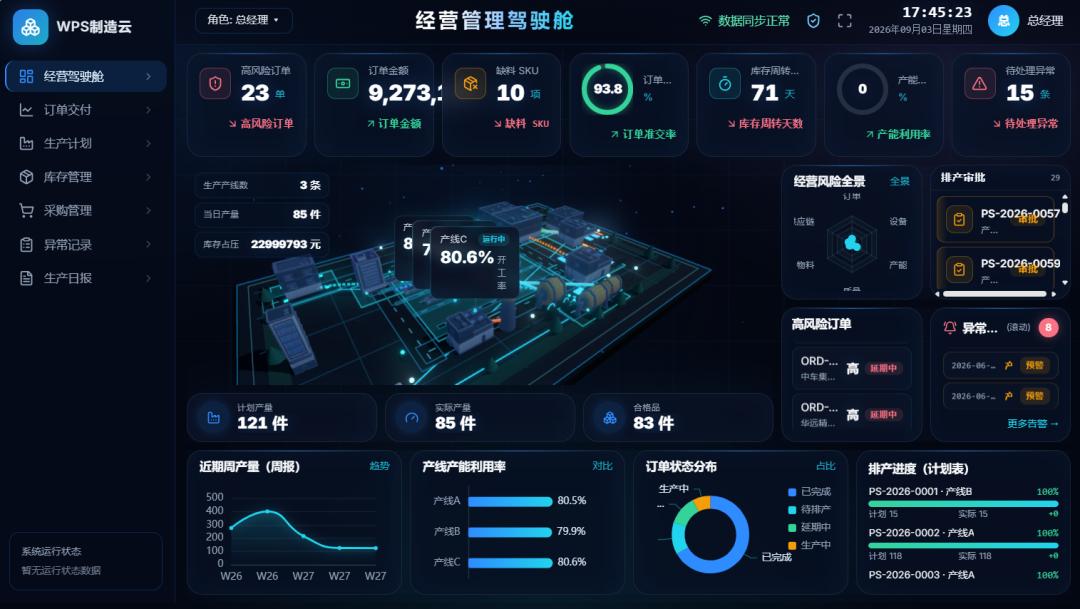
The launch of Inspire Application stems from the real pain points observed by Kingsoft Office in serving a large number of enterprise customers. As Yang Ding said: "Even if we have made 100 or 1000 types of charts, there is always a self-created chart in the enterprise that has never been seen in the market." Standardized software such as large-scale ERP and CRM can only cover the most core business main line of enterprises. There are still a large number of non-standard and fragmented business demands inside enterprises, and these scenarios are the "last mile" that standardized products cannot reach.
Inspire Application and general Vibe coding tools such as Cursor and Lovable all support natural language to generate applications, but the generated results are different: Vibe coding outputs a piece of independent code, while Inspire Application outputs a set of business applications that are built on the base of multi-dimensional spreadsheet.
The general Vibe coding outputs independent code. Although it can quickly produce a demo, non-technical personnel cannot read or modify the underlying code after the "honeymoon period". Coupled with the hallucinations of large models, the code becomes bloated and out of control after multiple iterations, and the generated applications gradually deviate from the real business.
However, the WPS Inspire Application generates a set of business applications based on the multi-dimensional spreadsheet base. It has three core differences:
First, it is generated based on existing fields, data and data relationships, and the AI does not need to reconstruct all business capabilities from scratch;
Second, business personnel do not need to master coding, and can adjust fields, views and business processes at any time;
Third, the full-link data and operation logic are traceable.
At the same time, the multi-dimensional spreadsheet itself is an online document, the generated application is deployment-free, takes effect immediately after saving, and the shared link can be used by all staff. Enterprise-level capabilities such as collaboration permissions, automated processes, and data association are the achievements of multi-dimensional spreadsheet after years of precipitation, and the AI only needs to call and orchestrate them instead of building from scratch.
But to make this upper-layer application run stably for a long time, three underlying conditions need to be met.
02
Backstage: Deep Understanding of Business, Accessible Data, System with High Load Capacity
The premise of enabling AI to orchestrate business is that AI can truly understand the business logic carried by spreadsheets.
WPS AI has successively won the first place in two internationally authoritative evaluation lists, SpreadsheetBench and TableBench, and its performance in SpreadsheetBench has surpassed the benchmark of human experts. The former tests execution capabilities — building spreadsheets, writing formulas, and setting up small business systems; the latter tests reasoning capabilities — data verification, attribution analysis, and visual output. In short, WPS AI can read and process real enterprise spreadsheets.
After understanding the business, we need to solve the problem of where the data comes from. A large amount of enterprise business data is locked in old business systems such as CRM and ERP, and different systems have different interface specifications. In the traditional mode, engineers often need more than three days to complete system docking.
WPS has reconstructed the AI-driven data connector. The business party only needs to provide interface documents, and the AI can automatically complete connector coding, full-process test verification, and generate a visual configuration interface, compressing the docking work that originally took several days to the hour level.
At present, the multi-dimensional spreadsheet has opened 114 OpenAPIs to the outside world, and according to official information, this number ranks first in the industry. These interfaces are standardized channels for Agents to read and operate enterprise business data.
The last barrier comes from real traffic pressure. When a large number of users fill in, modify records, and trigger automated processes at the same time, the dashboard rendering and large-scale statistics add up to the computing pressure, which makes the system prone to lag. WPS has reconstructed the underlying kernel engine for this purpose. On the one hand, it strips off unnecessary real-time computing tasks, and on the other hand, it maximizes system parallelization to fully release hardware computing power. After the transformation, even in the face of complex businesses with millions of rows of data and hundreds of people editing in parallel, the system can still maintain a collaborative response delay of 137 milliseconds.
With AI understanding capability, data connection channel and high-performance underlying engine all ready, Inspire Application is truly in place, but the product value must finally be verified in real business scenarios.
03
Verification: Maintenance Experience is Stored in the System
Chinese enterprises have been building the main road of digitalization for more than 20 years, and ERP and CRM have taken control of the core processes. However, the fragmented scenarios between the main roads, such as equipment maintenance, internship approval, and repair order transfer, have long relied on paper documents and manual docking. Low-code attempts to fill this gap, but the cost is to let business personnel learn development. Only natural language generation applications can give businesses the opportunity to grow their own applications.
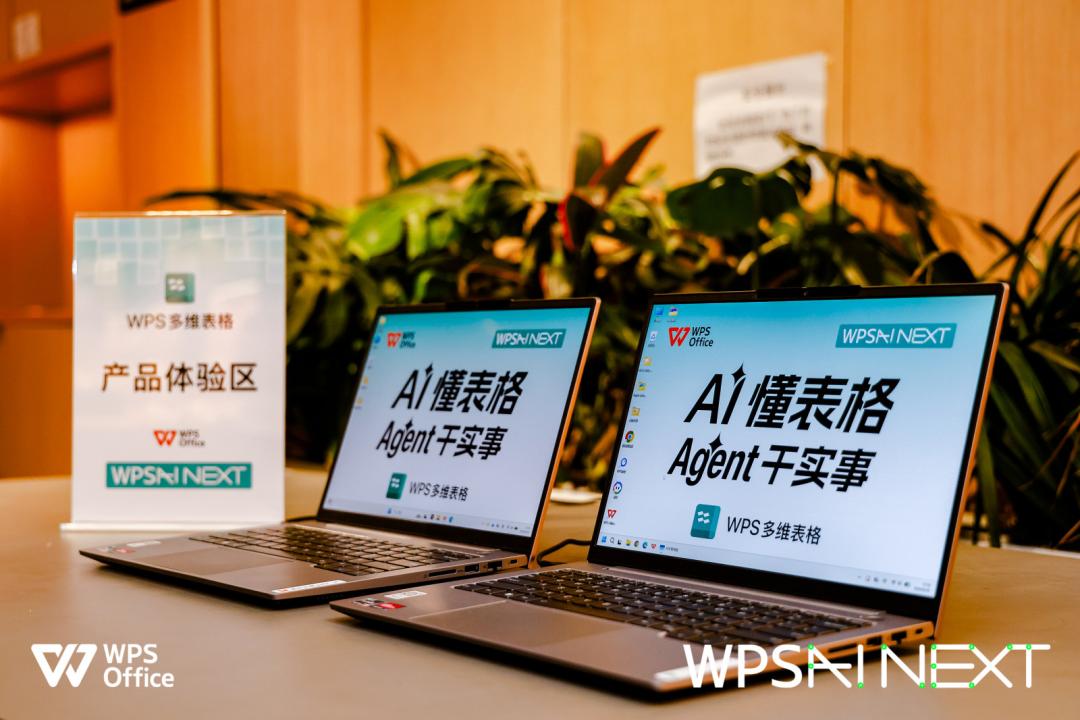
At the briefing site, case sharing by two specific business leaders from the manufacturing industry and higher education institutions reflected the practical value of multi-dimensional spreadsheets in solving the "last mile" problem of enterprises.
China International Marine Containers (Group) Co., Ltd. (CIMC) has many huge business lines. In the past, equipment management in some of its enterprises mainly relied on traditional spreadsheets, paper documents, telephone and email communication, which had pain points such as scattered processes, heavy statistical workload, high cost of special system construction, and long implementation cycle.
By using WPS Multi-dimensional Spreadsheet to build a lightweight equipment management application, it provides a unified and clear operation entrance for different roles through the application mode, centrally carries equipment information, repair reports, work order processing and report statistics, and supports the business to flexibly adjust fields, views and processes according to actual needs, reducing the threshold of front-line use and improving the efficiency of equipment management and cross-role collaboration.
The practical application of Beijing Normal University, Zhuhai Campus, is a typical case of multi-dimensional spreadsheet landing in the education service scenario. The academic affairs teacher has no programming and development background, and built an education internship management system covering three ends of students, teachers and managers based on the multi-dimensional spreadsheet. Internship schools do not need to access the internal portal of Beijing Normal University, they only need to click the link and scan the code to complete the student leave approval, and the whole process of operation is tracked and archived.
Luo Binkai, the academic affairs teacher of Beijing Normal University who shared on site, mentioned that in the past, a lot of time was spent on executive work such as processing data; after the multi-dimensional spreadsheet system was put into use, teachers can spend less time processing data and devote more energy to higher-value work such as business research and judgment.
04
Where is the Dividing Line
Behind the successful operation of one business scenario after another, the product positioning of WPS Multi-dimensional Spreadsheet has quietly changed: from a developer tool platform to a business infrastructure for AI.
There is a detail that is easy to ignore in the whole briefing: there is very little talk about the model itself. The results of the ranking list are mentioned briefly, and most of the space is given to field types, permission systems, connectors, and kernel engines.
This difference in detail itself is a judgment: model capabilities will be caught up, but business precipitation cannot be caught up.
There are now three forces crowded in the first echelon of AI office. DingTalk and Feishu hold the traffic entrance of organizational collaboration: DingTalk's Wukong Agent platform focuses on business flow automation, while Feishu, after merging with Doubao, bets on full-scenario AI; model vendors such as OpenAI and DeepSeek have strong capabilities but lack scenarios; Kingsoft Office's Lingxi Professional Edition holds years of precipitated office scenario understanding and document data.
Among the three forces, model vendors lack scenarios the most, but every one of them is desperately squeezing into enterprise scenarios; collaboration platforms have no shortage of entrances, but multi-dimensional spreadsheets are only a part of their ecology, and their investment has to compete with IM, documents and meetings for resources. Only vendors that regard spreadsheets as their core business will reconstruct the kernel engine and open more than 100 APIs.
Yang Ding said at the end: "AI will replace tools, but it cannot replace business scenarios that have been precipitated for many years."
The condition for this sentence to hold is actually not difficult to verify. The core is to see whether the Agent products of all parties are closer or further away from the enterprise business process after the release of the next-generation model. The current fact is that being able to take over the business precipitated in millions of spreadsheets is still the dividing line that distinguishes Demo from productivity tools.
The door for Agents has been opened, but how far it can go depends on whether it can take over the business precipitated in millions of spreadsheets.