The provincial sub-central city in central China fills a key missing piece of the puzzle.
According to reports from Hubei Daily and Xiangyang Daily, the 70GWh lithium battery industrial park project of Chuneng New Energy in Xiangyang was officially put into operation on August 30. On the same day, the Secretary of the Xiangyang Municipal Party Committee and the mayor emphasized during an inspection tour of the industrial park that efforts should be made to accelerate the building of a new energy and new material industrial cluster to further consolidate the support for economic development.
The report points out that the 70GWh lithium battery industrial park project of Chuneng New Energy in Xiangyang was launched on October 28, 2025. It took only 10 months from the start of construction to the roll-off of the first batch of products, creating a series of "Xiangyang Speed" records.
After the project is put into operation, it will mass-produce full-scenario energy storage and power products with higher safety and higher efficiency, including large-capacity energy storage batteries of 100Ah, 588Ah, 648Ah and higher capacities, and high-rate super fast-charging power batteries. When the project reaches full production capacity, nearly 400,000 batteries will be shipped to the global market every day, with an estimated annual output value exceeding 300 billion yuan.
Chuneng New Energy revealed in an interview with local media that the construction of the Xiangyang base not only refreshed the "Xiangyang Speed" but also set a new record for factory construction in the lithium battery industry, and was finally put into operation two months ahead of schedule.
Behind this speed reflects the urgent desire of this sub-provincial central city to promote industrial transformation.
In recent years, Xiangyang's economic growth has continued to face downward pressure. In 2024, its GDP was overtaken by Yichang, losing its position as "the largest non-provincial capital city in central China"; in 2025, it was further surpassed by Luoyang.
Last year, Xiangyang's GDP growth rate was only 2.1%, of which the growth rate of the secondary industry was only 0.2%, which became the main drag factor. In the first half of 2026, the momentum of economic recovery remained weak, with a growth rate of only 1.8%.
The core problem lies in that the supporting capacity of the automobile industry, which has long been Xiangyang's pillar industry, is gradually weakening, and there is a "gap" between old and new growth drivers.
Under the goal of accelerating the march towards a trillion-yuan economic aggregate, it has become an urgent task to enhance industrial momentum.
To this end, Xiangyang clearly proposed in the outline of the 15th Five-Year Plan to promote the transformation of the industrial pattern from "dominance by one single industry" to "multi-point support". New energy and new materials have been listed as one of the four key characteristic tracks to be developed.
The Xiangyang project of Chuneng New Energy is regarded as the "key puzzle piece" of its 100-billion-yuan new energy industrial cluster.
At present, the energy storage industry is at a critical stage of shifting from scale expansion to value creation. As a "dark horse" in the lithium battery industry that has risen in recent years, Chuneng New Energy has steadily ranked in the first echelon in China. According to data from the China Automotive Battery Industry Innovation Alliance, from January to July this year, its power battery and energy storage battery sales both ranked sixth in the industry.
According to the plan, the Xiangyang project of Chuneng New Energy will build a complete industrial chain covering cell production, PACK manufacturing and energy storage systems, filling the key gap for Xiangyang to extend its industrial layout from "automobile manufacturing" to "battery production", so as to enhance Xiangyang's position in the national new energy industrial chain.
For Xiangyang, this not only means huge economic increment, but also a far-sighted strategic layout.
From the perspective of a larger regional pattern, at the "first provincial meeting for the Spring Festival" of Hubei Province in 2026, Hubei proposed to build five trillion-yuan-level major industrial corridors, two of which involve Xiangyang: the "Han-Xiao-Sui-Xiang-Shi" New Energy and Intelligent Connected Automobile Corridor, and the "Yi-Jing-Jing-Xiang" New Energy and New Material Corridor.
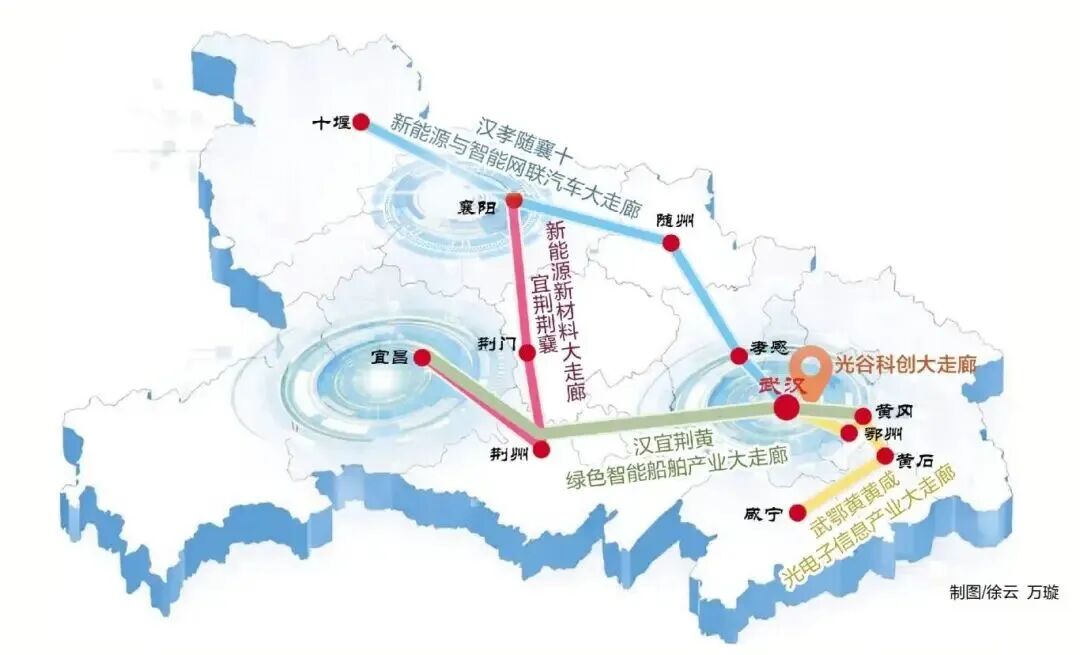
Image source: Hubei Daily
As the key fulcrum of the two industrial corridors, Xiangyang is expected to further grow into a core hub connecting the two trillion-yuan-level industries, and accelerate the improvement of the city's overall competitiveness.
This article is from the WeChat official account "City Evolution", author: Liu Yanmei, published with authorization from 36Kr.