NVIDIA: It will surge by another 70% next year, and the money printer of the computing power central bank is running at full capacity until it smokes.
NVIDIA (NVDA.O) released its second-quarter financial report for fiscal year 2027 (covering the period up to July 2026) after U.S. stock market hours in the early morning of August 27, 2026 Beijing time. The specific details are as follows:
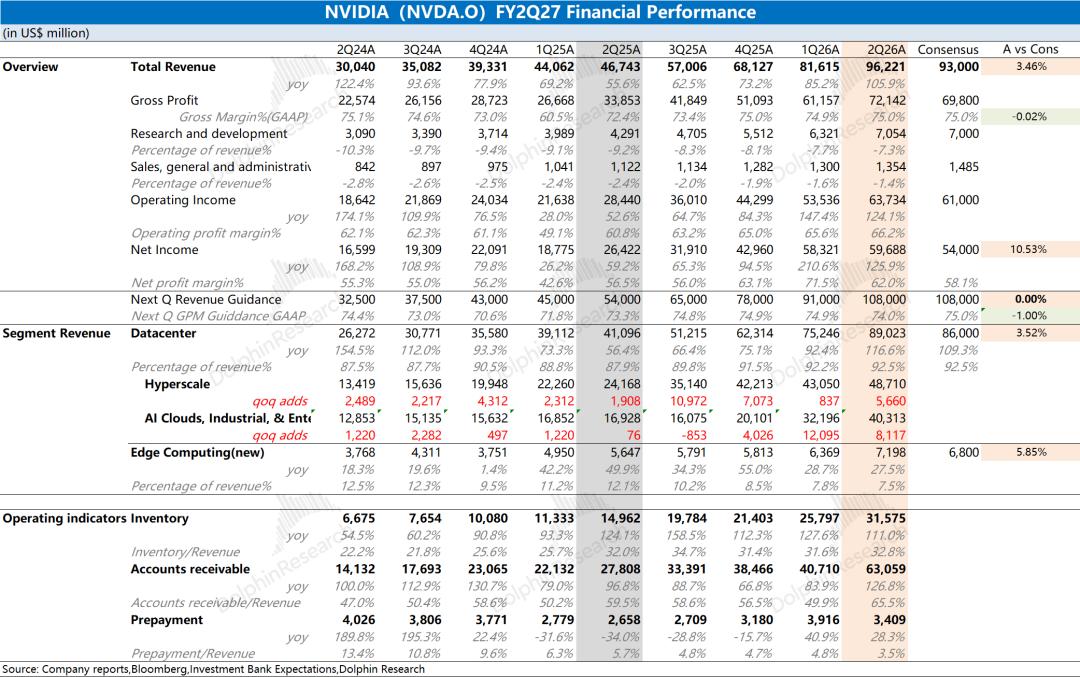
1. Data Center: Revenue for this quarter hit 89 billion US dollars, with a sequential increment of 13.8 billion US dollars, beating market expectations of 86 billion US dollars. The growth was mainly driven by shipments of the Blackwell series. The Rubin series will start shipping from Q3, gradually replacing the Blackwell series to realize product iteration and upgrading.
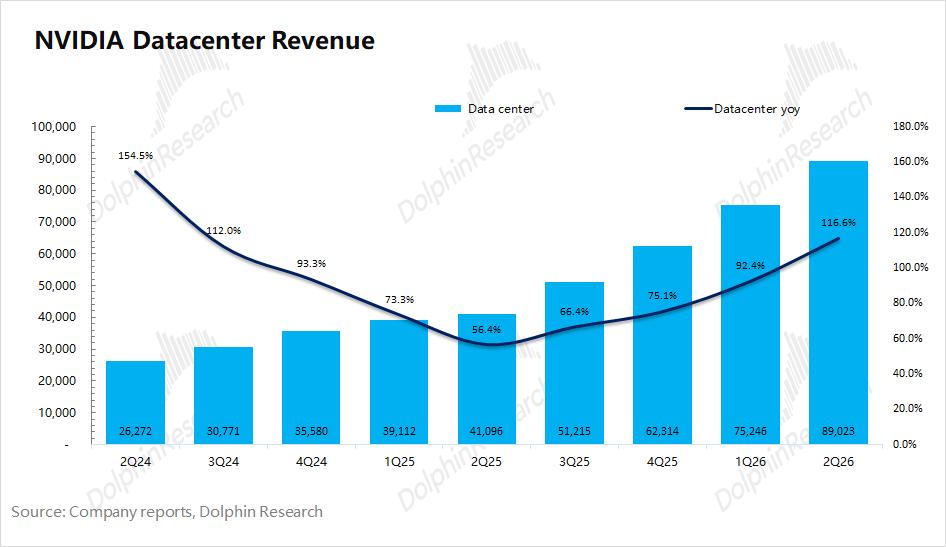
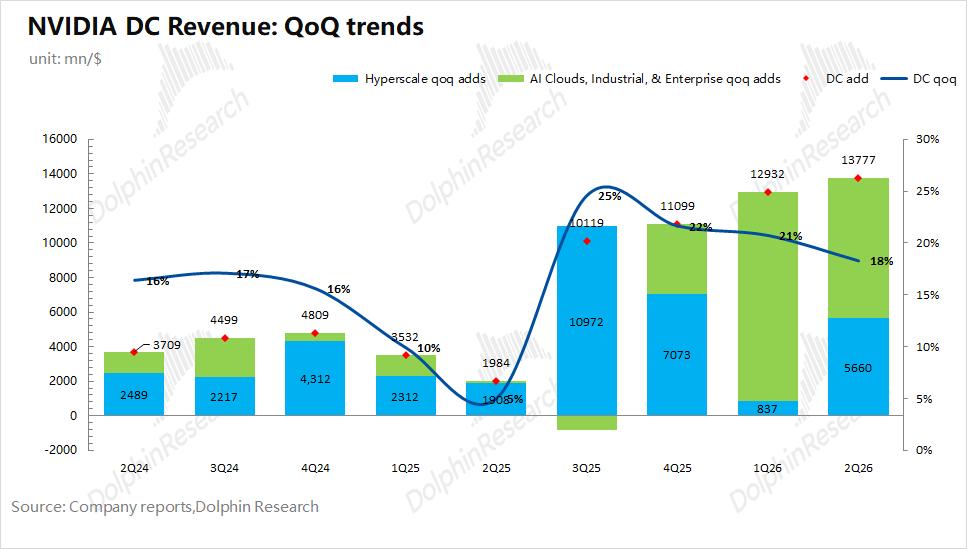
The company adjusted its disclosure caliber starting from this fiscal year, changing from the original segmented "Computing Business and Networking Business" to "Hyperscale Customers and ACIE (including industrial, enterprise and sovereign customers)". Specifically, revenue from hyperscale customers reached 48.7 billion US dollars this quarter, with a sequential increase of 5.7 billion US dollars; revenue from ACIE customer business reached 40.3 billion US dollars, with a sequential quarterly increase of 8.1 billion US dollars, making it the largest incremental driver of the company's revenue growth.
Against the backdrop of major CSP companies starting to develop self-developed chips, NVIDIA is making efforts to develop and support small and medium-sized customers (including government, enterprise and industrial markets), and has announced a 5000-billion US dollar computing power financing platform plan.
2. Core incremental information: The company highlighted three sets of data in this earnings report: Commitments, Additional Commitments, Guarantees
1) Commitments: Refers to signed but unperformed self-use procurement/lease/investment obligations, mainly targeting the upstream supply side. This figure previously appeared in the fine print of last quarter's 10-Q report, and the company fully listed it directly this time.
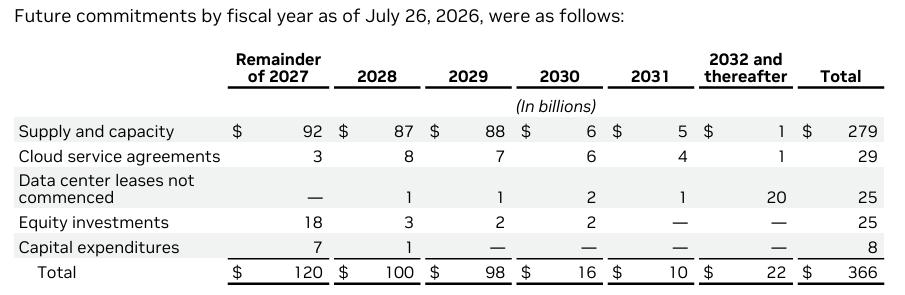
The most obvious change lies in the procurement commitments, which reached 279 billion US dollars as disclosed by the company this quarter. The 119 billion US dollars of procurement commitments disclosed by the company last quarter included 95 billion US dollars for fiscal year 2027, while the supply commitments corresponding to fiscal years 2028 to 2031 were only 24 billion US dollars.
The additional 160 billion US dollars added significantly this quarter mainly comes from the increased commitments for fiscal years 2028-2029 (corresponding to the 2027-2028 calendar years), which means the company has locked in HBM/DRAM production capacity from the spot market in advance. This can be regarded as the contractual base position of NVIDIA for the memory supply chain, which has stronger bargaining power than memory manufacturers.
2) Additional Commitments and Guarantees: Both are newly disclosed data for the first time, targeting the downstream side
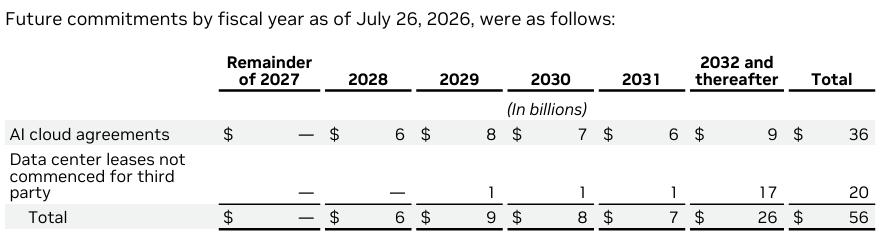
① Additional Commitments: Obligations signed to ensure customers can afford to purchase and build infrastructure, which are divided into two parts: "AI cloud agreements" and "unstarted leases signed on behalf of third parties".
a) AI cloud cooperation: NVIDIA sells server racks to neocloud (CoreWeave, Nebius, etc.) to recognize revenue -> the company commits to buy back or underwrite these computing power capacities (corresponding to 36 billion US dollars here) -> the company shares the revenue from neocloud's resale to third-party customers.
b) Unstarted leases signed on behalf of third parties: Pure credit intermediary behavior. NVIDIA uses its own credit to sign land and power contracts, and then transfers them to customers who cannot obtain sites or power resources. NVIDIA plans to transfer part of the data center leases to third parties. If the transfer fails, the 20-billion-US-dollar lease liability will fall back to NVIDIA's own balance sheet on the lease commencement date.
② Guarantees: Undertaken bottom-line support, which is currently divided into two categories AI cloud partner guarantees and SB Energy/PORTS-Pike guarantees.
NVIDIA provides guarantees for land, power and other resources for AI cloud partners, with a risk exposure of about 3.5 billion US dollars. As for the 4.25GW PORTS-Pike park in Ohio, the 20-year lease exclusively carries NVIDIA's computing power, with the lessee being OpenAI; there is also a 3.8GW expansion right.
The options after triggering rest with NVIDIA: the company can take over the lease by itself, require SB Energy to re-lease it, initiate a sale, allow termination, or postpone for up to one year on the premise of bearing specific project costs.
This excludes the over-100-billion-US-dollar guarantee newly added in August. Originally there were not many guarantees, but it should be noted that the 5000-billion-US-dollar new cloud financing pool announced some time ago has not been included in the statistics.

3. Company Guidance: The company expects revenue of 108 billion US dollars in the third quarter of fiscal year 2027 (i.e. 3Q26), with a sequential increase of 11.8 billion US dollars, which is in line with the upward revised buyer expectation of 108 billion US dollars; next quarter's gross margin (GAAP) will be 74%, down 1 percentage point sequentially, lower than market expectations of 75%.
In subsequent communications, the company's management explicitly gave the revenue guidance for fiscal year 2028 for the first time, and the company expects the revenue growth rate to reach more than 70%, far exceeding market expectations of around 40%. The after-hours stock price rose directly from -3% to around +5%. Correspondingly, under the same caliber of Blackwell+Rubin (calendar years 2025 to 2027), the total cumulative revenue was raised from 1 trillion US dollars to 1.2-1.3 trillion US dollars.
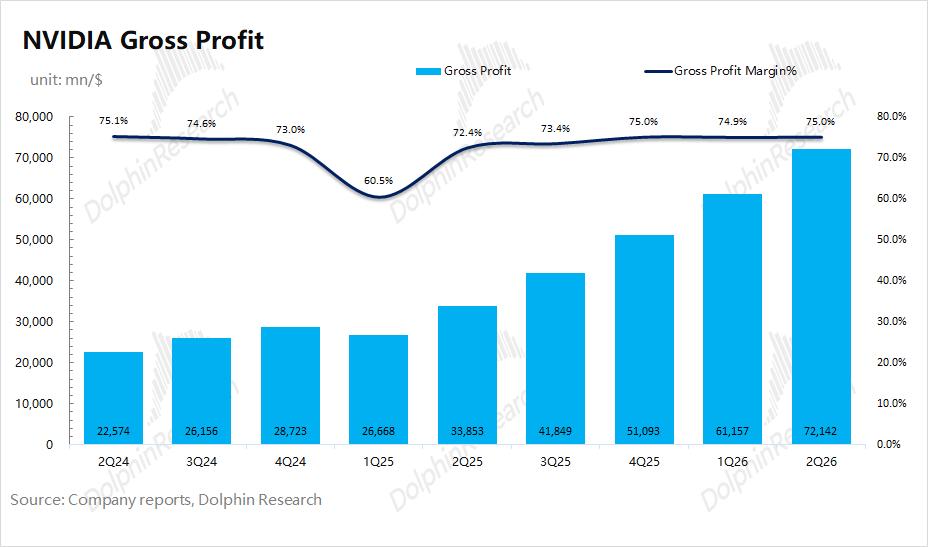
4. Operating Indicators: Total revenue was 96.2 billion US dollars, beating the upward revised buyer expectation of 93 billion US dollars, of which the sequential quarterly increase of 14.6 billion US dollars was almost entirely driven by the data center business. The company's gross margin this quarter was 75%, basically flat sequentially, in line with market expectations of 75%.
The company's core operating profit this quarter was 63.7 billion US dollars, a year-on-year increase of 124%, and the core operating profit margin also reached 66% this quarter, mainly driven by the high growth of revenue.
Dolphin Analyst's Overall View: Issuing guarantees, locking production capacity, the "70% guidance" staged a comeback against the wind
Since Jensen Huang previously gave the guidance that the cumulative revenue of Blackwell+Rubin from 2025 to 2027 (calendar years) will reach 1 trillion US dollars (which is actually raised to 1.2-1.3 trillion US dollars after the 70% guidance for fiscal year 2028 in this report), even if the short-term revenue exceeds expectations, the market actually pays more attention to the growth performance in fiscal years 2027 and 2028.
For the earnings report, the indicator that the market cares relatively much about is gross margin. The company's gross margin this quarter was 75%, and it gave a 74% guidance for the next quarter. Dolphin Analyst believes that the decline in gross margin is affected by factors such as the Rubin production ramp-up and upstream raw materials including memory.
The company's management explicitly gave the outlook of 70%+ revenue growth for fiscal year 2028 (corresponding to calendar year 2027) in subsequent communications, which is the biggest positive information in this earnings report, directly driving the after-hours stock price to rise sharply.
In this earnings report, the company also released core incremental information, including Commitments (commitments to the upstream), Additional Commitments (commitments to the downstream), and Guarantees. It is clearly seen that the company has explicitly locked the supply of upstream resources such as memory for fiscal years 2028-2029, and is making efforts to expand the downstream market.
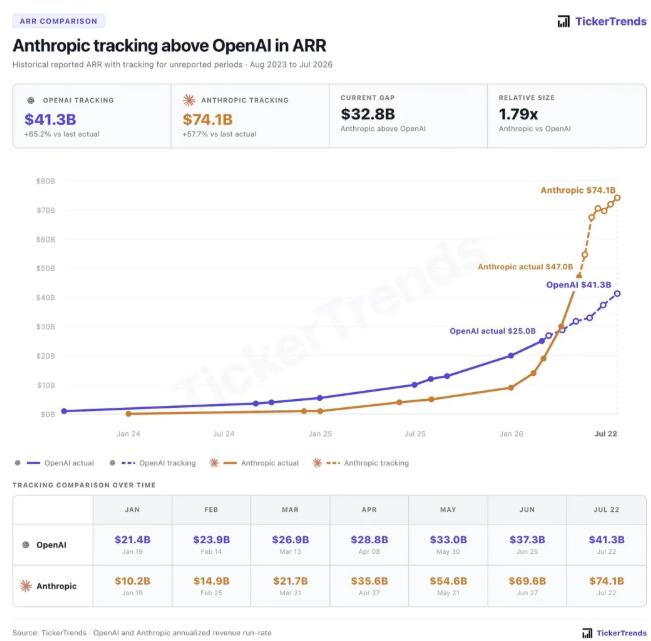
The major pullback of the company and the AI industry previously was mainly affected by events such as Chinese open-source models and Anthropic's ARR growth slope. As major CSP manufacturers announced their respective capital expenditure outlooks, Google, Meta and Amazon have all raised their full-year capital expenditure guidance again, indicating that the current demand for AI chips is still quite strong.
According to data from Ticker Trends, the growth slope of Anthropic has slowed down, while OpenAI still maintains an accelerating trend. The ARR of the two companies is the main tracking target for the market to evaluate closed-source models, and it will also affect the market's expectation of future capital expenditure of large CSPs.
Apart from this earnings report, the market also pays attention to the following aspects:
1) The 5000-billion-US-dollar computing power financing platform
On August 10, 2026, NVIDIA announced cooperation with six third-party investment institutions (Apollo, BlackRock, Blackstone, Brookfield, Goldman Sachs, KKR) to launch an AI factory financing platform of more than 5000 billion US dollars, to support AI labs, enterprises and cloud vendors to build infrastructure.

In some projects, NVIDIA may provide a residual value support mechanism covering up to 25% of a single transaction, with prudent evaluation on a project-by-project basis. This is a structured lease/project financing platform with capped residual value guarantee. NVIDIA transfers the majority of credit risk to the six financial institutions, and retains 25% of the "residual value guarantee" by itself.
2) Rubin's production ramp-up pace
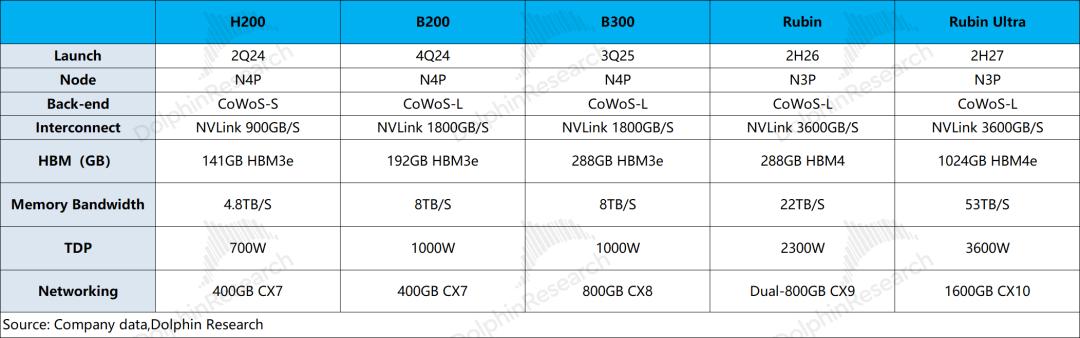
The company's revenue this quarter mainly comes from the Blackwell series. The Rubin series has now entered full mass production and is still in the mass production ramp-up stage, and will become a real volume release point starting from Q4.
The full-rack VR200 NVL72 is equipped with 72 Rubin GPUs (2 dies in a single GPU) + 36 Vera CPUs, with a total NVLink bandwidth of 260 TB/s, 3.6 EFLOPS for inference / 2.5 EFLOPS for training, and 100% liquid cooling.
Previously there were market rumors that the next-generation Rubin Ultra might be delayed, recently the company's IR revealed that Rubin Ultra has not been delayed and is still advancing as scheduled. Pay attention to the latest progress information of Rubin in subsequent management communications.
3) Competitive Landscape
NVIDIA is still the main leader in the AI chip market, with a market share of more than 70%. It cannot be ignored that as the focus of large models shifts to the inference side, NVIDIA's advantages are somewhat weakened.
Since the computing power requirement in the inference phase is relatively low, large cloud vendors have successively developed custom ASIC chips, and AMD is also preparing to launch the MI450X Helios rack-level system, which are all mainly targeted at the inference market.
In fact, the company has split its data center revenue into two parts: "Hyperscale Vendors" and "ACIE". The main incremental revenue of the company in the past two quarters did not come from large CSPs. Only large vendors have the ability to customize ASIC chips, while small and medium-sized customers do not have such capabilities. Additional commitments, guarantees and the 5000-billion-US-dollar financing platform can all provide support for such customers.
