Pop Mart is favored by Duan Yongping, but a large number of trendy toy studios are going bankrupt on a large scale.
"Right now, all designers are waiting for layoff notices, and the company has clearly stated that it cannot survive until the end of the year," Wei Wei told Zhiwei.
In Shipai Town, Dongguan, known as the capital of Chinese trendy toys, the exhibition hall of the company where designer Wei Wei (pseudonym) works does not even turn on the lights.
At a dinner table of industry practitioners in Shipai Town, trendy toy practitioners have sighed to Zhiwei one after another: "It's really hard to make a living this year."
"In the past two years, trendy toy fairs would launch some limited-edition blind box large figurines, many people would queue up for hours in advance to grab them, and the scalpers drove the market extremely hot. But in the past two years, even the fairs are not that lively," a practitioner said with a sigh.
At the same time, there are constant news in the market that "Duan Yongping invested in Pop Mart" and "Duan Yongping publicly stated that he will most likely not sell Pop Mart within 10 years". The industry seems to have entered a state of extreme polarization, and a brutal knockout round is about to begin.
From factories working overtime to fulfill orders, to all kinds of second-hand trendy toys being hyped to sky-high prices, and now to a large number of industry studios closing down, what on earth has happened to the trendy toy industry?
From "Financial Products"
Return to the Essence of "Plastic Figurines"
"When the company was thriving two years ago, there was even a billiards table specially equipped in the lounge, and the boss was willing to play ball and chat with everyone back then," Wei Wei told Zhiwei about the former glory.
In 2025, the single IP LABUBU generated a revenue of 14.16 billion yuan, with a gross profit margin as high as 72.1%. At its peak, the first-generation collectible Labubu doll was sold for 1.08 million yuan, and the premium of the hidden version of ordinary blind boxes exceeded 20 times, breaking the ceiling of the trendy toy industry.
The entire industry became hot, with design, ordering, opening live-streaming rooms... everyone wanted to get a share of the pie.
However, the price plunge in the second-hand trading market tore a crack in the industry.
At the end of 2025, the second-hand price of Labubu began to collapse. For example, the Labubu Sit-Down Party vinyl plush with an original price of 99 yuan was hyped up to more than 1,000 yuan in the secondary market at its peak, but now the average price in the secondary market has dropped below 50 yuan. Labubu is the most typical example. Since the beginning of this year, many practitioners have begun to feel the chill.
Xiao Min, the owner of a trendy toy live-streaming room, told Zhiwei: "I entered the industry relatively late, and my live-streaming room was established in 2024. The best time for trendy toy live-streaming rooms was around 2022. But in the good days two years ago, the profit could reach 30%, now it is around 10%, and the income only covers my food and daily expenses."
"Generally, the brand side first cooperates with distributors. There are many similar distributors in Dongguan. After the brand side negotiates an internal discount with them, they will release new product purchasing information according to market response. For example, the brand side gives them a 40% discount, and then they resell the products to us at a 30% discount," Xiao Min explained the profit model of the live-streaming room.
In the past, the stable second-hand price provided the basis for the profit of this kind of live-streaming room, but now it doesn't work anymore. Xiao Min said: "Now we can still make a little difference on the day the new product is released, because the price we sell is the same as the official price. But after the second-hand price comes out the next day, consumers are more inclined to buy confirmed open products, and few people place orders in the live-streaming room."
Xiao Min mentioned that after the Spring Festival this year, many old fans suddenly began to place orders rationally, and would not blindly buy for hidden versions or surprise versions, and were more inclined to buy second-hand confirmed products, and their design requirements for cute granular toys and figurines are getting higher and higher.
"The main reason is that the second-hand price has collapsed. For a blind box with an original price of 69 yuan, the unpopular version only costs about 30 yuan or even less on the second-hand platform. There are only one or two popular versions in a whole box. Drawing an unpopular version will greatly reduce consumers' confidence, making them feel that buying blind boxes is a loss of money. The day after the new cute granular toy is launched, its second-hand price can drop to about 5 yuan, and consumers no longer blindly pursue new cute granular toys," Xiao Min said.
Not only channel merchants such as live-streaming rooms are having a hard time, but original design trendy toy companies are also struggling this year. A designer from a trendy toy company said: "Our company has fired all core designers, leaving only two interns to do the work with AI."
The direct reason for the poor operating performance of the trendy toy company where Wei Wei works this year is overseas customers abandoning their orders.
The industrial business circle in the Pearl River Delta has always believed in the principle of keeping promises as good as gold. For a long time, the cooperation between suppliers, processing factories and regular customers in all upstream and downstream of various industries has been maintained by word-of-mouth in the circle. Many old customers can start production only through oral communication and small deposits. Out of years of friendship and mutual trust, few people struggle with cumbersome paper contracts, and human trust has become the default unspoken rule of the supply chain. Wei Wei mentioned: "This overseas order was placed very early last year, but no legally binding contract was signed. The goods have been finished, the overseas market has declined this year, and the customer broke the contract directly. Now there are 20 million yuan worth of goods stuck in the warehouse and cannot be sold."
It is worth mentioning that in terms of going global, even Pop Mart cannot resist the slowdown of growth. In the first half of 2026, Pop Mart's overseas market revenue was 4.972 billion yuan, a year-on-year decrease of more than 11%. The number of stores in the Americas market increased by 22 net in half a year, but the revenue decreased by 16.5%. The overseas Asia-Pacific region decreased by 9.7%. The only overseas region that maintained growth was Europe and other regions, with a year-on-year increase of 5.9%, which was only a single-digit growth.
Working Overtime With No Weekends Off,
Yet No Hit Products Are Produced
An interviewee told Zhiwei that it is almost difficult to find a job with two days off on weekends in trendy toy companies in Dongguan.
When the industry develops to a certain stage, "involution" is the norm, either involuting in low prices or involuting in production efficiency. In Shipai local area, the enterprises that can gain a firm foothold and have good operating performance at this stage are roughly divided into two categories: low-cost manufacturers that focus on small profits but quick turnover, and supply chain players that own their own factories and can quickly complete product iteration.
Designer Wei Wei introduced that there is a local enterprise with good operating momentum, and its core strategy is to achieve large-scale sales. "They have a huge order volume, but they are very loose on the quality of finished products and quality control standards, thus reducing the overall production cost. The brand relies on live-streaming room dumping and scalper channels for low-price circulation, and I have never seen anyone buy their products at the original price. Also because the price is cheap, their products are mainly sold to junior high school students and high school students."
Another interviewee said: "Now some companies even require a designer to produce two sets of designs a week."
He also said: "Now when looking for a new job, you should find a company that owns its own factory, so that it is easier to survive." If you have your own factory as support, the speed of new product mold opening, proofing and production will have priority over other companies, and the iteration speed will naturally be faster. Even if their own products do not sell well, such companies can also do OEM for other people's products, and survive stably relying on supply chain orders.
There is a very classic view in the trendy toy industry: If Labubu and Star People are USB flash drives with practical functions, you will only buy one. But when they are decorative ornaments without hard practical value, carrying only emotions, aesthetics and collection obsession, consumers will willingly buy the whole set and buy them repeatedly.
That is to say, trendy toys themselves do not drive consumption by rigid demand, and can only rely on continuous launch of new products and iteration of new styles to capture public attention and stimulate the desire for repurchase. Under this consumption logic, "speed" is inevitable.
But the paradox is that if you want to pursue "speed", it is difficult to achieve "creation" in the true sense. Designer Wei Wei mentioned: "The form of blind boxes has gradually iterated from the original PVC blind boxes to various directions such as plush, BJD (Ball Jointed Doll), and super movable figurines. In terms of design, we are pursuing novelty and difference, but the available paths are getting narrower and narrower."
Wei Wei gave an example. Now all manufacturers are making plush dolls with vinyl faces, which are basically big-eyed cute girl types. They look almost the same at first glance, but manufacturers have no choice. They have to bite the bullet to create differentiation, so they have developed all kinds of "movable eyeballs". Now "movable rotating eyeballs" have become the entry standard, and new products are constantly adding new gameplay, such as various star-shaped eyes and quicksand eyes.
In addition to the involution of new product design, another difficulty in the trendy toy industry is that the production cost is higher than expected, and it is almost a "heavy asset" industry.
First of all, on the design side, a designer said: "If you want to create a complete IP for long-term operation, before the first generation of products are produced, the drawings of the second generation basically need to be finished. After each single product is modeled, it needs to be proofed repeatedly and the details adjusted, including preparing the entire IP's picture library and materials. It is like raising a child, costing money and time. But now many bosses have no patience to do this, and some use AI to make a set of models."
On the manufacturing side, after a new product is determined for mass production, the investment is also considerable. A boss of a trendy toy factory told Zhiwei, for a set of BJD (Ball Jointed Doll), not counting the formal production cost, only the mold opening (custom mold) of a set basically costs hundreds of thousands of yuan.
In addition, it is understood that since this year, the costs of many factories have increased, and the quotations are more expensive than before. A practitioner said: "Not only PVC and other materials have increased in price, almost all raw materials have increased in price, even the fabric for making plush has increased in price, and some have nearly tripled." At the same time, he also said: "Everyone in the industry now knows how much you sell the products for, and the price is basically three or four times the cost, so the factory also wants to earn more."
In addition to the manufacturing side, in the trendy toy industry, channels also have great say. An insider said: "In our industry, many salespeople have higher status than designers."
The founder of CrePoP also told Zhiwei: "The reason why Pop Mart can succeed is, on the one hand, its ability to continuously develop hit IPs, and on the other hand, its ability in channel operation. It can quickly turn concepts into products and quickly take offline products to test the market, which is an obvious advantage."
Cannot Develop Our Own IP,
But Still Believe in the IP Myth
IP is an unavoidable topic for trendy toys. Apart from a few head large enterprises, the vast majority of small and medium-sized trendy toy studios on the market can hardly settle down to incubate original IPs for a long time, and complete the overall design of character and world view. Most players only keep a close eye on the market trend, and when a certain style becomes popular, they will swarm to copy it.
However, there is a relatively profitable shortcut to co-brand with well-established IPs such as Sanrio and Disney. Even for Pop Mart, the "hit rate" of co-branded products is much higher than that of self-operated IPs. This means that if you can get the co-branding authorization, you have a "guarantee of hit products".
To put it simply, trendy toy companies can negotiate copyright cooperation with large IPs, pay to get the authorization, and create, produce and sell derivative works of the large IP within the authorization period. If things go well, they can not only get the cost back but also double their profit.
But this gameplay is only applicable to companies with sufficient capital flow. According to previous reports from Tech Planet, the annual co-branding fee for IPs such as Butter Bear and Line Friends is around 2 million yuan. The cost of IP cooperation will vary greatly according to the willingness of the copyright party, the qualification of the cooperating unit, and the scope of involvement. It is understood that at present, most trendy toy co-branding copyrights adopt a short-term trial mode of signing once a year, and when the copyright expires, you cannot continue to use it if the product is not launched, and the products that have been put on the market cannot continue to be sold.
Therefore, under this model, for trendy toy companies, the biggest risk is that after paying the full copyright fee, due to problems such as overrun of design cost and construction period, it is difficult to successfully launch the product within one year and earn the cost back. (Only after purchasing the authorization, the copyright party will open the available image library, and the manufacturer cannot finish the product in advance and then buy the authorization.)
Wei Wei mentioned: "Our company bought a large IP before, and I also made a complete set of designs, but my design went through several rounds of communication, and the cost was too much overrun. They wanted to sell it cheaper, so the project couldn't move forward. Finally, we launched other basic models one after another, but none of them were as satisfactory as the original version. In short, we didn't finish the product when the one-year period expired, and the copyright fee was paid for nothing." Wei Wei said, unless it is a company that specializes in IP co-creation and derivative design, which buys copyrights for a long time, so they are not restricted by time and can produce products at any time, or large enterprises usually buy copyrights for 4 to 5 years, and the payback period will be much longer.
There is another way, which is to buy amateur IPs and "take a gamble". For example, the recent new IP YuY was originally a series of illustrations published by a post-2000 creator on social platforms, which accumulated a certain fan base on social platforms. After being "selected" by TOP TOY, it set off another queue craze in shopping malls across the country in the form of pop-up stores. According to people familiar with the matter, TOP TOY spent tens of millions of yuan to buy the copyright of YuY.
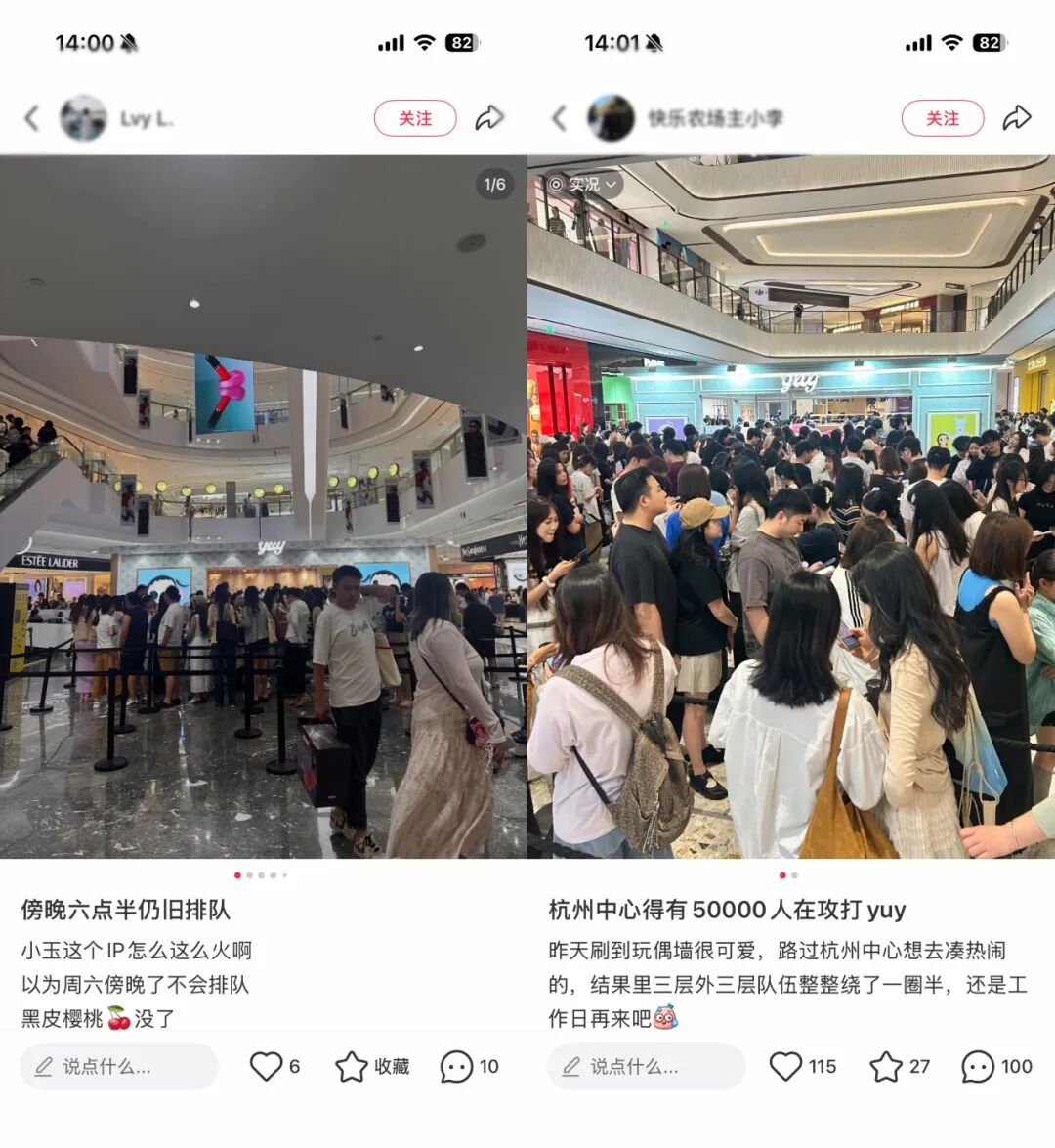
But for this kind of IP design, the founder of CrePoP told Zhiwei: "The IP creation ideas of top artists actually rely more on the artist's own inspiration. Whether it is MOLLY, Star People, or Labubu, they are a bit like genius singers such as Jay Chou and JJ Lin, driven by the artist's own inspiration, and it is difficult to make them regular."
As a member of start-up companies, the founder of CrePoP said: "We still need a data-driven methodology, and add soul on this basis."
For example, CrePoP's latest IP is a red-haired boy named Bomy. Bomy's designer shared: "At first, when we followed big data, we suddenly found that a group of young people agreed with the idea that 'not being able to bear it is also a virtue', because emotions that have been suppressed for a long time definitely need an outlet. In addition, we found that most of the healing IPs on the market are little girl images or anthropomorphic animals, and IPs dominated by little boys are more introverted, such as Ono who also has a gloomy personality, so we want to use a little boy with a hot temper and a little fl