The more AI game developers use, the more anxious they feel: 54% of them worry about being replaced, 37% say their workflow has not become faster, and even if it does speed up, the quality of their work does not improve.
AI is accelerating game development, yet developers do not seem to feel more at ease as a result.
The 2026 State of Real-Time Workflows Report released jointly by Perforce and AWS shows that AI is gradually moving from an "emerging tool" into the daily workflows of the gaming and related industries. At the same time, concerns around job security, content quality, creativity and ethics are also rising in tandem.
The report surveyed more than 600 game technology practitioners and professionals from related industries around the world. Overall, 50% of respondents are worried about job security or their roles being replaced by AI, 49% are concerned about the poor quality of AI-generated content, 48% have concerns in terms of ethics or compliance, and 36% believe that AI is reducing creativity or human participation in work.
Among game developers, this anxiety is even more pronounced.
The more AI improves efficiency, the more anxious game developers become?
The report shows that 54% of game developers are worried about job security or role redundancy, 54% have ethical concerns, and 39% believe that AI has reduced creativity or human participation.
It is even more noteworthy that the "efficiency improvement" brought by AI does not cover all developers.
37% of respondents said that AI has not brought any measurable acceleration to their workflows.
This means that after AI is introduced into the game development process, there is no simple one-way chain of "using AI → efficiency improvement → industry benefit".
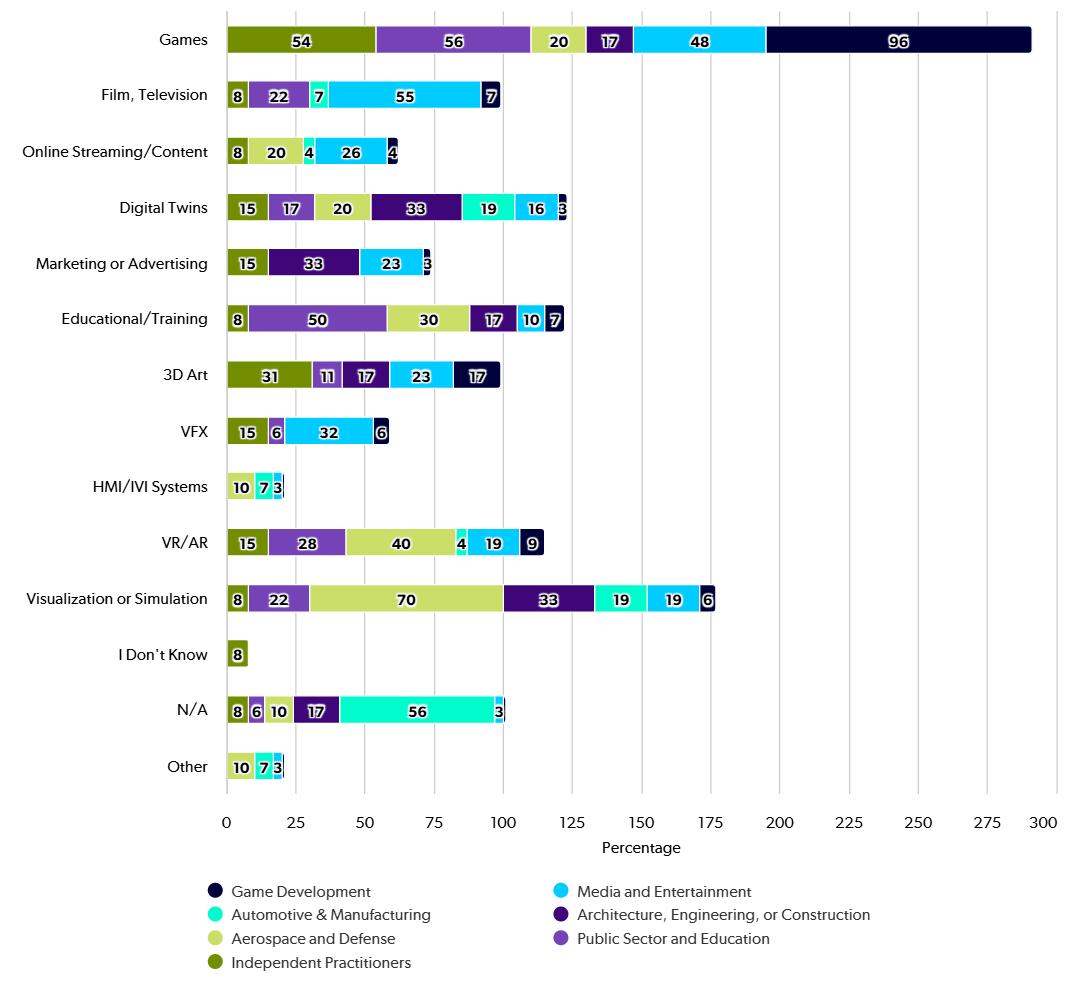
Distribution of project types developed by respondents' companies using game/real-time 3D engines
On the one hand, AI is indeed helping some teams reduce repetitive work and speed up content and code production; on the other hand, as AI can take on more and more tasks that were originally completed by humans, developers are also starting to rethink the value of their positions and what "efficiency improvement" really means.
The report even cites a 2026 UK study stating that 76% of game development practitioners have considered leaving the gaming industry, with layoffs and the uncertainty brought by AI being one of the important reasons.
From an industry perspective, the problems brought by AI are no longer just "whether people can use it", but how to find a new balance among efficiency, creativity and employment.
AI does improve efficiency, but "faster" does not equal "better"
Of course, the productivity improvement brought by AI is not the other side of the report.
Data shows that industries with the most active AI use are often the ones with the most obvious efficiency gains. Fields such as media and entertainment, automotive and manufacturing are at the forefront of AI application and workflow acceleration.
From a regional perspective, AI-driven productivity improvement in the Asia-Pacific region has reached 74%, the highest in the world.
This means that the value of AI for the gaming and related content industries is quite clear: when enterprises can truly embed AI into the production process instead of using it as a single-point tool, the efficiency improvement will be more significant.
But problems also follow — if AI only allows teams to "produce more" without simultaneously solving content quality, copyright compliance and creative control, the improved efficiency itself may not be translated into higher commercial value.
This is also a change that the report repeatedly emphasizes: the competition in the AI industry is shifting from "who can use it faster" to "who can control the costs and risks brought by AI".
Game technology is expanding beyond the gaming industry
In addition to AI, the report also reveals a trend that deserves more attention from the gaming industry: game technology itself is becoming the infrastructure of other industries.
The most typical example is the game engine.
In the media and entertainment industry, 55% of respondents have used game engines for film and television production, 32% for VFX, 26% for streaming content, and 22% for marketing and advertising.
Game engines are evolving from "tools for making games" to real-time production infrastructure in the content industry.
The same is true for the automotive and manufacturing industries. The report shows that 19% of respondents have used game engines for digital twins, visualization and simulation.
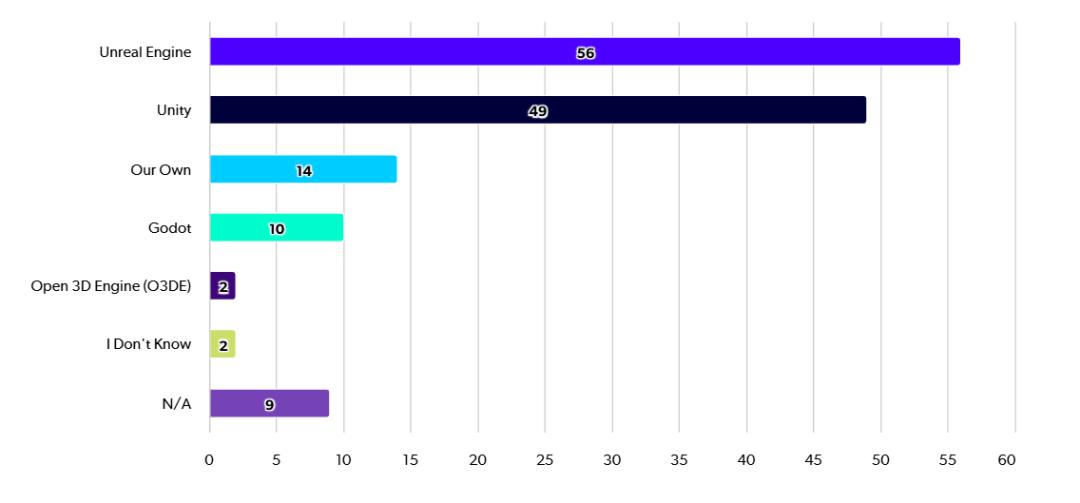
Distribution of game/real-time 3D engines used by respondents' teams
The logic behind this is not complicated: the gaming industry has long pursued real-time rendering, complex asset management and high-efficiency content production. As industries such as film and television, automotive and advertising have rising demands for real-time 3D and digital production, game technology is penetrating into more industries.
Even the infrastructure is changing. The report shows that the adoption rate of version control systems has increased from 86% in 2025 to 94%.
This is no coincidence. As AI begins to participate in the production of code, content and assets on a large scale, the "changes" in projects are increasing exponentially. The report's data shows that 36% of respondents have used AI to generate code, up from 28% in 2025.
The faster AI produces, the more teams need to know: who changed what? When was it changed? Why was it changed? Can we roll back if something goes wrong?
Therefore, AI has not made traditional development infrastructure less important, but has further amplified the value of version control, asset management and collaboration systems.
In the AI gaming era, the real competition may not be about "who generates more"
According to this report, the gaming industry is entering a somewhat contradictory new stage.
On the one hand, there is the productivity improvement brought by AI, and the continuous expansion of technologies such as game engines and real-time 3D beyond the gaming sector; on the other hand, there are developers' concerns about job security, content quality, creativity and compliance issues.
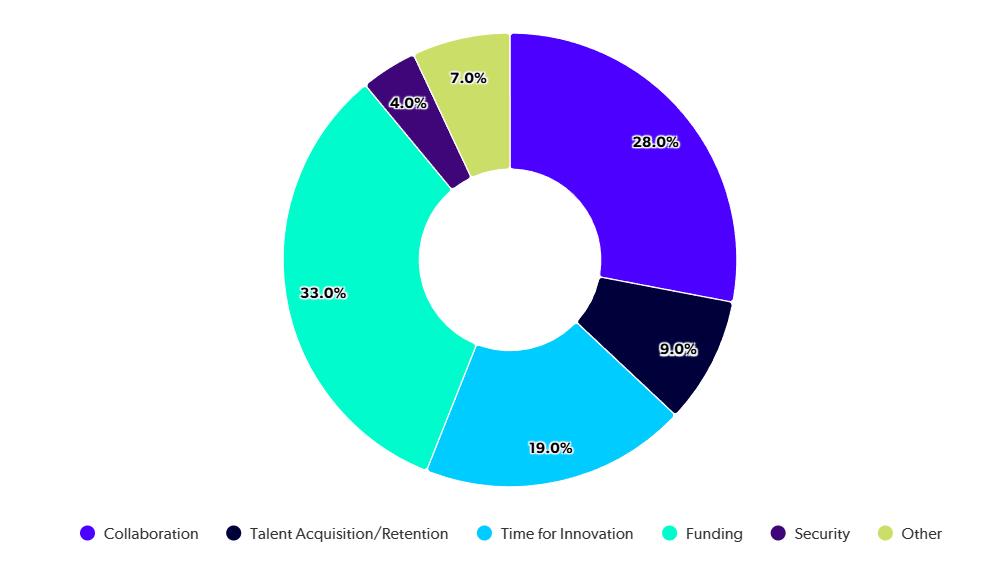
28% of respondents believe that the biggest challenge for their team is "collaboration", and 19% believe it is "time dedicated to innovation"
This also means that when game enterprises face AI, the focus of competition may be changing.
In the past, the industry paid more attention to "who can use AI first"; now, as AI has gradually become a basic production tool, the truly important question has become: who can translate the efficiency brought by AI into a stable, controllable and creative production capacity.
After all, for the gaming industry, producing content faster does not equal making better games.
When AI makes it easier and easier to "produce more", how to ensure content quality, preserve human creativity, and let developers truly benefit from efficiency improvement may be the question that the gaming industry really needs to answer in the next stage.
Source:
《2026 State of Real-Time Workflows Report: Game Technology & Beyond》
This article is from the WeChat official account "DataEye" (ID: DataEye), the author is DataEye Research Institute, and it is published with authorization from 36Kr.