Chinese EV sales are surging in Australia, with BYD closing in on Toyota
In Australia, sales of pure electric vehicles (EVs) are growing rapidly. Chinese brands such as BYD, which are launching affordable models, are squeezing Japanese automakers that have long regarded the Australian market as their "home base". At the same time, policies favorable to EVs are also driving their popularization, and it is expected that this boom is not just a temporary demand brought about by rising fuel prices.
"This is amazing growth," said Tony Weber, CEO of the Federal Chamber of Automotive Industries (FCAI), an Australian industry group, "A structural change is taking place where pure electric vehicles are becoming established as a substitute for gasoline cars."
110 EV Models Have Been Launched in the Australian Market
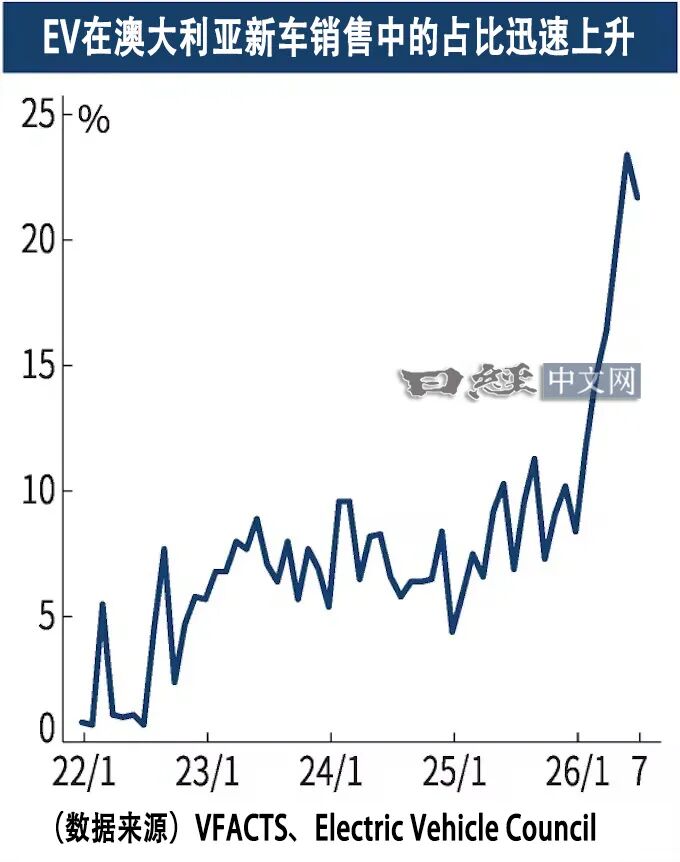
According to FCAI data, as of July, EVs accounted for 21.7% of new car sales in Australia, nearly tripling from January. There are currently about 110 EV models available on the market.
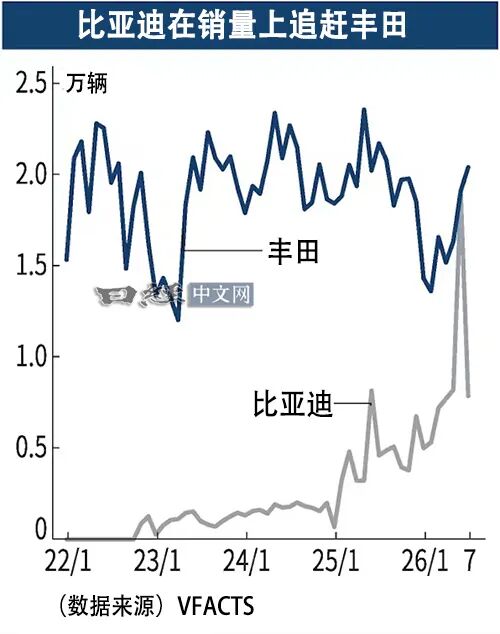
Chinese EVs are driving this growth. Sales of BYD, a representative enterprise, were zero before October 2022, but in June this year, about 19,000 units were sold, narrowing the gap with Toyota, the top-ranked brand, to only 243 units.
The biggest reason for the surge in Chinese EV sales is the rise in fuel prices. In February, before the situation in the Middle East became tense, the price of gasoline was 1.68 Australian dollars per liter (about 7.99 yuan), and it rose by about 30% in March. Consumers have turned to EVs with relatively lower usage costs.
The prices of Chinese automakers' vehicles are also relatively low. Riz Akhtar, Chief Executive Officer (CEO) of Australian market research firm CarLoop, pointed out: "BYD's strategy is to set lower prices for similar models than its competitor Toyota."
For example, consumers considering buying a hybrid vehicle (HV) or a plug-in hybrid vehicle (PHEV) will compare Toyota's "RAV4 (starting at about 46,000 Australian dollars)" with BYD's "Sealion 6 (starting at about 43,000 Australian dollars)" and choose the cheaper one.
Australia has geopolitical vigilance against China, but Weber said: "In the Australian market, the biggest factor affecting consumers' purchasing behavior is price." Australian automotive media reports that Chinese automakers have launched more than 15 brands in Australia and plan to further expand into the market.
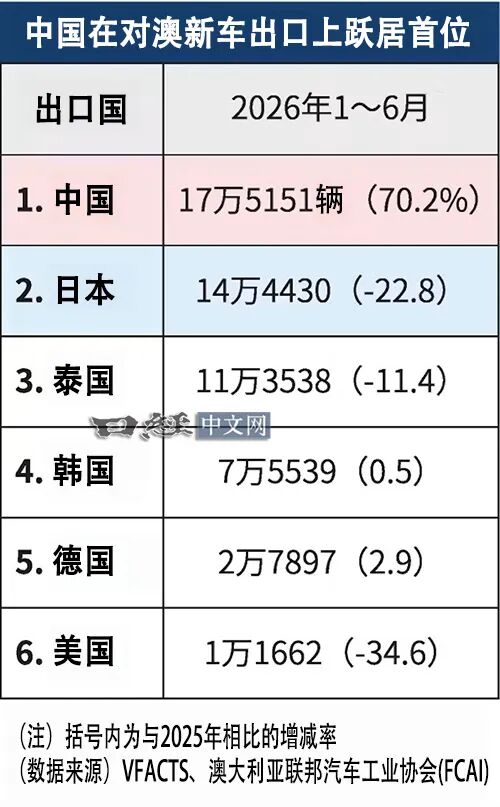
Chinese automakers are launching new models one after another, with shorter delivery cycles. Their dealer networks are also expanding rapidly. Akhtar said: "BYD can deliver vehicles as fast as 4 weeks, while the RAV4 requires a 6-month wait. Japanese automakers cannot keep up with the pace of Chinese automakers."
Chinese automakers have also begun to enter the Australian pickup truck market, where Japanese companies have long held advantages. BYD started accepting orders for its plug-in hybrid pickup "Shark 6" in 2024, and its market share has risen to 16% in less than two years. This model can drive 80 kilometers solely on battery power and is priced lower than competing products.
In Australia, Toyota produced vehicles locally for more than half a century, but ceased production in 2017. Ford also ended its local production in the country in 2016. In addition, the local brand Holden ceased production in 2017 due to high costs and other reasons, and the brand completely disappeared in 2020.
The United States and Europe have imposed high tariffs on Chinese EVs to protect their domestic automotive industries. On the other hand, Australia exempts imported EVs from tariffs, which has also driven the rapid growth of Chinese EVs.
The Australian Government Is Effectively Providing Support to Chinese Enterprises
The Australian government, on the contrary, regards EVs as a trump card to achieve decarbonization and is actively promoting their popularization. The government has set an ambitious target of reducing greenhouse gas emissions by 43% by 2030 compared with 2005 levels, and ensuring that 82% of power generation comes from renewable energy sources.
The core policy of the government to promote EV development is the new fuel efficiency regulation "New Vehicle Efficiency Standard (NVES)" to be implemented in 2025. It sets a cap on the average carbon dioxide emissions of new vehicles from each automaker to promote the launch of EVs and low-fuel-consumption vehicles. Manufacturers with a high proportion of high-emission models such as pickup trucks will face greater pressure.
If an enterprise's annual average emissions are lower than the standard, it can obtain carbon credits; if it is higher than the standard, it will get negative credits. Manufacturers with negative credits will have to pay fines, or purchase credits from other enterprises with surplus carbon credits to make up for the shortfall.
Steven Bragg from the accounting firm Pitcher Partners pointed out: "Chinese automakers can use the credits obtained from EV sales to improve their price competitiveness." It can be said that Chinese automakers are actually benefiting from the support of the Australian government's system.
The Australian government's purpose of promoting EV popularization is not limited to environmental protection. The country is a major producer of lithium, a battery material, and the growth of EV sales will help develop its domestic industry. 90% of the lithium ore concentrates exported by the country are sold to China.
Chinese EVs are rapidly gaining presence, but the future challenge lies in how to build trust with customers. Japanese companies have spent a long time building brand trust through continuous efforts.
Mike Costello from the US research firm Cox Automotive pointed out: "Chinese automakers will face tests in whether they can secure repair parts and maintenance personnel, provide complete after-sales services, and maintain the residual value of used cars."
This article is from the WeChat official account "Nikkei Chinese Net" (ID: rijingzhongwenwang), written by Ruri Imahashi in Sydney, and authorized for release by 36Kr.