Lenovo has decided to "add positions with floating profits"
During the trading session on August 13, Lenovo Group released its financial report for the first quarter of the 2027 fiscal year (the natural calendar year corresponds to 2026Q2), recording revenue of 26.94 billion US dollars, a record high in history. The adjusted net profit reached 1.08 billion US dollars, with a net profit margin of 4%, doubling compared to the same period last year. Both revenue and profit significantly exceeded market consensus expectations. (The one-page infographic of the financial report is shown below, unit: 100 million US dollars)
The performance on the digital front is quite impressive. After the financial report was released, Lenovo's stock price jumped 20%.
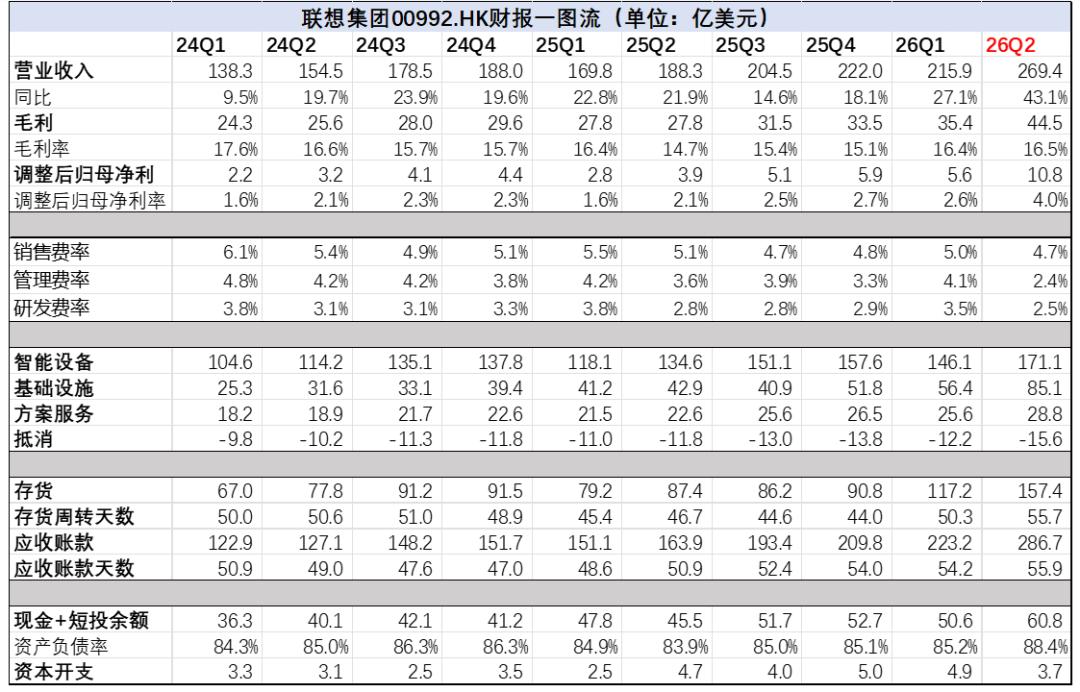
Lenovo delivered a standout financial report where revenue and profits both beat expectations across the board, with the backlog of AI server orders surging to 54 billion US dollars. We acknowledge that AI Capex has not yet reached its end at this stage, but risks should be considered even in prosperous times: will hardware manufacturers stuck in the midstream link, who keep increasing investment and see inventory surge, give rise to a reverse bullwhip effect?
The specific analysis of the financial report is as follows.
01
Benefiting from the robust NVIDIA supply chain, both revenue and profit significantly exceed expectations
In Q2 2026, Lenovo Group's revenue reached 26.94 billion US dollars, a year-on-year increase of 43%, nearly 4.5 billion US dollars higher than expectations, hitting a new all-time high for a single quarter.
Obviously, it is clearly biased to confine the positioning of Lenovo to the logic of a "contract manufacturer" nowadays. Since April this year, Lenovo's market value has increased by 281%, nearly tripling.
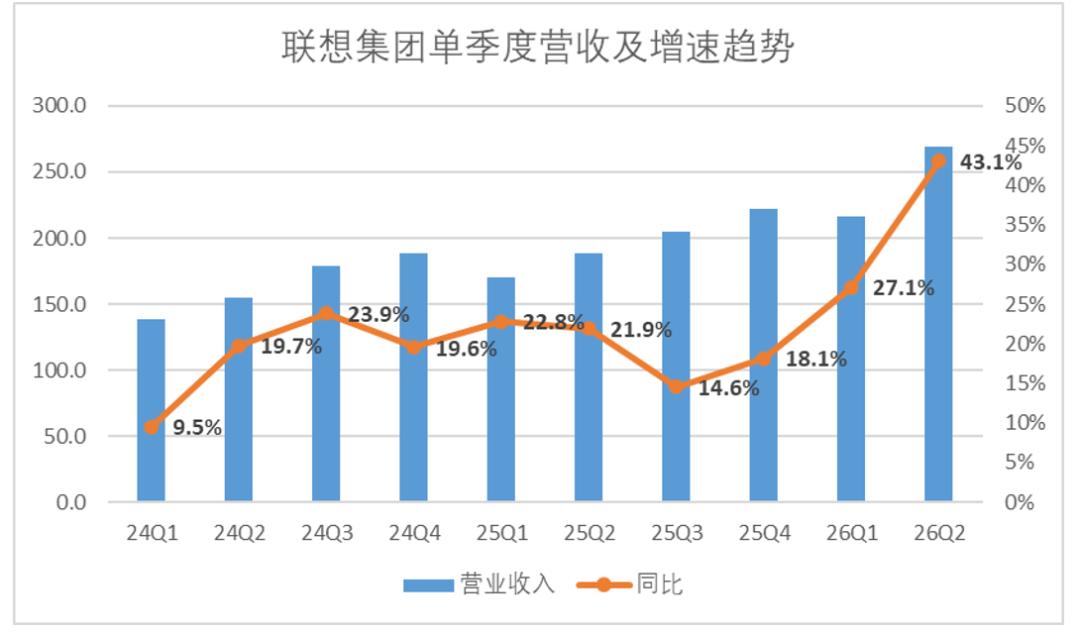
More critically, compared with previous quarters, Lenovo demonstrated a marked improvement in profitability to the market in its latest financial report. The adjusted net profit reached 1.08 billion US dollars, more than doubling Bloomberg's consensus expectation, and the overall profit margin level also nearly doubled.
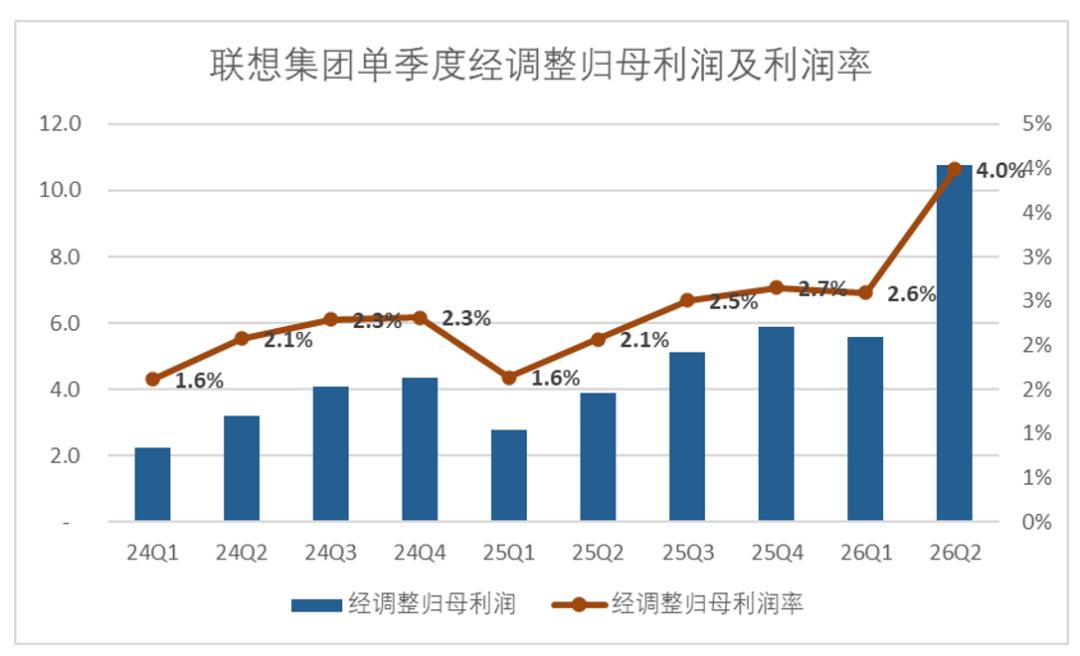
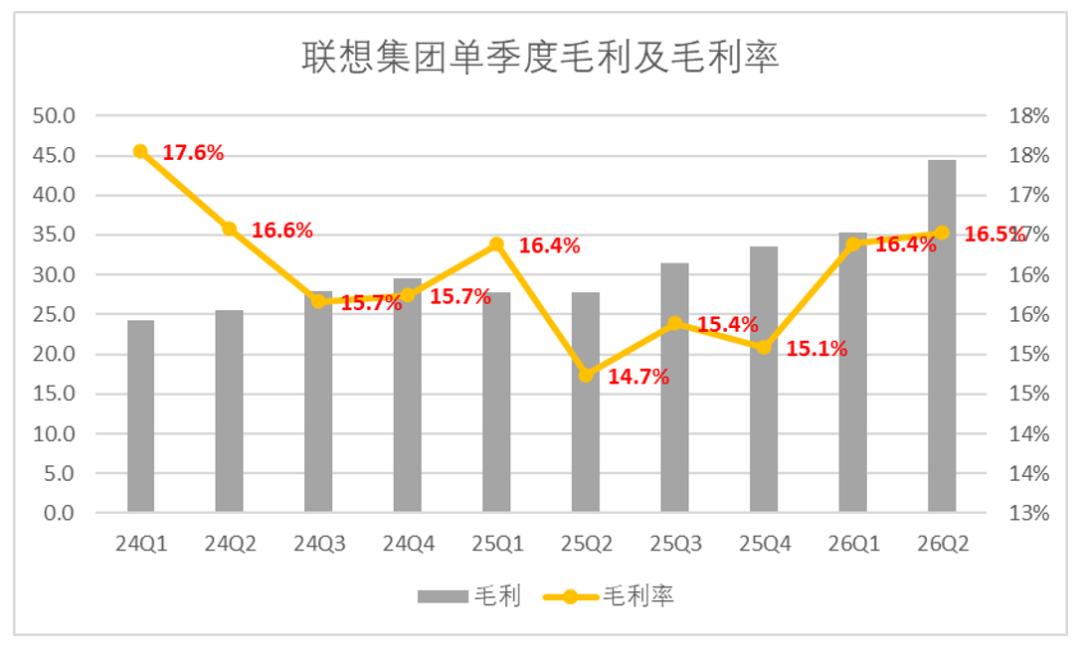
In terms of gross margin, the gross margin of actual business only increased by 10bp quarter-on-quarter from Q1. In other words, the net profit performance of this quarter is entirely driven by the positive growth brought by the dilution of expense rate through revenue scale expansion.
It is obvious that AI Capex is being realized at a frantic pace, especially for OEM manufacturers. According to previous reports from IDC, there are not many system integrators for NVIDIA. In the fourth quarter of last year, Dell's market share was around 10%, Super Micro Computer's share was around 9.4%, while Inspur, Lenovo and HPE accounted for 4.1%, 4% and 3.1% respectively.
From a longer-term perspective, OEM enterprises in the NVIDIA supply chain have actually performed well, and have obtained good valuations in the past two years. Dell's increase has reached 308% since the beginning of the year, Super Micro Computer and Inspur achieved impressive growth in 2023. Lenovo is the OEM enterprise that started the rally relatively late, but it finally won market pricing based on its performance.
Although the value of OEM manufacturers has always been controversial, the influence of the NVIDIA supply chain is obviously too great. Even if only 10% of the profit is distributed, it is enough to affect the industry pricing.
02
Structural dividends emerge in the PC market, and Motorola becomes a growth pillar
From the perspective of segmented business lines, Lenovo's IDC business is the line with the most contrasting performance.
Since the beginning of this year, personal PCs and mobile devices have been under pressure from rising memory costs, and overall shipments have continued to be under pressure. But for Lenovo, this does not seem to be a bad thing. As we analyzed in the first quarter report earlier, benefiting from supply chain capabilities (long-term agreed pricing), Lenovo's personal PC products have relatively strong competitiveness at this stage.
Although the overall shipment volume of the PC market is weak, some internal structural changes can also bring good incremental growth to Lenovo. This quarter, Lenovo's personal PC market share rose to 24.2%, a year-on-year increase of 50bp, which basically offset the impact of the overall industry shipment decline.
More critically, Motorola has performed extremely well overseas, achieving double-digit growth. The performance of Razr, Signature and Edge is all strong. From a domestic perspective, foldable screens are no longer new products, but in foreign markets, the growth space of the foldable screen market is indeed larger than expected.
Benefiting from this, the actual growth rate of Lenovo's IDC business reached 27.1%, refreshing the new high of the previous quarter.
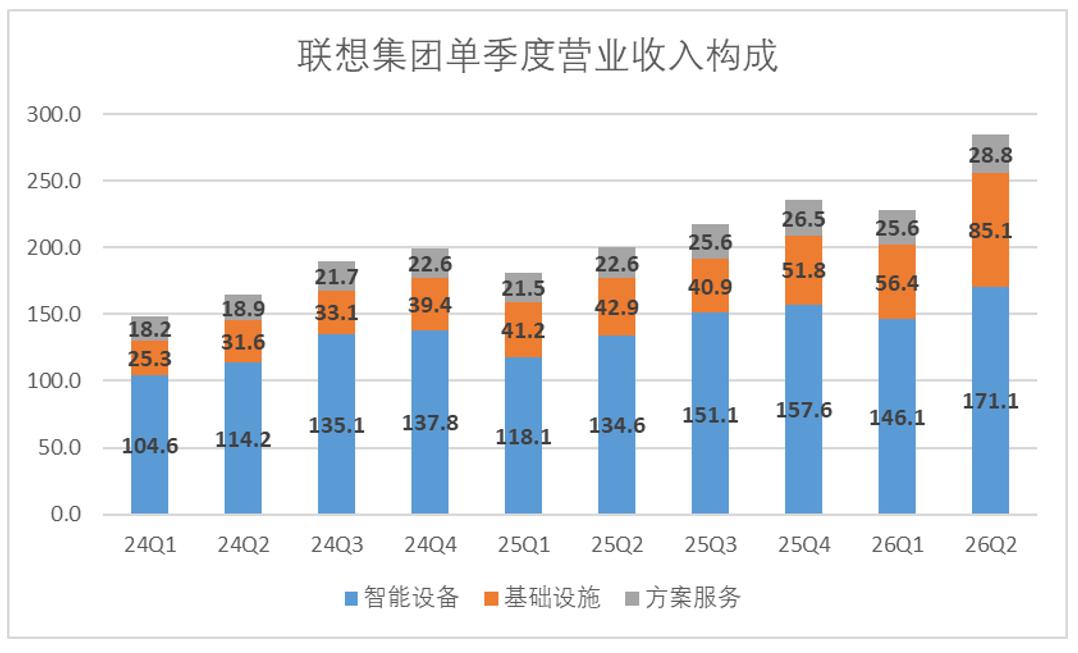
Looking back over a longer period of time, Motorola's performance has actually been consistently good. According to IDC data in the fourth quarter of last year, at the global market level, Lenovo Motorola's revenue increased by 11.0% year-on-year to 4.3 billion US dollars, ranking eighth with a 2.5% market share, and its growth rate significantly outperformed the global average level of 10.2%.
In terms of shipment volume, the global market excluding China reached 261.2 million units, a year-on-year increase of 3.3%. Lenovo Motorola's shipment volume reached 16.4 million units, a year-on-year increase of 8.6%, its market share rose to 6.3%, and its ranking climbed 2 places to fifth.
Obviously, Motorola has offset the potential shipment pressure in the personal PC market. For Lenovo's IDC business, the degree of squeeze on the supply chain price advantage and the performance of the mobile market after Apple's foldable screen is launched may be potential risk points.
03
ISG is the core of outperforming expectations, with on-hand orders increasing 157% quarter-on-quarter
Although the IDC business shows a strong contrasting performance, the core that truly supports Lenovo's outperformance is still the Infrastructure Solutions Group (ISG), especially in terms of growth rate and profit.
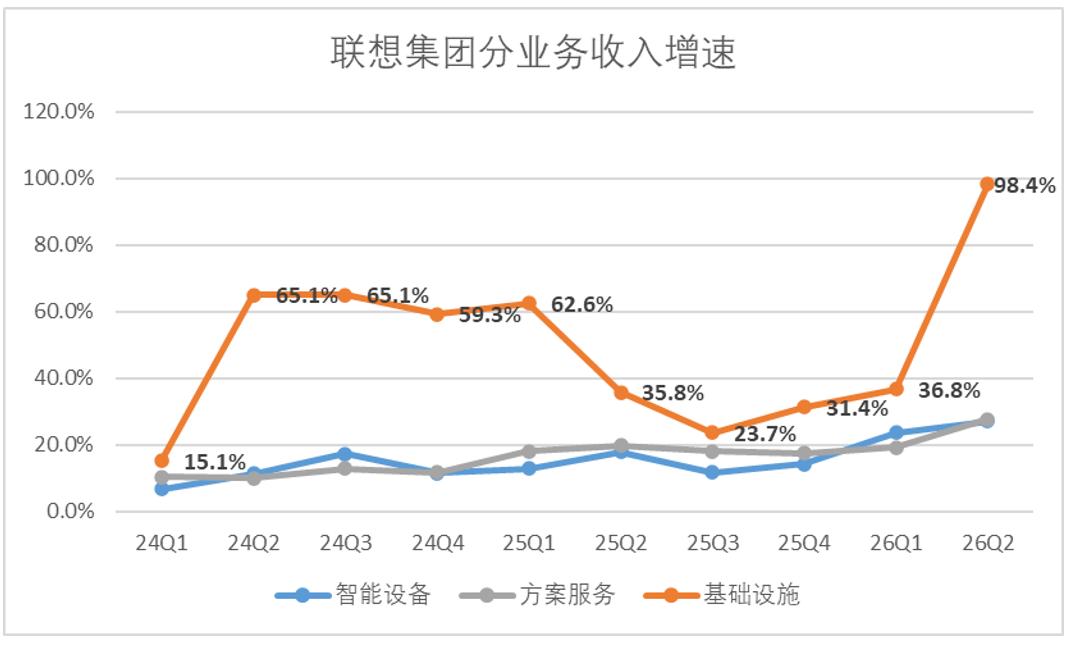
In terms of growth rate, Lenovo's ISG business recorded revenue of 8.51 billion US dollars in the second quarter, with a year-on-year growth rate nearly doubling, completely reversing the mid-term narrative of high base and low growth.
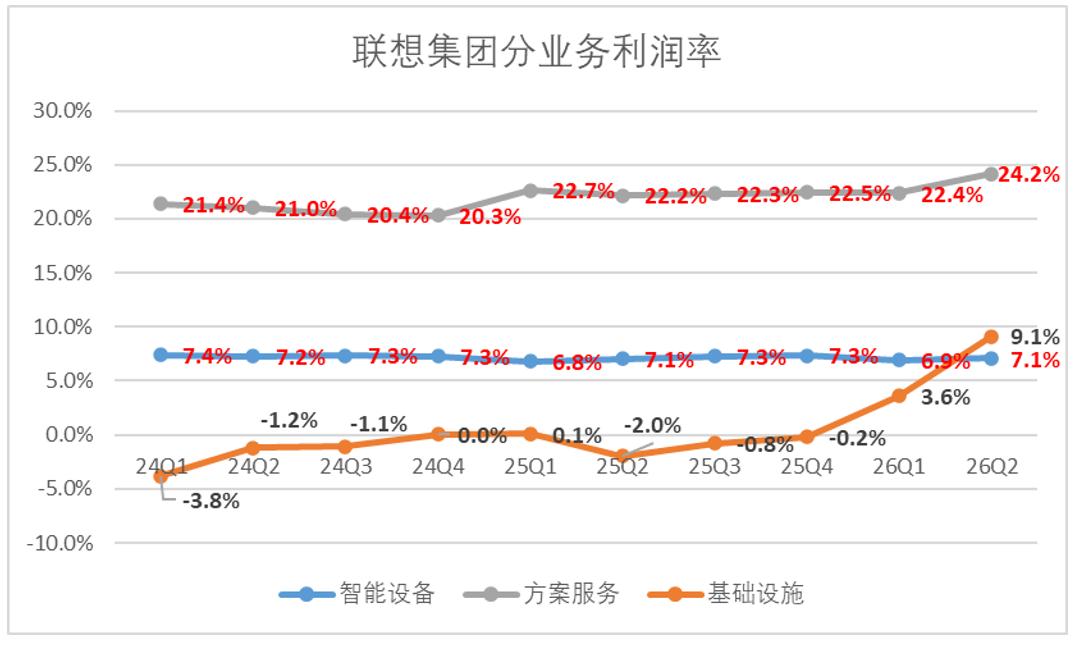
In terms of profit, ISG continued its strong performance from the previous quarter. It not only stayed above the break-even line, but also broke through 9.1% directly, becoming the core contributor to the profit side outperformance.
What makes ISG even more remarkable is the scale of its on-hand orders.
According to the financial report disclosure, Lenovo's AI server backlog has reached approximately 54 billion US dollars, an increase of 157% compared to the 21 billion US dollars in the previous fiscal quarter. The management revealed that Lenovo's current server order pipeline exceeds 50 billion US dollars, and how many orders can be converted subsequently largely depends on supply chain capabilities.
Morgan Stanley had already warned in a research report before the financial report release that the market might have underestimated the backlog of Lenovo's ISG orders. Facts have proved that the 54 billion US dollar order backlog and 9.1% operating margin are 460bp higher than Morgan Stanley's previous high forecast of 4.5%.
Obviously, the growth of ISG is unlikely to be a flash in the pan.
04
Under the 100-billion-dollar revenue guidance, Lenovo decides to "add positions on floating profits"
At the beginning of this year, Lenovo set a goal to achieve 100 billion US dollars in revenue within 2 years. According to the current growth momentum, it is obviously not difficult to reach the 100-billion-dollar scale. Yang Yuanqing also explicitly stated at the performance meeting that he is confident to achieve the goal ahead of schedule.
In retrospect, the reason why the 100-billion-dollar goal can be achieved in a short period of time comes from the resonance of two aspects:
First, the transmission efficiency of Capex in the AI industry is significantly stronger than expected. Even though capital expenditure is very high, due to the limitation of computing power production capacity, the demand side's sensitivity to prices has decreased significantly, which makes the OEM business, which sounds less attractive, become highly profitable.
Second, as we analyzed earlier, Lenovo has extremely strong "supply chain cognitive dividends". Before this round of memory price hikes, Lenovo made sufficient preparations, which is equivalent to locking a large amount of inventory at low price points, making it possible for the market share of its IDC business to increase.
The resonance of these two aspects constitutes the core driving force of Lenovo's current performance explosion. AI Capex pushes up the revenue scale, and supply chain stockpiling locks the cost at a low level. The superposition of the two is the source of profit elasticity.
Having tasted the sweetness, Lenovo obviously does not want to give up this structural opportunity. Entering this quarter, Lenovo's inventory scale has surged again, increasing by 4 billion US dollars quarter-on-quarter and 7 billion US dollars year-on-year.
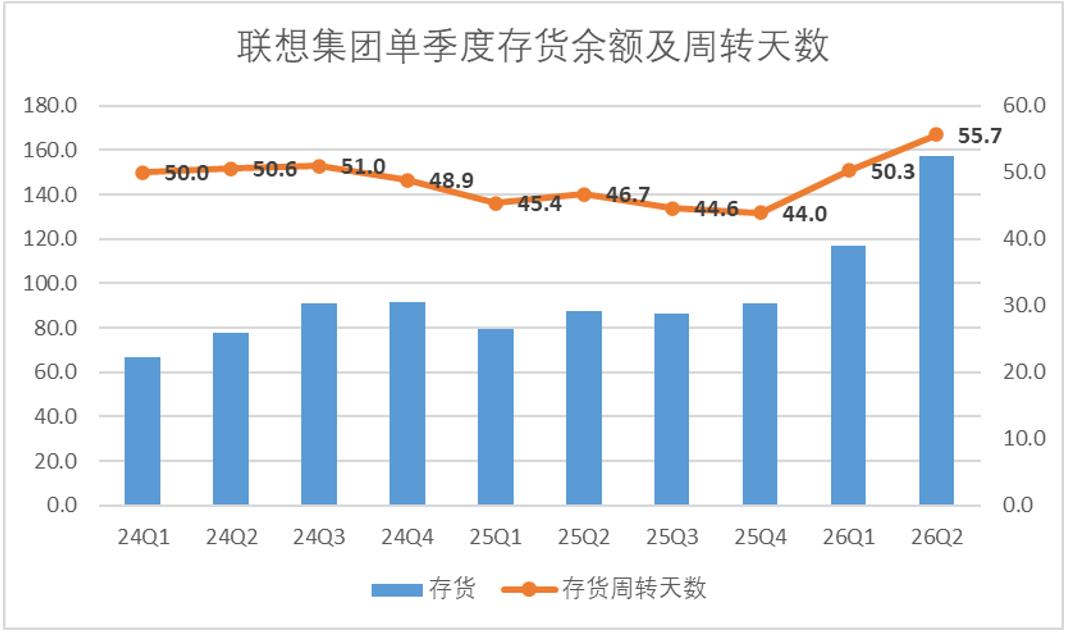
Obviously, Lenovo has decided to continue to increase its investment in this hardware upward cycle.
05
Prosperity is still ongoing, but volatility will not be absent
At Lenovo's performance meeting, Yang Yuanqing mentioned that there are some doubts in the current market about AI demand. "Everyone is very eager to know whether AI demand is sustainable. Our view is that there may be bubbles in some local areas of AI, and it is reasonable to discuss and question whether all funds have been invested in the so-called large foundation models and whether there is excessive capital burning, but AI as a general direction is definitely not a bubble."
In Yang Yuanqing's view, the popularization of AI has just begun, and there is still room for growth.
We believe this point is completely correct. As Perez stated in *Technological Revolutions and Financial Capital*, although technological iteration may lead to the deviation of asset value from actual productivity in a short cycle and cause bubbles, in the long run, when technology truly affects production capital, it will always enter a golden period of prosperity and stability.
The Internet era has already confirmed this point for us.
In fact, if we look back at the upstream hardware suppliers this year, whether it is ASML or TSMC, they will all be asked the same question, and the management of hardware enterprises basically has the same expression: judging from on-hand orders and industry information, market demand is still very strong. The views of upstream hardware manufacturers are highly consistent.
This indicates that in the short and medium term, AI Capex has not yet reached the end of the prosperity cycle.
However, risks should be considered even in prosperous times. From the perspective of anti-fragility, if all hardware manufacturers are overly optimistic, there may be a neglected variable: supply constraints themselves are amplifying the anxiety on the demand side.
This phenomenon has a corresponding name in business history: the bullwhip effect. A very small change in demand at the end of the supply chain will have its volatility amplified as it moves upstream.
When the balance between supply and demand is extremely unbalanced and the supply side is in an overly strong position, the bullwhip effect will act in the opposite direction: downstream customers will place orders in advance and over-order for fear of not getting the goods.
We have heard too many stories about Cisco. But the only lesson human beings have learned from history is that human beings have never learned any lessons from history.
According to data from New York-based data provider Ornn, the hourly rental price of NVIDIA B200 has continued to fall after peaking at $6.11 per hour on May 30, a three-month high, and has dropped to $4.22 per hour as of June 21, falling by about 30% in three weeks.
If we simply regard AI Capex as hoarding computing power that can eventually be sold through cloud business, should we also consider the economic efficiency of cloud business?
The market is re-examining the sustainability and economic efficiency of large-scale AI capital expenditure. Cloud service providers have begun to consider economic sustainability, optimize computing power scheduling, and optimize infrastructure.
The general direction of AI is definitely not a bubble, which is most likely correct. But the right direction does not mean that the cycle will not fluctuate. (Author: Yaohua)
This article is from the WeChat official account "Financial Report Record", author: Yaohua, published with authorization from 36Kr.