Lin Junyang from Shanghai Investment, wants to replicate the Hefei Model?
On August 12, Lin Junyang officially announced his new company Pragmatik Labs (Chinese registered name: Yuyong Technology), with a post-money valuation of approximately 2 billion US dollars. Gaorong Capital and HSG led the investment, Tencent followed with an investment of about 20 million US dollars, and Shanghai Future Industry Fund participated in the investment.
Previously, Musk praised Alibaba's Qwen on social media, saying "The intelligence density is impressive." Lin Junyang, the technical lead of Qwen, reposted and thanked him the same day. The next day, he officially announced his resignation.
"me stepping down". This post-1993 talent, the youngest P10 at Alibaba, wrote this sentence in English. The company focuses on Agents that span both the digital world and the physical world. Back in October last year, he established a robotics and embodied intelligence team inside the Qwen business line, and the physical Agent track has actually been laid out long ago.
2 Billion US Dollars for One Alibaba P10
In terms of equity structure, Lin Junyang and related entities hold a total of 88% of the shares, while external investors account for only 12%, showing a highly concentrated equity structure. Pragmatik Labs is nothing more than a shell company, and investors are pouring money in purely for Lin Junyang himself.

Gaorong Capital and HSG each invested about 100 million US dollars, betting on the technical reputation of Qwen. Qwen has recorded 1 billion open-source downloads, derived 200,000 derivative models, and a Stanford report narrowed the performance gap between top Chinese and American models to 0.3%. These figures support the 2 billion US dollar valuation. Although product revenue is almost zero at present, what investors are really betting on is that Lin Junyang can build another Qwen from scratch.
Tencent followed up with 20 million US dollars, which accounts for an extremely low proportion of the 2 billion US dollar valuation. After all, Tencent has its Hunyuan large model and WorkBuddy office agent in hand, and also holds equity in Agibot Robotics. The 20 million US dollar investment is just to secure a seat at the table, and the company does not care about the outcome of this round of bet.
However, the participation of Shanghai Future Industry Fund has a completely different intention. Agibot Robotics, MiniMax, and Stepfun are all included in its investment portfolio. Shanghai is making moves on the same chessboard, with the goal of making Agent the next pillar industry following new energy vehicles and integrated circuits.
Gaorong Capital and HSG bet on the individual, Tencent spends 20 million US dollars to secure a seat in the track, while Shanghai is playing a completely different game.
Lou Yihang, former researcher at Noah's Ark Lab and Huawei Genius Young Talent, also officially announced his startup in recent days. The new company is named Gravity Blueshift, focusing on embodied brains with parameters of 200B and above. Its direction overlaps with Lin Junyang's, as both are working on physical Agents. Lou Yihang focuses purely on robot brains, pouring all resources into hardware, and is seeking cooperation with Inovance. Lin Junyang advances on two tracks, covering both digital Agents and physical Agents. The landing speed of in-depth single-track development is most likely faster than that of parallel two-track development. Lou Yihang has obtained investment intentions from two top-tier capital firms, with a valuation of about 200 million US dollars, less than one-tenth of Lin Junyang's valuation, but it may realize commercialization earlier.
Hefei Invests in CXMT, Shanghai Acquires Talents
Hefei is the pioneer of this model. ChangXin Memory Technologies (CXMT), the only domestic DRAM manufacturer, received direct investment from the Hefei municipal government in the early days, with supporting upstream and downstream chip industrial chains, locking in talents, tax revenue and industrial clusters through heavy-asset real industries. The project was signed and launched in May 2016, Hefei Industrial Investment contributed 14.4 billion yuan, accounting for 80% of the shares, and the total investment of the first phase was 18 billion yuan. The first self-developed DDR4 was mass-produced in September 2019, achieving the development from 0 to 1 in more than three years. The early production lines locked talents into the industrial chain, driving tax revenue, employment and supporting facilities to develop accordingly. The Hefei model has proved successful, and Shanghai wants to replicate it.
The way Shanghai replicates the model is completely opposite. Hefei invests in production lines, while Shanghai invests in people.
The difference is that when Hefei made the investment, CXMT already had a clear technical route, the factory was under construction, and the supply chain was in place. The AI startups that Shanghai is betting on at present have no core assets other than their technical teams, with no products, revenue or physical anchors. Pragmatik Labs was only registered in May this year, the team is still being formed, and there is no trace of any product yet. But there is no doubt that entering the market earlier will bring greater returns.
In the Hefei model, the local government's binding with the enterprise goes far beyond the production line. The local government continues to increase investment through the industrial investment platform, with a cumulative investment of over 30 billion yuan, requiring invested enterprises to set up local R&D centers and complete industrial return investment with a return investment ratio of no less than 1.2 times the capital contribution, locking the entire chain of wafer fabs, equipment, packaging and testing, and materials in Hefei. Shanghai distributes 1 billion yuan of computing power vouchers every year, provides access to 140,000P heterogeneous computing power, gathers over 10,000TB of industry corpus, and launches 10 benchmark application scenarios. All support policies do not have mandatory constraints on retaining headquarters or production capacity, relying only on capital to attract resources, lacking the backing of physical anchors.
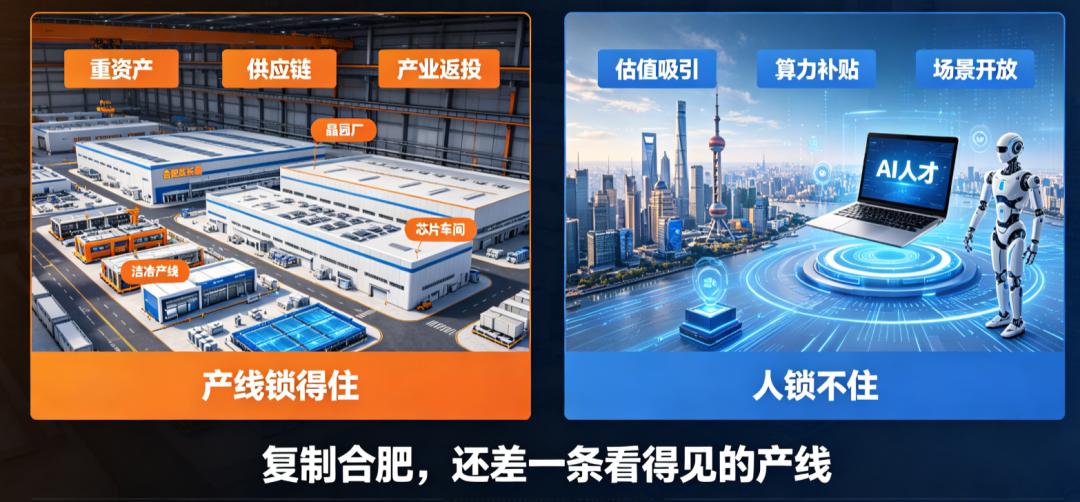
Talents can flow freely, and the industrial layout is extremely prone to hollowing out when the track cools down. Production lines can be locked in, but talents cannot.
ByteDance's Seed team lost 70 core researchers within one year, and all those who left successfully obtained large amounts of startup financing. After the core person in charge of Kuaishou's Keling large model resigned, he joined Alibaba to build a similar competing product. Even though Horizon Robotics offers annual salaries at the million-yuan level, core algorithm engineers keep leaving to establish their own robotics enterprises. Top AI talents only rely on algorithm expertise, and can rebuild teams in other cities without the need for factories or production lines. Such variables do not exist in the chip manufacturing industry.
From CXMT's signing in 2016 to mass production in 2019, and then to its listing in 2026, the state-owned capital of Hefei accompanied the company for ten years and invested more than 30 billion yuan in total to get one storage production line running. Shanghai cannot even come up with a mass production schedule for Agents at present. Chip manufacturing has a mature industrial foundation, while the Agent industry does not.
Capital Takes the Lead
Let's talk about the physical model itself.
Ant Group's open-sourced Ling-3.0-flash has 124B parameters, covering Coding, General and DeepResearchAgent scenarios, and has built more than 10,000 interactive training environments. Ant Group's LingBot-VA has been accepted by RSS 2026, which is the world's first open-source autoregressive video-action world model. Tencent released Hy-Embodied-RxBrain-1.0, an embodied native world cognitive model, in July.
Ant Group, Tencent and NVIDIA have already taken up all the space at the Agent table. Lin Junyang, who entered the track with a 2 billion US dollar valuation, can only stand by for now from the current perspective.
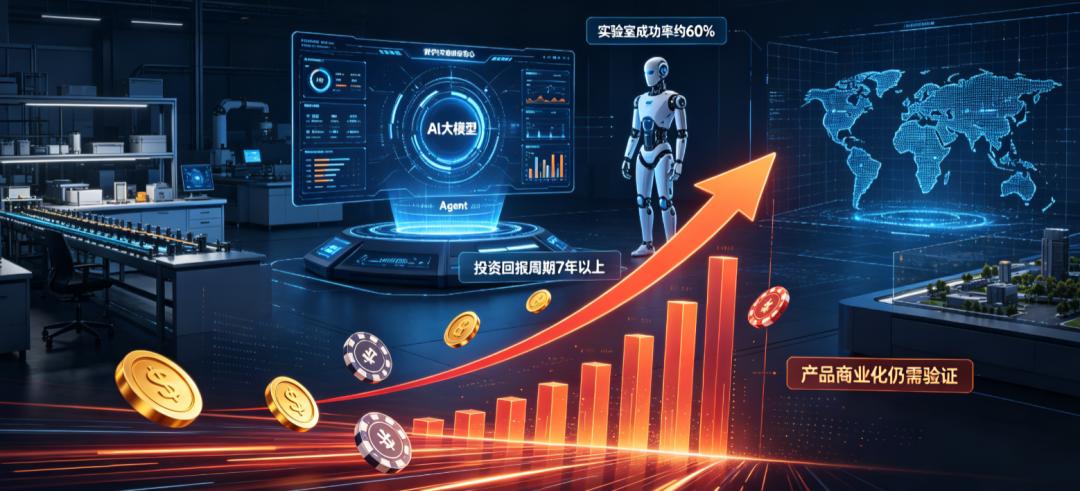
According to estimates by industry research institutions, the current success rate of continuous tasks for laboratory robots is about 60%, which is still far from the 99.9% stable operation standard for industrial use. The hardware cost of a single humanoid robot is hundreds of thousands of yuan, and the investment return cycle is generally more than 7 years. There is an insurmountable gap between the simulation world and the real physical environment, and pure large model reasoning cannot solve engineering problems such as hardware control and safety certification. Compared with the mature industrial supply chain of chip manufacturing, the Agent industry is still in the early experimental stage.
Lin Junyang said that "whether the model can execute" is more important than "whether the model can think". The product has not been developed yet, but the talent has already been priced.
Lou Yihang is bound to hardware and has clear landing scenarios. Lin Junyang advances on two parallel tracks with scattered resources. The core asset that Shanghai is betting on is talent, and people are far more difficult to lock in than production lines.
If Lin Junyang's digital Agent achieves commercial operation first, the revenue will come from token-based billing, which is completely separate from physical Agents. To make physical Agents commercially viable, hardware, factories and supply chains are required. These assets cannot be bought with a 2 billion US dollar valuation. Without additional resource input, the most likely outcome of advancing on two tracks is that neither track can be fully completed.
The logic behind Lou Yihang's 200 million US dollar valuation is industrial-oriented, with hardware binding and clear landing scenarios, featuring high certainty. The valuation logic behind Lin Junyang's 2 billion US dollar valuation is completely different: internet capital gives it a premium based on imagination space. The larger the imagination space of a track, the longer the capital burning cycle, and the higher the risk.
Shanghai is trying to replicate Hefei's venture capital myth by investing in talents. There is a fundamental difference between AI Agents and chip manufacturing: chips are tangible and production lines are fixed in place, while top AI talents can move to another city with just a laptop. Capital and local governments place bets in advance, pushing valuations higher and higher, while no product that can be landed and monetized can be seen. People like Lin Junyang can set off from Shanghai to another city at any time, so "replicating Hefei" still requires a tangible production line to complete the layout.
This article is from the WeChat official account "AI Contrarian", written by Li Xiaowen, and published with authorization from 36Kr.