Why hasn't Qwen started charging merchants yet?
Both Doubao and Qwen have taken a critical step in their commercialization journeys.
On August 10, according to Sina Tech reports, Doubao officially began charging a 12% commission on hotel transactions completed through its entry, specifically consisting of an 11.4% software service fee plus a 0.6% payment processing fee. In comparison, the rate for the same category on the main Douyin platform is only 8%. For the same transaction, going through the Doubao entry means 4 percentage points more commission than going through the Douyin information feed.
In response to this, Doubao's head of public relations stated that the claim is inaccurate: Doubao's local life service business currently has no paid promotion, and Doubao does not charge advertising fees for recommending hotels. However, some hotels have indeed received relevant notifications.
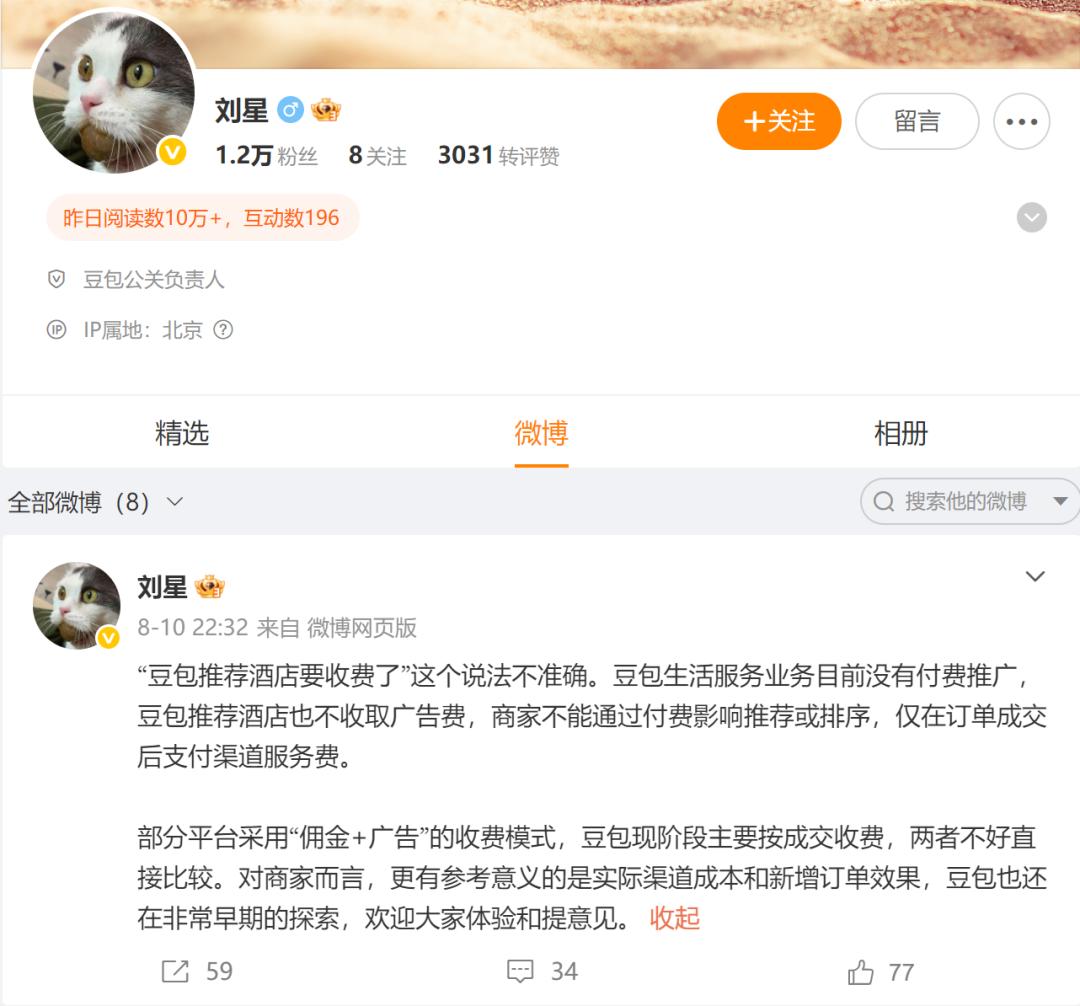
Image source: Liu Xing
On the same day, the Qwen App launched paid memberships for professional users, with the office assistant membership starting at as low as 19 yuan per month, and video generation charged by usage quota.
A few months ago, this would have been almost unthinkable. During the Spring Festival, the red-hot Qwen was still pouring 3 billion yuan into marketing expenses to run free-order campaigns, with its peak DAU once hitting 73.52 million. The Financial Times also reported that in 2025, ByteDance invested 150 billion yuan in AI. Burning cash to grab users was the only universally accepted rule at that stage.
But in the AI era, constrained by the brutal reverse scale effect, users have turned from assets to liabilities, and scale has changed from a moat to a bleeding outlet, so all players have started to count their costs.
China's AI industry has completed a collective shift from burning cash for scale to commercial monetization, and the 18-month-long cash-burning battle has finally reached its physical limit.
I. Qwen Has Completed All Required Layouts Within a Week
From August 3 to 10, Qwen completed a series of intensive actions.
On August 3, Alibaba released Qwen3.8-Max and announced the public beta of Qwen Work; on August 7, the Qwen App launched new functions such as office assistant, thinking and research, and scheduled tasks; on August 10, the Qwen App launched paid memberships and opened its open platform. Within one week, it made full progress across the model, product, platform and commercialization sectors.
This level of intensity has never been seen before in Qwen's history. Why is Qwen in such a hurry?
By breaking down the actions of these days, it can be seen that Qwen hopes to build a complete link from capability to scenario and then to commercialization. The core problem driving the acceleration of this chain is that the user opening frequency of the Qwen App is too low.
Facts have proved that the huge marketing investment during the Spring Festival did push the DAU to a short-term peak, but after the subsidies were withdrawn, the curve returned to its original position. QuestMobile data shows that the average monthly usage times per user of the Qwen App is only 17.4, and the average usage duration per user is only 22.9 minutes. What the money spent brings is one-off traffic that leaves right after use.
Since the opening frequency of pure chat scenarios is inherently limited, most users will not take the initiative to open an AI chat tool. Even if AI gives users the freedom to create virtual characters, this freedom has not been translated into a sufficiently high opening frequency.
On July 15, with the official implementation of the Interim Measures for the Administration of Artificial Intelligence Anthropomorphic Interactive Services, Qwen and Doubao simultaneously removed the user-built agent function.
For platforms, instead of investing huge sums of money to reconstruct the risk control system to meet the full-coverage review standards, it is better to shut down the function directly. This shutdown action itself also indicates that the cost of maintaining such functions has exceeded the user value they bring.
Therefore, the Qwen App must find scenarios that users have to open, and the office scenario is the most important one. Because there are rigid demands for processing documents, making PPTs and sorting information on workdays, which can give users more reasons to open the Qwen App.
Following the office entry, the Qwen App has also accessed services such as express delivery, car rental and house hunting, providing several life service entries, hoping to continuously increase the opportunities for users to "turn to Qwen for help".
II. Doubao Collects Transaction Tax, Qwen Can Collect Productivity Tax
Behind Qwen's eagerness to supplement high-frequency scenarios, there is a more urgent reason: Doubao has taken the lead in commercialization.
Doubao launched C-end paid memberships in June, and on August 10 it started charging a 12% commission on hotel orders. In comparison, Qwen did not launch paid memberships until August 10, and has not taken any step to start B-end charging. At first glance, ByteDance is moving faster than Alibaba.
ByteDance can quickly start B-end commission collection because it holds a card that Alibaba cannot play for the time being: a local life transaction closed loop that has been running smoothly for many years.
Douyin Local Life has been operating for several years, millions of merchants have opened stores on Douyin Laike, and the rate system, settlement process and merchant relationships are all ready-made. What Doubao needs to do is to separate the orders generated by AI recommendations, label them as "Doubao Channel", and raise the commission rate from 8% on the main platform to 12%.
There is almost no technical threshold, and the real difficulty lies in whether ByteDance has the courage to set a high price directly on a new channel. ByteDance has made a judgment: to price the AI conversation traffic separately, the active needs expressed by users in AI conversations have far higher information value than a passively swiped advertisement.
But Alibaba does not have such conditions. Ele.me, Fliggy, Amap and Freshippo operate independently, and there is no unified local life service pool that can be called by Qwen as a whole. If Qwen wants to charge commissions from merchants, it must first solve the problem of supply side integration, and this work is far from being completed.
If the explanation that Qwen has not charged merchants yet is because the supply is too scattered, this explanation only touches the surface. Alibaba also holds a card that ByteDance does not have, and this card has a larger imagination space than the transaction closed loop: the merchant service system.
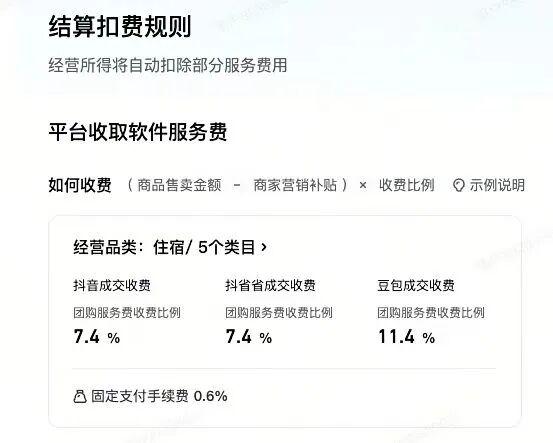
Image source: Jinan Times
The essence of ByteDance's commission collection is selling channels: AI recommendation brings a transaction, the platform takes a cut from the transaction, and the merchant pays a 12% commission to buy the single transaction brought by Doubao's recommendation.
But Alibaba's value to merchants is never just bringing a single deal. For example, the merchant service systems of Taobao and Tmall, including store operation, marketing promotion, logistics fulfillment, financial payment and other modules, have been running for more than ten years. The money merchants spend in the Alibaba ecosystem is far more than the commission of a single transaction, and merchants are paying for the operational efficiency improved by AI.
In fact, Alibaba has already been verifying the path of selling capabilities. In May 2026, Alibaba released Accio Work, providing AI agent services for cross-border e-commerce merchants, with the entry version priced at 2999 USD per year. In the same month, Taobao Tmall released AI Shop Assistant, charging by session, with the cost per session as low as 0.2 yuan, while the cost per session of manual customer service is generally 3 to 4 yuan. 1688 also released the Integrity Pass AI version, with an annual fee of 9988 yuan.
If Qwen charges merchants, it can take a completely different path, letting merchants pay for "AI operation capabilities": AI helps you write copy, AI helps you select products, AI helps you analyze competitors, AI helps you manage customer service. The charging logic of these functions is that you pay me a service fee when your efficiency is improved by using AI.
If what Doubao collects is transaction tax, then Qwen can collect productivity tax. The ceiling of the former is the transaction scale, while the ceiling of the latter is the degree of merchants' dependence on AI.
At present, Qwen has two cards to play: one is to follow Doubao to collect commissions, and the risk may be that the rate is set first while the transaction scale has not kept up; the other is to take the capability-selling path that Alibaba is better at, which is more in line with Alibaba's genes, but also requires a longer preparation cycle.
ByteDance has already submitted its paper on charging merchants, while Qwen is still drafting, but both paths have their own unsolved problems.
The premise of Doubao's commission collection is that users really complete transactions through Doubao. If users only get information on Doubao and then return to other platforms such as Meituan or Ctrip to place orders, this set of commission collection logic cannot be implemented. At present, according to public data, Doubao's average daily transaction volume is about 10 million yuan. Converted by its 382 million monthly active users, each user contributes less than 5 cents per day.
Moreover, merchants will not remain indifferent to the new channel cost. If merchants raise prices for the Doubao channel or hide low-cost inventories due to the 12% commission rate, users will return to their original price comparison habits faster.
The problem of the Qwen App is more fundamental: when it is free, the average daily user stay time is less than 23 minutes, so why should we believe that users will stay after paying?
If users really frequently call Qwen3.8-Max to generate PPTs and documents, 19 yuan cannot even cover the computing power cost. Whether this logic can work depends on whether the product of the Qwen App really provides value that users cannot live without.
III. Are Qwen App and Qwen Work "Frenemies"?
At this stage, Doubao is not the most tricky competitor of Qwen. On the contrary, the frenemy relationship between the Qwen App and Qwen Work, which are neither enemies nor friends, is more worthy of attention.
The public beta of Qwen Work and the launch of the office assistant on the Qwen App are only four days apart. Users who do not know much about the business lines under the Qwen brand will mistakenly think that this is Alibaba's continuous move in the AI office track.
But the actual situation is more complicated. The two products that share the Qwen brand not only belong to two separate organizations, but their commercial logics also point to two different directions.
Qwen Work is not a functional upgrade of the Qwen App, it is an independent enterprise-level product integrated from three products: QoderWork, MuleRun and Wukong, and these three products will no longer exist independently in the future.
Qwen Work entered public beta on August 3, with the web version and PC client opened simultaneously, and it will later connect to all DingTalk entrances. The Qwen Work Division is a first-level division under the ATH Business Group, led by Chen Yusen, who is in charge of both Qwen Work and DingTalk, the two core businesses. The Qwen App belongs to the Qwen Division led by Wu Jia, which is responsible for C-end applications.
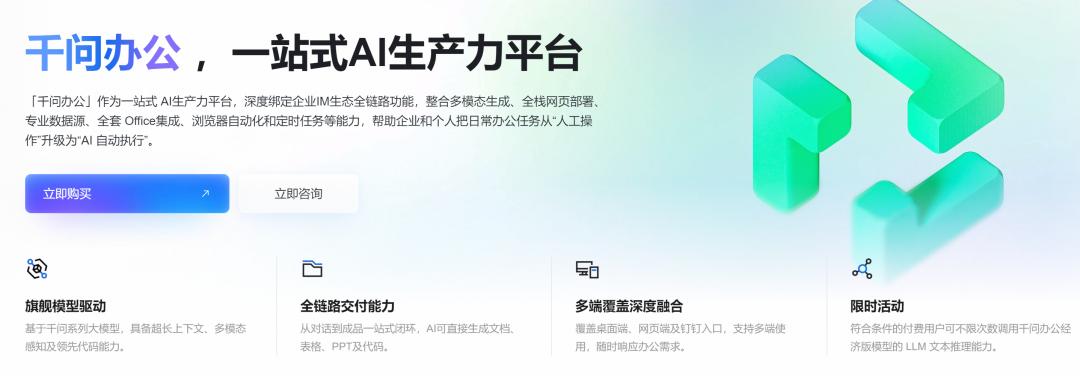
Image source: Qwen Work
The brand ties the two products together, but their pricing is completely independent. The Qwen App promises free basic functions for individual users, with paid memberships starting at 19 yuan; the personal standard version of Qwen Work is 98 yuan per month.
Generally speaking, when the same user sees the same name, they will think that this is two modes of the same product, rather than two businesses operated by two different teams.
According to reports from Huxiu, senior group executives including Wu Yongming will personally participate in the key meetings of Qwen Work, and Qwen Work has become one of the most critical strategic-level products in the company. As of press time, there are no similar reports about the Qwen App.
Behind the resource tilt is the shift of strategic focus. Alibaba has regarded AI office as one of the company's strategic directions in the AI field, and the decision-making level has positioned it as an enterprise-level AI productivity platform for enterprise organizations, rather than a personal AI office tool only for C-end users.
As a first-level division under the ATH Business Group, the Qwen Work Division does not assess the number of users and monthly active users in the short term, and gives priority to polishing product experience and implementing enterprise scenario solutions. This positioning itself explains the problem: Qwen Work is given a longer time window and higher strategic priority.
However, the Qwen App was defined as a C-end application from the very beginning. The competition between the Qwen App and Qwen Work is essentially a by-product of the shift of Alibaba's AI strategic focus from the C-end to the B-end.
ATH has unified the architecture, but the two Qwen products still face problems such as sharing the same brand, competing for the same scenarios, and targeting overlapping user groups. The competition will not disappear automatically due to the unified architecture, and their collision is only a matter of time.
ByteDance provides a reference case.
On July 30, ByteDance launched the organizational adjustment of its AI business: the Feishu product team and the Doubao product team were integrated to form a new Doubao product team, led by Zhao Qi, the head of Doubao, and Xie Xin, the head of Feishu, reports to Zhao Qi. The GTM team of Feishu was integrated with the Volcano Engine team to form a new ToB GTM organization.
Feishu, a business that Zhang Yiming once placed high hopes on and operated independently for nearly five years, has completely lost its status as an independent BU. After the integration, Doubao is responsible for model capabilities and unified entry, Feishu provides enterprise office scenarios and customer touchpoints, and Volcano Engine undertakes the computing power base. The enterprise version of Doubao, which is deeply developed by the Feishu product team, has started internal testing among some Feishu customers.
ByteDance's logic is: the AI entry will take over the office entry. Doubao becomes the unified export of all AI capabilities, and Feishu is reduced to a scenario module of Doubao.
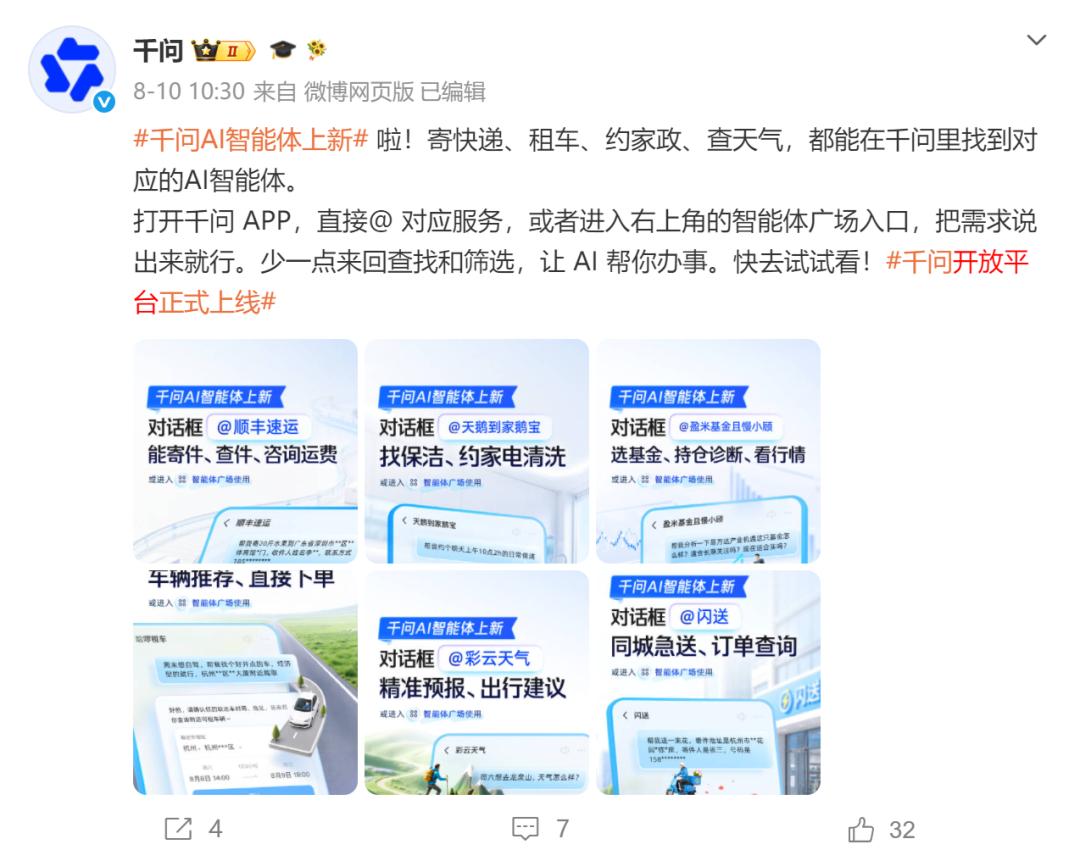
Image source: Qwen
Alibaba's two Qwen products are still running in parallel, but historical experience shows that when two products "compete for users" in the same track, the one that gets the attention of the top management of the group is more likely to survive.
The Qwen App launching paid services, open platform and office assistant is not a declaration of war against Doubao, but a proof of its own survival. It must at least prove to Alibaba's management that there are still users willing to pay for it, and it still has a reason to exist.
The situation faced by the Qwen App is more complicated than that of Feishu. When Feishu is merged into Doubao, at least the brand is unified and the logic is clear: Doubao is the AI entry, and Feishu is the office scenario. If integration is inevitable in the end, who will take the lead?