Pony.ai on the ledger
You have most likely heard of Pony.ai.
The driverless taxis running on the streets are called Robotaxi in the industry.
Founded in 2016, it was listed on the US stock market at the end of 2024, and also got listed on the Hong Kong Stock Exchange in November 2025. That was the largest IPO in the global autonomous driving industry that year, with public offering subscriptions 15.88 times oversubscribed. Over 15 times, isn't that crazy?
It runs two core businesses, let's sort them out first.
One is passenger transport, the Robotaxi service operating on the streets of Guangzhou and Shenzhen; the other is cargo transport, the autonomous driving truck known as Robotruck in the industry, which operates on trunk lines, in ports and for urban distribution scenarios.
Around its listing, the story it told to the public was basically all about Robotaxi.
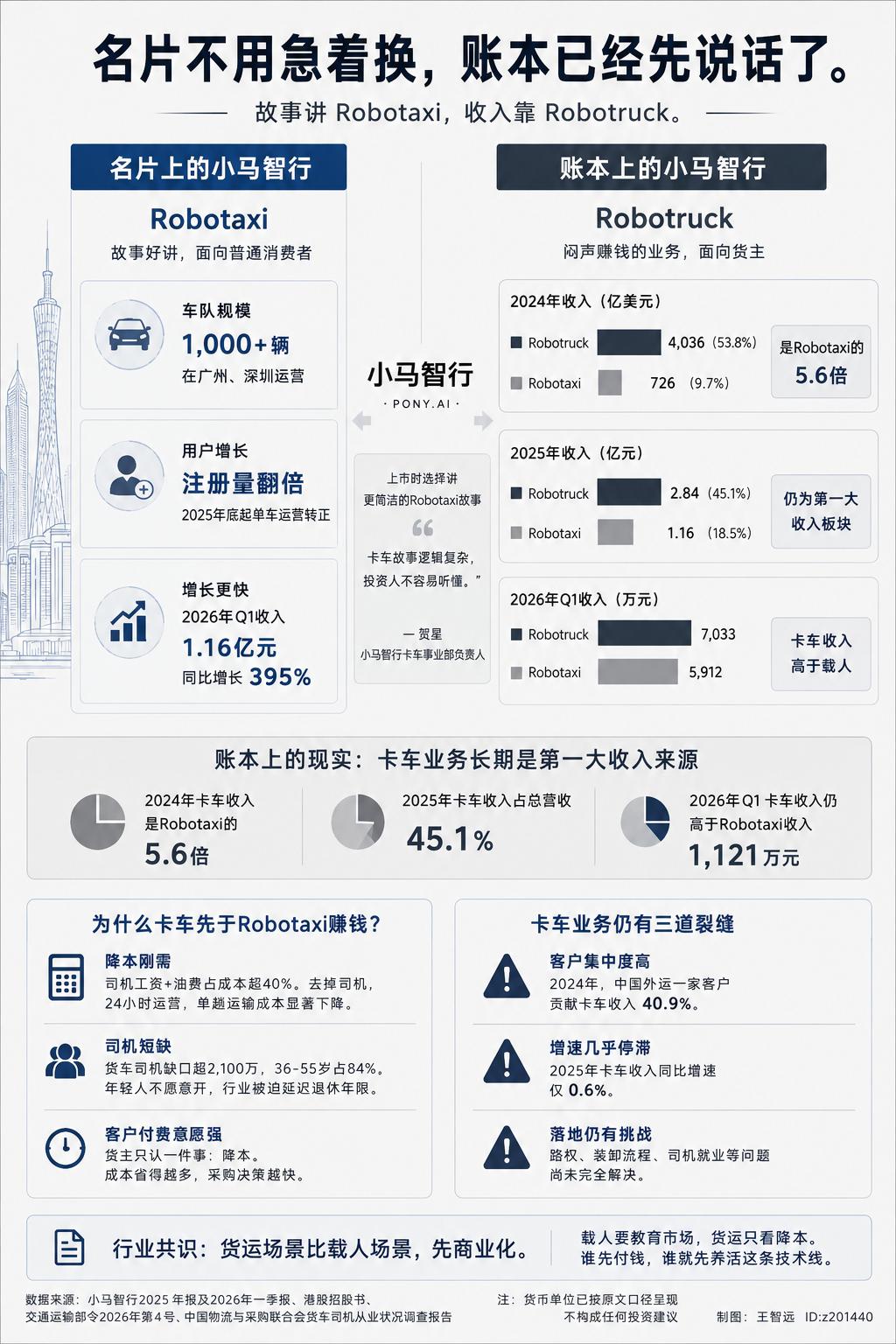
As the world's first Robotaxi stock, this title was printed on the company's business card, and the story was really easy to promote; it owned a fleet of more than 1,000 vehicles that were actually operating to carry passengers in Guangzhou and Shenzhen, the number of registered users multiplied rapidly, and since the end of 2025, the single-vehicle operation permits of its services in Guangzhou and Shenzhen have been officially approved one after another.
It has enough attractive highlights and solid data, every point it told to investors hit the key points.
However, if you check its financial reports, you may find a strange contradiction: the company positions itself as a Robotaxi player on its business card, but the actual revenue structure shows a completely different picture.
I specifically looked up the data. For the full year 2024, the revenue of Robotaxi business was 7.26 million US dollars, accounting for 9.7% of the total revenue; the revenue of truck business was 40.36 million US dollars, accounting for 53.8%.
The revenue of truck business is more than 5 times that of passenger transport business. 5 times, you can feel how big the gap is.
In 2025, the revenue of truck business reached 284 million RMB, accounting for 45.1% of the total revenue, still the largest business segment; the revenue of Robotaxi business was 116 million RMB, accounting for 18.5%.
In the first quarter of 2026, the revenue of truck business was 70.33 million RMB, and the revenue of Robotaxi business was 59.12 million RMB. The truck business still generated more revenue, which is really surprising.
But in terms of growth rate, the revenue of passenger transport business rose by 395% in this quarter, while the growth rate of truck business was only 31%. The truck business still contributes the largest share of revenue, but the protagonist printed on the business card is developing at an increasingly fast speed.
A company that went public with the Robotaxi story actually relies heavily on truck business in its financial books; the company itself is fully aware of this contrast, and does not even try to hide it.
He Xing, head of the Truck Division of Pony.ai, told the media in early August that the logic of the truck business story is relatively complicated, so when the company went public, it chose to explain its business with the more concise Robotaxi narrative.
In other words, the Robotaxi story is easy to explain, its customers are ordinary people, everyone can understand it immediately, since taking a taxi is a very familiar scenario for all.
The story of the truck business is complicated, you need to explain the cost per ton-kilometer, the shortage of drivers, the mutual recognition of policies, the loading and unloading processes, and many other messy contents, investors may be confused after listening and have no patience to figure it out.
Therefore, choosing to tell the Robotaxi story at the time of listing is a more friendly and easier solution.
But have you ever thought about which one on earth represents the real company, the content printed on the business card or the data recorded in the financial books?
In the real physical world, that complex cargo transport business has long been making money quietly, and making huge profits without attracting much attention.
In this sense, Robotruck is like a hidden line: the team keeps developing related technologies, iterating products, and putting vehicles into actual operation, but rarely speaks out publicly. He Xing himself said that our Truck Division has not formally communicated with the public for a very long time.
The market has been following the Robotaxi logic to ask questions: When will Robotaxi be cheaper than online car-hailing? When will it be deployed across the country? When will it achieve large-scale profitability?
Everyone thinks that as long as the Robotaxi business is fully operational, the company will achieve great success.
But the financial books have already written the answer: the truck business is the largest revenue source, and this status did not appear just this year. Therefore, the questions raised by the public may have been deviated from the very beginning.
......
The correct way to ask questions should start from the cost composition of the freight business.
For a single road freight order, where does the money go? Driver salary, fuel cost, toll fee, vehicle depreciation, maintenance.
Driver salary and fuel cost are the two largest parts, accounting for more than 40% of the total cost in total.
Fuel cost is hard to reduce, since the oil price is not determined by you; driver salary is also hard to cut, the drivers need to make a living and support their families, if you lower their salary, they will go to work for other companies.
What if you don't need to hire a driver at all? The cost will be greatly reduced immediately, you save the driver's salary, no need to arrange rest time for drivers, the vehicle can run 24 hours a day continuously, the goods that used to be delivered in two days can be delivered in one day.
Freight business operators are clearer about this account than anyone else, because this industry has been so fiercely competitive that there is almost no profit margin left.
I checked the data, someone calculated with the road logistics freight index released by China Federation of Logistics & Purchasing, the index has dropped by 3.16% in total in the past five years, nearly 30% of individual drivers earn 5000 to 8000 RMB per month, and only 10% of individual drivers can earn more than 15000 RMB per month.
There are too many vehicles but insufficient freight orders, the cargo owner presses the fleet to cut cost, the fleet presses the driver to cut cost, all people are squeezed on a downward slippery slope.
At this time, someone tells you that I can remove the driver cost item for you, just calculate how much money you can save?
This is the first reason why the truck business makes money earlier than Robotaxi: the payers of freight services are a group of business operators who are extremely anxious about cost reduction, they calculate accounts faster than anyone else.
The second reason is that there is a real serious shortage of drivers.
According to the 2025 report of China Federation of Logistics & Purchasing, among 38 million truck drivers, the drivers aged 36 to 55 account for 84.38%. The number of drivers under 35 years old is less than 20% of the total.
Young people are unwilling to drive large trucks, the work is tough, tiring and dangerous, and the income is not attractive enough, they would rather work in factories.
How big is the gap? Guo Zhaoming, Deputy Secretary-General of China Federation of Logistics & Purchasing, said that there are more than 21 million truck drivers, very few of them are post-90s, and the shortage of truck drivers is measured in millions.
Policies also confirm this situation. In March 2026, the Ministry of Transport raised the upper age limit for freight drivers from 60 to 63 years old; since they can't recruit enough young drivers, they can only let the old drivers work for three more years. You can see how serious the labor shortage in this industry is.
A sentence from He Xing left a deep impression on me. He said it is very difficult to find a driver who is willing to drive from 2 a.m. to 4 a.m., but the unmanned light truck can work normally during this period.
At 2 a.m., the city is asleep, the express sorting centers are busy, the supermarkets are waiting for replenishment, the cold chain transport demands are waiting for vehicles, but there are no available drivers.
Pony.ai is not the only company that sees this trend.
WeRide has developed Robovan, Qcraft has entered this track, Momenta has invested in Lingyi Auto, JiuShi together with Neolithic has occupied 95% of the low-speed unmanned distribution vehicle market, all players are surprisingly consistent in direction, all pouring into the freight track.
The whole industry has realized that the freight scenario will achieve commercialization earlier than the passenger transport scenario. So you see, passenger transport and cargo transport face two completely different markets.
For the passenger transport side, users care about low price, good experience and safety, you need to spend a long time to educate the market; for the freight side, customers only care about one thing, cost reduction. The more cost you can help them save, the faster they will choose your service.
The side that is willing to pay first will support the development of this technology line first. The freight side pays first, so the financial books record more revenue from the truck business.
Up to now, I can't rush to a conclusion that cargo transport making money first is an established rule. But can this rule be replicated? Can the mature experience of heavy truck business be applied to light truck scenarios?
At least for the terminal distribution part, the technology cannot be directly copied.
......
Let's make it clear first, how does Pony.ai promote its light truck business strategy.
At the Beijing Auto Show in April 2026, together with CATL, it launched the world's first full-vehicle-specification, full-redundancy L4-level autonomous driving light truck.
On August 3, the company announced that its heavy truck products have been mass produced, and the light truck products have entered the actual scenarios of its logistics partners for test operation, with the target of achieving an annual sales volume of 100,000 light trucks by 2030.
What does 100,000 units mean?
At present, the total number of light trucks for urban distribution in China is about 7 to 8 million. 100,000 units means a penetration rate of about 1%, which is not a large number, but it is a huge breakthrough from 0 to 1.
Pony.ai does not think technology is a problem, the light truck products reuse almost 100% of the Robotaxi hardware solutions and technology stack, with a sharing rate of over 95%. Since the day it was born, it has been supported by the company's ten years of technology accumulation in urban autonomous driving scenarios.
The real problem lies in the human part: after the driver is removed, unloading becomes a new problem.
Xiao Ping, head of Truck Division Product Department of Pony.ai, said a very realistic point. Large express logistics enterprises have staff at both transfer centers and outlets, with tailboard tools and standardized loading and unloading systems, which is suitable for the first batch of landing of unmanned vehicles.
But the terminal scenarios such as supermarkets are different, many stores do not have mature automatic loading and unloading facilities, the goods that used to be unloaded by drivers will now need to be handled by store staff.
The automatic tailboard will be upgraded, the loading and unloading tools will be upgraded, but there still needs to be staff involved in the unloading process.
The technology can realize autonomous driving, but cannot realize automatic unloading, this is the first obvious gap.
The second gap is the employment problem of people.
There are millions of light truck drivers for urban distribution making a living in this industry. The biggest selling point of unmanned light trucks is that no driver is needed, one remote supervisor can manage several vehicles, the fixed-line and regular driving positions will be replaced first.
The industry always talks about human-machine collaboration and job transformation. But in reality, a large number of middle-aged drivers have single work skills, and the transformation channels are very limited. The other side of technological cost reduction and efficiency improvement is the livelihood of grassroots workers.
This problem cannot be solved by Pony.ai alone, nor by the whole industry, and there is no clear supporting policy yet.
The third gap is hidden in the financial books.
The revenue growth rate of this largest business segment in 2025 was only 0.6%, almost stagnant. Among the total revenue of this business, how much is contributed by the single customer Sinotrans? The data in 2024 shows that the proportion is 40.9%.
The truck business is so closely tied to one giant customer, which is essentially walking with one leg; the stagnant growth rate and high customer concentration. Putting these two facts together, the truck business recorded in the financial books is not as prosperous as it seems.
Pony.ai is fully aware of this. He Xing said that there will be major breakthroughs in road access permits in the fourth quarter of this year. This is a forecast, not an established fact.
At this point, we have to mention a company, TuSimple.
It went public in 2021, with a market value of 18.3 billion US dollars at its peak, as the world's first autonomous driving truck stock. It was delisted in 2024, with a market value of less than 100 million US dollars, its market value evaporated by 99%.
Earlier, several truck autonomous driving startups including Trunk Tech, Inceptio Technology and Xingxing Tech, whose founders all came from Pony.ai, eventually went bankrupt or cancelled their registrations.
The lessons of the past are placed in front of us, there are many failed cases in this track.
So should the company change its business positioning on the public "business card"?
My view is that there is no need to rush to change the business card, the financial books have already told the real situation: the truck business is really making money, and the revenue of truck business accounting for the largest share is also a fact.
The problems of unloading, employment, customer concentration, and the unfulfilled forecast of road access permits are also real gaps.
Before these gaps are filled, the original positioning cannot be completely abandoned. Whether the light truck business can succeed after being launched depends on the implementation of terminal scenarios, supporting policies and enough time, the final number of actual operating trips on the road is the only valid indicator to judge the result.
Data Source:
[1]. 2025 annual report and 2026 first quarter report of Pony.ai, Hong Kong stock prospectus, Ministry of Transport Order No. 4 of 2026, China Federation of Logistics & Purchasing Survey Report on the Employment Status of Truck Drivers; the content does not constitute any investment advice
This article is from WeChat official account "Wang Zhiyuan" (ID: Z201440), Author: Wang Zhiyuan, 36Kr is authorized to distribute this content.