Apple: Defying the Wave of Price Hikes, How Long Can the Hardware Titan's Confidence Last?
Apple (AAPL.O) released its Q3 2026 fiscal earnings report (covering the period up to June 2026) after U.S. market hours in the morning of July 31, 2026 Beijing time. The key points are as follows:
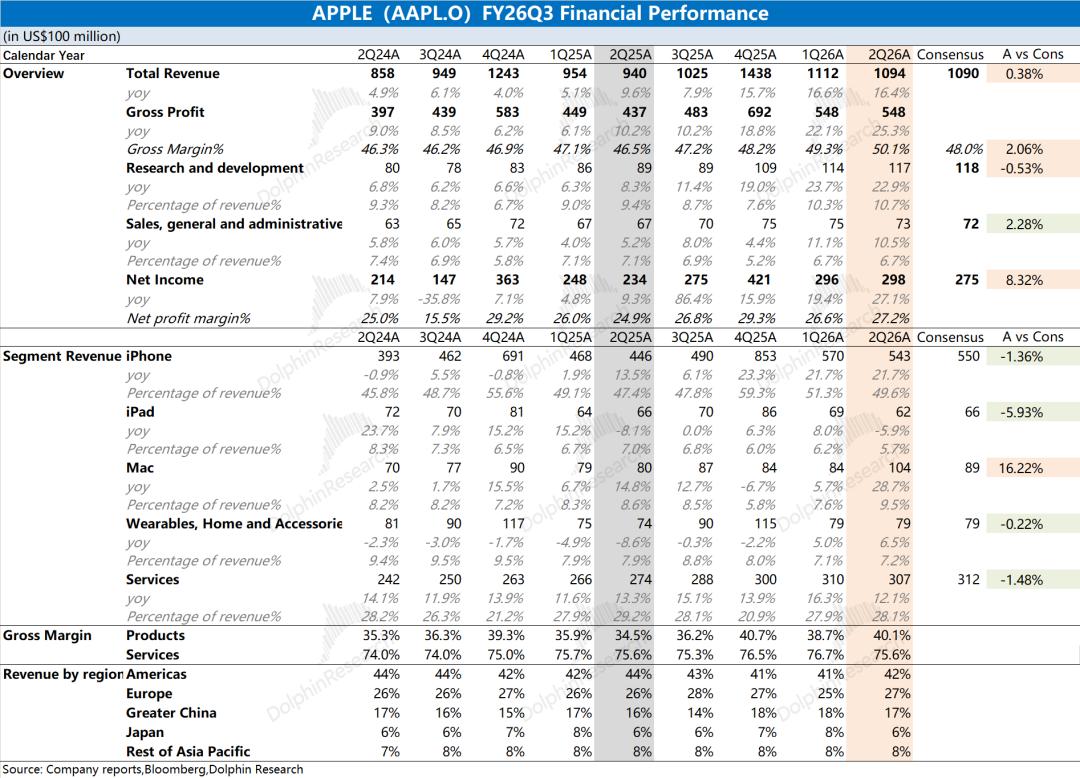
1. Overall Performance: In this quarter, Apple posted total revenue of USD 109.4 billion, up 16% year on year, in line with market expectations (USD 109.0 billion). The revenue growth this quarter was mainly driven by the expansion of iPhone, Mac and software services businesses.
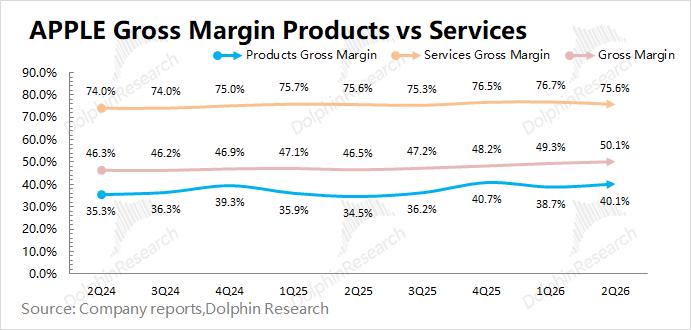
Apple's gross margin reached 50.1%, up 3.6 percentage points year on year. Excluding the tax rebate impact of around 2%, the quarterly gross margin was close to market expectations (48%), among which the gross margin of software services remained at 75.6%, the gross margin of hardware business was 40.1%, with the tax rebate impact at around 2.5%. The actual gross margin dropped by about 1 percentage point quarter on quarter, which was mainly affected by the rising price of storage components.
2. iPhone Business: In this quarter, Apple's iPhone business generated revenue of USD 54.3 billion, up 22% year on year, lower than market expectations (USD 55.0 billion). The growth of mobile phone business this quarter was mainly driven by the hot sales of iPhone 17 series in the global market. For this quarter, Dolphin Analyst estimates that the overall iPhone shipment volume increased by 16% year on year, and the average selling price of shipments rose by 5% year on year.
3. Other Hardware Businesses Excluding iPhone: The company's Mac business achieved a 29% year-on-year growth this quarter, mainly driven by the growth of MacBook Pro and MacBook Neo; iPad sales dropped by 6% year on year, and wearables and other hardware maintained a single-digit growth performance.
4. Software Services: The company's software services revenue reached USD 30.7 billion this quarter, below market expectations (USD 31.2 billion), representing a 12% year-on-year growth. With a high gross margin of 75.6%, the software business, accounting for 28% of total revenue, generated 42% of the company's total gross profit.
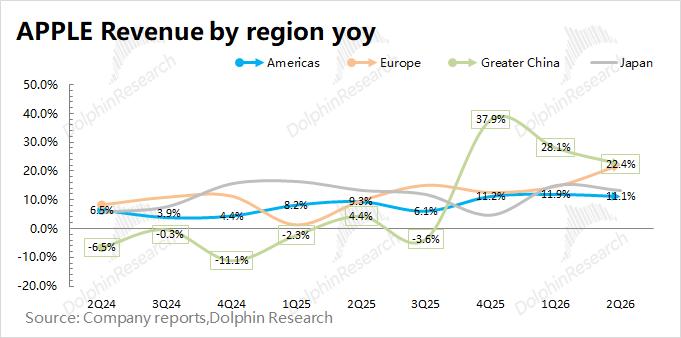
5. Revenue by Segment: The Americas region remains the company's core market, with its revenue share staying above 40% and achieving 11% year-on-year growth this quarter; both Greater China and Europe regions recorded over 20% growth this quarter, among which the shipment volume of iPhone in Chinese mainland increased by 24% year on year (IDC data).
Dolphin Analyst's Overall View: As an AI Safe Haven, Apple's Growth is Also Set to Slow Down
Against the backdrop of high market expectations, Apple's performance this quarter seems a bit "unremarkable". The revenue performance is basically in line with market expectations. The gross margin this quarter was positively affected by tariff rebates (around 2%). Excluding this impact, the gross margin stood at around 48%, which also matched market expectations.
① Double-digit revenue growth: Mainly driven by the iPhone 17 series. The iPhone business recorded 22% year-on-year growth this quarter, and the sales volume of iPhone 17 series in China and other overseas markets all posted double-digit growth. Under the pressure of continuous storage price hikes, other brands have generally raised their product prices, while iPhone 17 maintained its previous price, winning more favor from consumers;
② Gross margin improvement: The company's hardware gross margin reached 40.1% this quarter, including the tariff rebate impact of around 2.5%. Without considering this impact, the company's hardware gross margin is around 37.6%, down 1.2 percentage points quarter on quarter, which is mainly affected by the sharp rise in storage prices.
Since Apple's products such as iPhone are mainly targeted at the mid-to-high end market, the cost impact brought by storage price increases is relatively smaller than that of its competitors, and the company can better absorb this part of the pressure.
Apart from this quarter's data, the company's management also provided guidance for the next quarter: The company's revenue in the next quarter will grow by 9-11% year on year, corresponding to USD 111.7-113.8 billion, among which the growth rate of iPhone business will be around 15%; the gross margin for the next quarter is expected to be 47-48%, which means that the actual hardware gross margin of the company will further drop by 1-1.5 percentage points (due to factors such as rising storage prices).
Under the circumstance that the growth of software business is relatively stable, it is estimated that the revenue of the company's other hardware (excluding iPhone) in the next quarter will only be USD 23.1-25.2 billion, which may decline year on year (the figure for the same period last year was USD 24.7 billion). Combined with the price increase announcements of products such as Mac and iPad at the end of June, the demand for this part has been released in advance.
Beyond Apple's current earnings report, the market is also focusing on the following aspects:
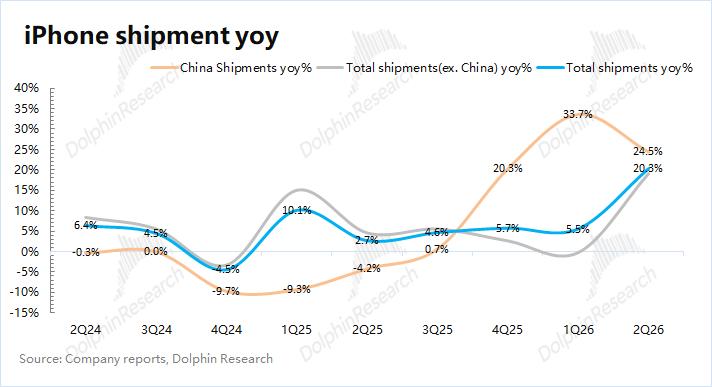
a) Strong growth in the Chinese market: The rebound of the company's performance this quarter is mainly driven by the increase of iPhone sales in the Chinese market. By breakdown, the year-on-year growth of iPhone shipment volume in the Chinese market reached 24% this quarter, and the shipment volume in other markets (outside China) also recorded 19% year-on-year growth.
b) "Resilience" under the pressure of storage price hikes: Even facing the pressure of continuous storage price increases, the company's overall gross margin still maintained at 48% this quarter, and the hardware gross margin also reached 37.5% (excluding the tariff rebate impact).
This is mainly benefited from the company's excellent supply chain management capabilities: ① Signing long-term memory procurement agreements to lock in costs; ② Reducing component costs through self-developed basebands and other methods; ③ Optimizing product structure or appropriately raising product prices.
c) AI Strategy: According to the announcement from Cyberspace China on July 15, 2026, "Apple Intelligence" has officially passed the filing for on-device generative AI services on mobile phones.
The overseas version of Apple integrates ChatGPT as an optional third-party model into the Apple Intelligence ecosystem. Since this solution cannot be implemented in China, Apple must cooperate with local Chinese manufacturers, and it has confirmed to establish a strategic partnership with Alibaba. AI functions are expected to strengthen Apple's competitiveness in the Chinese market, encourage existing users to upgrade their devices and boost consumption willingness.
Against the backdrop of the recent major correction in the AI sector, Apple has instead become a "safe haven" for the market, for two reasons: ① Apple has not followed up to make massive investments, the company's quarterly capital expenditure remains at around USD 2-3 billion, but it still controls the core hardware terminals; ② The company has "solid" performance support, and the iPhone 17 has achieved great success amid industry headwinds.
Just like Microsoft, which "did not raise its capital expenditure" yesterday, was "rewarded by the market". Apple has never significantly expanded its capital expenditure, earning more than USD 100 billion per year, while its annual capital expenditure still stays at just over USD 10 billion. Especially when the market is worried about the sustainability of AI Capex, "not blindly following the trend" has instead brought in capital inflows.
Apple has formed an obvious "seesaw effect" with the other 6 companies in the MAG 7. On the one hand, on-device AI requires more storage and computing power, and the rise in component prices driven by AI will delay the upgrade progress of on-device AI; on the other hand, Apple's relatively low capital expenditure forms a sharp contrast with the massive capital expansion of other tech giants.
Against the market's "high expectations" for Apple, the earnings report it released this quarter is "slightly unremarkable", and it also provided guidance for slowing growth in the next quarter. Recently, the company's valuation is obviously "not cheap", especially under the circumstance of slowing growth.
The capital that flows from the "AI industry" to Apple values its "certainty". But now the management has released the message that "growth is going to slow down", which will undoubtedly shake market confidence. For Apple, the iPhone 17 product cycle is a success, and follow-up attention should be paid to the performance of iPhone 18 and AI functions. Only when Apple's performance accelerates again with the empowerment of AI, can the company be expected to break through to a higher level.
The following is the detailed analysis
Performance Acceleration Brought by iPhone 17
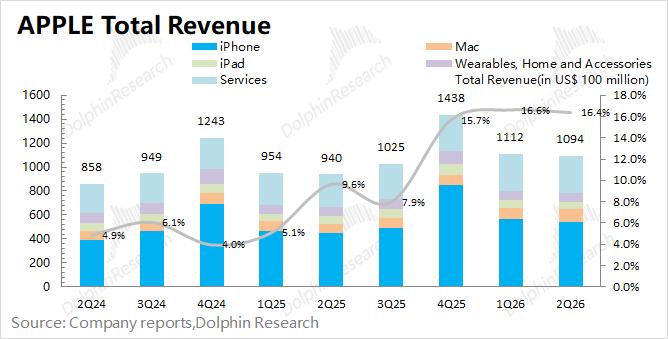
1.1 Revenue Side: In Q3 2026 fiscal year (namely 2Q26), Apple achieved revenue of USD 109.4 billion, up 16% year on year, in line with market expectations (USD 109.0 billion). The company's growth this quarter was mainly driven by the growth of iPhone and Mac businesses.
From the perspectives of hardware and software:
① The growth rate of Apple's hardware business this quarter is 18%. The accelerated growth of hardware business this quarter is mainly driven by the growth of iPhone and Mac businesses. Driven by the hot sales of iPhone 17 series, the growth rate of iPhone business has remained above 20% for three consecutive quarters;
② The growth rate of Apple's software business this quarter is 12%, maintaining double-digit growth. The implementation of more AI applications in the future is expected to drive the software business to accelerate again.
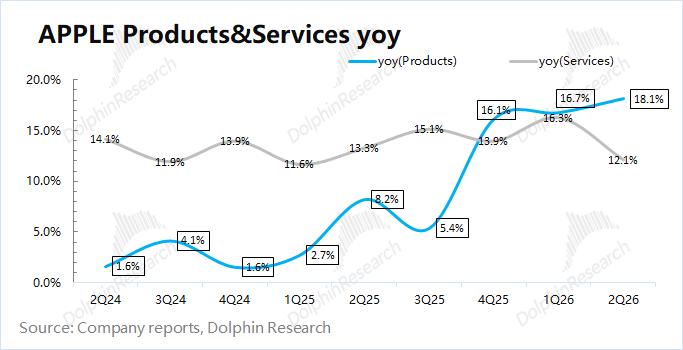
From the perspective of different regions: Revenue all achieved year-on-year growth with different magnitudes. The Americas, Europe and Greater China are the three most important revenue sources of the company. Specifically, the revenue share of the Americas region stays above 40%, and it recorded 11% growth this quarter; the growth rate of the Europe region rose to 22% this quarter.
Greater China has maintained rapid growth for three consecutive quarters, and its growth rate still reached 22% this quarter. When other brands raised their product prices, Apple kept its original price and achieved more sales. The sales volume of iPhone in Chinese mainland increased by 24% year on year this quarter.
1.2 Gross Margin: In Q3 2026 fiscal year (namely 2Q26), Apple's gross margin reached 50.1%, up 3.6 percentage points year on year. Since the company had a tariff rebate impact of around 2% this quarter, excluding this impact, the gross margin is close to market expectations (48%). The actual gross margin dropped quarter on quarter, which is mainly affected by the rising price of storage components.
Dolphin Analyst breaks down the gross margin of software and hardware: Apple's software gross margin remained at 75.6% this quarter; the hardware gross margin was 40.1%, and after excluding the tariff impact (2.5%), it is around 37.6%, down by about 1 percentage point quarter on quarter. Storage price hikes still brought pressure on the cost side.
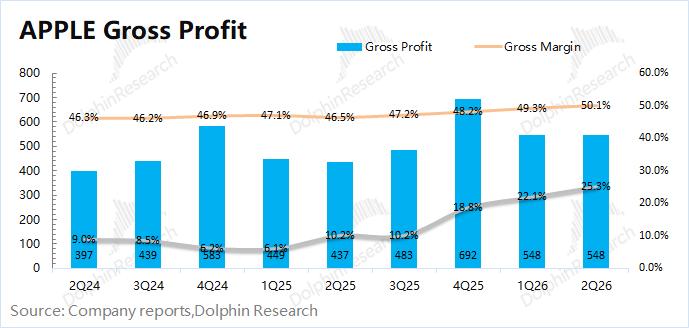
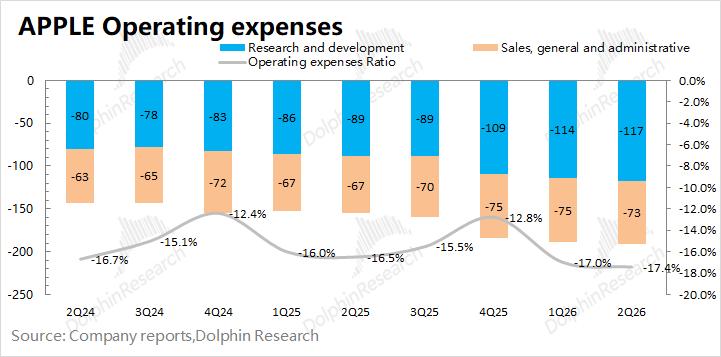
1.3 Operating Profit: In Q3 2026 fiscal year (namely 2Q26), Apple's operating profit reached USD 35.7 billion, up 27% year on year. The growth of Apple's operating profit this quarter is driven by both revenue growth and gross margin improvement.
The company's operating expense ratio was 17.4% this quarter, up 0.9 percentage points year on year. This is mainly because the company increased its investment in R&D, and the R&D expense this quarter increased by 23% year on year.
In terms of capital expenditure, compared with the hundreds of billions of quarterly investment of other tech giants, Apple's quarterly capital expenditure was only USD 2.46 billion. While other large manufacturers are increasing their investment in AI, Apple has not followed up to make massive investments, which has won the favor of market capital recently and pushed up its share price.