Amazon's most profitable business is selling models
Amazon released its Q2 earnings report last night.
The report is filled with dense figures. Net profit reached 62.6 billion US dollars, total revenue hit 200.6 billion US dollars, and earnings per share came in at 5.75 US dollars, while Wall Street's consensus expectation was only 1.82 US dollars. On the surface, this figure beat expectations by more than 200%.
At first glance, you might think: this performance is explosive. But if you read one more line, the hidden trick will come to light.
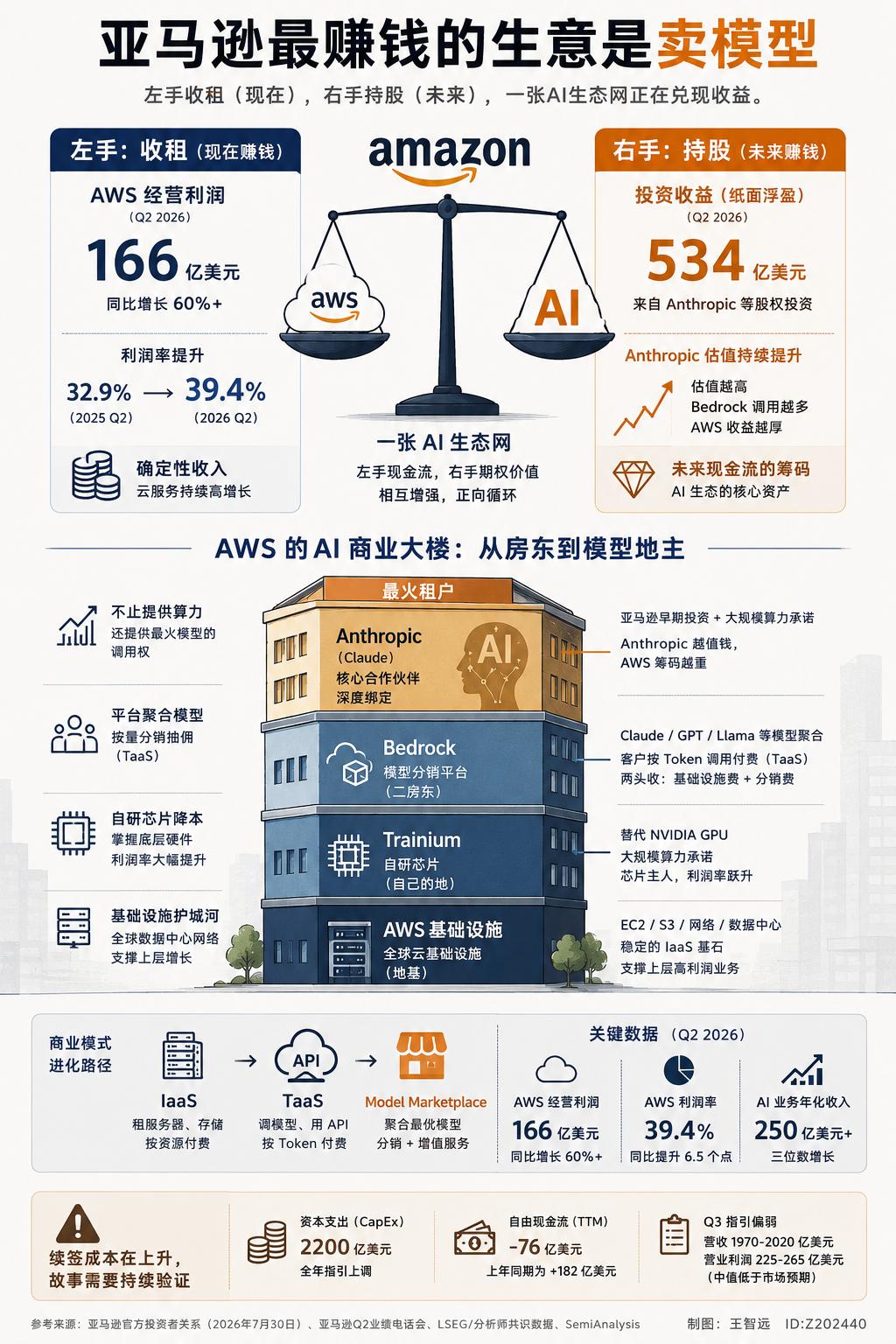
Of the 62.6 billion US dollars in net profit, 53.4 billion is unrealized paper gains. What does that mean? The equity investments in companies including Anthropic have risen in valuation, adding this extra amount to the books.
To put it plainly, the actual profit earned from selling goods and cloud services is the 27.5 billion US dollars of operating profit on the left side. The 53.4 billion US dollars on the right side comes from the rise of Anthropic's valuation, and no actual 53.4 billion US dollars in cash has flowed in.
I guess most people's first reaction would be: this earnings report is "distorted".
If you apply the old valuation method, the net profit is inflated by investment income, so the P/E ratio will be compressed; it seems that Amazon is undervalued and cheap, which does not look unreasonable.
If you take a closer look, the operating profit growth rate is 43% and the net profit growth rate is 245%, you will find that these two figures do not belong to the same narrative at all.
What is more interesting comes later.
After market hours following the earnings release, Amazon's stock price once rose by more than 9%, nearly 10%. You should know that before this, the stock price was around 235 US dollars, which had corrected by nearly 19% from its 52-week high of 278 US dollars in early May.
The Q3 guidance is relatively weak, with expected revenue ranging from 197 billion to 202 billion US dollars, while Wall Street originally expected 203.9 billion US dollars. Capital expenditure (capex) has also been raised to 220 billion US dollars, and the trailing 12-month (TTM) free cash flow has turned negative by 7.6 billion US dollars.
When these factors are combined, the scenario does not seem to support a sharp rise at all. Think about it: weak guidance, increased capex, and negative free cash flow. But the market voted in favor of it.
Why?
I later figured it out. When evaluating Amazon, more and more people now learn to break down its income statement. Operating profit reflects "whether you can make money now", while investment income reflects "whether you have chips in your hand in the future".
You cannot simply say that the 53.4 billion US dollars of unrealized gains is inflated water.
It is the chip Amazon laid out in advance in the AI industrial chain, and part of it has now been realized. The more valuable Anthropic is, the more model calls there will be on Bedrock, and the thicker AWS's revenue will be. The two are connected as a single network.
What really drives the re-pricing is the structural change hidden in the 27.5 billion US dollars of operating profit on the left side.
AWS alone contributed 16.6 billion US dollars in operating profit, a year-on-year increase of more than 60%. Its profit margin directly jumped from 32.9% last year to 39.4%.
See? Left and right sides. The left hand acts as a landlord collecting rent, and the right hand holds the options. The market sees the certainty, and pays for the left side.
At this point, the question arises: how did AWS get the 16.6 billion US dollars in profit as "rent"? Why did its profit margin jump by 6.5 percentage points all at once?
......
Let's start with the conclusion: In addition to selling computing power, AWS is also selling model calling rights.
If you understand it as a "server rental" business, with 42.2 billion US dollars in revenue and a 37% year-on-year growth rate, higher sales will indeed make the profit look better.
However, the profit margin would not jump so sharply. Higher sales and thicker profits are two different things. The core reason is that AWS's revenue model has changed.
I break it down into three layers.
The first layer: the computing power itself. EC2 instances, S3 storage, the most basic IaaS business, with a medium gross profit margin, making profits purely through scale. AWS has been developing this business for nearly 20 years, and this layer is already very mature with no surprises.
The second layer is more interesting: model distribution.
The Bedrock platform allows customers to directly call APIs of various large models, including Claude, GPT, and Llama, so that customers do not need to build their own underlying infrastructure.
What customers buy is Tokens. Every time they call the model, they pay based on usage.
AWS's identity has changed here. It is no longer just a computing power landlord, but also a sublessor of models.
This is similar to several domestic cloud vendors, such as Alibaba Cloud and Baidu Intelligent Cloud, which integrate all models into their platforms. In this way, as long as customers use their services, they have to go through them. Isn't this business very attractive?
Then, the more valuable Anthropic is, the more people use Claude, the larger the call volume on Bedrock, and the more commission AWS gets. This is TaaS, Token-as-a-Service.
What is the biggest difference from traditional IaaS?
What customers buy is no longer "I rent a server from you", but "I use your model on a pay-per-use basis". AWS collects infrastructure fees on one hand and model distribution fees on the other, earning profits from both ends.
Andy Jassy, the current CEO of Amazon, mentioned on the earnings call:
AWS's AI business has an annualized revenue of over 25 billion US dollars, with triple-digit growth; customer spending on Bedrock in this quarter has exceeded the sum of all previous quarters.
These people always speak in a reserved way. Let me rephrase that: Bedrock is evolving from a trial product to the main business track. It does not only have room for imagination in the future, it is already generating revenue now.
Okay, the third layer: self-developed chips, Trainium.
In the past, when AWS sold computing power, most of the underlying hardware was NVIDIA's GPUs, so the cost was controlled by NVIDIA.
Now it has its own alternative solution. Both Anthropic and OpenAI have given multi-year, large-scale computing power commitments to Trainium. It was revealed on the earnings call that the annualized scale of Trainium-related business has also crossed the 25 billion US dollar threshold.
AWS has transformed from a reseller of NVIDIA to a computing power owner selling its own chips. The profit margin of a reseller and that of a chip owner are not in the same league at all. You do not need me to calculate it, you can easily figure it out.
When you look at the three layers together, AWS has changed from a "parking fee collector" to a "brand franchise fee collector".
Furthermore, it also wants to be a supplier: the underlying Trainium is its own land, the middle Bedrock is the platform that collects tolls, and the top Anthropic is the most popular tenant.
With this transformation from a computing power landlord to a model landowner, how could the profit margin not jump?
Several major cloud vendors are enjoying the dividends of this AI wave. Azure is growing, Google Cloud is growing. The key to differentiation, in addition to the growth rate, is the structure of profit margin; AWS is the first cloud vendor to scale up the model distribution business into a high-margin business.
According to estimates from research firm SemiAnalysis, Bedrock's EBIT profit margin can reach around 55%. Let's do the math: A business that accounts for less than 5% of AWS's total revenue contributes nearly 30% of its year-on-year incremental gross profit. This is leverage.
However, for this structure to hold, there is a prerequisite: continuous investment.
Anthropic is willing to tie so much of its business to AWS because Amazon has invested in it, supported its development, and provided it with computing power. In turn, the more valuable Anthropic is, the heavier AWS's chips are. This is a closed loop.
......
How long this closed loop can operate depends on the renewal cost.
The premium has indeed occurred, but it comes with conditions. The market is now willing to price Amazon with the growth stock framework, but the problem is that the renewal cost of this framework is getting higher and higher.
Let's start with several striking figures.
The full-year capital expenditure has been raised from 200 billion to 220 billion US dollars, 20 billion more than the guidance in April. Jassy explained very frankly on the earnings call: the rise in memory prices has pushed up the expected expenditure.
You can savor this sentence. He is saying that "the cost increase forced the guidance to be raised, and I did not do this voluntarily", directly shifting the responsibility. 220 billion US dollars may not be the final figure.
What is more striking is the cash flow: in the past 12 months, free cash flow was negative 7.6 billion US dollars, while the same period last year had a positive inflow of 18.2 billion US dollars.
You can feel how sharp this turn is.
Amazon is putting the cash it has accumulated in the past, together with borrowed money, into AI infrastructure with unprecedented intensity. This is an infrastructure playbook of spending heavily to build a moat.
The valuation logic of the two sets of playbooks is completely different, but they have one thing in common: you have to prove that the money is not spent in vain.
The Q3 guidance also shows a slight cooling sign.
Revenue is expected to be between 197 billion and 202 billion US dollars, a year-on-year increase of 9% to 12%. The midpoint of the range is lower than Wall Street's expectation of 203.9 billion US dollars. The operating profit guidance is 22.5 billion to 26.5 billion US dollars, and the midpoint also does not reach the market's expected 25.1 billion US dollars.
Of course, there is the noise of Prime Day here.
You know Prime Day, right? It is Amazon's membership day, similar to China's Double 11 shopping festival.
This year Prime Day was moved to June in advance, while it was held in July in previous years. Therefore, Q2 took part of the revenue from Q3. Amazon itself said that excluding the impact of Prime Day, the Q3 growth rate will be nearly 400 basis points higher.
However, even with these 400 basis points added, the guidance itself is still relatively conservative. You can interpret it as the management leaving room for itself, or as them not having very high visibility for the second half of the year.
Jassy said a very confident sentence on the earnings call:
Even if we reach 220 billion US dollars in capex, we still will not have enough production capacity to meet all the demand by 2026, and I believe this trend will continue in 2027. In fact, we think the demand in 2028 is already very significant.
To rephrase that: don't ask when we will get the payback, first ask if the production capacity is enough. The demand is there, and now it is supply constrained, not insufficient demand. That is a very strong statement.
You also need to hear the implied meaning behind it.
It is a forward check. No matter how significant the demand in 2028 is, it cannot solve the real problem of negative free cash flow and weak profit margin guidance in the second half of 2026.
Look at Google's playbook last week: it raised capex, its cash flow turned negative, and its stock price fell. Microsoft's playbook: it maintained capex, its cloud business beat expectations, and its stock price rose sharply.
Amazon's playbook is in between: It raised capex and its cash flow turned negative, but AWS's 37% growth rate and 39.4% profit margin make the market willing to believe that its money is spent in the right place.
What does this mean? It is not as simple as "AWS's high growth rate leads to a stock price rise".
The same mechanism of "capital expenditure, cloud growth rate, market confidence" will lead to completely different trends under different evidence weights. AWS's 37% growth rate directly reversed the market's evaluation of Amazon's AI investment return rate. This is the key variable.
The question is whether this variable can be sustained, which depends on two figures.
First, can AWS's profit margin stay above 35%? If Bedrock's TaaS model continues to expand, the profit margin will be supported. If competition intensifies and a price war breaks out, the profit margin will drop, and the "model landowner" narrative will be shaken.
Second, can Bedrock's customer growth maintain triple-digit growth?
This is the core indicator for the TaaS model to be validated. As long as the call volume continues to grow exponentially, Amazon will have the confidence to keep investing. Once the growth rate slows down, the 220 billion US dollars of capex will turn from an investment into a burden.
These two figures will be gradually revealed in the quarterly reports and earnings calls in the next few months. The Q3 earnings report in three months will be the first test paper.
Finally, to put it simply, Amazon has indeed told a great story.
At the very least, it has given a lesson to domestic vendors: Look, my growth rate is high because my cloud infrastructure is well built, and old customers are all using it; at the same time, new customers are all using AI, so I have to buy hardware.
This is such a shrewd calculation. It is like saying "I am willing to spend any amount of money for you" when courting a girl, then turning around and saying to friends "Look at my return on investment" after succeeding. It has all the excuses covered on both sides.
References:
[1]. Amazon Official Investor Relations (Late July 30, 2026), Amazon Q2 Earnings Call, LSEG / Analyst Consensus Data, SemiAnalysis
This article is from the WeChat official account "Wang Zhiyuan" (ID: Z201440), Author: Wang Zhiyuan, Published with authorization from 36Kr.