Weng Li is reported to have returned to OpenAI, just 24 hours after she resigned from Thinking Machines Lab due to health reasons.
She just announced her departure from the startup citing health issues, and immediately returned to her former employer.
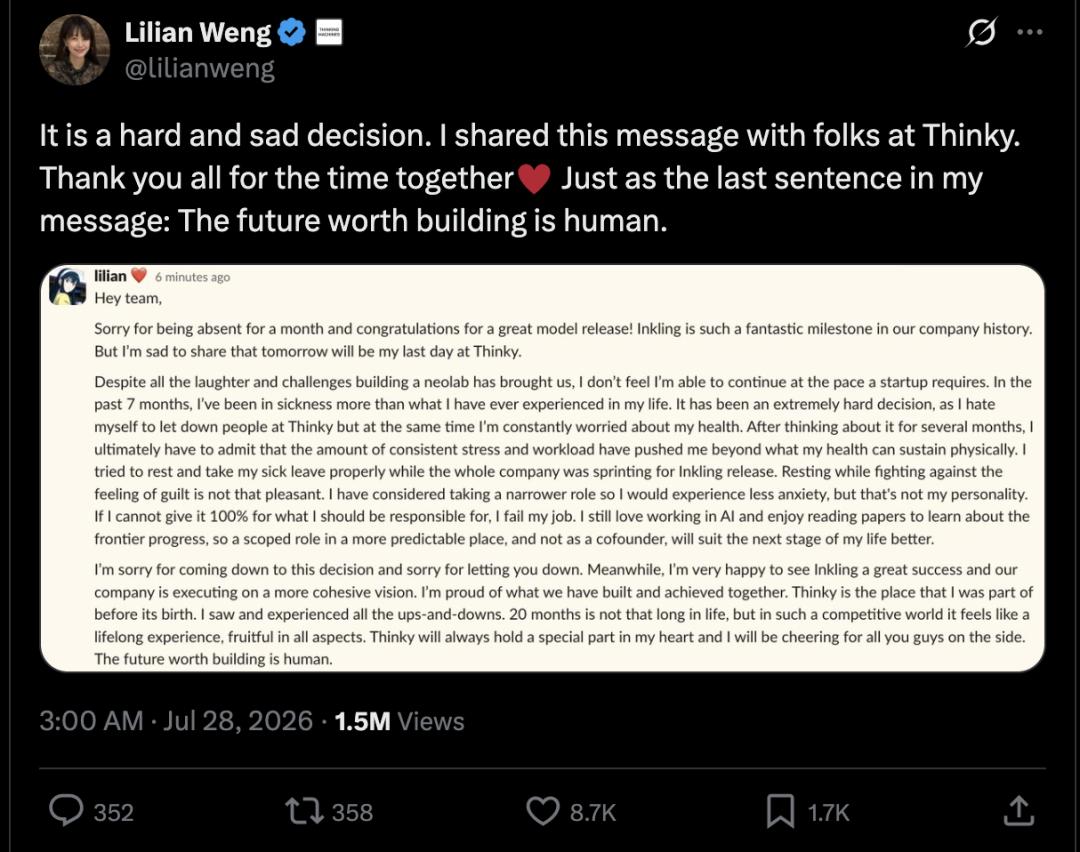
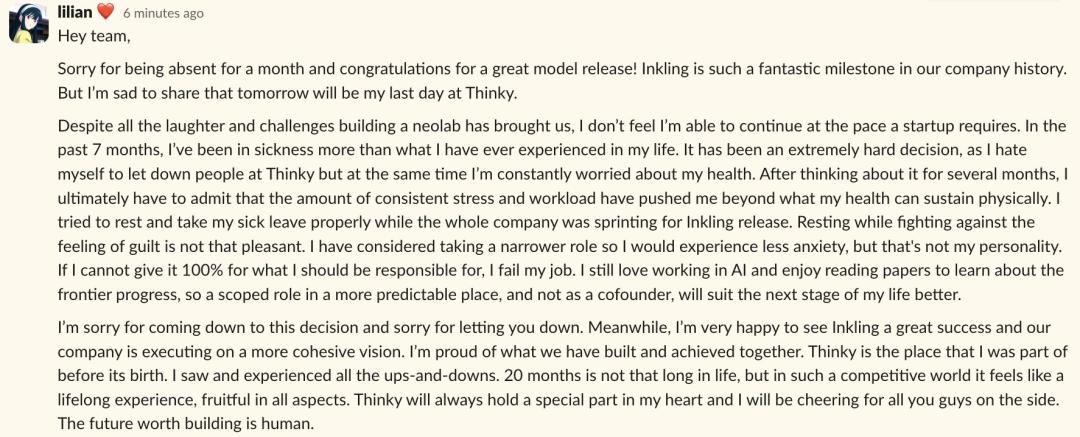
On July 27 local time, Lilian Weng, co-founder of Thinking Machines Lab and an alumna of Peking University, made public a farewell letter to internal employees. She stated that the sustained pressure and workload had exceeded what her body could tolerate, and she could no longer maintain the pace required of a startup.
July 28 was her last working day at Thinking Machines.
Just one day later, OpenAI confirmed to TechCrunch and Business Insider that Lilian Weng will return to the company to lead a high-level internal research team, supporting cross-research efforts including "recursive self-improvement". The so-called recursive self-improvement refers to enabling AI systems to participate in improving training methods, research processes and even next-generation models, thus forming a closed loop of continuous capability iteration.
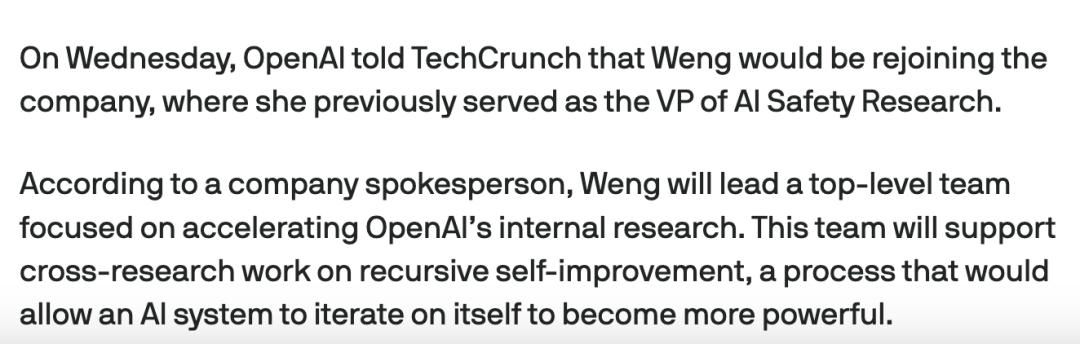
On the surface, this seems like a sudden reversal: on the one hand, she said her body could not withstand the high-pressure pace of a startup, and on the other hand, she quickly joined one of the most competitive AI companies in the world.
But a closer look at Lilian Weng's resignation letter shows that what she wanted to quit was not the AI industry, but the role of co-founder, which lacks boundaries and requires continuous overall responsibility.
The first time she left OpenAI, she did not publicly criticize the company
Lilian Weng joined OpenAI around 2018. In the first few years, she participated in the Dactyl project of OpenAI's robotics team: researchers used reinforcement learning and large-scale domain randomization to enable a humanoid robotic hand to complete Rubik's Cube manipulation without real-world training data. She was also one of the authors of the related research paper.
Since 2021, Lilian Weng has led OpenAI's applied AI research team, participating in the deployment and safety work of language models. According to OpenAI's official introduction, the team has built harmful content assessment data, content classifiers, and methods to reduce unsafe outputs of models. After the release of GPT-4, she further took charge of integrating OpenAI's Safety Systems team, with work covering model behavior, safety assessment, red team testing, content moderation, and safety infrastructure at the deployment stage.
In August 2024, Lilian Weng was promoted to Vice President of Research and Safety at OpenAI. In November of the same year, she announced the end of her nearly seven-year career at OpenAI.
It is worth noting that Lilian Weng did not attribute her resignation at that time to conflicts over safety routes, management disagreements, or product commercialization pressures. In her open letter, she only stated that after working at OpenAI for many years, she felt it was time to "start over and explore new areas". She also specifically reviewed the growth of the Safety Systems team from scratch to more than 80 people, as well as the team's safety support for products such as GPT-4, GPT-4 Turbo, voice functions and o1.
Therefore, based on the existing public information, her first departure from OpenAI cannot be simply interpreted as "disappointed with OpenAI" or "leaving due to incompatible safety concepts". A more accurate statement is that she left a highly organized company and joined a new project initiated by Mira Murati, former Chief Technology Officer of OpenAI, trying to build a new cutting-edge AI lab from scratch.
At Thinking Machines, she participated in building a "new lab"
In February 2025, Thinking Machines Lab was officially launched. In addition to Murati and Lilian Weng, the initial co-founders also included John Schulman, co-founder of OpenAI, Barret Zoph, former Vice President of Research at OpenAI, researchers Luke Metz and Andrew Tulloch.
The direction set at the beginning of the company's establishment was to make cutting-edge AI systems easier to understand, customize and use, emphasizing multimodality, human-machine collaboration, co-design of research and products, and continuous improvement of safety mechanisms through real deployment. In July 2025, Thinking Machines completed a $2 billion seed round of financing with a valuation of $12 billion, making it one of the largest seed round financings for startups at that time.
Thinking Machines did not publicly release a detailed list of responsibilities for co-founders, so it is not certain which product or model team Lilian Weng specifically led. What can be confirmed is that she participated in the early construction of the lab as a co-founder, and her previous experience focused on robotics, model deployment, safety systems and applied research, which overlaps with the model safety, real deployment and research infrastructure that Thinking Machines publicly emphasizes.
During her tenure, Thinking Machines successively launched Tinker, a model training and fine-tuning platform, the research preview of Interaction Models that supports real-time input of audio, video and text, and Inkling, the first independently trained open-weight model. Inkling adopts a mixture-of-experts architecture, with a total of 975 billion parameters and 41 billion activated parameters, supports text, image and audio input, and can be further fine-tuned through Tinker.
Lilian Weng herself has been continuously focusing on reasoning and model self-improvement issues. In 2025, she published "Why We Think", which systematically sorted out test-time computation, chain of thought, reinforcement learning and model self-correction; on July 4, 2026, she published "Harness Engineering for Self-Improvement", discussing how to enable AI systems to gradually improve their research capabilities through tool invocation, context management, workflow, evaluation and persistent state around the model.
These articles are Lilian Weng's personal technical blogs and cannot be directly equated with Thinking Machines' internal research projects, but at least it shows that before leaving Thinking Machines, her research interests have clearly shifted to model reasoning, agent systems and recursive self-improvement. This forms a direct technical connection with her new responsibilities after returning to OpenAI.
What really made her leave was the physical overdraft caused by the role of entrepreneur
Lilian Weng gave a very clear reason for leaving Thinking Machines this time.
She stated in the internal letter that in the past seven months, the frequency and severity of her illness have exceeded any period in her life. After months of consideration, she had to admit that the continuous pressure and workload had exceeded the range her body could tolerate. She did not disclose the specific disease or diagnosis.
When Thinking Machines was sprinting for the release of Inkling, Lilian Weng tried to rest and take sick leave normally, but when the whole team was moving forward and she had to stop, she was always plagued by a sense of guilt. She also considered narrowing her scope of responsibility and taking a position with lower pressure and less uncertainty, but finally thought it was not suitable for her character — as long as she could not devote all her energy to the things she was responsible for, she would feel that she did not do a good job.
The key point is that Lilian Weng did not say she would completely leave the AI industry.
On the contrary, she explicitly wrote that she still loves AI and still enjoys reading cutting-edge research papers. She hopes that her next job will be a role with "a clearer scope of responsibilities, a more predictable environment, and not a co-founder".
From this statement, returning to OpenAI does not completely contradict her reason for leaving. What she quit was the co-founder position of the startup, not the research work itself.
The responsibilities of a co-founder are usually difficult to strictly divide: in addition to research and products, they also have to face team building, recruitment, financing, corporate strategy, organizational culture and external expectations. After returning to OpenAI, although Lilian Weng will still be in a high-intensity cutting-edge research environment, she will be responsible for a relatively clear research task and will no longer assume the overall responsibility of a startup.
Of course, there is no public information at present to specify Lilian Weng's working hours, management scope and health arrangements at OpenAI, and it cannot be asserted that the new position must be more relaxed. TechCrunch also pointed out that this choice seems contradictory, but compared with being a co-founder, taking a research position with a clear scope of responsibility in a mature company may expose her to less direct entrepreneurial pressure.
Thinking Machines suffered another loss of key personnel
Lilian Weng's departure has more impacts on Thinking Machines than just losing a researcher.
Among the six co-founders announced initially, Andrew Tulloch has joined Meta, Barret Zoph and Luke Metz have returned to OpenAI, and now Lilian Weng has also chosen to return.
According to statistics from Business Insider, 13 of the original 42 founding members of Thinking Machines have left; after Lilian Weng's departure, only CEO Murati and Chief Scientist Schulman remain in the company among the six initial co-founders.
Murati showed no public disagreement when responding to the news of Lilian Weng's departure.
She said she would miss Lilian Weng, was glad that the latter decided to put health first, and thanked her for everything she had done for the company.
For OpenAI, this means the return of a veteran who is familiar with its research system, model deployment and safety infrastructure. Lilian Weng not only has the experience of building teams from scratch, but also has experienced model training, safety assessment and product deployment during the GPT-4 and o1 stages. This time, assigning her to be in charge of work related to recursive self-improvement means that OpenAI is trying to promote "accelerating AI research with AI" from scattered tools and experiments to a more systematic cross-team research direction.
Therefore, the core of this "resignation reversal" that seems to have happened within 24 hours is not that Lilian Weng suddenly changed her judgment on health, but that she no longer takes on all the uncertainties of a company as a co-founder, and continues to pursue cutting-edge AI within a clearer scope of responsibilities.
The last sentence she left when she left Thinking Machines was: "The future worth building should be people-oriented."
Now, this sentence is first applied to herself.
Reference Links
https://x.com/lilianweng/status/2081816923088814421
https://techcrunch.com/2026/07/29/thinking-machines-co-founder-lilian-weng-left-the-company-citing-health-reasons-then-joined-openai/
This article is from the WeChat official account "AI Front" (ID: ai-front), written by Dongmei, and authorized for release by 36Kr.