The "highest-priced stock" has slumped sharply: can its reported 8-fold surge in profit help it regain its 200 billion yuan market capitalization?
Today, the "throne" of the A-share market has been officially divided between two major tech stocks: Link Instruments remains firmly seated as the "king of stocks by unit price", while Changxin Technology claimed the title of "king of stocks by total market capitalization" on its first trading day after listing. As of the close on July 27, Changxin Technology was trading at 49 yuan per share, with a full-day increase of 465.82%, giving it a total market value of 3.31 trillion yuan; on the same day, Link Instruments also surged by 10%.
But just one day later, both of these "stock kings" saw a sharp reversal in their fortunes: on July 28, Link Instruments plunged more than 18% during intraday trading, while Changxin Technology opened 7.71% lower at 45.22 yuan per share, though it later recovered some of its losses. By the close, Link Instruments and Changxin Technology had fallen by 14% and 4.08% respectively.
As the saying goes, "tall trees catch much wind". Once a company takes the title of stock king, it naturally draws far more market attention. Compared with the explosive market debut of Changxin Technology, "unit price stock king" Link Instruments (688808.SH) has actually been surrounded by considerable controversy. In its recently released semi-annual report, Link Instruments projected its attributable net profit for the first half of the year to be in the range of 510 million yuan to 580 million yuan, representing a year-on-year increase of 801.96% to 925.75%. However, such a high profit growth rate still cannot keep its market value stably above 200 billion yuan.
According to a report by National Business Daily, on June 25, the share price of Link Instruments once hit a peak of 2777.77 yuan per share, pushing its total market value past 280 billion yuan, but then the stock began to fluctuate downward.
From June 25 to July 28, the lowest point of Link Instruments' share price dropped to 1583 yuan per share; after the release of its half-year performance forecast on July 23, the stock rose briefly, but now it has plunged again. Its current market value of about 189.9 billion yuan is still more than 90 billion yuan lower than the nearly 280 billion yuan market value it had on June 25.
This creates a very contradictory impression: the hard data of Link Instruments' performance clearly confirms the dividend brought by the upward cycle of AI computing power to the optical communication testing equipment track, but on the other hand, hidden risks such as its extremely high valuation, small-cap liquidity constraints, and industry cycle fluctuations still hang over the company.
01 Performance surges sharply, but a clear gap remains with global leaders
Link Instruments, whose semi-annual profit has increased by up to 9 times year-on-year, is also a beneficiary of the current market boom, but the reason its share price can far exceed that of major optical module and optical chip manufacturers lies in a completely different development path.
Link Instruments does not produce optical modules or optical chips; it only provides "testing products and services" for these computing power equipment, and yet it has achieved the "myth" of its share price rising 32 times in two months after listing (it went public on April 24 at an issue price of 81.88 yuan per share, and hit an intraday peak of 2777.77 yuan per share on June 25).
The "meteoric rise" of Link Instruments is not entirely driven by capital speculation. From 2020 to 2022, the company focused on the 800G optical module testing field, and in 2024, it upgraded to the 1.6T optical module testing field, closely following the iterative demand for computing power equipment. Both its performance and share price growth are backed by a strong industrial foundation.
For Link Instruments, electronic measuring instruments and semiconductor testing equipment are the two core product lines contributing to its revenue. In 2023, 2024, and the first three quarters of 2025, these two products together accounted for over 90% of its total revenue, and they are mainly applied in three major fields: optical communications, silicon carbide power devices, and semiconductor integrated circuits.
Among these, revenue from testing products in the optical communications field has long accounted for more than 70% of total revenue, growing from about 200 million yuan in 2023 to 558 million yuan in 2024, and further rising to 629 million yuan in the first three quarters of 2025.
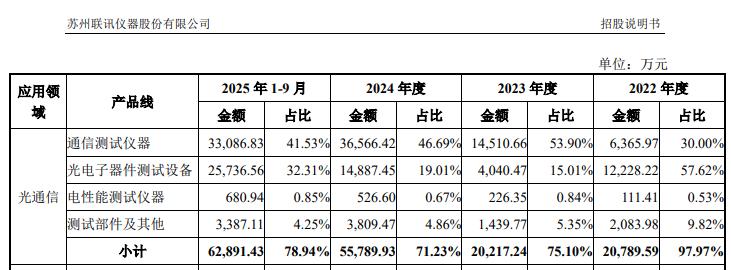
It is obvious to all that Link Instruments has seized the market opportunity driven by global AI computing infrastructure, which has boosted procurement demand for optical communication testing equipment.
Performance forecast data shows that Link Instruments' attributable net profit for the first half of 2026 is between 510 million yuan and 580 million yuan, while its net profit in the same period of 2025 was only 56.54 million yuan, representing a year-on-year growth range of 801.96% to 925.75%. What is even more notable is the single-quarter data: the company's attributable net profit in the first quarter of 2026 was 119 million yuan, based on which its attributable net profit for the second quarter alone is estimated to reach 391 million yuan to 461 million yuan, a sequential increase of 228% to 287% over the first quarter.
The nearly threefold sequential surge in second-quarter performance directly reflects that optical module manufacturers are accelerating the mass production deployment of high-speed optical modules, leading to a concentrated landing of testing equipment procurement orders.
However, this is still not enough for Link Instruments to rest easy.
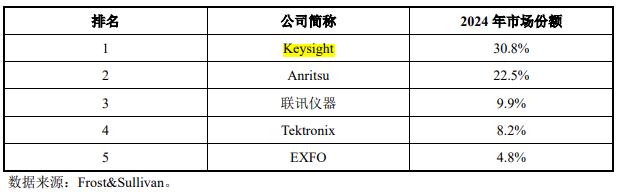
This is because the testing equipment market where Link Instruments operates is currently monopolized by American and Japanese companies such as Advantest and Teradyne. According to data from Frost & Sullivan, overseas companies represented by Keysight and Anritsu occupied about 84% of China's optical communication testing instrument market in 2024, while the market share of local Chinese companies was only around 16%.
Link Instruments, meanwhile, holds a 9.9% market share in China's optical communication testing instrument market, ranking third in the market, and is the only domestic company among the top five players.
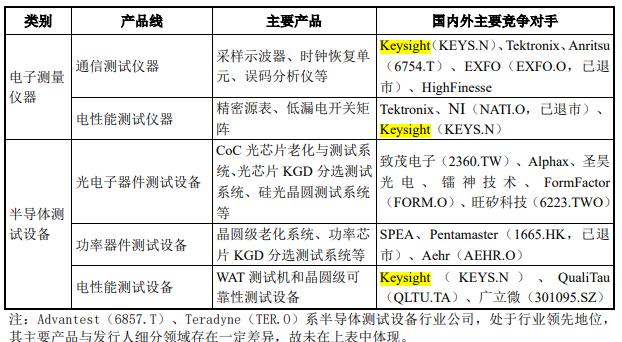
Main competitors of Link Instruments; Source: Prospectus
It is not hard to see that globally and across its main product lines, one of Link Instruments' key competitors is Keysight, a well-known company whose predecessor was Hewlett-Packard (HP) of the United States. In 1999, HP reorganized into Agilent Technologies and HP, and in 2014, it split again to form Keysight, which was then listed on the New York Stock Exchange.
In 2024, Keysight accounted for about 31% of China's optical communication testing instrument market, around 21% higher than Link Instruments' share.
As of October 31, 2025, Keysight's fiscal year revenue was approximately 5.375 billion US dollars, with a net profit of 850 million US dollars. According to data from Eastmoney.com, Link Instruments' total revenue in 2025 was around 1.194 billion yuan, with an attributable net profit of 174 million yuan.
In terms of fiscal year data, Keysight's revenue scale is 30 times that of Link Instruments. Although the two companies operate in different market scopes, comparing with leading industry players can provide a more reasonable reference benchmark.
Other domestic manufacturers of storage device testing equipment are also catching up, such as Rigol Technologies, Siglent Technologies, Changchuan Technology, Huafeng Test & Control Technology, and Liantronics Technology. However, overall, most domestic peers are still in the early stages of R&D or industrialization, with a significant gap in product performance compared to international leading companies, and high-speed products are still largely uncharted territory for them.
Overall, at the current stage, Link Instruments is the only domestic company that has achieved large-scale deployment of high-end computing power optical communication testing equipment, with no local competitors of comparable strength. But as the profit prospects of this track become prominent, continuous inflows of domestic capital in the future will gradually intensify industry competition.
02 Small floating share vs. two large-scale unlock events
In the short to medium term, compared with its domestic peers, Link Instruments will maintain its leading market share in China. The future uncertainties will mainly come from upstream testing demand and the replacement of testing equipment driven by technological iteration. However, in the short term, the strong demand for computing infrastructure and optical communications is not expected to weaken suddenly.
From an investor's perspective, if one is concerned about sharp fluctuations in Link Instruments' share price, the company's shareholding structure is an aspect that deserves close attention.
Link Instruments has a total share capital of 102.6667 million shares, of which only 19.2961 million are unrestricted floating shares, representing a floating ratio of 18.79%, while more than 80% of the shares are still under lock-up periods. With such a small floating share base, a small amount of incremental capital can drive a sharp rise in the share price. Once market sentiment in the sector cools down and capital withdraws, the stock is highly vulnerable to a cliff-like decline.
The price fluctuations since its listing also show that the maximum increase in Link Instruments' share price in the early stage of listing exceeded 32 times, and after hitting the peak, the maximum drawdown in 22 trading days reached 43%, with a volatility level far higher than the overall level of the STAR Market.
In terms of share unlock events, the company will face two large-scale unlocks of restricted shares at the end of October 2026 and April 2027. In April 2027, a single unlock event will involve shares accounting for more than 30% of the total share capital. The substantial expansion of floating shares will change the supply-demand relationship of the stock, bringing obvious medium and long-term downward pressure.
In addition to the shareholding structure, we can also compare Link Instruments' customer structure with its asset structure.
From 2022 to 2024 and in the first three quarters of 2025, the total sales amount from Link Instruments' top five customers accounted for 42.64%, 52.81%, 44.21%, and 36.94% of the total sales revenue of the corresponding periods respectively. This structure is relatively reasonable, with no single customer accounting for more than 50% of the company's annual total sales, nor is the company heavily dependent on a small number of customers.
Its main customers include well-known domestic and overseas players such as Innolight, Eoptolink, Accelink, Hisense Group, Source Photonics, Sanlei Technology, and Lumentum.
However, at the same time, Link Instruments is also facing issues such as high accounts receivable and accumulated inventory, which have increased the pressure on impairment and capital turnover, putting its asset structure under strain.
Data from Eastmoney.com shows that the book balance of Link Instruments' accounts receivable was only 82.46 million yuan at the end of 2022, but it had surged to 563 million yuan by the end of the first quarter of 2026, with an increase of more than 525% in two years. It is worth noting that if some downstream customers face operational pressure and delay payments, the company will need to make large provision for bad debts, which will erode its net profit.
In addition, to meet order demands, Link Instruments has stocked up on upstream components and finished products in advance. As a result, its inventory balance skyrocketed from 70.73 million yuan at the end of 2022 to 751 million yuan at the end of the first quarter of 2026, an increase of over 910%.
It is important to note that the technology of high-speed testing instruments iterates extremely fast. Once a new generation of products is launched, the old equipment will depreciate rapidly. Although current demand is surging, the risk of inventory impairment from overstocked products still needs to be guarded against.
In the long run, the iteration of computing power will not stop. After 1.6T optical modules, the R&D of 3.2T and 6.4T ultra-high-speed optical modules has already started. Each speed upgrade will bring new demand for testing equipment replacement. Meanwhile, China has included high-end scientific instruments in its sci-tech self-reliance strategic plan, with policies continuing to support domestic enterprises. In addition, testing scenarios for in-vehicle optical interconnection, silicon optical chips, and third-generation semiconductors are continuing to expand. All these markets are industry opportunities that can help Link Instruments break free from the constraints of the single optical communication sector cycle.
But at the same time, domestic companies still have a 5-8 year technology gap with overseas leading players in high-speed sampling algorithms and underlying radio frequency chips, making full substitution of ultra-high-end equipment impossible in the short term. The global AI capital expenditure rhythm is volatile, and coupled with the hidden risk of overcapacity caused by capital inflows into the track, the overall industry profit center will face downward pressure in the future.
As of the close on July 28, Link Instruments plunged 14%, erasing most of the gains from previous trading days. Its share price stood at 1850 yuan per share, with a total market value of about 189.9 billion yuan. However, Link Instruments' attributable net profit in 2025 was only 174 million yuan, leaving its PE ratio still as high as thousands of times.
Such an extremely high valuation obviously cannot be digested by a single performance realization. Volatility along with the sentiment of the computing power sector will remain the norm in the short term. Whether Link Instruments can maintain its position as the A-share "unit price stock king" in the future will mainly depend on comprehensive factors such as the sustainability of global computing power capital expenditure, the company's R&D iteration capabilities, and the effectiveness of its cash flow and customer supply chain optimization.
This article is from the WeChat public account "Alpha Workshop Research Institute", author: Alpha, published with authorization from 36Kr.