Ten years of serving the world is becoming the foundational strength that Pudu Robotics relies on to advance towards embodied intelligence.
On July 17, the annual World Artificial Intelligence Conference opened in Shanghai. The scorching heat was not just from the weather, but also from the tangible and intangible industry competition unfolding within the exhibition halls.
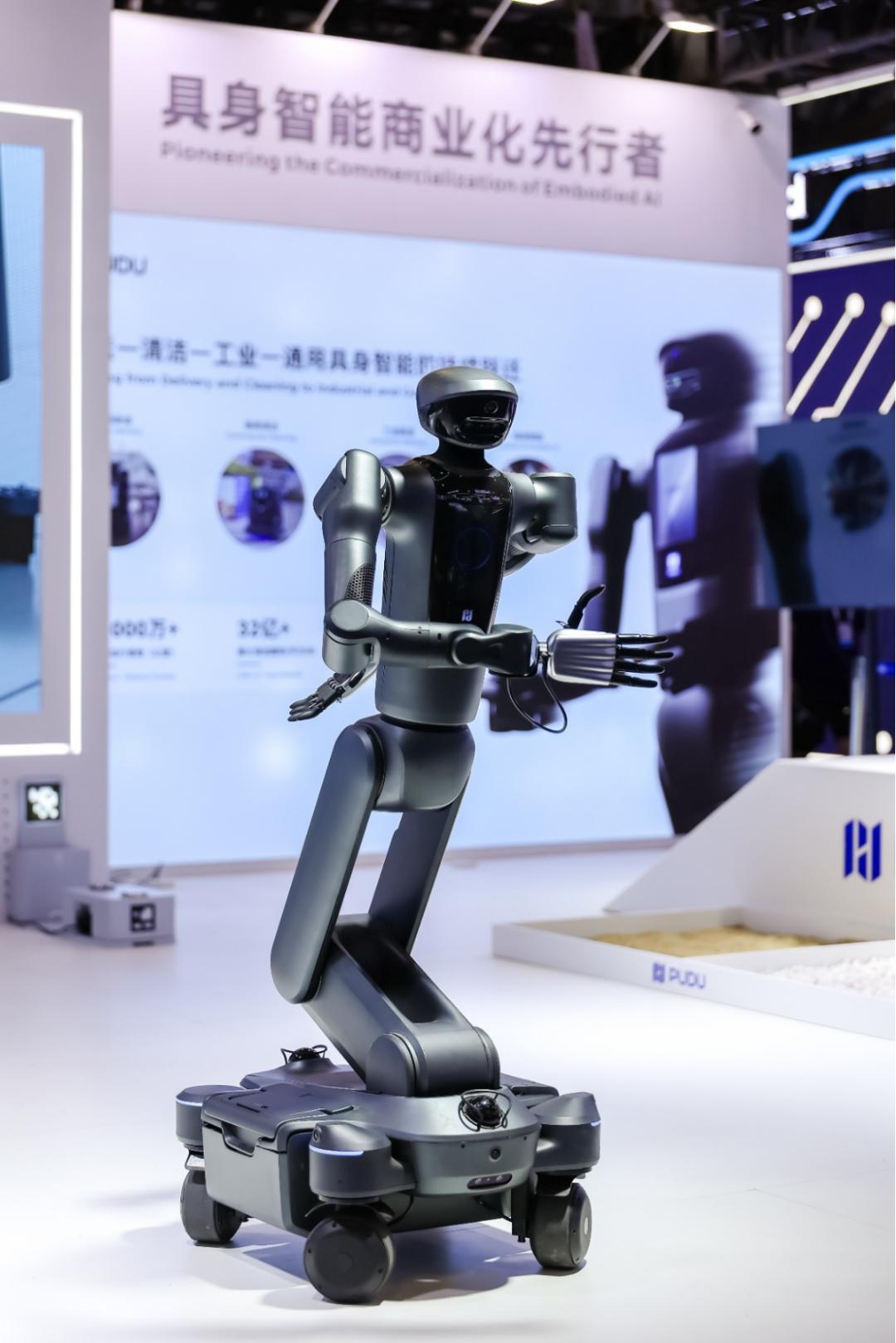
Among all exhibition zones, the embodied intelligence pavilion saw particularly intense rivalry. Reports indicated that 208 embodied intelligent terminals and over 300 physical units would make their debut appearances. Amid a multitude of robots of diverse shapes, a robot with a deep matte gray exterior stood steadily before the crowd. Constructed from large square geometric blocks, it featured soft, rounded curves at every joint transition and connection point, while its four-legged wheeled chassis design allowed it to glide smoothly and stably through the complex aisles of the exhibition booth.
This marks the first offline appearance of PUDU D7, Pudu Robotics' humanoid intelligent robot focused on scenarios including industrial and retail environments.
Over the past two years, the embodied intelligence industry has experienced explosive growth. The capital market has responded directly: data from IT Juzi's event database shows that total financing in China's domestic embodied intelligence sector reached 935 billion yuan in the first half of 2026, a 5-fold increase compared to the same period in 2025.
Massive amounts of capital, talent, and public attention have poured into the field, while debates over bubbles have persisted endlessly. Amid the commotion, some industry insiders regard 2026 as the first year of large-scale mass production for humanoid robots, as well as a critical milestone for commercial implementation and scenario validation. After two years of showcasing technical feats, what the market truly needs and is waiting for is embodied intelligence technology that can land in real scenarios to solve practical problems.
Whether enterprises are prepared or not, the turning point has already arrived. The winner will be the one who can rapidly deploy robots for actual use in factories, supermarkets, and hospitals first. This challenge no longer only tests laboratory R&D capabilities, but also involves strategy, technology, product development, commercialization, supply chain management, organizational structure, and many other aspects.
As a global leader in the commercial robotics field, Pudu Robotics started with food delivery services a decade ago. It now serves multiple industries including retail, hospitality, manufacturing, warehousing and logistics, catering, property cleaning, healthcare, entertainment and sports, education, and public transportation and services, with cumulative shipments reaching 130,000 units and a valuation of 10 billion yuan. In this showdown for embodied intelligence implementation, Pudu is meeting the challenge head-on with a systematic approach of in-house software and hardware development, and an efficient closed loop of data and commercial operations.
01
Multi-form, full-category product rollout and dominance in real-world scenarios
"Unlike consumer-facing products where a failed first launch can make recovery extremely difficult, business-facing operations are a multi-round game that requires endurance rather than explosive performance. It allows companies to use time to gain space through multi-category layouts," stated Tao Zhang, Founder and CEO of Pudu Robotics, during his speech at the BEYOND Expo in Macau this May.
Pudu has executed this strategy firmly and successfully: expanding from service delivery robots to commercial cleaning robots, industrial delivery robots, and then to general-purpose embodied intelligent robots, with four widely diversified product lines mutually supporting each other.
In its earliest service delivery product line, apart from maintaining its leading position in the global market, year-on-year cumulative revenue growth exceeded 100% from January to April 2026. Its products will also integrate large AI models and multi-modal interaction technologies to enable environmental data feedback and intelligent decision-making. Taking the star product "Bella Pro" for mid-to-high-end indoor delivery as an example, it has developed functions that combine AI with retail scenarios, enabling intelligent inspection and restocking, crowd feature recognition, and AI stain detection with call linkage.
Facing a trillion-yuan market, Pudu's commercial cleaning robots consistently rank as the industry leader in shipment volume. Its core Magic Cleaning AI Agent system can not only accurately identify special materials such as rubber prints and carpets, but also achieve customized recognition of special obstacles like cotton and plastic bags. Derived functions such as "garbage/stain detection heatmap", "instant cleaning", and "intelligent supplementary cleaning" have significantly reduced users' daily deployment and operation costs.
In terms of industrial delivery, Pudu's industrial delivery product sales achieved 100% year-on-year growth in the first quarter of 2026. Among them, the flagship intelligent handling AMR T300 series shipped over 4,000 units in its first year on the market, recording the industry's fastest growth rate. The lightweight intelligent handling robot T150 also exceeded 1,000 units in shipments just four months after launch. The products have entered more than ten niche industries including automotive manufacturing, electronics and semiconductors, consumer electronics, PCB manufacturing, and warehousing logistics. This May, Pudu also officially announced its entry into the unmanned forklift market.
Tao Zhang has a clear understanding of the industry, judging that the global industry as a whole is in a "transitional period where dedicated robots are achieving widespread commercial adoption while general-purpose embodied intelligence is undergoing scenario validation in laboratories". As a company that has already achieved profitability in dedicated robots and firmly secured its leading position, Pudu has both the confidence and strategic vision to take the lead in advancing toward general-purpose embodied intelligence.
Pudu's embodied intelligence product matrix is divided into three segments: the first is the quadruped robot line, which features stunts, all-terrain obstacle crossing, autonomous inspection, and following capabilities, suitable for tasks such as power inspection, mapping, guide assistance, and disinfection. The second is the humanoid robot line, equipped with self-developed joint modules and three-finger dexterous hands, focusing on complex dual-arm collaborative flexible operations in industrial production and commercial services. The third is the humanoid robot line, focusing on the in-depth upgrading of two core capabilities: "body structure" and "bionic cerebellum", accelerating their entry into the deep waters of human production and daily life.
At present, Pudu Robotics' products have been widely applied across 16 scenarios including retail, hospitality, manufacturing, warehousing and logistics, catering, property cleaning, healthcare, entertainment and sports, education, and public transportation and services, with shipment volume and revenue continuing to grow. Cumulative shipments have exceeded 130,000 units, and its business covers 85 countries and regions worldwide.
According to the "2025 Global Independent Market Research Report on Embodied Intelligence and Commercial Service Robots" updated by international consulting firm Frost & Sullivan on July 15, Pudu Robotics ranks first in the industry globally in revenue, shipment volume, and overseas expansion for commercial service robots, with respective proportions of 25%, 23%, and 44%. In the niche commercial cleaning segment, Pudu Robotics holds a 29% market share by revenue, ranking first. Overall, Pudu is one of the few enterprises in the industry that has achieved full-category mass production, global penetration, and a clear path to profitability.
A long-cycle multi-round competition tests how to use the depth of product lines to win long-term customer trust amid the long and brutal market reshuffling. Each category expansion relies on the technology stack, scenario understanding, and channel resources accumulated during the competition, enabling the extension of reusable capabilities to a wider range of robot forms and realizing the leap from single-point breakthroughs to platform-based layout.
Pudu's four product lines have formed a solid defensive line covering all categories, which not only mitigates the risk of volatility in a single market, but also builds a globally self-sustaining commercial closed loop.
02
The "One Brain, Multiple Forms" concept and the world's largest real data accumulation
Behind the global rollout of the full product line lies a set of robust technical mastery. "Technology and business are like two legs: you cannot go far without either," stated Tao Zhang.
In the embodied intelligence era that most severely tests technological and scenario understanding, Pudu has its own top-level planning and core formula:
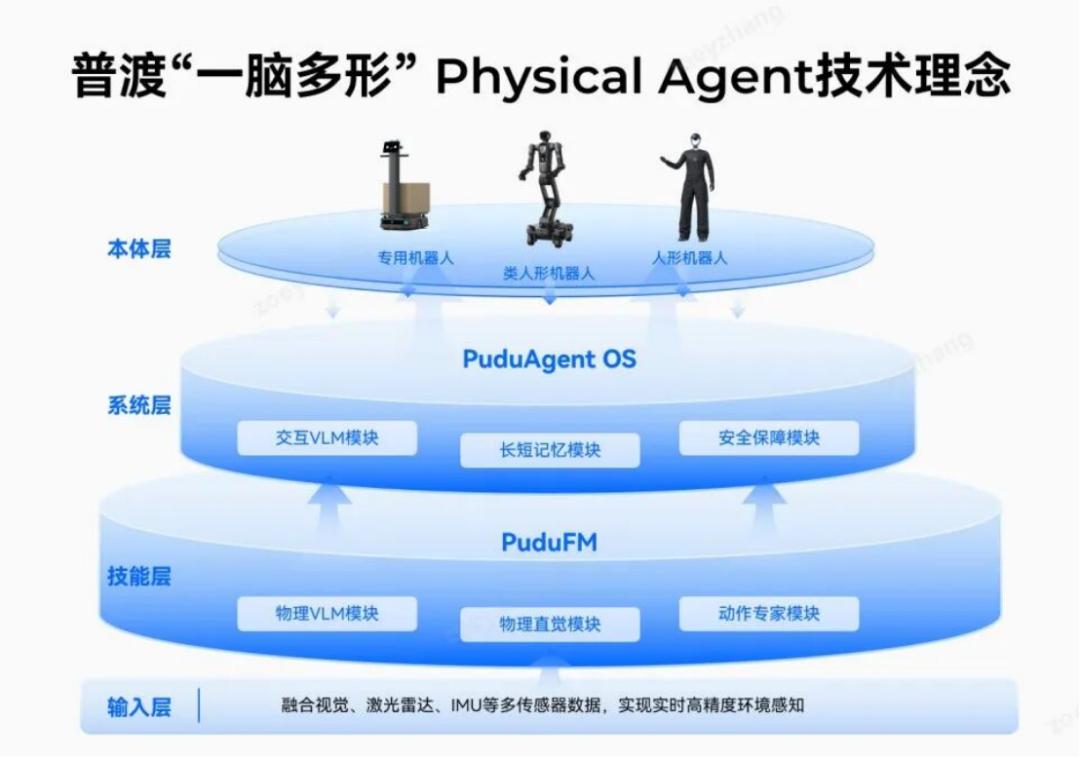
Physical Agent = Body + System + Skills
The embodied intelligence industry is evolving from "single execution tools" to "general-purpose physical agents". The "One Brain, Multiple Forms" architecture is analogous to the ecological closed loop of "smartphone + operating system + applications" in the mobile internet era. Pudu hopes to reconstruct this grand blueprint in the embodied intelligence industry: a unified intelligent brain can adapt to multiple configurations including dedicated, human-like, and full humanoid forms, significantly lowering R&D barriers and improving adaptation efficiency.
For a long time, the practical implementation of embodied intelligence has faced three major bottlenecks: first, architectural fragmentation causing "uncoordinated hands and feet", where navigation systems handle movement and operation systems handle manipulation, lacking a unified central control that leads to frequent breakdowns in complex tasks. Second, the absence of physical intuition: robots can see objects but lack common sense such as gravity and friction, making fine operations feel like groping for an elephant in the dark. Third, robots of different configurations train dedicated models separately, preventing model capabilities from being transferred across forms. A deeper crisis lies in the massive amounts of real data generated in various scenarios being isolated from each other, unable to synergize.
To address these issues, Pudu has developed the embodied intelligence foundational large model PuduFM, which builds three core technical dimensions: deep perception and reasoning of three-dimensional space, future-oriented physical state prediction, and a learning mechanism that continuously evolves through real-world interactions. Based on an understanding of the physical world, it supports the unified operation of heterogeneous machines, realizing the leap from "execution" to "cognition". In simple terms, PuduFM aims to help robots understand the physical world.
On the other hand, to achieve large-scale implementation, robots must provide a unified physical agent system that allows developers to flexibly assemble existing capabilities like combining standard modules to quickly build applications, rather than reinventing the wheel every time. Therefore, Pudu has constructed PuduAgent, a general-purpose embodied intelligence platform oriented to the physical world. If PuduFM is responsible for letting robots understand "how to get the job done", then PuduAgent acts more like the robot's "task brain". It can further understand user task objectives, independently break down complex workflows, dynamically call different capability modules such as navigation, operation, and perception, and coordinate multiple robots to complete long-distance complex tasks across regions and processes.
On top of this unified underlying model, robots of different forms are like separate avatars sharing the same "intelligent brain": greeting robots understand appropriate smiles and subtle gestures, delivery robots autonomously plan optimal paths to complete precise deliveries, and cleaning robots perceive ground materials and environmental dynamics in real time to adjust strategies.
This means that Pudu's technical accumulation in delivery scenarios can be efficiently transferred to new fields such as cleaning and industry. With only a small amount of targeted training, it can achieve rapid new product development and consistent user experience, fundamentally reshaping the R&D paradigm and implementation efficiency of service robots.
The "One Brain, Multiple Forms" architecture builds an exquisite skeleton, and data is the blood that gives the skeleton its muscle. The scale and quality of data determine the upper limit of embodied intelligence model capabilities, and the efficiency of data acquisition affects the model's iteration speed.
However, a widely acknowledged pain point in the industry is the scarcity of real scenario data. Simulation data has limitations, while real machine data comes at too high a cost. Tesla can obtain massive road test data through hundreds of thousands of cars on the road, but in the embodied intelligence field, no enterprise can deploy hundreds of thousands of robots in the real world out of thin air.
This, precisely, constitutes Pudu's irreplicable advantage. As an embodied intelligence company with one of the world's largest robot navigation data assets, Pudu relies on 130,000 commercial robots deployed globally to generate a cumulative total of 50 million hours of real machine data each year, including 36.5 million hours of authentic, effective, and diverse navigation data.
In the fine-grained "operation data" dimension, the teleoperation data commonly used in the industry is expensive and inefficient. Handheld collection methods easily cause distortion of human movements due to configuration differences. To solve this problem, Pudu has proposed a non-intrusive collection solution.
Pudu collaborates with global channel partners and customers to deploy non-intrusive collection devices, allowing operators to complete data collection during daily work without changing their usual work habits. A single operator can generate up to 1,580 hours of data per year. By quickly aggregating 1,000 partners through ecological collaboration, a flood of 15.8 million hours of operation data can be formed annually.
This "scenario as collection, work as data" model not only reduces data collection costs by an order of magnitude, but also ensures the physical authenticity of the data and the naturalness of movements. Relying on a large amount of non-intrusive collected data, PuduFM can rapidly learn a vast amount of prior knowledge and operational concepts. On this basis, reinforcement learning fine-tuning using correction data and fault data can support large-scale online distributed strategy updates and continuous evolution for robots.
The "One Brain, Multiple Forms" technical architecture, combined with the real-world data flywheel built by over 130,000 deployed real machines worldwide, means that Pudu's scenario understanding and data accumulated across different industries can be transferred to "general-purpose embodied robots", realizing cross-product-line technical reuse for dedicated, human-like, and full humanoid robots.
03
The new humanoid leap enabled by PUDU D7
In the implementation spectrum of embodied intelligence, if delivery scenarios test robots' autonomous movement and path planning capabilities in three-dimensional space, then more complex real-world operation scenarios further test robots' understanding and manipulation capabilities of the physical world—requiring them not only to "arrive", but also to "grasp accurately, place stably, and perform well". This means robots need to achieve a capability leap from "legs" to "hand-brain coordination".
Currently, embodied intelligent robots are accelerating their entry into real operation scenarios such as industrial manufacturing, warehousing and logistics, and retail supermarkets, but the industry is still exploring different technical approaches.
Traditional industrial robotic arm manufacturers try to enhance flexible operation capabilities by introducing large models, but they are limited by fixed working spaces and lack autonomous movement and environment perception capabilities. Humanoid robot startups hope to cover more scenarios with a general form, but the stability, maintenance costs, and supply chain maturity of bipedal structures during long-term, high-frequency operations still require further verification.
The PUDU D7 unveiled at this year's WAIC offers an alternative approach to embodied intelligence implementation.
As a new generation of humanoid intelligent operation partners created by Pudu for real operation scenarios, PUDU D7 adopts the technical route of "omnidirectional mobile chassis + flexible dual arms", combining the fine manipulation capabilities of dual arms with the stability and high efficiency of a mobile platform. It balances dexterous operation with higher operational reliability and scenario adaptability.
At present, the D7 can support a maximum load of 14kg and a working height of 2 meters, capable of completing complex tasks such as material handling, shelf picking and placing, and in-site transportation. It can not only meet the high-frequency operation needs in industrial manufacturing scenarios, but also gradually expand to more real commercial environments that require mobile manipulation capabilities, such as warehousing, logistics, and retail supermarkets.
For high-precision tasks such as dispensing and precision assembly, the D7 is equipped with high-precision tactile sensors that can perceive contact force and pressure feedback in real time, achieving millimeter-level force control adjustment. The system can dynamically adjust the force application method according to different materials and working conditions, maintaining stable performance in scenarios such as fine grasping, gentle pressing, and precise force application, avoiding workpiece damage caused by improper force application. At the same time, the device has stable thrust output capabilities, and can independently complete operation tasks such as cart pushing and cargo transportation, further improving the operational efficiency of warehousing logistics and production sites.
More importantly, the D7 is not just a product, but also an important practice of Pudu's "One Brain, Multiple Forms" technical system in real operation scenarios. While executing tasks such as handling, grasping, picking, and placing, the robot continuously collects multi-dimensional data including environment perception, motion execution, and human-robot interaction, forming a data closed loop covering the entire task workflow. The PuduFM embodied intelligence large model continuously learns spatial relationships, operation logic, and task workflows based on this real-world data, continuously optimizing the robot's decision-making and execution capabilities in different scenarios.
This means that relying on PuduFM and the unified intelligent foundation, the D7 can continuously understand tasks, accumulate experience, and optimize motion strategies in real environments. It integrates the complete motion chain of movement, approach, grasping, handling, and placement into a single intelligent system, enabling continuous reuse of capabilities across tasks and scenarios.
For Pudu, industrial manufacturing is only an important starting point