Can't hold on! These benchmark projects are being "forced" into community malls
In the past, public attention has mostly focused on high-end department stores and city-level shopping malls that serve an entire urban area. In reality, however, the seemingly unassuming neighborhood businesses represent the "silent majority" in the shopping mall industry.
According to Winshang Big Data statistics, after excluding high-end malls and outlet centers, high-tier shopping malls account for 56.3% of the national market share, and nearly 80% of these projects belong to the neighborhood-level category.
In actual operations, constrained by their limited scale and small service radius, neighborhood shopping malls generally do not see impressive foot traffic. Their tenant mix is dominated by dining and lifestyle services catering to nearby residents, with a low proportion of retail, which restricts the absolute growth of sales per square meter. Nevertheless, neighborhood businesses stand out as an asset class with the highest customer loyalty, most stable foot traffic, and steadiest operating performance.
At present, the valuation logic of neighborhood business REITs takes a leading position among consumer infrastructure assets, with capitalization rates remaining within a reasonable and relatively low range. This reflects the market's high recognition of the asset quality and risk-resistance capabilities of neighborhood commercial properties.
So how should we properly identify neighborhood businesses? How should we define them? And what trends will shape their future development?
01.
Identifying Neighborhood Businesses:
The "Backbone" of the Shopping Mall Industry
What defines a neighborhood-level shopping mall? To answer this question, we must first properly distinguish shopping malls of different tiers, using the malls in Guangzhou as an example:
City-Level Projects
City-level shopping malls have a service scope that can cover or even extend beyond their host city, and must meet the following criteria:
First, the project is located in the absolute city center, with strong reach to customers from distant areas, and a potential extended service radius of over 10 kilometers.
Second, they have an ultra-large scale capable of serving the entire city, with most commercial properties exceeding 150,000 square meters to accommodate a vast number of brand stores.
Third, thanks to their scale and reach, their foot traffic ranks among the highest in the city.
Fourth, they belong to the first tier of projects that introduce city-first stores, especially with strong appeal from retail first-outlets.
Currently, among the city-level shopping malls in Guangzhou, besides Taikoo Hui, the non-luxury malls that meet these standards are only Grandview Mall, Tianhe Sports Center, and Teemall.
Regional-Level Projects
Regional-level shopping malls serve surrounding districts, with a core service radius of at least 3-5 kilometers and a potential extended range of 5-10 kilometers, which varies according to the size of the administrative district. If located at the boundary of an administrative district, their service scope usually spans multiple districts.
Different from city-level projects, the key criterion for defining regional-level projects is their core service range, not the potential extended reach. They can be roughly divided into two categories:
The first category consists of top regional destinations, with generally only 1-2 such projects in each administrative district. These projects show city-level potential in terms of foot traffic, scale, reach, and brand quality, but are classified as regional-level due to their non-central locations. For example, Guangzhou Panyu Teemall covers the entire southern part of Guangzhou, but is defined as a regional-level project because it is not located in the city center.
The second category includes regional benchmark projects, which represent the majority of regional-level properties, with a core service radius of around 5 kilometers that focuses on serving a specific area. A typical example is Guangzhou Poly Longhui Taikoo Li, located at the border of Liwan and Haizhu districts, which attracts surrounding visitors with its unique waterfront open-air commercial block format.
Neighborhood-Level Projects
After excluding city-level and regional-level shopping malls, all remaining malls in a city are classified as neighborhood-level, accounting for nearly 80% of the total with an extremely large quantity.
These projects are relatively small in scale, with their core service range concentrated within 1-3 kilometers of the surrounding area, and potential extended coverage no more than 5 kilometers. Their main purpose is to serve nearby residents and office workers.
A typical product line is Vanke's "Vanke Li" series, a neighborhood-focused commercial brand positioned as a "community neighborhood center" that aims to bridge the "last mile" of community life and bring convenience to local residents. Guangzhou Jisheng Vanke Li and Jiangyan Road Vanke Li both meet these criteria, with a scale of less than 50,000 square meters and a highly concentrated service range within 3 kilometers.
02.
Defining Neighborhood Businesses:
More Than Just "Supermarkets + Residential Podiums"
At the current stage, most people have a misunderstanding about neighborhood businesses, often equating them to low-tier commercial projects with small scale, low sales efficiency, and weak operational capabilities. Under this inertial thinking, shopping malls compete to label themselves as "regional benchmarks" and "city flagship projects", using brand quality as the sole measure of success while ignoring the real needs of their core customer groups.
In fact, neighborhood business is a broad concept, and it is by no means equal to "supermarkets plus residential ground-floor shops".
The *Community Building and Community Planning Work Manual* points out that most definitions of "community" involve three core elements: geographic space, shared connections, and social interaction. The book *Community Building: Theory, Process and Cases* defines community building as "a model led by the government, driven by public initiative, and supported by social organizations, which enables residents to achieve self-organization, self-governance, and self-development to jointly solve public issues facing the community".
Under this framework, any commercial entity that participates in community building can be defined as neighborhood business. It is not merely a type of commercial product, but also a kind of operational philosophy.
For example, the well-known Aranya model, famous for its cultural tourism commercial operations, essentially adopts a community-building operation model. Aranya is one of China's most successful non-standard real estate projects, with its core business model centered on property sales. For many property owners, purchasing a home in Aranya is not just about the property itself, but more importantly, about becoming part of the community.
This "community" has long transcended the concept of physical residence, and is embodied in three core dimensions:
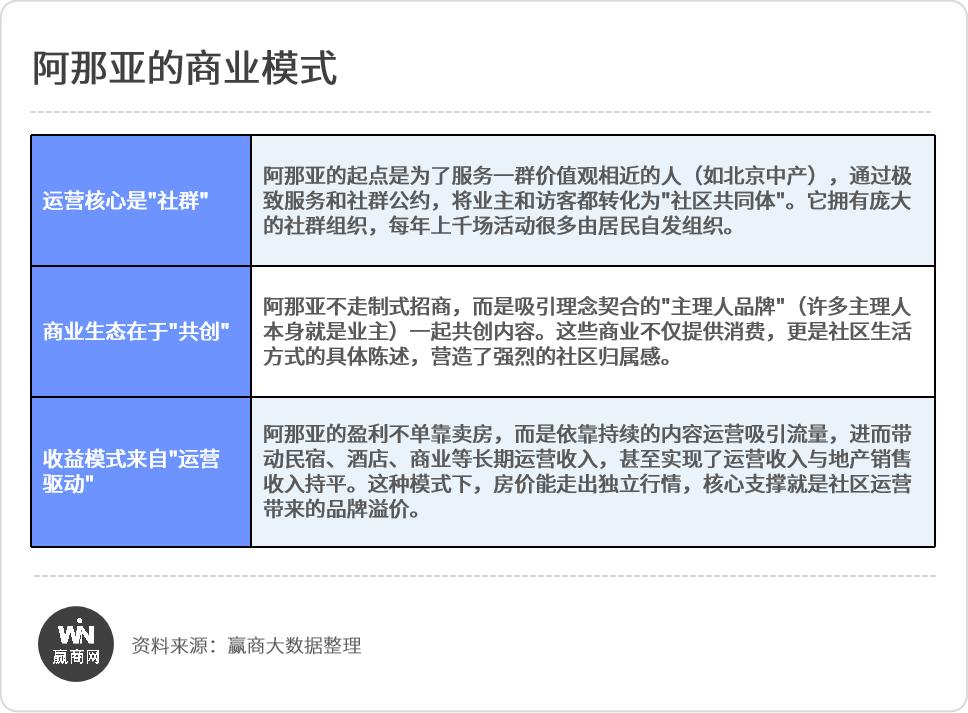
For Aranya, cultural tourism commerce serves as its outer shell and entry point, while the community co-creation model is the core driver for its sustainable operation and ability to withstand market cycles. To date, Aranya has been labeled with various reputations: a social media-famous destination, a cultural utopia, and the spiritual backyard of the middle class. Beyond its residents, it also attracts a large number of art-loving young visitors.
The Aranya case demonstrates that when neighborhood businesses are developed to their full potential, they can also become benchmarks at the regional level and even across the entire city.
Based on this, we have formed a new definition for neighborhood business:
The narrow definition of neighborhood business, referencing the characteristics of neighborhood-level shopping malls, refers to commercial entities whose primary purpose is to serve nearby residents and office workers, with a core service radius concentrated within 1-3 kilometers.
The broad definition of neighborhood business refers to all commercial entities that deeply engage in community building and form a co-creation relationship with local residents — its core does not lie in the size of the service radius, but in whether residents participate in joint creation, whether the business gives back to the community, and whether a self-sustaining and sustainable ecosystem has been formed.
03.
Future Trends:
The "Neighborhood-Oriented Transformation" of Shopping Malls
After in-depth industry research and interviews with industry practitioners, many insiders have put forward a consistent view: The "neighborhood-oriented transformation" of shopping malls is becoming a major industry trend, with an increasing number of regional-level projects moving closer to the neighborhood business model.
Looking at the changes in penetration rates of high-tier shopping malls over the past five years, this neighborhood-oriented trend is evident: 1. The overall penetration rate has increased, indicating that total foot traffic is growing and more consumers are visiting shopping malls; 2. The penetration rate among customers within 3 kilometers has risen significantly, showing that consumers increasingly prefer nearby consumption.
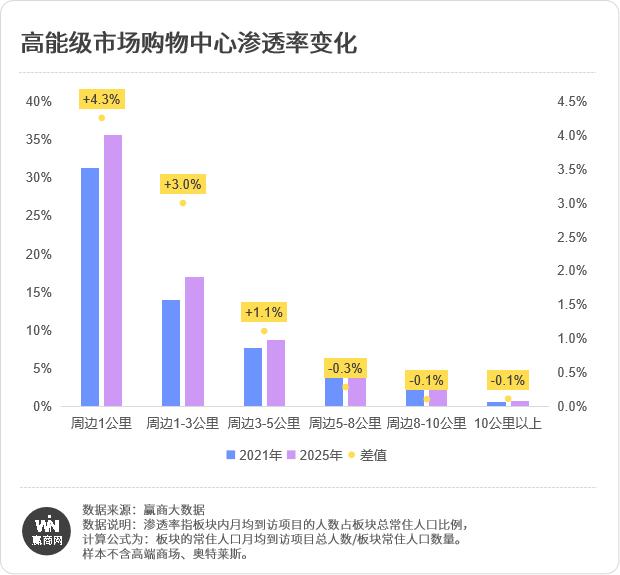
On one hand, the transformation comes from "passive" neighborhood orientation driven by intensified competition. In recent years, with a continuous influx of new shopping malls entering the market, competition has become increasingly fierce, and the segmentation of customer flow within regions has become more pronounced, leading more and more regional-level shopping malls to show a neighborhood-oriented tendency.
For example, Guangzhou CapitaLand Le Feng Square, opened in 2013, has a scale of over 80,000 square meters, located directly above Shayuan Station of Metro Line 8 and Guangfo Line. It has an average daily foot traffic of more than 70,000 people, consistently ranks among the top 10 shopping malls in Guangzhou in terms of visitor volume, and is a landmark mall in Haizhu District.
As commercial competition in Haizhu District intensified in subsequent years, Le Feng Square gradually lost customers from distant areas, and its core service radius kept shrinking. The proportion of customers within 5 kilometers of the project has shown a noticeable increase in the past five years.
On the other hand, more and more projects are actively identifying the consumption needs of their core surrounding customer groups, and through "proactive" operational adjustments, they create brand mixes that cater to local preferences, thereby enhancing consumption loyalty and visitor volume.
Guangzhou Poly Time Mall is a benchmark case of community-focused commercial operation in Guangzhou. The project opened in 2011, located in Guangzhou's original mature business district — Huanshi East Road. As one of the city's most densely populated residential areas, this area not only gathers a large number of high-quality family consumers, but also covers high-quality office workers from surrounding schools, TV stations, and government institutions, with a strong consumption foundation. Guangzhou's first high-end mall, La Perle, is also located in this area.
According to research, Guangzhou Poly Time Mall underwent a comprehensive renovation during the pandemic, and has grown into today's "community building benchmark":
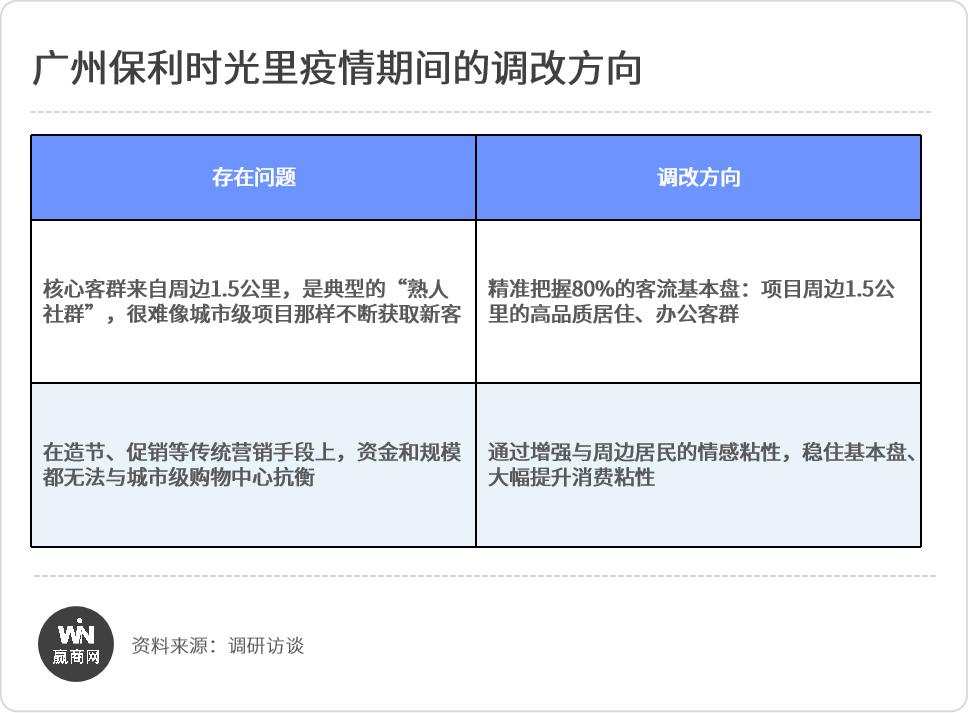
The specific implementation was carried out in two stages:
■ Identify the project's advantageous business types, understand the real consumption needs of core customers, and continuously introduce brands that meet these demands:
With a dense and high-quality residential population, the project added high-frequency daily consumption options such as premium fitness services: it introduced Super Monkey and a women-only gym, and opened the first store of a well-known massage brand in Yuexiu District, forming a complementary tenant mix with the fitness facilities.
With a large number of high-net-worth customers and strong off-peak consumption demand, the project's afternoon tea category achieved outstanding performance, and it added boutique brands of matcha, coffee, and traditional dessert shops.
With a dense office worker population and strong business reception needs, the project introduced high-quality Chinese catering brands.
■ Local consumers in this area face no significant financial pressure and have a strong sense of belonging to their community, so the project vigorously developed community building initiatives:
Participatory design: Before the renovation, the project organized open-day surveys and community walking tours to invite residents to participate in spatial planning.
Creator co-creation: The project connected with community influencers, providing them with a low-cost platform to realize their ideas, and supported their growth instead of adopting a traditional merchant recruitment model.
Cultivating public awareness: Focusing on topics such as pet-friendly policies and neighborhood mutual assistance, the project guided residents to shift from passive participation to active proposal of ideas.
Content self-generation and sustainability: Activities are spontaneously initiated by residents, exploring sustainable operation models such as space leasing and brand cooperation.
Breaking consumption boundaries: The project transformed corner spaces of the mall into "community living rooms", where people can stay and socialize without making purchases.
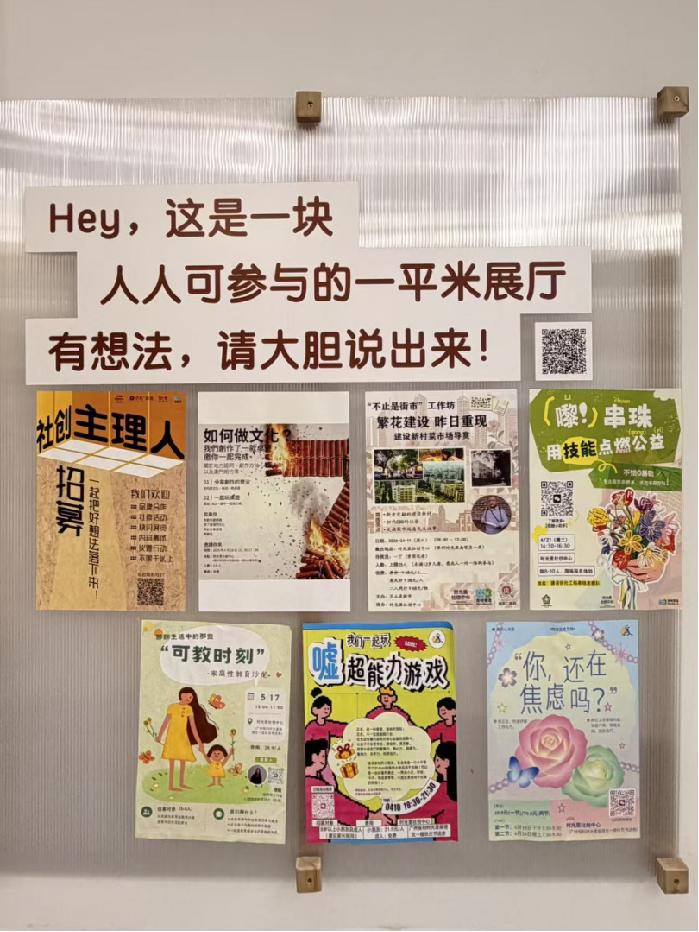
Community co-creation practices at Guangzhou Poly Time Mall
In essence, this renovation represents a transformation from a traditional shopping mall to an "urban public living room", which consolidates operational resilience by building emotional connections within the community. It is reported that after the adjustment, consumer loyalty at the project has been greatly improved, with rental income increasing by about 30%.
From passive classification to active community building, neighborhood business is undergoing a process of value re-evaluation. It is no longer seen as a second-tier commercial product that "fails to meet higher standards", but as an asset type that is closest to consumers, has the highest consumption loyalty, and demonstrates the most outstanding ability to withstand market cycles.
When shopping malls no longer blindly pursue scale and sales per square meter, but return to the daily needs of surrounding residents and grow in tandem with the community, they will gain the confidence to sustain development through market cycles.
This article is from the WeChat public account "Winshang", author: Yu Qing, and is republished with authorization from 36Kr.