From cross-border e-commerce to AI large models: Two global ventures of a post-90s woman who spent 10 years in Europe
In the 1950s, "Made in Japan" was synonymous with low prices and third-rate products across the world. By the 1970s, Japanese home appliances rose to global prominence, with 30% of color televisions in the U.S. market at their peak being Japanese products. In the 1980s, Japanese automotive brands including Toyota, Honda, and Nissan took over the baton from home appliances to expand globally. Later on, Japan's cultural and entertainment industries such as anime, video games, and music began to expand overseas and became pillar industries of the national economy.
From low-cost apparel to anime and manga, Japan's core export products have gone through several rounds of transformation over the past 70 years, which indirectly illustrates that a country's mainstream overseas export products are never fixed, but evolve alongside the nation's industrial capabilities.
This very same evolutionary narrative is now unfolding for today's Chinese entrepreneurs going global. In 2015, Li Luwei traveled from Ningbo, China to France to pursue higher education. At that time, major Chinese tech firms had just begun testing cross-border e-commerce operations, and Chinese products started entering European and American markets through online channels like Amazon, AliExpress, and eBay, while cross-border logistics networks such as ocean shipping were taking shape. Li Luwei, still a graduate student at the time, seized the opportunity and independently launched a B2B2C e-commerce platform called Import Market Sales (IMS) in 2017, which connected China's industrial clusters with local European e-commerce platforms and end consumers. The platform focused on the niche category of outdoor furniture, while also building a direct-to-consumer brand called Avril Paris. Over 9 years, without any external funding, the business achieved cumulative sales of 35 million euros, established partnerships with over 20 international and local e-commerce platforms in France and the UK, and served more than 80,000 direct customers.
During a business trip to Morocco in 2025, Li Luwei noticed that many local residents were discussing Chinese AI models such as DeepSeek. She realized the world had fundamentally changed, and new opportunities for overseas expansion were emerging in different sectors.
A year later, Li Luwei left Paris for London to join ByteDance, where she leads global partnership and ecosystem development for large AI models. Recently, she shared with us her entrepreneurial journey over the past decade and her insights into the European market. Below is her firsthand account.
1. Building 35 Million Euros in Cumulative Revenue Over 9 Years With a 7-Person Team
When I first started my business in France 10 years ago, I was still an international student. I noticed that French people love living in houses with gardens, and they dedicate a significant amount of time and effort to maintaining their gardens. This made me realize there was a large, underserved market here. Coincidentally, my hometown Ningbo is home to a major outdoor furniture industrial cluster, so I chose the outdoor furniture category as my entry point.
Back then, cross-border e-commerce was a novel yet unfamiliar concept. To reach overseas markets, businesses primarily relied on trade shows to secure orders through distributors or large overseas clients. Chinese products were separated from end consumers in foreign markets by layers of importers, wholesalers, and retailers, creating a large market gap. Although I had no shortage of supply chain resources, I lacked the capital to hold large inventories. So I developed an original e-commerce platform architecture based on the B2B2C model, which connected factories, local platforms, and end consumers. My startup provided brand authorization and marketing support, suppliers handled product fulfillment, and the platform earned commission fees on transactions. This model had no existing precedent at the time. As a result, I was selected to join France's renowned startup incubator Station F in 2017, and in 2020, I received official recognition as an "Innovative Enterprise" from the French Ministry of Economy's French Tech initiative.
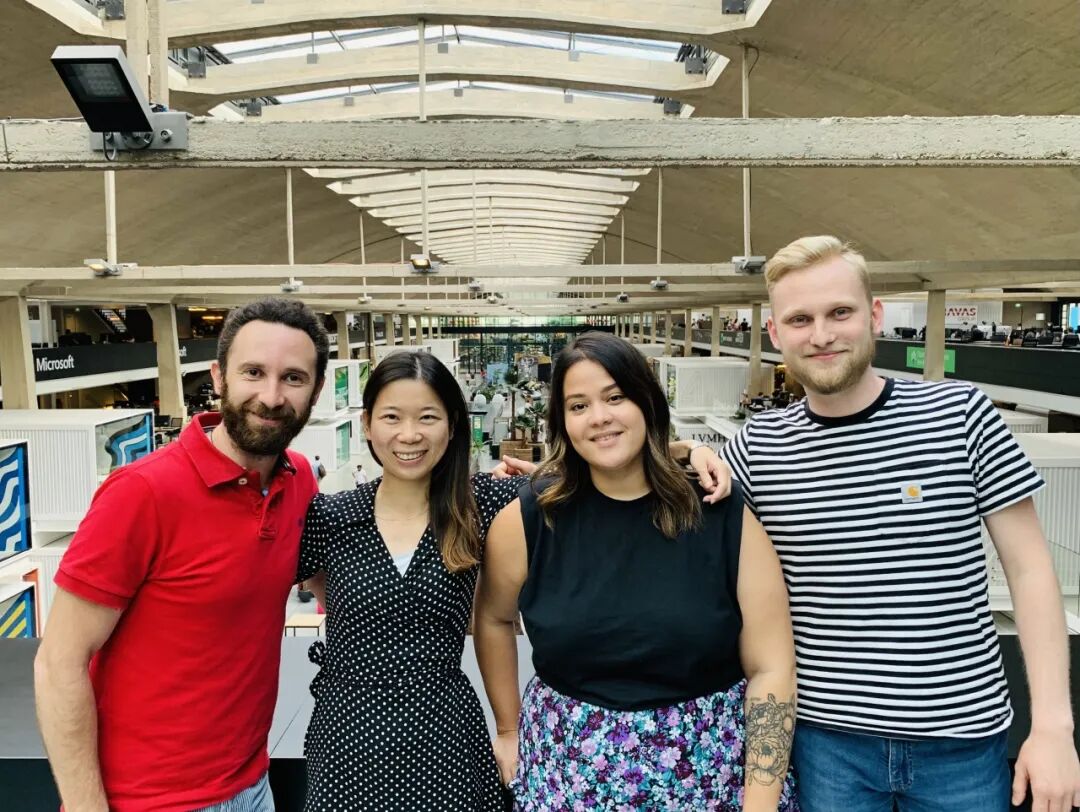
Li Luwei with colleagues at the Station F incubator
A photo of Li Luwei during her time at the Station F incubator in France
Running a cross-border e-commerce startup in Europe involves multiple interconnected segments: supply chain, logistics, warehousing, marketing, finance, and legal compliance. I approached and negotiated partnerships with each French company in every segment one by one. During this process, marketing was the segment that demanded the highest level of local adaptation. At an e-commerce trade show, after a conversation with the CEO of a marketing firm, I found that his experience perfectly complemented mine, so I offered him a partnership opportunity.
France is an extremely challenging market to enter. You must speak French fluently, and you need to understand local laws, tax regulations, and cultural norms, which requires deep immersion in local life and work. Over all these years, I learned through trial and error, gradually paving a viable path for the business.
For foreign entrepreneurs, managing an international team is another skill that requires accumulated experience. All my team members were hired locally, and many of us have worked together for years. I intentionally kept the team small to preserve the agility characteristic of early-stage startups. At the same time, we invested heavily in in-house software development (over 300,000 euros in total), and I set new process automation goals every year to support scalable growth. At its peak, the team only had 7 employees, yet we generated 35 million euros in cumulative sales over 9 years, with a per capita output of 5 million euros per person — an exceptionally high productivity ratio in the pre-AI era.
2. Transitioning From E-Commerce to AI
Between 2020 and 2022, driven by rising consumer demand for home goods and the explosive growth of online shopping, our business reached its peak, with annual sales exceeding 7 million euros at its highest point and an average annual growth rate of 82%.
However, starting in 2023, France was impacted by global geopolitical tensions and experienced its worst inflation in nearly 40 years, which eroded French household purchasing power. French consumers began cutting non-essential spending, comparing prices more carefully, and prioritizing lower-cost products. It was around that time that platforms like Temu and Shein started gaining popularity in France.
Last year, several cross-border e-commerce brands that had been focused on the U.S. market shifted their core operations to Europe after being hit by tariff conflicts. This led to increased supply, more severe product homogenization, and far fiercer market competition. Facing mounting pressures from both internal and external factors, I decided to bring my entrepreneurial journey in e-commerce to a close.
After deciding to end my e-commerce business, I began reflecting on a question: Why was I able to succeed in cross-border e-commerce in those early years?
Part of the success certainly came from my own judgment and execution capabilities, but looking back, without the boom in online shopping driven by Europe's widespread work-from-home policies between 2019 and 2022, without the collective embrace of cross-border e-commerce platforms by China's manufacturing sector, and without the maturation of online payment and logistics systems, no matter how much effort I put in, the business would likely have remained a small-scale operation.
This is why it is so critical to identify trends in industrial transformation and catch the next wave of productivity growth.
Where will the next wave come from?
In the spring of 2025, I took a flight to Morocco, originally planning to discuss new cross-border e-commerce opportunities with leading local enterprises. But after speaking with business leaders in the local logistics, e-commerce, and fintech sectors, everyone was enthusiastically telling me: "Your DeepSeek model is truly remarkable." This made me realize the world had changed, and China's competitive industrial strengths had shifted dramatically. I began focusing on researching leading AI companies in China and Europe, as well as the real-world deployment of AI across European markets.
In Europe, AI presents enormous untapped potential, and just like cross-border e-commerce in its early days, it is on the verge of explosive growth. In the autumn of 2025, I attended Adopt AI, one of France's largest AI exhibitions, and found that 95% of company CEOs wanted to use AI to improve organizational efficiency, but less than 5% understood how to implement AI solutions in practice.
Different from starting my own business directly, this time I chose to join a leading large AI model company. That's how I came to London to join ByteDance, where I work on global partnership and ecosystem development for large AI models.
In the European large AI model market, OpenAI, Anthropic, and Google have the most robust foundational model capabilities, making them unavoidable competitors. There are also local European large model companies, such as France's Mistral, which typically secure most government procurement orders. However, these companies are more locally focused, concentrating on single-model development, and they do not directly compete with Chinese enterprises — they are more suitable to be our collaboration partners.
Unlike the past when Chinese products entered overseas markets relying on cost-effectiveness, in the AI sector, as long as a company has strong technical competitiveness, ensures data security, and meets local compliance requirements, some of its products can even be priced higher than those of international competitors.
However, compared to the United States, Europe is not a truly unified large market. It is a collection of many smaller national markets, with higher compliance costs, and each country has distinct corporate procurement logic and business practices. Therefore, for companies developing AI models or AI products, localized adaptation is required in every individual market.
These challenges share many striking similarities with the obstacles I faced during my previous entrepreneurial journey. As a result, this career transition, which on the surface seems to span two completely different industries, is essentially a natural evolution built on the foundation of my 10 years of accumulated experience. The same set of methodologies for succeeding in European overseas expansion and deep market understanding remains essential. I am very much looking forward to collaborating with local partner enterprises in this more international market and higher-growth sector, to empower local businesses in Europe and America with the productivity benefits that AI can deliver.