Apple is not afraid of selling fewer units; what it fears is selling them at a low price.
Lei Jun's words "The earlier you change your phone, the better" are echoing and resounding again.
On May 21st, Lei Jun of Xiaomi said in an interview that the price of memory has increased several times in the past year, and "the entire price increase situation is extremely crazy." Lei Jun believes that the price of memory will continue to rise in the next two years, and the prices of new phones will follow the market trend and increase. He also predicted: "If you hope to change your phone in the next year, the earlier you do it, the better."
More than a month later, Apple suddenly raised its prices.
On June 25th, Apple's US online store was briefly closed. In the past, this move often meant that new products were about to be launched. But after the store reopened this time, there were no faster chips, no new screens, and the only change was the price.
The price of the same MacBook Pro increased from $1,699 to $1,999, the MacBook Air rose from $1,099 to $1,299, and the entry - level MacBook Neo, which was launched in March, also increased from $599 to $699. The prices of the iPad, HomePod, Apple TV, and Vision Pro were adjusted synchronously, while the prices of the iPhone, Apple Watch, and AirPods remained the same for now.
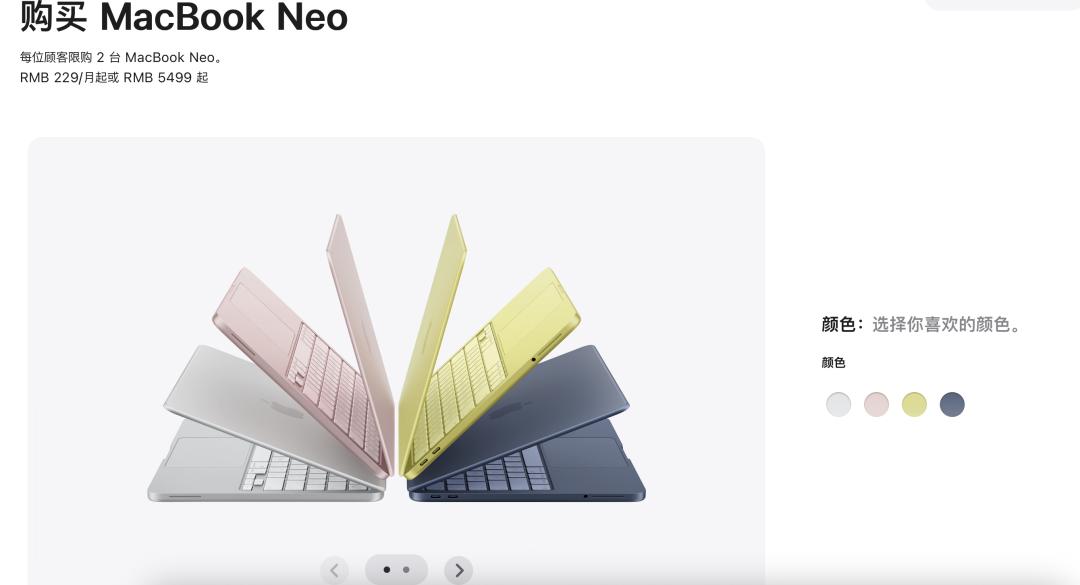
Screenshot of Apple's official website
Different from Apple's more common price adjustments due to product upgrades, this time it was not a repricing accompanied by a product upgrade, but a direct price change for the same - generation products.
This move was not without warning. On June 17th local time, Apple CEO Tim Cook said in an interview with the Wall Street Journal that the increase in memory and storage costs has made price increases "inevitable." At the same time, he compared the current shortage to a "once - in - a - century flood" and said that he had never seen a similar situation in his more than 40 - year career.
One day before the price adjustment, on June 24th, memory manufacturer Micron told the other side of the story.
Micron's Chief Commercial Officer, Sumit Sadana, told the Wall Street Journal that during the industry trough in 2023, a small number of customers continuously demanded more aggressive procurement prices, and at the same time emphasized that the poor prices and profits had led to the suspension of a number of industry investments.

Sumit Sadana, Source: DIGITIMES
In Sadana's statement, he did not directly mention Apple's name, nor did he attribute the shortage to any single customer. Both sides did not publicly name names and chose to explain the cost pressure from their own positions.
Xiaomi's influence in the supply chain cannot be compared with Apple's. Apple has always had a strong desire and ability to control core technologies and business efficiency. This restrained confrontation at a distance raises a more important question than "how much more expensive a Mac has become": Why couldn't a company known for controlling its supply chain ultimately control the memory price?
Maintaining the price means earning less on each product sold; increasing the price means potentially selling fewer products. Apple seems more willing to take the risk of lower sales this time rather than let the hardware gross margin, high - end brand, and price system loosen simultaneously. This choice reflects more of a rational financial logic: it's better to sell fewer products than to sell them cheaply.
Apple was once best at preventing costs from turning into prices
Apple is not the first company to raise prices due to the impact of memory chips.
Previously, on April 3rd, Xiaomi announced that due to the continuous and significant increase in the prices of key components such as global memory chips, after careful evaluation, the company would adjust the recommended retail prices of some of its on - sale products starting from April 11th, 2026. Xiaomi President Lu Weibing once said on Weibo that the intensity of this round of memory price increases has far exceeded expectations, and the price of the same memory version has soared nearly four times compared to the first quarter of last year.
What makes Apple's price increase special is that for the past 20 years, it has been good at supply chain management.
Fortune magazine still referred to Cook as a supply chain master when reporting on this event and pointed out that because it was Apple, a company with a huge procurement scale and high reputation in the supply chain, that raised prices, this move was regarded by the market as a signal that the shortage had reached the end - consumer level.
This reputation is not just a later addition.
In 1998, Cook joined Apple, which was still in the recovery stage, as the Senior Vice President of Global Operations. Apple's official resume shows that before becoming CEO in 2011, he served as the Chief Operating Officer, responsible for global sales and operations, including end - to - end management of the supply chain, services, and support.
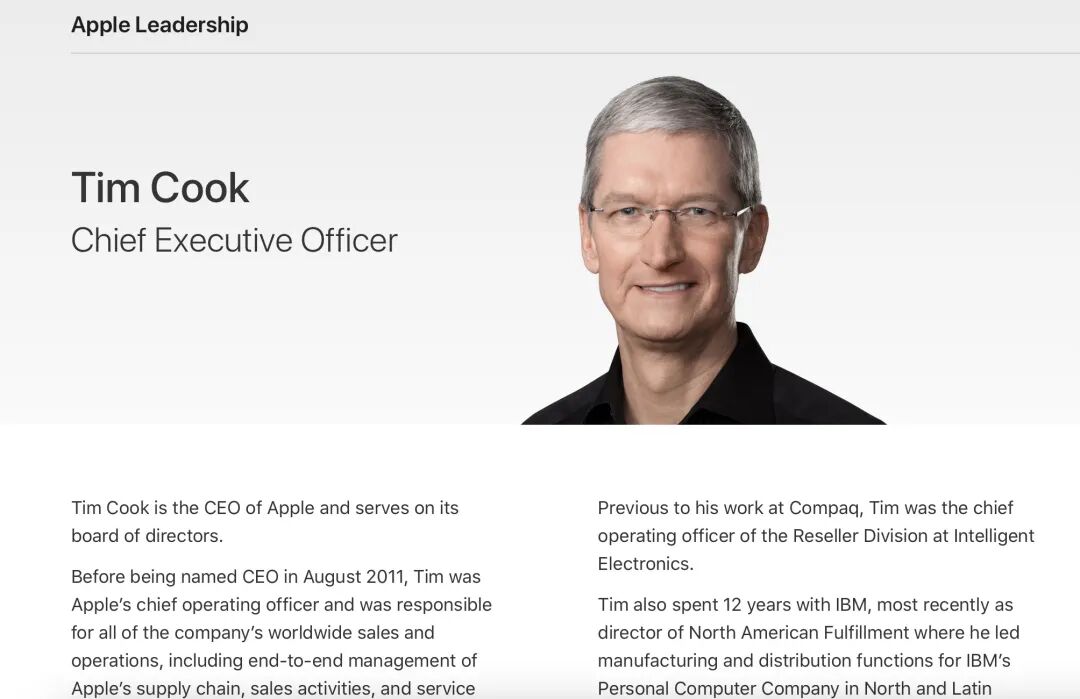
Screenshot of Cook's introduction on Apple's official website
In the same fiscal year that Cook joined, Apple disclosed in its 10 - K that its inventory decreased from $437 million in the previous fiscal year to $78 million, and the inventory days were reduced from 31 days to 6 days; during the same period, Apple also consolidated about 15 independent products into three main product families and expanded outsourced assembly. By fiscal year 1999, the inventory further decreased to $20 million, about two days, and the company also outsourced the final assembly of some products to third - parties. The same annual report also admitted that outsourcing would reduce direct control over production and distribution.
Later, Fortune's review of Cook's early operational reforms also summarized it as: The inventory retention time was shortened from "several months" to "several days."
Of course, not all of these changes can be attributed to Cook, who had just taken office. It is certain that this period formed the prototype of the later "Apple - style supply chain": Reduce self - held inventory, transfer more production flexibility to the external manufacturing system, and then use order volume, cash, and forecasting ability to gain cost and delivery advantages.
In an article titled "Unveiling the Supply Chain Control Techniques of Apple, the Control Freak" published by HeFan Finance, these management methods were elaborated in detail.
Apple's control also lies in its willingness to use cash to buy certainty.
On November 21st, 2005, after the cumulative sales of the iPod exceeded 30 million units, Apple announced in Cupertino, California, that it had signed long - term supply agreements for NAND flash memory with Hynix, Intel, Micron, Samsung, and Toshiba, which would last until 2010, and planned to prepay $1.25 billion in the next three months.
How to understand this?
Here, we can see that Apple's supply chain control is not just about "having a large procurement volume, so it can bargain." It lies more in combining order volume, prepayments, and long - term commitments: suppliers gain certainty, and Apple obtains price, production capacity, and delivery guarantees.
Twenty years later, this method is still in operation.
Apple's 2025 10 - K shows that as of September 27th of that year, the company's manufacturing procurement obligations were approximately $56.2 billion, of which $55.4 billion would be paid within one year; such procurement commitments usually cover the predicted demand for about 150 days in the future. At the same time, Apple also configures capital assets at suppliers' sites and supports production through inventory prepayments and other means.
That is to say, Apple doesn't wait for components to be made and then inquire about the price in the market. Instead, it combines cash, contracts, equipment investment, and multi - supplier competition to shape the supply chain in advance.
The resulting power relationship is clear.
The large - scale orders and multi - supplier strategy have expanded Apple's bargaining power, but they cannot eliminate the supply dependence. Even when the upstream prices fluctuate, Apple can often rely on old inventory and long - term agreements to delay the transmission of price increases or let suppliers absorb some of the pressure first.
As late as March 2026, Apple was still using this ability to launch a price offensive. The M5 MacBook Air doubled its basic storage to 512GB while keeping the starting price at $1,099; the M4 iPad Air increased its memory, and the 11 - inch model still started at $599; the brand - new MacBook Neo entered the entry - level market occupied by Windows laptops and Chromebooks for a long time with a price of $599 and an educational price of $499.
At that time, the signal Apple sent was that AI devices need more memory, but consumers don't need to pay more for it for the time being.
However, three months later, the prices of the same batch of products suddenly changed.
Even the strongest buyer can't buy cheap memory
Has Apple's supply chain control suddenly failed?
In 2023, the memory industry was worried about another crisis. In the first quarter of 2023, TrendForce statistics showed that the average selling price of DRAM decreased by about 20% quarter - on - quarter, and it was still expected to decline by 10% to 15% in the second quarter; even though manufacturers cut production, weak consumer electronics demand and high inventory still pushed prices down further.
Micron's 2023 10 - K showed that the average selling price of DRAM decreased by about 40% year - on - year, and NAND decreased by about 50%; the annual revenue decreased from $30.76 billion in the previous year to $15.54 billion, and the gross margin dropped from 45% to - 9%. The company significantly cut the production of DRAM and NAND wafers, and its capital expenditure on plants and equipment also decreased from $12.07 billion to $7.68 billion.
Thus, a contradiction emerged. From their own positions, they inevitably have different demands: companies like Apple require lower prices, while memory manufacturers tend to cut wafer production and capital expenditure in this situation.
But the problem is that the investment in the memory industry is lagging, and who will fill the time gap between investment and demand?
It often takes several years for a new wafer factory to form effective supply. Although the expansion of existing production lines and technology transformation are faster, they cannot immediately fill the gap. Take Micron's factory in New York State as an example. It was founded in 2026 and is expected to start production in 2030.
That is to say, the investments postponed or cancelled in 2023 did not cause shortages on the shelves that year, but they may turn into shortages when the demand suddenly changes in a few years.
On June 24th local time, 2026, Micron released its financial results for the third fiscal quarter ending May 28th. After the release of the financial report, Chief Commercial Officer Sadana recalled the negotiations in 2023 to the Wall Street Journal. Sadana mentioned that a small number of customers still pushed for more aggressive prices during the industry trough, and some industry investments were cancelled due to low prices and profits.

This statement is thought - provoking because Apple and Micron have been partners for more than 20 years and are also trading opponents at the procurement negotiation table. In January 2026, at the foundation - laying ceremony of Micron's large - scale wafer factory in New York State, Apple publicly stated that Micron has been an important memory technology partner for more than 20 years.
End - customers' pursuit of lower procurement prices during the trough period, memory manufacturers' self - protection through production cuts and investment reduction, and the subsequent AI - driven demand far exceeding expectations have collectively pushed the industry to a position with little buffer.
Large - scale AI servers require a large amount of HBM, server DRAM, and enterprise - level SSDs. Although they are not exactly the same products as the LPDDR and client - level NAND used in Macs and iPads, they compete for the wafers, advanced manufacturing processes, packaging capabilities, engineering personnel, and capital budgets of the same companies. Micron also explained in its 2025 10 - K that due to the more complex structure of HBM, producing the same number of bits requires more wafers and clean - room space.
TrendForce predicted on March 31st, 2026, that the contract price of regular DRAM in the second quarter would increase by 58% to 63% quarter - on - quarter, and the NAND contract price would increase by 70% to 75%. One of the reasons behind this is that suppliers continue to allocate DRAM production capacity to server products and shift NAND resources to enterprise - level SSDs.
The financial results released by Micron on June 24th of the same year provided another set of evidence for this change in power.
In the third fiscal quarter of FY2026, the revenue reached $41.456 billion, 4.5 times that of the same period last year, which was $9.301 billion; the GAAP gross margin increased from 37.7% to 84.6%, and the gross margin of the mobile and client - side business reached 87%.
Apple is still one of the most important consumer electronics customers, but it is no longer the only customer that suppliers cannot afford to lose. In the past, the biggest temptation Apple could offer to memory manufacturers was large - scale orders and multi - year certainty. Now, AI customers are also willing to sign long - term contracts, lock in volumes, and can accept higher prices.
When the cost can no longer be contained upstream, Apple is left with only two options: Bear it itself or pass it on to downstream customers.
The battle to defend gross margin: After selling fewer products
This is a battle to protect the gross margin, but it's necessary to clarify which layer of gross margin Apple is protecting.
According to Apple's second - quarter financial report for the fiscal year ending March 28th, 2026, the company's total revenue was $111.184 billion, of which the iPhone revenue was $56.994 billion, accounting for 51.3%; the Mac revenue was $8.399 billion, and the iPad revenue was $6.914 billion, accounting for 13.8% in total. Calculated based on revenue and cost of sales, Apple's product business gross margin was about 38.7%, while the service business gross margin was about 76.7%.
The high - margin service business has boosted the group's figures, but the memory cost first erodes the product gross margin of less than 40%. The Mac and iPad can alleviate the profit pressure, and they don