A wave of memory price hikes has forced the "King of Africa" to raise funds on the Hong Kong Stock Exchange
In the past year, AI has stolen the limelight in the mobile phone industry, while the rising storage prices have eroded the profits of many mobile phone manufacturers.
This round of price hikes has affected almost all mobile phone brands, but it is Transsion, known as the "King of Africa," that has been pushed to the forefront.
Recently, Transsion Holdings resubmitted its application for listing on the Main Board of the Hong Kong Stock Exchange with H-shares. This is already its second attempt to list on the Hong Kong stock market within half a year.
However, the timing of this listing is not easy.
Currently, Transsion's stock price has dropped by nearly 70% from its historical high; in 2025, the company's revenue declined, and its net profit attributable to shareholders plummeted by 53.49% year-on-year. Accounts receivable continued to increase, and the operating cash flow has been significantly weaker than the net profit for two consecutive years.
The rising storage prices are of course just one of the reasons, but what they magnify is the pressure on Transsion's long - term reliance on the low - cost mobile phone model. Meanwhile, Chinese mobile phone manufacturers such as Xiaomi and Honor are continuously increasing their presence in the African market. The moat that Transsion built through localization and channels in the past is also facing the most intense challenge since its establishment.
Therefore, Transsion's decision to restart its listing on the Hong Kong stock market may not just be about having an additional financing platform. It hopes to leverage the international capital market to reserve more chips for AI R & D, product upgrading, and global competition.
However, when the stock price has dropped by 70%, the profit has been halved, and it is becoming increasingly difficult to make money in the low - end market, will the capital market still be willing to believe in the new story of the "King of Africa"?
It's Getting Harder to Be the King of Africa
The African mobile phone market today is no longer an era where Transsion dominates.
On one hand, Chinese mobile phone manufacturers such as Xiaomi and Honor are continuously increasing their presence in the African market. On the other hand, the entire mobile phone industry has entered a new stage of rising costs and pressured profits. For Transsion, which has long held the top position in Africa, this may be the most complex competition since its establishment.
However, to understand Transsion today, we first need to go back twenty years.
Let's go back to 2006.
At that time, smartphones were not yet popular, and most Chinese mobile phone manufacturers were still competing in the feature phone market. Zhu Zhaojiang, 33 years old, left Bird and founded the predecessor of Transsion.
Different from many of his peers, he did not continue to engage in price wars in the domestic market, nor did he rush to enter Europe and the United States. Instead, he set his sights on Africa, which was almost ignored at that time.
In the eyes of many international mobile phone brands, Africa was just a low - end market with limited consumption capacity. But in Zhu Zhaojiang's view, it was the last emerging market in the world where smartphone penetration had not been completed.
In 2008, Transsion established its first overseas branch in Nigeria. It did not copy products from the Chinese market but redesigned mobile phones around the real needs of local users.
For example, there are many mobile operators in Africa, and many users have long used two or even more SIM cards simultaneously. Transsion was the first to launch dual - SIM and multi - SIM phones, quickly opening up the market.
Power supply is unstable in some local areas, and users are extremely sensitive to battery life. Transsion continuously optimized battery capacity and developed low - cost high - voltage fast - charging technology.
Photography is another classic example.
In the past, most mobile phone imaging algorithms were mainly optimized for light - skinned people, resulting in problems such as gray skin tone and loss of details when dark - skinned users took selfies. For this reason, Transsion specifically formed a R & D team, collected more than 100,000 portrait data of dark - skinned people, and finally developed an imaging algorithm more suitable for dark - skinned users.
These innovations may not seem complicated, but they are almost all centered around the most real usage scenarios of local users. It is precisely through this extreme localization that Transsion reaped the greatest benefits during the era of smartphone penetration in Africa.
Ultimately, Transsion grew from an unknown mobile phone company in emerging markets to the "King of Africa" in the eyes of the capital market.
According to Frost & Sullivan, in 2024, Transsion's market share in the African mobile phone sales reached 61.5%, ranking first. According to IDC and other institutions, in 2025, its market share in the African smartphone market was about 40%, still ranking first.
In 2019, Transsion was listed on the Science and Technology Innovation Board. Since then, the company's revenue has increased from 37.79 billion yuan in 2020 to 68.72 billion yuan in 2024, and its stock price once reached a historical high of 161.59 yuan in 2021.
For a long time in the past, the market was willing to give Transsion a high valuation not only because it sold more mobile phones but also because it proved one thing: a Chinese mobile phone manufacturer can build its own business empire in emerging markets through in - depth localization, even if it avoids mainstream markets such as the domestic market and Europe and the United States.
However, this story is no longer as easy to impress the capital market as before.
In February 2021, Transsion's stock price once reached a historical high of 161.59 yuan (pre - adjusted for rights). Recently, its stock price has dropped to only about 54 yuan, about one - third of the high, with a cumulative decline of nearly 70%.
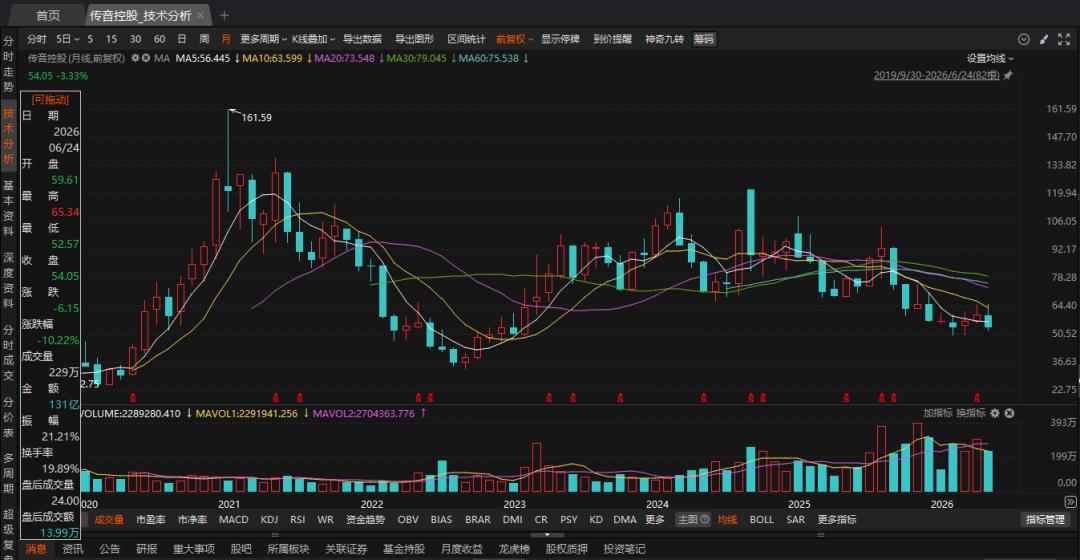
The significant correction in the stock price is of course affected by changes in market sentiment. But the deeper reason is that the external environment that supported Transsion's rapid growth in the past is changing.
The low - cost market, localization advantages, and competitive dividends that once helped it succeed have not disappeared, but they are becoming increasingly difficult to replicate and magnify.
For Transsion, the real challenge is no longer how to become the "King of Africa," but whether the past successful methods can continue to win the next round of competition.
Transsion Can't Bear the Storage Price Hike
If low costs made Transsion successful in the past twenty years, then the rising storage prices in the past year have begun to rewrite this business logic.
In 2025, the global DRAM and NAND flash memory entered a price - rising cycle. According to Counterpoint Research, the prices of both types of storage chips increased by more than 40%.
This is a cost test for all mobile phone manufacturers.
However, for Transsion, which has long relied on products priced below $100 to open up the market, the impact is significantly greater.
UBS once estimated that low - end mobile phones need to be priced up by an average of 17% to cover the new costs. The problem is that Apple and Samsung can raise prices, and high - end brands can rely on brand premiums to absorb costs. But Transsion faces the most price - sensitive consumers in the world, and every price increase may directly affect sales.
According to a report by National Business Daily, since the second half of 2025, Transsion has gradually raised the prices of some products. However, the cost of the price increase is also beginning to show. In 2025, Transsion's mobile phone sales dropped to 169 million units, a decrease of about 32.4 million units compared with 2024.
The rising costs and pressured sales are quickly reflected in the financial statements.
In 2025, Transsion's revenue decreased from 68.72 billion yuan to 65.59 billion yuan, and its net profit attributable to shareholders plummeted by 53.49% year - on - year.
Meanwhile, in the context of declining revenue, accounts receivable increased from 3.377 billion yuan to 3.726 billion yuan, almost doubling compared with 2023, while the revenue remained at around 60 billion yuan during the same period. This means that Transsion's business scale has not expanded significantly, but it is becoming increasingly difficult to collect money.
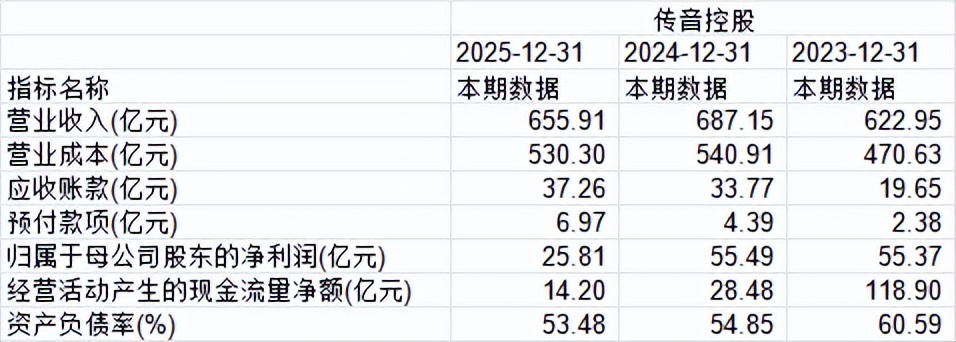
In addition, although the operating cost decreased with the decline in revenue, the prepaid accounts increased from 439 million yuan to 697 million yuan. Ultimately, the net operating cash flow in 2025 was only 1.42 billion yuan, significantly lower than the net profit attributable to shareholders for two consecutive years.
This shows that Transsion is facing not only profit shrinkage but also pressure on the overall operating quality.
However, the rising storage prices are just the fuse. What really makes Transsion feel the pressure is that the African market, which it is most familiar with, is also changing.
For a long time in the past, Africa was an emerging market with relatively mild competition. European and American brands focused more on the high - end market, and Chinese mobile phone manufacturers mainly invested resources in the domestic market, India, and Europe. Transsion thus had a rare development opportunity.
However, as competition in mature markets such as the domestic market and India becomes more and more intense, the importance of Africa has begun to rise rapidly.
In recent years, Chinese mobile phone brands such as Xiaomi and Honor have continuously increased their presence in the African market. In particular, Xiaomi entered Africa as early as 2017, established an African business department in 2019, and has listed Africa as a key growth area for several consecutive years. In 2025, Xiaomi also opened its first self - operated brand flagship store in Morocco, continuing to strengthen local brand and channel construction.
According to Omdia data, in 2025, Transsion still ranked first in the African smartphone market, but its market share has fallen below 50%. Meanwhile, Transsion's shipment growth rate was only 7%, while Honor's was as high as 144%.
More importantly, what these latecomers bring is not just competition.
Compared with Transsion, brands such as Xiaomi and Honor have accumulated a more mature supply chain system, stronger R & D capabilities, and a more diverse product portfolio in the mid - to - high - end market. When these capabilities start to penetrate into the African market, the competitive advantages that Transsion built through localization in the past are also being continuously weakened.
In the past, Transsion's greatest advantage was that others were not willing to seriously develop the African market.
Today, its greatest challenge is that more and more people are starting to seriously develop the African market.
The rising storage prices are just an industry cycle, but they have exposed a deeper problem in advance:
It is becoming increasingly difficult to make money from low - end mobile phones.
Can AI Save Transsion?
For Transsion, the biggest task of restarting its listing on the Hong Kong stock market is not to replenish cash flow.
What is really important is that it needs to find a new growth story.
The prospectus shows that the funds raised from the Hong Kong stock market this time will be mainly invested in AI and terminal technology R & D, global brand and channel expansion, and the construction of the mobile Internet and Internet of Things ecosystem. The remaining funds will be used to supplement working capital. Judging from the flow of funds, Transsion has placed the focus of its next - stage development on product upgrading and AI capability building.
According to a report by National Business Daily, Transsion's management said at the 2025 performance meeting that the company is adjusting its product structure. "In the future, the sales proportion of products priced below $100 will decrease. The proportion of products priced between $100 and $200 will increase, and products priced above $200 will have a relatively large growth."
It is not difficult to understand why Transsion has chosen this path.
In the past, it quickly opened up the market through low prices and localization. But with the rising storage prices and intensified competition, the profit margin of low - end products is getting thinner and thinner, and it is becoming increasingly difficult to support growth by simply increasing sales volume.
In contrast, higher - priced products not only have higher profit margins but also have stronger ability to resist cost fluctuations. For Transsion today, moving upmarket is not an option but a necessity.
Today, almost all mobile phone manufacturers cannot avoid AI when targeting the mid - to - high - end market.
For example, OPPO is talking about AI assistants and multi - scenario services, focusing on work efficiency, life entertainment, and health management. Vivo is promoting the BlueHeart large - scale model, integrating AI capabilities into the system. Honor is talking about the AI intelligent agent YOYO, emphasizing cross - scenario proactive services. Nubia, a subsidiary of ZTE, has even jointly launched the Doubao mobile phone with Doubao, trying to use voice control to complete complex tasks across platforms.
AI is no longer just a function but has gradually become part of the mobile phone experience. This is also an important reason why Transsion is focusing its fundraising on AI R & D this time.
However, the real challenge lies precisely here.
In the past, Transsion was best at developing products around specific needs. If African users needed multiple SIM cards, it developed dual - SIM and quad - SIM phones. If the local power supply was unstable, it developed long - battery - life phones. If dark - skinned users had poor selfie effects, it optimized the imaging algorithm.
These capabilities helped Transsion become the "King of Africa." But in the AI era, the competition logic has changed.
What users need is no longer just a single function but a continuous set of intelligent experiences. From voice assistants, search, and office to payment, content, and local life services, more and more capabilities need to be connected.
This means that AI tests not only R & D investment but also the long - term accumulated software capabilities, ecosystem capabilities, and understanding of users' digital lives of a mobile phone manufacturer.
Looking back, the rising storage prices are just an industry cycle. What has really changed is that it is becoming increasingly difficult to make money from low - end mobile phones, and the competition in the mobile phone industry is shifting from hardware to experience.
In the past, Transsion proved that a global mobile phone giant can emerge from the low - end market. Now, it needs to prove another thing:
Can a company that started from the low - end market complete a high - end transformation?
If this step can be successful, the Hong Kong stock market financing will become a new starting point for Transsion. If not, having an additional listing platform will be difficult to regain the valuation premium that once belonged to the "King of Africa."
Reference materials:
Juchao, "The African Mobile Phone King Is Struggling"
Caixin, "Global Smartphone Shipments in 2026 Will Hit a New Low in More Than a Decade. Storage Shortage and the US - Iran Conflict Intensify Cost Pressure"
Entrepreneurship Frontline, "Transsion Holdings Sold 32.4 Million Fewer Mobile Phones in a Year! Its Profit 'Halved,' and Zhu Zhaojiang Earned Over 1 Billion in Dividends in 3 Years"
This article is from the WeChat official account "Golden Horn Finance,"